What Your Child Shows You at Pickup Reveals How They’re Really Growing
The Moment That Tells You Everything: Reading Your Child at Pickup
There is a particular moment at the end of every childcare day that most parents in Singapore know well. You walk through the gate, and there is your child — flushed from outdoor play, or settled into quiet concentration, or running toward you with something clutched in their fist that they want to show you before anything else.
You scan their face first. You are looking for distress, for tears, for any signal that something went wrong. It is an instinct that never quite turns off, no matter how confident you feel about the choice you have made.
But if you stay in that moment a little longer — if you look beyond the absence of distress — you will notice something else. Something quieter. Something that tells a different and far more important story than whether your child cried today.
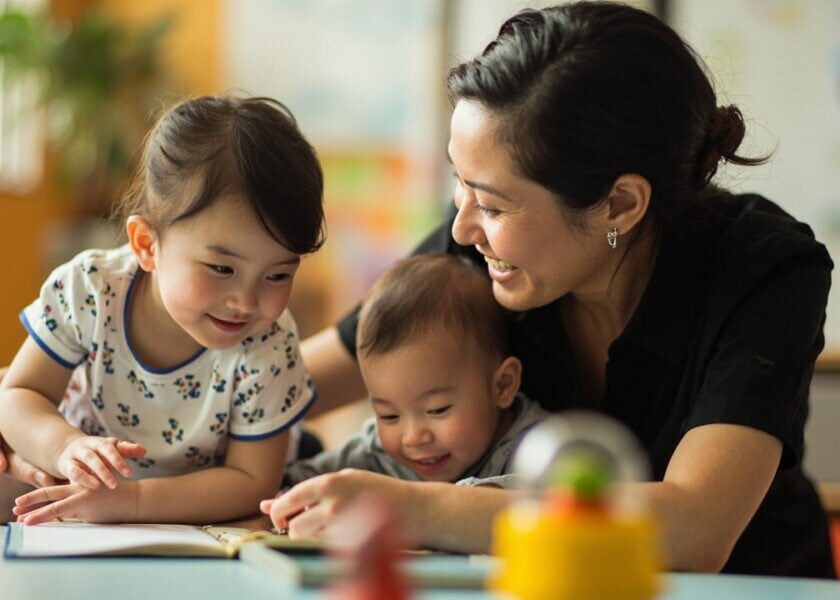
You might notice the way your toddler uses a word you have not taught them. The way your infant reaches for a caregiver with easy trust, then turns back to you with a smile that says both are true. The way your two-year-old walks to the gate with a new kind of independence, pausing to wave goodbye to a friend.
These are not small things. These are the hours you could not see, made visible in your child.
What matters now — what is genuinely useful — is understanding what quality childcare produces, and learning to read it in your own child at the exact moment when you need that evidence most.
The Five Signs Your Child Is Flourishing
Whether you are evaluating your current arrangement or researching options, here are the observable signs that your child is genuinely growing — not just safely occupied:
- Language that surprises you — new words, new ways of using words, the beginning of narration and questioning
- Social ease — the ability to play near, then with, then alongside other children
- Curiosity that persists — reaching, trying, exploring without excessive fear
- Emotional regulation — the ability to be soothed, to wait, to show calm rather than just quietness
- Genuine connection — easy trust with the caregiver, not dependency or distress
These are not personality traits your child either has or does not have. They are outcomes — produced by environments that allow them to develop.
Language Development
When a child is in an environment that is genuinely excellent — not just safe, not just clean, but genuinely excellent — you will see it in their language. Whether they are beginning to narrate their experience: “Mama, today we went to the garden and the butterfly was blue.” Whether they are asking questions that reveal real thinking: “Why is the water going down?” Whether they are using language to negotiate rather than only to demand: “Can I have a turn when you are finished?”
Language development in the early years is not a checkbox. It is a window into cognitive and social growth, and it accelerates most dramatically in environments that are language-rich, responsive, and tuned to the individual child.
Social Ease
You will see it in their social ease. Whether they can play near another child, then with another child, then in a group — each stage building on the last, each stage requiring a different kind of safety and facilitation.
Children who are simply supervised may tolerate proximity. Children who are genuinely nurtured learn to be social beings — and this is the most important and most difficult skill humans ever develop.
Curiosity
A child who feels safe explores. A child who explores grows.
The physical confidence to climb. The cognitive willingness to try something unfamiliar. The emotional resilience to come back after something does not work. These are not personality traits some children have and others do not. They are outcomes produced by environments that reward curiosity and protect the explorer.
Emotional Regulation
Perhaps the most important and most overlooked sign of all: a child who can be soothed. A child who can wait. A child who can name what they are feeling, or who can show you through their body that they are calm rather than merely quiet.
Emotional regulation is the foundation of every relationship your child will ever have. It is developed not through instruction but through consistent, responsive, attuned caregiving — the kind that notices when a child is frustrated and gently helps them find their way back to calm.
Connection With the Caregiver
The kind of bond that allows your child to feel safe enough to go to the caregiver when they are hurt, then turn around and engage with the world again. Not dependency — not clinging, not distress at separation. Connection.
Your child is not confused about who their parent is. They are simply able to trust another adult — which is exactly what healthy development looks like.
What You Are Seeing Is Not Luck
These signs do not appear because children are resilient by nature. Resilience is not a trait children have or do not have. It is an outcome of environments that allow it to develop.
What you are seeing at pickup is not luck. It is the visible result of invisible work — the work of trained, attentive caregivers who have been present all day, noticing your child, responding to your child, facilitating growth in ways that are gentle and intentional.
This is the structural reality of childcare in any society: you drop your child off in the morning, you go to work, and you are simply apart. You cannot see the hours in between. What matters is not pretending that gap does not exist, but building the bridge that makes it legible.
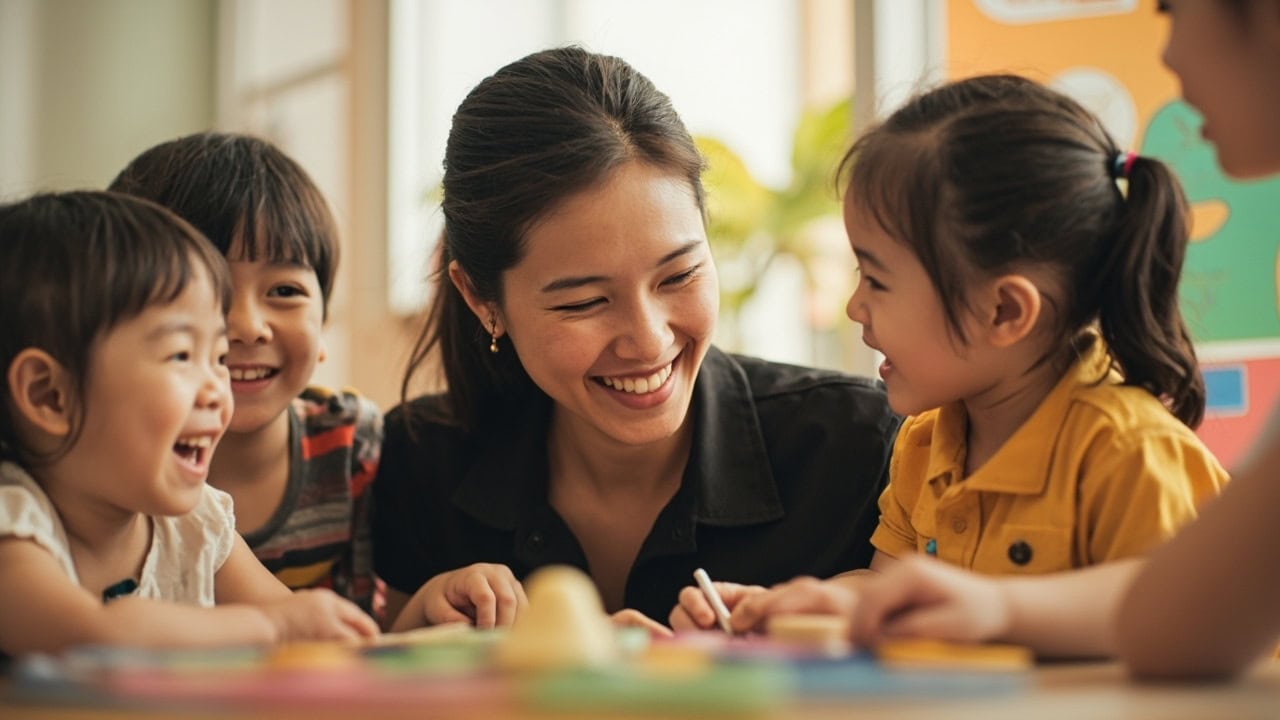
Quality childcare writes a very specific text. It is not written in test scores or performance reviews. It is written in the small, ordinary, extraordinary details of your child’s development: how they speak, how they move, how they relate to others, how curious they are, how regulated their emotions have become.
These are not abstract milestones. These are observable, daily facts about your child’s inner life — and they are the signs you can learn to see.
How Communication Bridges the Invisible Hours
Here is where caregiver communication becomes not just a nice-to-have but the essential bridge between the hours you cannot see and the child who comes home transformed.
Most parents receive some version of a daily report. A note, a photograph, a few lines in an app. But a report is not communication. A report is data without interpretation.
What parents need — what parents deserve — is meaning. They need someone who has been with their child all day to translate what happened into something legible: what your child was interested in, what challenged them, what they mastered, what they are beginning to work toward.
This is not administrative reporting. This is developmental storytelling. The difference between knowing your child’s schedule and knowing your child’s experience.
When a caregiver tells you not just that your child had porridge for lunch, but that they refused the porridge at first, then watched another child eat it, then tried it, then asked for more — that is a story. That is information about your child’s relationship with food, with peer modeling, with new experiences. That is the kind of insight that allows you to continue the work at home, to understand your child more deeply, to see them as a person who is actively growing rather than a schedule to be maintained.
What to Look For When Evaluating Childcare in Singapore
For parents researching their options, here are the concrete questions to ask and signs to look for:
- Caregiver narrates the day with observation — They are paying attention to your child’s individual experience, not just reporting activities
- Your child shows easy familiarity with the caregiver — The relationship is warm and trusting, not transactional or anxious
- Small group ratios, especially for infants — More individual attention, genuine observation, less dilution of care
- Your child uses new language after days at care — The environment is language-rich and developmentally responsive
- Evidence of social development over time — Your child is learning to be social, not just tolerating proximity to others
What quality childcare is not: perfection. Children have hard days. Children regress. Children are human beings, and their development is not linear.
A day in which your child is clingy or off-color or overwhelmed is not evidence that your childcare is failing. It is evidence that your child is having a human experience, and that the environment is safe enough to show that.
You are not looking for a perfect report card at every pickup. You are looking for a trajectory — the direction your child is moving over weeks and months.
The EduNanny Approach: Built for Families Who Want More Than Supervision
EduNanny was built on the recognition that Singapore parents needed more than adequate supervision — they needed visibility, relationship, and developmental support.
As part of the ECDA Childminding Pilot, EduNanny represents a different model of childminding: one that treats caregiver work as a profession, invests in training and ongoing support, and maintains communication systems designed to make the invisible hours legible to parents.
The home-based option allows your child to be cared for in a familiar environment, with ratios that are remarkable by any standard — up to one to three for infants. That means your child is not one of eight or ten. They are one of two or three. The attention is not diluted. The observation is not generalized. The caregiver can genuinely know your child.
The centre-based pathway offers a different kind of richness: peer interaction, community, a curriculum that is intentionally designed around developmental stages rather than arbitrary age groupings.
Both pathways share the same commitment: that the hours you cannot see should not remain invisible.
On the practical side, EduNanny’s fee structures are designed to remove cost as a barrier. CDA and Baby Bonus usability means that the financial tools Singapore has put in place to support families can actually be used for this. Monday to Friday care blocks fit the reality of working family life.
The Most Honest Sign of Quality
Your child is not a mystery you must solve by interrogating your caregiver or scrutinizing credentials. Your child is a text that is always telling you the truth about whether they are in the right place.
You have been reading this text already, every afternoon at pickup, even if you did not know what you were looking for.
The next time you collect your child, stay in the moment. Look beyond the absence of distress. Look for language — new words, new uses of words, the way they tell you something. Look for social ease — the way they relate to the caregiver, to other children, to you. Look for curiosity — the reaching, the trying, the noticing. Look for regulation — the calm body, the recoverable frustration, the ability to be soothed. Look for connection — the easy trust, the genuine warmth, the willingness to let go and come back.
These are not luxuries. These are not bonuses. These are the signs of a child who is flourishing — and when you see them consistently, over time, you will know something important.
You will know that your child is in a place that is producing growth, producing capability, producing the person they are becoming.
Explore EduNanny’s ECDA Childminding Pilot pathways — home-based and centre-based options designed for Singapore families who want more than adequate supervision. Because the hours apart matter, and they should be visible.
To learn more about EduNanny and what sets this approach apart, visit about EduNanny or get in touch to start a conversation.