Is My Child Genuinely Okay A Singapore Parent’s Childcare Guide
The Question That Keeps You Up at Night
It is late evening. The house is quiet except for the soft sound of your child breathing beside you, or perhaps still awake, needing one more comfort before sleep comes. In these quiet hours — in the brief moment after the drop-off when you are still sitting in the childcare car park, hands warm from holding theirs — there is a question that many Singapore parents carry but rarely say aloud.
It is not really a question about ratios or certifications or curriculum. Those things matter, and you have thought about them carefully. But underneath all of that logistics, there is a deeper, quieter fear:
Is my child okay in there? Not supervised. Not occupied. But genuinely okay. At ease. Safe in the way that matters most — emotionally, internally, in that place inside them where trust either grows or quietly withers.
This is the question we want to explore with you. Because in Singapore, we are exceptionally skilled at evaluating childcare on almost every dimension except the one that counts most deeply.
What This Article Covers
- Why the emotional dimension of childcare is the most important — and most overlooked
- What it actually looks like when a child feels genuinely at home in care
- How young children’s nervous systems respond to emotional safety
- Observable signs parents can look for without being intrusive or anxious
- The practical questions that reveal whether your child is truly known and held
- How EduNanny Singapore approaches childcare as a second emotional home
The Difference Between Accommodation and Belonging
You check ratios. You read reviews. You compare curricula and ask about food schedules, napping routines, and whether the centre has CCTV. All of that has its place, and responsible parents do this work.
But there is a far deeper concern that rarely gets named out loud — and when it does, it often gets folded into a conversation about safety or trust, as if the real fear is that something might go wrong. The real fear is subtler than that.
It is the fear that your child is in a place where no one really knows them. Where they are warm and fed and changed and stimulated, but not held in the way that builds the kind of confidence a human being carries for the rest of their life.
Here is what guides everything we do at EduNanny Singapore: the difference between a childcare arrangement and a childcare home is not about facilities or fees or even the qualifications on the wall — though those matter too.
The difference is whether your child has walked into a space where they are not merely accommodated, but genuinely at ease. Where the routines are not just observed but felt as rhythm and comfort. Where the caregiver is not just a capable professional but a familiar, trusted person who has learned the particular way your child needs to be soothed, the particular sound that calms them, the particular way their face changes just before they fall asleep.
This is not a small thing. It is, in many ways, the most important thing.
What Emotional Safety Looks Like From the Inside
Think for a moment about what it actually means for a young child — an infant, a toddler — to spend their days in someone else’s care. For hours each day, the world they are navigating is not the world of their family. The faces, the sounds, the textures, the rhythms — these are different.
A child’s nervous system is exquisitely sensitive to that difference. It registers it constantly, in ways that are invisible to the eye but deeply real in their effect.
When a Child Feels Safe
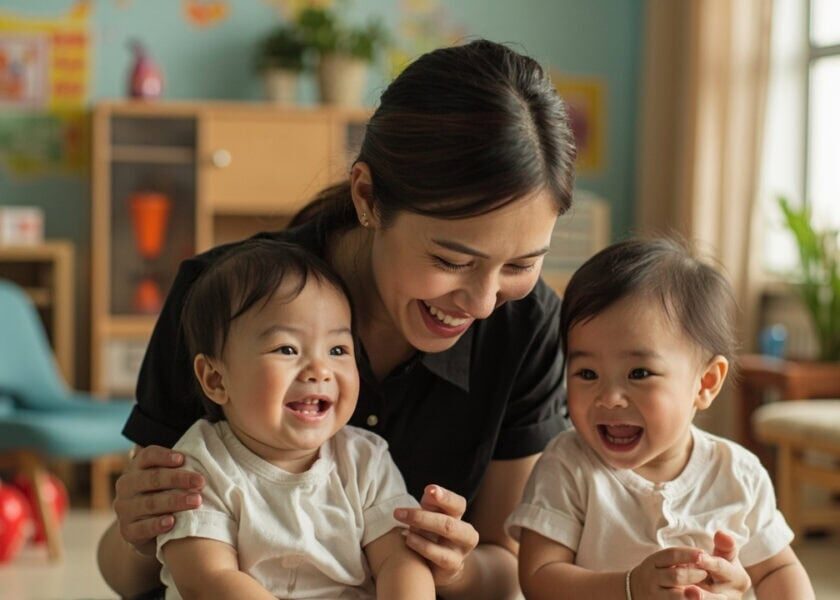
When a child feels emotionally safe in their childcare environment, something remarkable happens. Their body relaxes. They begin to explore. They reach out to other children. They experiment with words, with objects, with their own emerging sense of agency. They cry less. They laugh more — and more freely.
They begin, quietly and without fanfare, to build the foundations of who they will become.
When a Child Does Not Feel Safe
When a child does not feel safe — not physically unsafe, but emotionally uncertain — the opposite occurs. Their energy goes inward, toward managing anxiety rather than toward the magnificent, demanding work of growing.
They adapt. They perform. They become, in a very real sense, passengers in their own days.
This registers quietly, in ways that parents often sense before they can name:
- The child who is inexplicably more clingy after pick-up
- The child who resists being dropped off with a desperation that seems out of proportion
- The child who seems fine, perfectly fine, but somehow not quite themselves
These are not definitive signs of poor care — children have difficult days, and all children go through phases. But they are worth noticing. They are worth asking about. And they are worth taking seriously.
The First Thousand Days: Why the Early Years Shape Everything
We want to be honest about something else, because Singapore parents deserve that honesty. The early years — and we mean the first thousand days, from roughly the first two to three years of life — are not just a period of growth. They are a period of construction.
The architecture of a human being’s emotional and social capacity is built during this time, through exactly the kinds of experiences we have been describing: the felt sense of safety, the experience of being responded to consistently, the gradual discovery that the world is a place where their needs are understood and met.
This is not a metaphor. It is how development works. The neural pathways that govern stress response, attachment style, social confidence, and emotional resilience are all being laid down and refined during these years. What happens during this period does not disappear. It becomes the substrate on which everything else is built.
This is why the childcare decision is, in a very real sense, one of the highest-stakes decisions a parent makes. Not because the wrong choice will cause visible, immediate harm — it rarely does. But because the right choice — the one where your child is genuinely at home, genuinely seen, genuinely held — creates something in your child that lasts.
It creates a base of security from which they can explore, take risks, learn, connect, and grow. It gives them what they need to walk into the world not armored but confident. Not performing safety but genuinely feeling it, deep down, in a place that no curriculum can reach and no activity plan can manufacture.
Signs You Can Actually Observe
So what does this look like — not in theory, but in the actual, observable, daily experience of a child?
It looks like a child who runs toward their caregiver in the morning, not with hesitation but with recognition. It looks like a child who, when they fall and skin their knee, is soothed not just by being picked up but by being picked up in the way they specifically need — a particular hold, a particular voice, a particular phrase.
It looks like a child who is learning to say “I don’t like that” and having it be heard and respected. It looks like a child who is beginning, in small and tentative ways, to tell you what they want for lunch, what song they want sung, who they want to sit next to at circle time.
It looks like a child who is not just being cared for but who is beginning to feel a sense of ownership over their own care — who is learning that their preferences have weight, that their voice matters, that they belong.
The Child’s Voice as a Sign of Quality
This is one of the most underappreciated signs of quality care. A childcare environment that has genuinely become a home for a child is one where the child is not merely a recipient of excellent care but an active participant in it. Where their likes and dislikes, their rhythms and peculiarities, their emerging personalities are known and honoured.
This is not a soft or sentimental idea. It is a developmental one. Children who feel their voice is heard — even in the small, daily negotiations of a childcare day — develop stronger self-regulation, more secure attachments, and a more resilient sense of self.
Questions That Reveal Quality
You can also ask, and the answers matter as much as the questions.
Not “what did my child do today” but “how was my child today.” Not “what did my child eat” but “was my child comfortable, was my child at ease.”
These are not questions that every caregiver can answer easily, because they require a different quality of attention — an attention that is not just monitoring but truly observing, not just recording but understanding. When a caregiver can answer these questions with specificity and genuine knowledge of your child’s inner state, you are seeing evidence of something important: a person who has been paying attention to the child as a whole person, not just as a set of needs to be met.
You might also notice:
- Whether your child’s caregiver can tell you, without prompting, that your child has been asking for the blue cup today, or that they seemed a bit off colour this morning
- Whether your child talks about their day — not in detail, because young children rarely narrate their experiences the way adults do, but in feeling. “Mama, I go school. I like school.”
- Whether your child draws a picture of the childcare space with a figure that has a smile
- Whether your child, on a Saturday morning, asks to go to school
These are not proof. But they are signals, and attentive parents are extraordinarily good at reading them.
EduNanny Singapore: Built Around the Child’s Inner World
We know that in Singapore, this vision — childcare that is genuinely a home — meets a very particular set of realities. Singapore parents are navigating extraordinary pressures: the cost of living, the demands of dual-income households, the expectations of career and advancement, the particular social landscape of a city that moves quickly and expects a great deal of its people.
For many families, childcare is not a choice but a necessity, and it comes with its own set of complex feelings — some of which can carry guilt, or doubt, or a sense of something lost. We understand those feelings, and they do not make you any less of a parent. In fact, they are evidence of the depth of your care.
Our Framework and Approach
EduNanny Singapore is part of the ECDA Childminding Pilot, which means it sits within a carefully structured framework designed to raise the quality and accessibility of childminding across Singapore. We offer both home-based and centre-based pathways, because families are not all the same and neither are their needs.
In our home-based model, your child can be cared for in the familiar, warm environment of their own home, by a trained and vetted caregiver who becomes a consistent, trusted presence in your child’s daily life. In our centre-based option, small groups and carefully considered environments create the conditions for the kind of closeness and attentiveness that define quality care.
What This Means in Practice
Our ratios matter — up to one to three infants — because we believe that the capacity for genuine emotional attunement is not a numbers game. No caregiver can truly know and respond to a child if they are responsible for too many.
Our pilot fee structures are designed to be accessible, and eligible families can use the Child Development Account and Baby Bonus schemes, because quality care should not be a privilege reserved for those who can afford premium pricing. Our care operates Monday through Friday, in structured blocks that give parents the consistency they need for their own work and family planning.
Where deployed, our communication and transparency measures — including CCTV — are in place not as a surveillance tool but as a reassurance, because we believe parents deserve to know what is happening in their child’s day.
The things we have described — the warmth, the attunement, the child’s voice, the second emotional home — these are not features on a list. They are the way we think about what we do, and they inform every decision we make:
- How we train our caregivers
- How we design our environments
- How we communicate with you about your child’s day
- How we think about ratios, schedules, and the small rituals of daily care
We are building something here that is rooted in a simple but demanding conviction: that every child in our care deserves to feel at home. Not safe in the basic sense — though they are that, and thoroughly. But at home in the way that matters most: emotionally, deeply, in the place where they are known and where they belong.
Choosing With Confidence: A Practical Guide for Singapore Parents
Singapore parents deserve clarity about what they are actually choosing. So let us be direct about some of the concerns we know you carry.
Will my child feel abandoned or confused?
Children are remarkably adaptive, but they are not fooled. They know the difference between being cared for and being held. The goal is not to replace the family — that is neither possible nor desirable. Children need the experience of multiple attachments, multiple environments, multiple sets of warmth and expectation. What they need alongside that is at least one place outside the home where they feel equally safe, equally known, equally at ease.
How do I know if my child is really okay and not just “fine”?
Look for the small things, and trust the pattern they form. Pay attention to the quality of your child’s engagement after pick-up — are they clingy or genuinely glad to see you? Do they mention their caregiver with warmth? Do they resist the drop-off with increasing desperation, or with a kind of reluctant acceptance that suggests they trust the process? These are the signals that tell you what is really happening beneath the surface.
Is it selfish to prioritise my career over full-time parental care?
The love you feel for your child is not a small thing. It is not a manageable thing. It is enormous, and it demands the best of everything you have — including your time, your energy, your resources, and your own wellbeing. Parents who show up for their children with intention and care — even if that includes quality time with trusted caregivers — are not failing. They are doing what families in Singapore, and everywhere else, have always done: adapting to reality while holding onto what matters most.
Questions to Ask During Your Visit
- How does the caregiver respond when a child is distressed? (Look for specific, individualised responses, not just general soothing)
- Can the caregiver tell you something specific about your child’s personality, preferences, or recent development without being prompted?
- What does a typical day look like from the child’s perspective — is there space for child-led activities, or is everything scheduled and rigid?
- How do caregivers handle conflict between children? (Look for respect for each child’s perspective)
- What is the ratio of caregivers to children, especially for infants?
Signs to Observe Over Time
- Does your child seem genuinely happy at pick-up, not just compliant?
- Does your child mention their caregiver or friends at home with warmth?
- Does your child show any signs of regression — increased clinginess, sleep disturbances, changes in appetite — that persist beyond the initial settling period?
- Do you feel that your child’s individual personality is being seen and valued, not just their needs being met?
Trust your instincts as a parent. You know your child better than anyone. If something feels off — even if you cannot articulate exactly what it is — take that seriously. Visit at different times of day. Ask the questions that matter to you. And remember: the right childcare arrangement should feel like a partnership, not a transaction.
What You Are Actually Choosing
You are not choosing a service. You are choosing a place where your child’s heart and mind and sense of self will be shaped, day by day, by the people and the environment around them.
That is not an exaggeration. That is what is actually happening, every day, in the hours you are apart.
So we believe — and we invite you to believe this with us — that the childcare decision deserves to be made with that weight in mind. Not with anxiety, but with intention. Not with fear, but with the full recognition of what is at stake.
You are doing something extraordinarily difficult. You are holding the weight of a new human being’s entire future — or at least, that is how it feels in the quiet moments, and it is not an exaggeration.
The love you feel for your child is enormous, and it deserves the best of everything — including the best place outside your home where your child can grow, feel safe, and flourish.
That is what EduNanny Singapore is here for. Not just to care for your child in your absence, but to stand alongside you in this profound, demanding, extraordinary act of raising a human being.
If you are ready to learn more about how EduNanny Singapore can become your child’s second emotional home, we invite you to reach out. Ask your questions. Share your concerns. Tell us about your child.
We are listening.
At EduNanny Singapore, we believe every child deserves to feel at home. Learn more about who we are and our approach to thoughtful, development-oriented childcare.