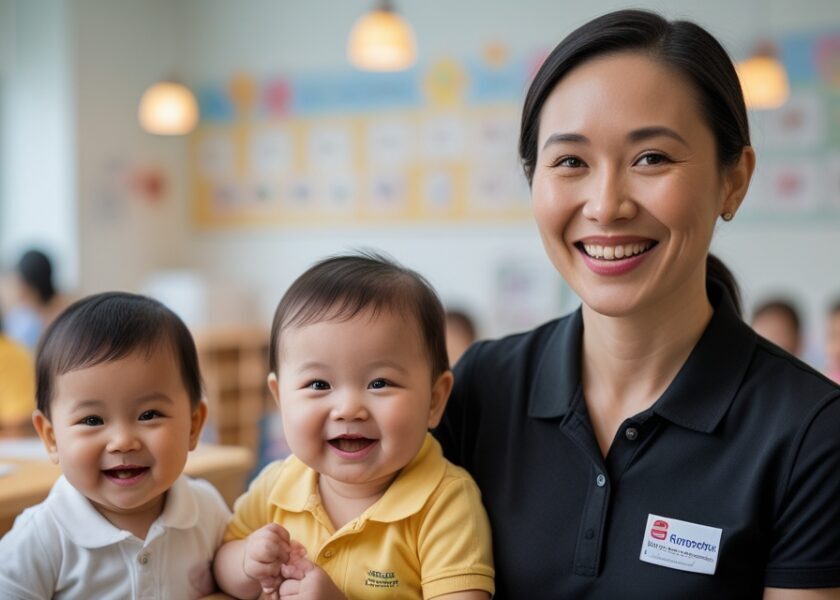
What Your Child Is Building While You’re Not There
The Question Every Singapore Parent Carries (But Rarely Asks)
Every morning across Singapore, a familiar scene unfolds. A parent hands their child to a caregiver—not with doubt, but with a question that rarely gets asked aloud. Not “will my child be safe?” They already know the answer to that. The question is deeper: what is my child building while I am not here?
This is one of the most quietly profound questions a parent can carry, and it deserves more than a reassuring answer. It deserves an informed one.
We live in a city where parents are among the most intentional people on earth. We plan enrichment activities, research developmental milestones, compare curricula, and read about pedagogical philosophies. We want decisions that matter. Yet when it comes to the hours spent in childcare—the hours that make up a significant portion of our children’s waking lives in these first critical years—there is often a strange silence.
Most conversations begin and end with logistics. Who will be there. What the routine looks like. Whether the environment is clean and stimulating. These are not small things—safety and supervision are the floor, not the ceiling. But the question that your child is quietly building something during these hours deserves to be met with understanding, not just logistics.
The Science of Early Brain Development
In the first years of life, your child’s brain is not merely developing. It is being architected. During infancy and early childhood, the brain forms synaptic connections at a rate that will never be repeated.
Consider these numbers: a single neuron in a newborn’s brain can accumulate as many as fifteen thousand connections in a single second. By the age of three, a child has formed roughly one thousand trillion synapses—more than they will ever have again. This is not a metaphor. This is the rate at which human beings are built.
Here is the part that changes everything: those connections are not formed randomly. They are sculpted by experience. Every interaction, every sensory engagement, every moment of attunement between a caregiver and a child strengthens some pathways and prunes others.
The brain is not a vessel being filled. It is a city being planned, and the planner is the quality of early human experience.
This is what neuroscientists mean when they talk about critical periods and sensitive periods. The early years are not simply important—they are formative in a biological sense. The experiences your child has in these years quite literally become the structure of their mind. It means that what happens in those hours apart from you is not passive time. It is active construction.
What Quality Care Actually Builds
Research consistently shows that quality early childhood care builds measurable developmental outcomes—not soft skills, but cognitive achievements housed in the prefrontal cortex, the same region responsible for focus, planning, and decision-making throughout life.
When children receive warm, responsive, play-rich care, something specific happens.
Emotional Regulation
Children learn, over hundreds of small interactions, that big feelings are survivable. That when distress arises, a responsive adult will stay present. That they do not have to manage fear or frustration alone.
This is not about eliminating difficulty. It is about scaffolding—providing the external regulation (a calm voice, a patient presence, a consistent response) that the child’s brain gradually internalizes until it becomes their own capacity.
Social Confidence
Children who have experienced consistent, attuned caregiving in their early years show greater social confidence, more cognitive flexibility, and better stress recovery. They are not less attached to their parents. They are more capable of trusting others and navigating the world because of what they learned about trust.
Learning Readiness
Children who have been in developmentally rich care environments arrive at formal schooling not simply with cognitive knowledge, but with the emotional foundation for learning itself. They know how to be curious. They know how to persist when something is difficult. They know how to engage with adults who are not their parents and navigate peer relationships.
The Difference That Changes Everything
This is the difference between childcare as containment and childcare as architecture. Containment keeps a child safe and occupied. Architecture builds the structures the child will carry forward.
Not all childcare builds the same architecture. A stimulating room and a warm heart are not the same thing. A busy schedule is not the same as intentional interaction. The quality that transforms childcare from supervision into development is something more specific and more demanding.
It is the quality of human presence. Caregivers who function as attachment figures and developmental partners—adults who observe, respond, and engage with intention, who understand not just what a child needs in the moment, but what their developing brain needs across time.
You cannot separate caregiver excellence from child outcomes. They are the same variable. Quality caregivers need structured training, continuous development, and working conditions that allow them to bring sustained presence rather than exhaustion to the children in their care.
EduNanny Singapore: Built Around This Understanding
EduNanny Singapore was designed with a conviction that has since been validated by Singapore’s own Early Childhood Development Agency (ECDA) through the Childminding Pilot Programme.
The ECDA Childminding Pilot represents something important: a formal recognition that the way forward for infant care is not simply more of the same institutional models, but a more responsive, relationship-centered approach.
The pilot opens pathways—home-based care and community or centre-based options—that allow families to choose what fits their life while accessing support structures that ensure quality. And it does so with infant ratios of up to one to three, meaning that when your child is in EduNanny care, they receive something rare in the crowded landscape of early childhood: individual attention.
When a caregiver can give your infant focused responsiveness—when your child’s subtle cues, their emerging curiosities, their moments of distress or delight, can be noticed and honored—there is a kind of developmental amplification that simply cannot happen in higher-ratio settings.
Every missed cue is a lost opportunity. Every time a child must compete for attention or wait for response, the architecture being built is different. Slower. Less secure. Attention is not just what we give. It is what builds the brain.
EduNanny’s approach to transparency—through regular communication, documentation, and where deployed, CCTV measures—is designed not because we assume parents need to monitor us, but because parents deserve visibility. Because informed parents make better decisions, and because trust is strengthened by clarity, not secrecy.
Addressing What Singapore Parents Actually Wonder
The Cost Question
Early childhood care can feel like an enormous financial commitment, and parents rightly want to know that what they are paying for is real.
The ECDA Childminding Pilot offers fee structures designed to make quality care accessible within realistic family budgets. Additionally, Singapore’s Child Development Account (CDA) and Baby Bonus schemes can be used for EduNanny services. The financial architecture of support that Singapore has built for families is available here.
The Trust Question
Leaving your child in someone’s care requires a kind of trust that is not given lightly. You deserve to know what your child’s day looks like—not in vague generalities, but in ways that help you understand their experience and participate in their development even while apart.
The Guilt Question
There is a quiet hunger among thoughtful Singapore parents—a hunger that most childcare messaging fails to address. It is not a hunger for reassurance. Reassurance is what you get when you are told that things will be fine, that your child will adapt, that separation anxiety is normal.
What you are looking for is understanding. You want to know what is happening in your child’s developing mind when you are not there. You want to understand why certain experiences in the early years have such outsized effects. You want to feel that your childcare decision is not just emotionally sound but intellectually grounded.
Choosing quality childcare is not a compromise. It is an investment—one of the most compounding investments you will ever make in your child’s life. The neural pathways formed in the early years do not dissolve. The emotional patterns established in the first five years do not simply get overwritten. The brain your child carries into primary school, into adolescence, into adulthood—into their own relationships and challenges and capacities—is being built right now, in these early hours.
Practical Guidance: Choosing Infant Care in Singapore
If you are researching infant care or childminding options in Singapore, here are the questions that actually matter:
- What is the caregiver-to-child ratio? Lower ratios mean more individual attention and responsiveness for your infant.
- How are caregivers trained and supported? Quality care requires quality caregivers—and caregivers need ongoing development to sustain responsive presence.
- What is the communication approach? You deserve to understand your child’s day, not just receive generic updates.
- Is the environment designed for development or just supervision? Look for play-rich, responsive settings rather than just stimulating rooms.
- What financial support is available? Check whether CDA and Baby Bonus can be used, and what the ECDA Childminding Pilot offers.
The Architecture of Your Child’s Future Is Being Built Now
Every day, across Singapore, parents are making a choice they believe in but sometimes struggle to articulate. They know—intuitively, deeply—that what happens in the early years matters. That the hours apart are not empty time. That their child’s mind is being shaped by experiences they cannot always see.
What if the parents are right? What if those hours apart are not a compromise at all—what if they are the most important hours?
What if every moment of quality interaction, every secure attachment formed, every neural pathway strengthened in a responsive, developmentally intentional environment—what if all of this is not a substitute for what parents would provide, but a powerful complement to it?
What if the parent who chooses quality childcare is not someone who has accepted a tradeoff, but someone who has made one of the most informed, forward-looking decisions available?
EduNanny Singapore is designed for families who want more than containment. Who want to understand what their child is gaining. Who are willing to invest in quality because they understand what quality actually builds.
Through the ECDA Childminding Pilot, this quality is now within reach for families who want it without bearing unsustainable costs.
If you have been carrying the quiet question this article opened with—the one that asks not just whether your child is safe but what they are building—then EduNanny was built with you in mind. Not as a service that asks for your trust. As a model that earns it through what it actually delivers.
EduNanny Singapore provides relationship-centered infant care and childminding services through the ECDA Childminding Pilot Programme. To learn more about how we support your child’s early development, we welcome you to reach out to our team or explore more about our approach.