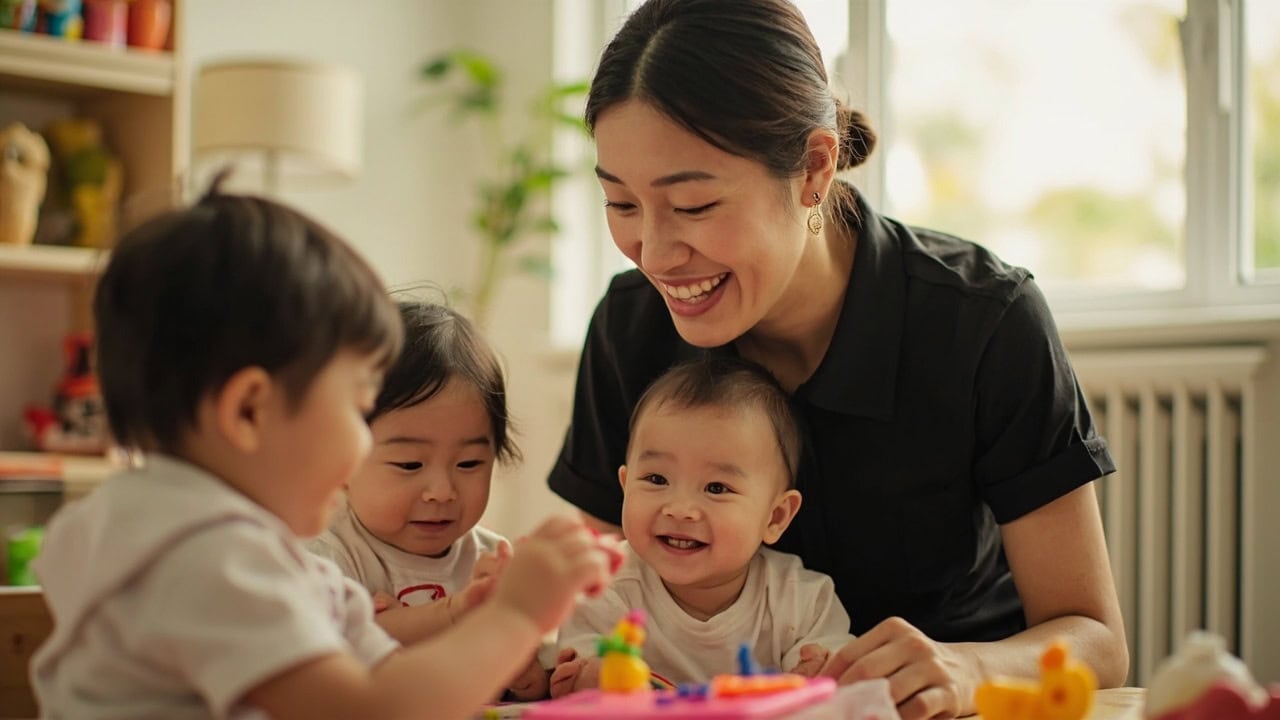
Why Caregiver Continuity Is the Foundation of Your Child’s Security
What Happens When Your Child’s Caregiver Is Absent
Caregiver absence at a childcare service can take several forms:
- Short-term illness. Your child’s primary caregiver wakes up unwell and cannot come in.
- Emergency leave. A family situation, a personal crisis, an unexpected obligation.
- Planned leave. Annual leave, medical appointments, maternity or paternity-related absences.
- Longer-term transitions. A caregiver who moves on, relocates, or changes career paths.
In most childcare arrangements, each of these scenarios triggers the same reactive response: someone scrambles to find coverage. Your child meets a stranger. The stranger does their best with limited information. The routine is disrupted. Your child cries. You worry.
This is not a failure of individual caregivers. It is a structural gap. Most childcare services have not built systems to prevent this disruption. They have built systems to respond to it.
The Quick Answer for Busy Parents
- Your child will not face a stranger. Every child at EduNanny has at least one other caregiver who is already familiar — someone who knows their rhythms, preferences, and comfort strategies.
- Knowledge transfer is structured, not improvised. When a new caregiver steps in, they receive detailed briefings about each child — temperament, current interests, settling strategies, and warning signs.
- You will be told. Communication about caregiver transitions is proactive. You should never wonder whether the person caring for your child knows anything about them.
- The system holds regardless of who is present. EduNanny’s operations are built so that continuity does not depend on any single individual.
Why This Concern Is Real — And Worth Taking Seriously
If you have felt this anxiety as a parent, you are not being overprotective. You are being accurate.
You understand something true about how children experience the world. A young child’s sense of security is not abstract. It is physical. It is specific. It is built person by person, day by day, in the presence of caregivers who have learned the particular music of their laughter, the exact texture of their fussiness at the end of a long afternoon, the way they reach for comfort when they are tired.
This knowledge is not incidental to quality care. It is the foundation of it.
Research on early childhood attachment tells us that young children form deep bonds with their primary caregivers, and that the predictability of those relationships shapes how they learn to trust the world around them. When care becomes unpredictable, that foundation of trust is tested — not necessarily broken, but tested.
So when that knowledge disappears, something real is disrupted. Not in theory. In your child’s actual experience of the world. In the specific way they feel safe or uncertain, connected or anxious, ready to explore or clinging to the familiar.
This is not a logistical inconvenience. This is a developmental concern.
How EduNanny Singapore Approaches Caregiver Transitions
EduNanny Singapore was built on a different understanding. As part of the ECDA Childminding Pilot, a government-supported initiative that recognises the importance of flexible, high-quality childcare options for Singapore families, we operate across home-based, community, and centre-based pathways.
The principle that guides every pathway is the same: a child’s care should never be held hostage by the fragility of any single arrangement.
Caregiver Pairing Systems
When a caregiver at EduNanny is absent — for any reason, at any time — we do not improvise. We do not call around at 7 AM hoping to find someone. We do not present your child with a stranger and call it a backup plan.
We have built systems that treat caregiver continuity as an operational commitment, not an aspiration.
Our caregiver pairing systems ensure that every child in our care has at least one other caregiver who is not unfamiliar. Someone who has been present in the environment. Someone who knows the rhythms of the day, the preferences of the child, the small rituals that anchor a young child’s sense of safety.
When a primary caregiver is absent, the transition is not a disruption. It is a rotation within a familiar structure.
Knowledge Transfer Protocols
When a caregiver joins our team, they do not simply arrive and begin. They shadow. They learn the children they will serve. They are briefed not just on schedules and routines but on individual children:
- Their temperaments and personality traits
- Their current interests and favourite activities
- The strategies that help them settle when upset
- The sounds and signals that mean they are becoming overwhelmed
- The small rituals that comfort them — a particular song, a favourite blanket, a way of being held
This documentation is not paperwork for its own sake. It is the institutional memory that protects your child’s continuity even when a human face is temporarily different.
When a New Caregiver Steps In
And when a new caregiver does step in — whether due to planned leave, unexpected illness, or longer-term transitions — we ensure that knowledge transfer is active, structured, and visible.
You, as a parent, are not left wondering whether the person caring for your child today knows anything about them. You are told. You are updated. You are treated as a partner in your child’s care, not a recipient of whatever happens to be available.
This is what operational maturity looks like. It is not a marketing claim. It is the difference between a childcare service that depends on individual people doing their best and a childcare service that has built systems robust enough to function consistently regardless of which specific people are present on any given day.
Why Reliability Is a Developmental Decision
For working parents in Singapore, the logistics of childcare are genuinely demanding. Monday to Friday care blocks. CDA and Baby Bonus structures. The dance of drop-off and pickup. The thousand small negotiations that family life requires.
We do not pretend these are simple. But we also do not reduce childcare to logistics.
Your child’s experience in our care is not a scheduling problem we are solving. It is a developmental environment we are maintaining — with consistency and intention and genuine attention to the human beings, small as they may be, who are in our keeping.
Consider what happens in a child who knows — in their body, in their nervous system, in the quiet confidence with which they move through their day — that the adults around them will be there. That the structure will hold. That their world will not suddenly become strange.
They are free. Free to attach. Free to explore. Free to learn. Free to grow into the curious, capable beings they are meant to become.
That freedom is not possible when every sick day brings uncertainty. When every caregiver transition introduces unfamiliarity into a child’s most intimate world. The stress of unpredictable care has documented effects on children’s development, on their sense of security, on the attachment relationships that shape their capacity for connection throughout their lives.
Questions Every Singapore Parent Should Ask
When you evaluate childcare options, you are right to ask about curriculum and philosophy. You are right to ask about caregiver qualifications and training. You are right to ask about safety measures, about nutrition, about how your child’s day is structured.
These are important questions.
But the question that will matter most to your child’s daily experience — and to your own peace of mind over months and years — is the question almost no one teaches you to ask:
What happens when my child’s caregiver cannot be here?
Ask it. You deserve a real answer. If the answer is vague — if it involves phrases like “we have backup” without specifics, if it relies on reassurances rather than demonstrated systems — you have learned something important about that service.
What Good Answers Sound Like
A service with genuine continuity systems should be able to tell you:
- Whether your child will always have at least one familiar caregiver — not just “we’ll find someone”
- How new caregivers are introduced and integrated before they work independently
- What information is documented about your child and how it is shared with backup staff
- How you will be informed about any changes to your child’s primary caregiver arrangement
- What the transition looks like from your child’s perspective — not just the administrative process
If they cannot answer these questions specifically, that is information. Not a disqualification — some services may be smaller or newer and still developing these systems. But it is a question worth pressing on, because the answer reveals how they think about your child’s experience.
What EduNanny Offers Singapore Families
At EduNanny, we have faced these questions. We have built around them. We have made it a point of pride and a standard of practice.
Our caregivers are not interchangeable parts in a system. They are individuals with training, with warmth, with commitment to the children they serve. But the system itself is designed so that your child’s well-being does not depend on any single one of them.
It depends on an institution that has made a commitment: that continuity of care is not a feature we offer when circumstances allow. It is a standard we maintain because your child’s security is not a feature. It is a foundation.
This commitment operates across our model, which includes:
- Small caregiver-to-child ratios — up to one caregiver for every three infants — that allow for genuine relationship-building and careful pairing
- Multiple care pathways — home-based, community, and centre-based — because families have different needs
- Affordable fee structures supported by CDA and Baby Bonus usability, so that quality care with genuine continuity is not a privilege reserved for those with significant financial flexibility
For parents already with EduNanny, know this: the system that protects your child is not always visible in your daily interactions. That is by design.
You should not need to think about it. You should not need to worry about it. You should be able to drop your child at our door each morning knowing that whatever the day brings — for you, for your caregiver, for the broader rhythms of life — the structure holds.
Your child is known. Your child is safe. Your child is cared for by an institution that has made a promise and has built the means to keep it.
Our Invitation to You
If you are a parent considering your childcare options, we invite you to ask us the hard questions. Not just the easy ones.
- Ask us about caregiver backup.
- Ask us about how we handle transitions.
- Ask us about the specific practices we have in place.
- Ask us what happens when the 6 AM phone call comes.
We have answers. Real ones. Structured ones. The kind that come from an organisation that has thought carefully about what it means to provide care for young children and has built its operations accordingly.
This is what EduNanny Singapore offers. Not just care. Not just quality. But continuity — the kind that allows children to flourish because they know, deep in their small and still-forming selves, that the world is reliable.
That the people who love them will be there. That the place they go each day is safe.
That is not a small thing. That is everything.
We are proud to walk alongside Singapore families in this work — to serve the children, to support the parents, to build something that matters not just in the words we use but in the systems we maintain, the practices we uphold, the quiet daily commitment to being the kind of childcare that children and families can count on.
If this article resonated with you, we would welcome the chance to answer your questions in person. Schedule a consultation with EduNanny Singapore to learn more about our approach to continuity-based childcare — and to ask us anything this article may have raised.
Learn more about who we are or visit eduNanny.com to explore your options.