The Critical First Year: How Your Baby’s Brain Is Built
The First Twelve Months: A Developmental Sprint
In the first twelve months, your baby’s brain is not simply growing. It is constructing itself.
The newborn brain contains roughly one hundred billion neurons, but the connections between them — the synapses, the pathways, the entire architecture of thought, feeling, and movement — are not yet formed. They are built. They are built by every interaction, every response, every moment in which a caregiver notices what an infant needs and meets it.
A cry that is answered. A gaze that is returned. A small hand that is held during a procedure that would otherwise be frightening. These are not sentimental gestures. They are the raw material of your baby’s brain.
Neurodevelopment researchers describe the first thousand days — from conception to approximately the third birthday — as the period of greatest plasticity: the window in which the brain is most receptive to the environment’s influence. Within that extraordinary window, the first twelve months represent a kind of sprint.
By the time most infants in Singapore are celebrating their first birthday, their brains have formed more than one million new neural connections every single second. The rate is staggering. So too are its implications.
What happens in these months — what is seen, heard, felt, and responded to — does not simply pass through your baby. It becomes your baby.
This is why the distinction between adequate infant care and quality infant care is not a matter of semantics or marketing. It is a matter of neurobiology.
Adequate care meets a baby’s physical needs. Quality care — shaped by an understanding of how infant brains develop — actively participates in building the neural architecture that underlies everything that follows: language, reasoning, emotional regulation, the capacity for relationship.
A child who is only adequately cared for during these months may appear fine. They may be safe, fed, clean, and content. But the architecture of their brain is not being actively built. It is being passively maintained. And the difference, over time, between a brain that was built and a brain that was merely kept is not small.
The Four Rivers of Infant Growth: What Parents Can Actually See
So what does it look like when a brain is being built? What do parents actually see?
Watch your infant carefully over the coming months — not with a checklist in hand, but with open eyes and a curious heart. Notice what is happening across four key areas:
- Cognitive development — how your baby thinks, learns, and makes sense of the world
- Motor development — how your baby moves and controls their body
- Language — how your baby communicates and understands
- Social and emotional engagement — how your baby connects with others
These are the four rivers of infant growth, and they are all observable, all real, and all profoundly influenced by the quality of caregiving.
Cognitive Development: A Mind Organizing Itself
In the earliest weeks, cognitive development shows up in the smallest things. A newborn tracking a face with their eyes. An infant at two months beginning to recognize the sound of a caregiver’s voice among others, turning toward it, settling.
By four months, most infants show genuine curiosity — reaching for a toy, watching the way their own hands move, responding differently to a familiar face than to a stranger’s.
By nine months, you will see problem-solving emerge: a baby who drops a spoon over the side of the high chair and watches where it falls, or who looks to you for a reaction before reaching for something they have been told not to touch.
These are not accidents. These are the visible edges of a mind that is rapidly organizing itself, sorting the world into categories, building expectations, learning cause and effect.
When you observe these moments in your infant, you are watching cognition develop in real time.
Motor Development: Movement That Expands the World
Motor development follows its own predictable, breathtaking sequence.
From the reflexive movements of a newborn — the rooting reflex, the grasping reflex, the startle reflex — to the intentional reaching that emerges around three months. From the moment an infant learns to bring both hands to the midline of their body, as if discovering they have two hands that belong to the same person.
From rolling over, which most babies achieve between four and six months, to sitting with support and then independently by seven or eight months. From the cautious, determined attempt to crawl — which may look more like a determined shuffle or an impressive commando crawl depending on your baby — to pulling up to standing sometime between eight and twelve months.
Each of these milestones is not simply a physical achievement. It is also a cognitive one. Each new movement expands what an infant can explore, and exploration builds the brain.
Language: It Begins at Birth
Parents sometimes feel that language development does not begin until a child speaks. This is one of the most important misconceptions we can address. Language begins at birth.
It begins in the cooing sounds that emerge around two months, the long vowel expansions that fill a quiet room. It begins in the babbling that starts around six months — the canonical babbling, da-da-da, ba-ba-ba, the syllables that sound like words but are, in fact, the foundational practice of learning to use one’s voice.
By nine months, most infants are using specific vocalizations to communicate specific needs — a particular cry for hunger, another for tiredness, another that means simply: I want you to look at me.
By twelve months, many infants have said their first word, or are very close. And even those who have not yet spoken are listening with extraordinary sophistication, understanding far more than they can yet say.
What produces this progression? Responsive caregiving. When a caregiver talks to an infant — not at them, not over them, but with them, narrating what they are doing, naming what the baby is looking at, pausing to let the baby respond with a sound before continuing — the infant’s language centres are actively engaged.
Brain imaging studies have shown that infants in linguistically rich caregiving environments develop measurably denser neural pathways in the regions associated with speech and language processing. This is a measurable, observable difference in brain architecture that begins in infancy and provides the foundation for everything that follows.
Social and Emotional Development: Where Secure Attachment Lives
The fourth domain — social and emotional development — is in many ways the most important, and certainly the one that weighs most heavily on parents’ hearts. This is where secure attachment lives.
Secure attachment is not a feeling. It is a neurological state — the product of consistent, responsive caregiving over time. It is built from moments in which an infant sends a signal and a caregiver receives it, responds to it, and resolves the infant’s distress or fulfils their need.
When this happens reliably enough, the infant’s brain builds a fundamental expectation: the world is responsive. My needs are noticed. I am not alone.
This expectation becomes the operating system for all future relationships. It shapes how a child responds to stress, how they form friendships, how they eventually love a partner or lead a team or raise their own child. The science on this is robust and has been replicated across cultures, including in Singapore.
What does secure attachment look like to a parent?
You will see it in how your baby responds when you return after a period apart. Not with indifference — that is worth noting — but with recognition, with excitement, with the kind of full-body reaching that only an infant who genuinely knows you can produce.
You will see it in the way your baby uses you as a base of exploration: playing confidently a few feet away, then glancing back to confirm you are there, then returning to play. This is the hallmark of secure base behaviour, and it is one of the most beautiful things a parent can witness.
It tells you that your infant has internalized the sense that you are reliable, that the world is safe enough to explore, and that you will be there when they need you.
Observable Milestones: What Thriving Looks Like Across the First Year
Every infant develops at their own pace — your baby will not read a schedule. But within a broad and well-understood range, the progression is observable. Here is what quality infant care makes visible:
| Age Range | Cognitive | Motor | Language | Social-Emotional |
|---|---|---|---|---|
| 0–3 months | Tracks faces and objects; recognizes caregiver’s voice | Reflexive movements; intentional reaching emerges around 3 months | Cooing begins around 2 months; responds to voices | Bonds with primary caregivers; focuses on faces |
| 3–6 months | Shows curiosity; explores hands and toys; distinguishes familiar from stranger | Brings hands to midline; rolls over; sits with support | Babbling begins (da-da, ba-ba); laughs | Smiles responsively; enjoys play with others |
| 6–9 months | Problem-solving emerges; drops and watches objects; looks to caregiver for reactions | Sits independently; may begin crawling or shuffling | Specific vocalizations for specific needs; responds to own name | Develops stranger anxiety; shows clear preference for caregivers |
| 9–12 months | Experiments with cause and effect; points to share discoveries; joint attention begins | Crawls; pulls to stand; may take first steps | Understands simple words; may say first word; gestures (waves, points) | Secure base behaviour; separation anxiety; reaches for caregiver with joy |
Every infant develops at their own pace. These ranges represent general guidelines, not rigid benchmarks. If you have concerns about your baby’s development, speak with your paediatrician or a developmental specialist.
The Difference Quality Makes: Scaffolding and Active Building
Because here is what every parent in Singapore should understand: when your infant is in quality care, these developmental domains are not advancing on their own. They are being actively cultivated.
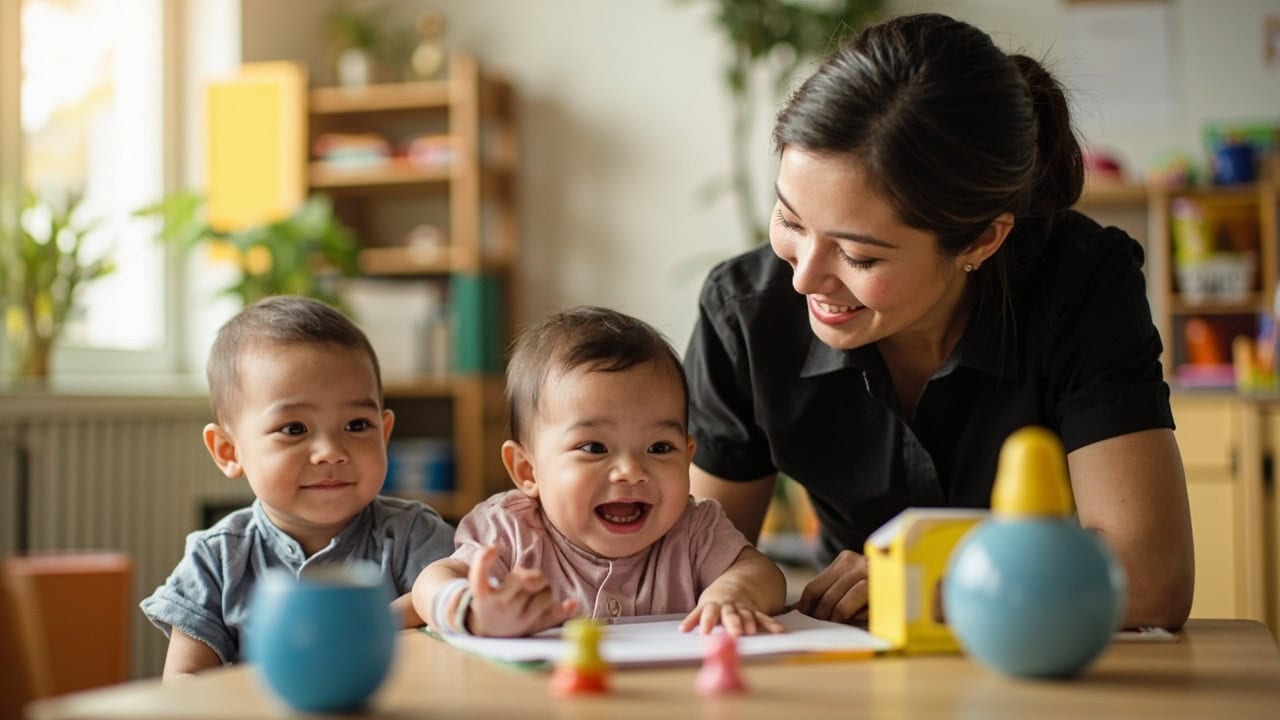
A trained and attentive infant caregiver does not simply feed, burp, and soothe your baby. They notice.
They notice when a baby is beginning to lose interest in a toy and pivot their attention before frustration sets in. They notice when an infant is working hard to roll over and quietly position themselves to give the baby space and encouragement to succeed. They notice when a baby’s cooing is taking on a conversational quality and respond in kind, entering into the exchange as if it were the most important dialogue in the world.
Because to that baby, it is.
This is what developmental psychologists call scaffolding — the art of offering support at exactly the moment and level that an infant needs, then withdrawing it as the infant masters the skill and reaches for the next one. It is an intimate, responsive, moment-by-moment practice.
And when it is done well, it produces results that parents can see — not months from now, not years later in a psychologist’s office, but now. In the way your baby moves, sounds, reaches, smiles, and connects.
Evaluating Infant Care in Singapore: What to Look For and Ask
We want every parent in Singapore to leave their infant in the morning and feel not guilt, not anxiety, but confidence. Confidence that somewhere, someone is watching for the same things they watch for.
Here is what to look for — and what to ask — when evaluating infant care:
At Pickup: Signs Your Baby Was Built Today
- They reach for you with recognition, not indifference
- They are calm and regulated — not just fed and changed, but settled
- They show curiosity about their surroundings, the caregiver, you
- The caregiver tells you specifics — “She discovered she could bang the blocks together today” or “He finally rolled from his tummy to his back”
- Your baby looks at the caregiver with trust and comfort
In Daily Care: Signs of Scaffolding in Action
- Caregivers talk with infants, not just to them
- Caregivers notice and respond to infant cues before crying escalates
- Caregivers adjust their support as infants master new skills
- Caregivers narrate what is happening (“You’re looking at the mobile — yes, those are the red ones”)
- Infants have space to explore safely and encouragement to practice new movements
In Communication: Signs of a True Partnership
- Daily updates that go beyond feeding and sleep logs
- Specific observations about emerging skills and interests
- Questions about what you see at home, to connect developmental threads
- Honest conversations about concerns, if any arise
- Warmth and genuine investment in your baby’s progress
Common Questions from Parents
How do I know my baby is developing well if I can’t be there?
You know by what you can observe — and by what you are told. Watch your baby at pickup. Notice their alertness, their engagement, the way they move and sound. Ask your caregiver what they observed that day. Over time, patterns emerge that tell a story: your baby is not just being cared for, but being cultivated.
What if my baby seems behind on milestones?
Every infant develops at their own pace within a wide range. Milestones are guideposts, not deadlines. What matters most is that your baby is progressing — gaining new skills, making new connections, responding to the world. If you have concerns, raise them with your caregiver and your paediatrician. Quality care includes monitoring and honest communication about development.
Is home-based or centre-based care better for infants?
The quality of caregiving matters more than the setting. What matters is individual attention, responsive interaction, and stable relationships. Whether care is delivered in a home environment or a centre, look for the principles outlined above: small ratios, trained caregivers, active scaffolding, transparent communication.
How do I afford quality infant care during these critical months?
This is a real concern for many Singapore families. Look into CDA funds and Baby Bonus schemes that may be applicable. Ask providers about fee structures and payment options. Some families find that investing in quality care during these irreplaceable months provides returns that go far beyond what can be measured in dollars. Quality is an investment in your child’s architecture — and that architecture lasts a lifetime.
The Parent-Caregiver Partnership: Making the Invisible Visible
The relationship between parent and infant caregiver matters deeply. It is not merely a logistical arrangement. It is a shared developmental partnership.
When your infant caregiver communicates to you what your baby is learning each day — the new sound they discovered, the way they reached for a sibling, the toy they finally grasped after weeks of trying — they are not simply reporting. They are translating your infant’s invisible growth into visible language.
They are giving you the words for what you already suspected in your heart: that your baby is not just being kept, but being built.
This communication, this transparency, is one of the most reassuring things a parent can receive during the vulnerable months of infant care.
Our Commitment to Singapore Families
EduNanny operates as part of the ECDA Childminding Pilot, situating our work within a framework designed to provide Singapore families with options that are both responsive and accessible.
- For infants, we maintain ratios of up to 1:3, ensuring that each baby receives the individual attention their development requires
- Care is available across Monday to Friday blocks, offering the consistency that infant development thrives on
- Within the pilot fee structure, we work with families to make quality infant care a realistic choice — including supporting the use of CDA funds and Baby Bonus where applicable, so that financial considerations do not force families into inadequate care during these irreplaceable months
Whether care is delivered through our home-based pathway or within our community and centre environments, the principles remain consistent:
- Responsive caregiving that actively builds developmental capacity
- Caregiver relationships that are stable, trained, and attuned
- Communication with parents that makes the invisible visible
- Where deployed, transparency measures including documented observation and reporting
Thriving: The Word That Captures Everything
There is a word that developmental psychologists sometimes use when they describe the infant in quality care. The word is thriving.
Not growing. Not developing. Thriving.
The distinction is deliberate. Growing means getting bigger. Developing means acquiring new capacities. But thriving — thriving means all of that and something more.
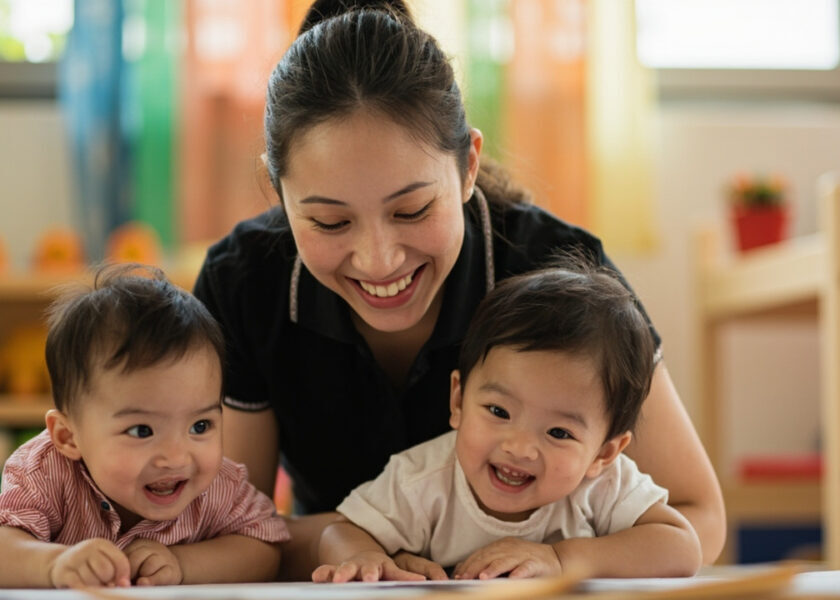
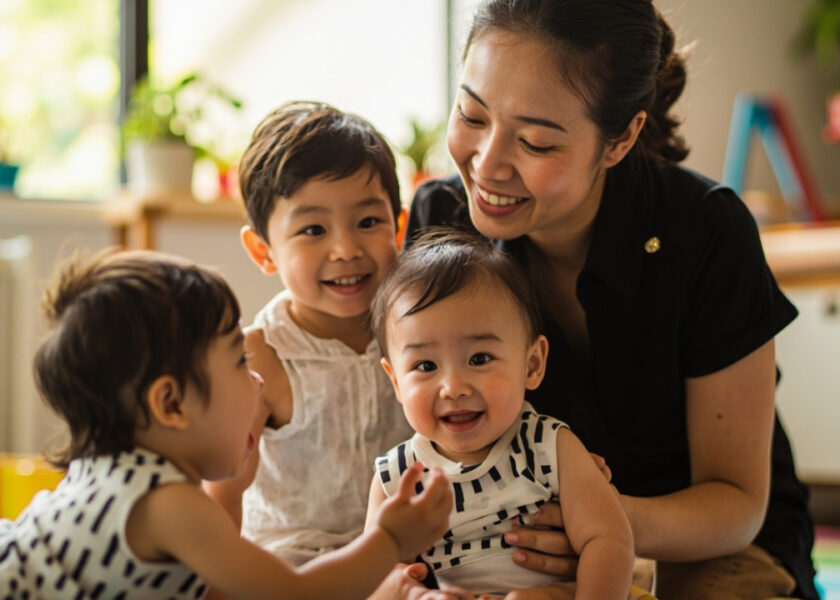
Thriving means a baby who is not merely advancing through milestones but radiating a kind of quiet, deep contentment. A baby who is engaged, curious, connected. A baby’s nervous system calm and regulated because the world has reliably met their needs.
A baby who looks at the people who care for them with trust, reaches for them with joy, and then turns back to the world ready to explore it further.
That is what quality infant care builds.
Singapore asks a great deal of its parents. The cost of living, the pace of work, the demands of careers that do not pause for the sake of development windows — all of these create pressures that make the question of infant care not just a logistical choice but a deeply felt tension in the lives of families across this island.
We know that. We have sat with families in that tension.
Our deepest answer is actually simpler than any service detail: we want every parent in Singapore to leave their infant in the morning and feel not guilt, not anxiety, but confidence.
Confidence that somewhere, someone is watching for the same things they watch for. Someone is noticing the new sound, celebrating the new reach, scaffolding the new skill. Someone is building your baby’s brain with the same love and intention that you would bring if you could be there every moment.
And when you return at pickup, you will see it — in your baby’s face, in their movements, in the way they look at you and the way the caregiver tells you, with specifics and warmth, exactly what today meant.
We are here not to replace what parents do, but to join them in the most important construction project of a human lifetime — the building of a child’s brain, one responsive moment at a time, across the twelve months that matter most.
Your infant is not just being cared for. They are being built. And what they are becoming, in the hands of quality care, is extraordinary.
If you are navigating the decision about infant care — if you are carrying that quiet question about whether your baby is truly developing, truly thriving — we would welcome the opportunity to speak with you.
Discover what we see in your baby each day, and how we help you see it too. Learn more about EduNanny and our approach to responsive, development-focused infant care.
#infantcareSingapore #qualitychildcare #babythriving #ECDAchildmindingpilot #first1000days