How Singapore Children Learn to Trust Before School
The Moment Every Singapore Parent Knows
Every morning, across Singapore, something happens that never quite becomes routine. A parent stands at a gate. A child looks back. And in that moment, every promise made during the tour — every assurance about curriculum, caregiver ratios, and communication — either holds or it doesn’t.
You have probably lived this. You know the weight of it.
You prepared for the decision. You read reviews, compared syllabi, asked about qualifications and meal plans and nap schedules. What no one told you was that the real test would be this: the backpack slipping off one small shoulder, the brief hesitation before the turn toward the classroom.
Trust, as any parent knows, is not a feeling you can simply decide to have. Trust is built in moments like these — and it can be undone in them too.
This is where the real story of childcare begins. And this is where we want to meet you.
At the Gate: Why the Morning Handoff Matters
The morning handoff is not a logistical moment. It is an emotional one. Your child arrives carrying something from home — an overnight dream, a conflict with a sibling, the general residue of a small world that sometimes feels too much. And they are meeting someone who will hold the next nine or ten hours of their day.
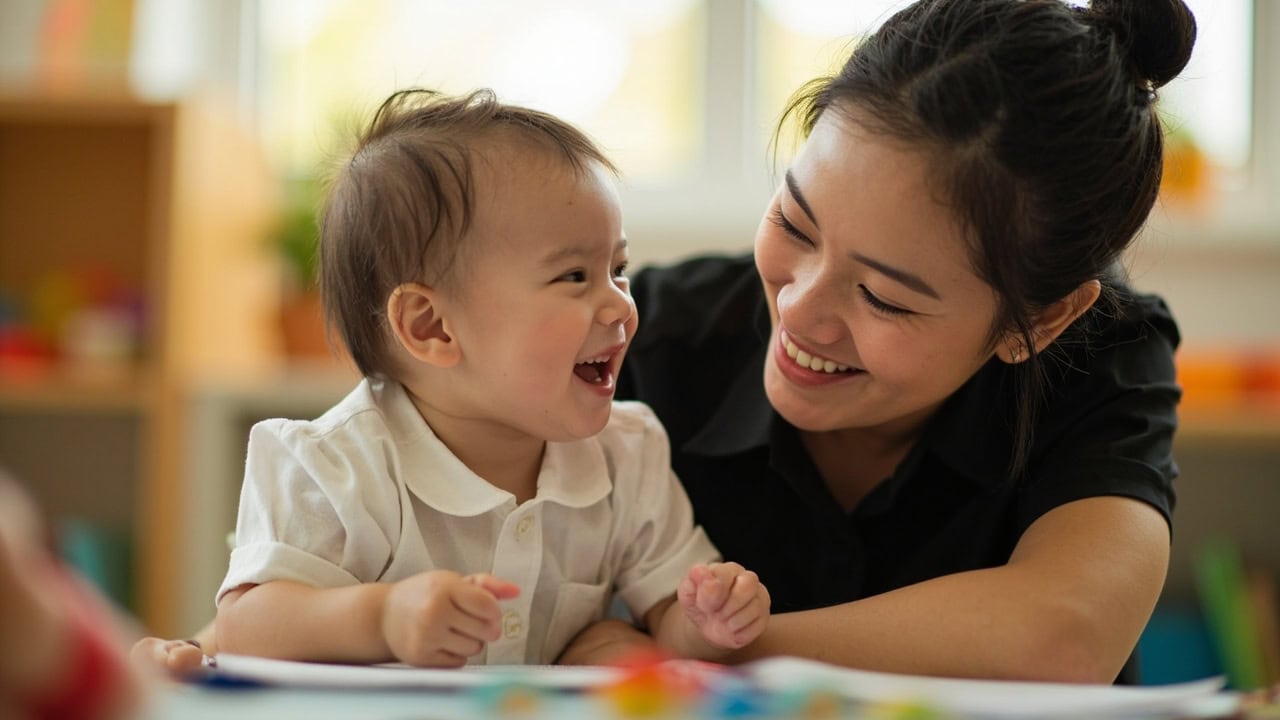
A rushed drop-off where the caregiver is already looking past you toward the next child. A warm greeting where your child’s name is said with recognition, where the transition from your arms to theirs is not a drop but a passing. These are profoundly different experiences, even if they take the same amount of time.
What separates them is not complicated:
- Attention. The caregiver is present with your child, not managing a checklist.
- Consistency. The same faces, the same greeting style, the same quality of presence.
- Willingness to step into the moment. Rather than managing it efficiently, the caregiver receives it fully.
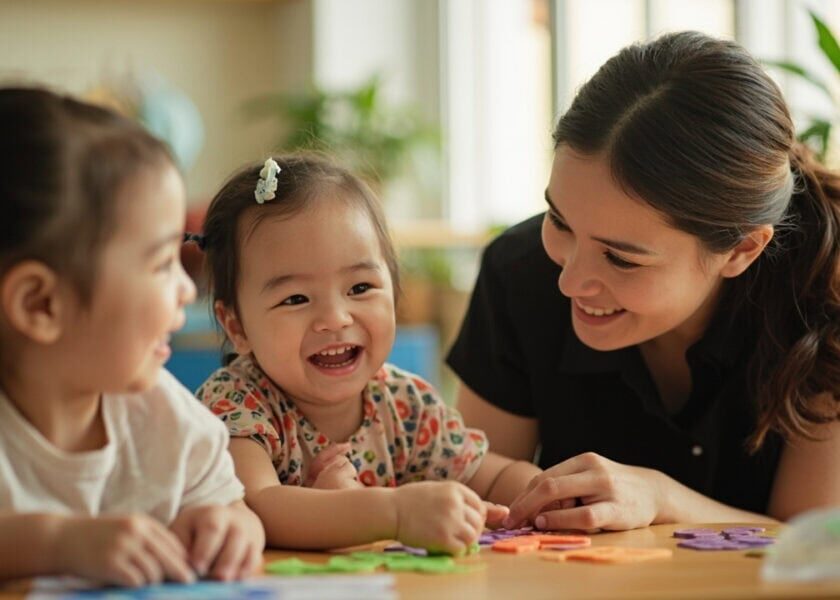
When a child experiences the morning handoff as a ritual rather than a routine, something shifts. They learn that separation is survivable. They learn that the person on the other side of the gate was expecting them, is glad they are there, is ready to continue the work of knowing them.
A child who arrives anxious will not learn well. A child who arrives recognized will.
What Quality Childminding Actually Looks Like
Singapore parents face a particular challenge: quality childcare that offers genuine attention is not always easy to find, and the costs can feel prohibitive. But quality is not just about what you pay. It is about how the system is designed.
The ratio question
Caregiver ratios matter because they determine what is actually possible in any given moment. When one caregiver is responsible for ten infants, warmth becomes an aspiration rather than a baseline. When one caregiver is responsible for three, genuine attention becomes achievable.
At EduNanny Singapore, our childminding arrangement through the ECDA Childminding Pilot maintains ratios of up to one to three for infants. This is not simply about safety compliance — though safety is foundational and non-negotiable. It is about capacity for the kind of knowing that makes transitions smooth.
Consistency of faces
Children do not generalize well when they are young. A familiar face is not interchangeable with another familiar face. When your child sees the same caregivers day after day, the morning handoff becomes easier because the relationship has been established. There is no restart each morning.
The difference between being watched and being known
There is a profound distinction between supervision and understanding.
A child can be watched by someone who does not see them — who does not know why they are crying, what makes them laugh, or what they are working on learning right now.
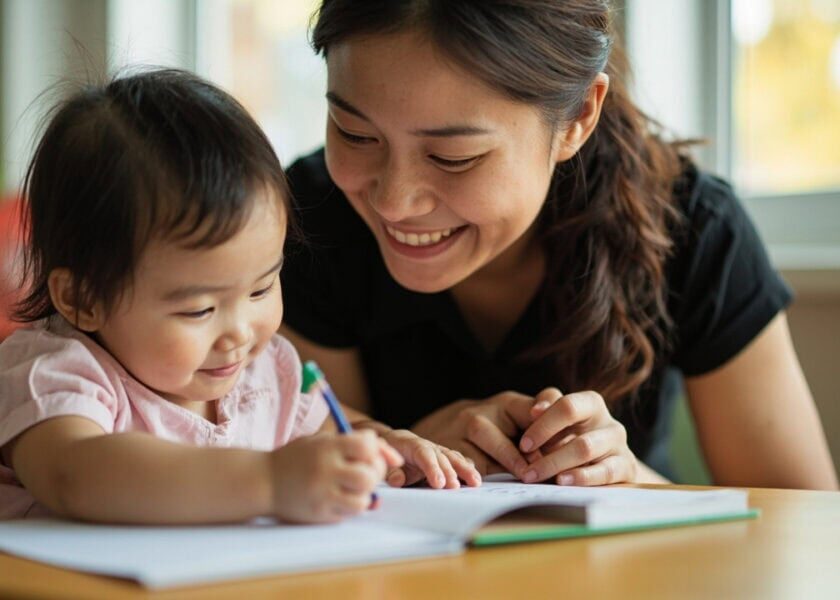
Or they can be known: their rhythms understood, their signals read, their individual tempo respected.
When a caregiver is capable of this, you will notice it in the details:
- Noticing that a child is working on their pincer grip this week
- Observing that another has been quieter since a grandparent visited
- Understanding that a third child needs a few extra minutes of transition time before moving to a new activity
These observations are not trivial. They are the substance of early childhood. And they are only possible when the system is designed to allow them.
Communication: Windows, Not Walls
We know that many families worry about what happens when they are not there. How can you know that the handoff was good? How can you know your child settled? How can you know that the trust you are extending is being honored?
We believe parents deserve windows, not walls. Where daily updates are offered, they are specific — not generic observations about coloring activities, but genuine notes about your child’s demeanor, their engagement, the small moments that told the caregiver they were okay.
This transparency is not a feature. It is an ethical commitment. You are trusting us with your child. You deserve to know how that trust is being honored.
What meaningful updates look like
- Notes on your child’s mood and energy level
- Observations about social interactions with other children
- Mentions of milestones or breakthroughs, big or small
- Honest communication when something was difficult — and what the caregiver did about it
The goal is not to create dependency on constant updates. The goal is to build the kind of trust where you can let go of the need to check constantly — because you know, in your bones, that your child is in good hands.
Separation Resilience and Your Emotional Journey
There is something that happens over weeks and months in quality childcare that many parents do not expect: their child becomes more capable of separation, not less.
This seems counterintuitive. Shouldn’t constant togetherness build security? Shouldn’t the more you are with your child, the better they handle being without you?
The research on secure attachment tells a more nuanced story. Attachment is not created by proximity alone. It is created by the experience of being reliably responded to — by the knowledge that your needs will be met, your feelings will be acknowledged, your world will be made sense of.
When a child experiences this consistently, both at home and in their childcare environment, they develop internal working models: templates for how relationships work. They come to believe that people can be trusted, that leaving does not mean abandoning, that the world is explorable because there is a secure base to return to.
This is separation resilience. And it is built through transitions — good ones.
What this looks like in practice
- A child who can be dropped off and trust that the day will be okay
- A child who sees a familiar caregiver and feels relief rather than alarm
- A child who can separate from you and still carry a sense of your presence — not because you are physically there, but because the relationship has been internalized
What to expect as a parent
We want to speak directly to the emotional journey you are on.
If you are feeling anxious about transitions, about whether your child is okay, about whether you made the right choice — you are not failing. You are paying attention. The anxiety you feel at the gate is not a sign of weakness or overprotectiveness. It is a sign that you care deeply, which is exactly what a parent should feel.
But anxiety without a framework becomes paralyzing. Anxiety with a framework becomes discernment.
- Expect some mornings to be harder than others. Expect your child to have days — or weeks — when drop-off is a struggle, with no clear explanation. Separation anxiety can resurface after holidays, after illness, after any disruption to routine. This is normal. It is development, not evidence that something is wrong.
- Expect to wonder. Wonder whether your child is actually learning or just being entertained. Wonder whether the caregiver really knows them or is going through the motions. Expect to need reassurance sometimes, and ask for it.
- Expect the relationship with your provider to evolve. In the early months, you may be in frequent communication, building trust. As time goes on, daily updates may become less detailed — not because your child matters less, but because there is an established rhythm that does not require constant narration. This is healthy. It is a sign of a partnership that has settled into genuine trust.
Transitions: From Infant Care to Primary 1
One of the most significant transitions in a Singapore child’s early life — and one that is almost never discussed in the childcare decision frameworks parents are given — is the move from infant care to toddler care.
This is a developmental handoff. Your child is moving from one stage of capability to another, from one set of expectations to a more demanding one. The environment changes. The peer group changes. The ratio may shift.
For many families, this transition is managed with a phone call or an email: Your child is aging out. Please register for the toddler room by this date.
This is not how it should be.
What quality transitions look like
Quality childcare providers understand that transitions between stages are not administrative events. They are developmental moments that deserve careful handling:
- Visits to the new room before the official move
- Gradual introduction to the new caregiver
- Communication between the old and new teams about the child’s routines, preferences, and ongoing concerns
- Exploration of the new environment with you present before navigating it alone
The child should not feel dropped into a foreign world. They should feel guided into an expanded one.
School readiness: What Primary 1 actually requires
The anxiety about school readiness in Singapore is extraordinary. It is fed by a competitive education system, by well-meaning but often misdirected advice, and by a broader cultural anxiety about keeping up.
We want to name this anxiety and then gently set it down.
The pressure to prepare children academically for Primary 1 has led to a cottage industry of school readiness programs — worksheets and drills and early literacy curricula that promise to give your child an edge. Some are harmless. Others are counterproductive, teaching children to associate learning with anxiety rather than curiosity. And almost all of them miss the point.
What does a child actually need to succeed in Primary 1?
- They need to know how to be a student. They need to understand that school is a place where they belong, where their questions matter, where their effort is recognized.
- They need social confidence. The ability to navigate a new peer group, to share and take turns and resolve small conflicts without a caregiver stepping in.
- They need emotional regulation. The ability to manage disappointment, to ask for help, to sit with discomfort long enough to work through it.
- They need curiosity. The intrinsic belief that learning is worth doing for its own sake, not just for the grade or the praise.
These are not things you can drill into a child. They are cultivated through relationship, through experience, through the slow accumulation of being in a supportive environment that challenges them appropriately.
At EduNanny Singapore, school readiness is not a program we run in the final months before Primary 1. It is the outcome of everything we do every day:
- When we give children space to explore at their own pace, we are building curiosity.
- When we let them struggle with a puzzle before offering help, we are building persistence.
- When we name their emotions and reflect them back, we are building emotional literacy.
- When we create consistent, warm environments where children learn to trust adults outside their families, we are building the social confidence that will carry them through a new classroom full of strangers.
How to Choose: A Framework for Discerning Parents
Here is what to look for when you are evaluating infant care or childminding options in Singapore:
At the morning observation
- How does the caregiver greet arriving children? Is it warm and individualized, or routine and perfunctory?
- Do the same caregivers appear each day, or does the face change frequently?
- How do the children who have been there longer respond to the caregiver? Do they show recognition and comfort?
- How do the caregivers respond to a child who is distressed at drop-off?
In conversation with the provider
- How do they describe their approach to communication? Ask for examples of what updates look like.
- How do they handle stage transitions — infant to toddler, toddler to preschool?
- What is their caregiver ratio, and why was that ratio chosen?
- How do they define school readiness, if at all?
Questions to ask yourself
- Do I feel seen when I am here, or just processed?
- Does the caregiver seem to know the children as individuals?
- Do the children seem curious and comfortable, or just managed?
- Would I feel okay leaving my child here on a difficult morning?
The Gate Will Be There Tomorrow
Singapore is a demanding place to be a parent. The cost of living is high, which means most families need two incomes. The educational expectations are intense, which means parents feel pressure to optimize every stage of their child’s development. Against this backdrop, quality childcare is not a luxury. It is infrastructure — the support system that allows parents to participate in the economy without sacrificing their children’s wellbeing.
This is the work we are called to. And it is work that happens in the transitions — the daily hand-offs, the stage changes, the leap to school, and all the smaller moments in between.
Every time a child crosses from one world to another and feels safe doing so, something is being built.
Every time a parent hands their child to a caregiver and feels, despite the anxiety, that this is okay — that their child is known, that their child is growing, that they made the right choice — something is being affirmed.
We did not choose this work because it is easy. We chose it because it matters. And we stay in it because we have seen what is possible when children are known, when parents are supported, when the transition from home to childcare and from childcare to school is handled with care and intention.
The gate will still be there tomorrow morning. Your child will still hesitate. You will still feel the weight of that small hand in yours before you let go.
But we hope — and we work toward the day when — you will also feel this:
The quiet certainty that your child is stepping into a place that understands them, that will hold them well, that will pass them back to you at the end of the day not just cared for but known.
That is what quality childcare looks like. That is what EduNanny Singapore is here to offer.
And that is why we believe — truly, and with full hearts — that every child in Singapore deserves to transition well.
Begin Your Journey with EduNanny Singapore
If you are looking for a childcare partner who understands that the morning handoff is sacred, who knows the difference between looking after and knowing, who takes the long view on your child’s development — we would be honored to walk this path with you.
Arrange a visit with EduNanny Singapore to see what thoughtful, development-oriented childminding looks like in practice. Learn more about our approach and the standards we hold ourselves to — or explore our ECDA Childminding Pilot arrangement to understand how we maintain the ratios and attention that make genuine knowing possible.