What Your Child’s Brain Is Building While You’re Apart
The Morning Handoff: What Your Child’s Brain Is Actually Doing While You’re Apart
There is a moment, every morning, when you hand your child to someone else.
It lasts only seconds. Your fingers release. Your eyes meet. You walk away carrying something heavier than your handbag or your laptop—a quiet, persistent question that no amount of reassurance has ever fully answered.
What is actually happening during the hours that my child is not with me?
This is not a question born of doubt. It is a question born of love, and of the particular kind of love that comes with responsibility—the kind that wants to understand, to know, to be certain that every hour counts.
In Singapore, where dual-income households are not a trend but a reality, where grandparents may live across the island rather than next door, where the cost of raising a child demands that both parents work, this question carries more weight than it ever has before.
You are not alone in asking it. And this article wants to answer it—not with promises, but with understanding. Because what happens in quality developmental care is not hidden. It is simply not visible unless you know what to look for.
If You’re Short on Time: What Science Tells Us
Neuroscience has established these facts about the first years of life:
- Your child’s brain builds more neural connections before age three than it ever will again—at a speed that will never be matched in adulthood.
- Responsive caregiving shapes secure attachment, which becomes the foundation for all future relationships, emotional regulation, and the capacity to explore confidently.
- Language exposure during sensitive windows builds the neural scaffolding that makes thought itself possible—not just vocabulary, but cognitive architecture.
- Guided peer interaction develops executive function—planning, impulse control, emotional regulation—the capacities that will serve your child into their mid-twenties and beyond.
- Play is not the opposite of learning. In early childhood, it is the primary mechanism by which learning happens—combining language, social, cognitive, and motor development into a single, powerful experience.
These are not philosophies. These are facts established by decades of developmental neuroscience. And they mean something concrete: the hours your child spends in quality care are not filler. They are foundational.
The Architecture of a Developing Mind
In the first three years of life, your child’s brain is not merely growing. It is being constructed. This distinction matters more than any parenting advice you will ever receive.
Adult brains are largely finished architecture—stable, efficient, built to maintain rather than to build. But a child’s brain in the first thousand days is something else entirely. It is a city under construction, with neural highways being paved at a speed that will never be matched again.
By age three, a child’s brain has formed approximately one thousand trillion neural connections—more than twice the number an adult possesses. This is not a metaphor. This is the literal architecture of thought, of language, of emotional regulation, of the capacity to pay attention, to solve problems, to wonder about the world.
The scientific term for this period is the “critical window” or “sensitive period”—and the word “sensitive” is chosen carefully. It does not mean that children are fragile during this time. It means that their brains are exquisitely receptive to specific kinds of input. A window is open. What passes through it shapes the structure of everything that comes after.
Language: Building the Scaffolding for Thought
Language exposure during these years does not simply teach words. It builds the neural scaffolding that allows thought itself to become possible.
When a caregiver narrates the world—”Look, the ball is rolling under the chair, let me reach for it”—the child’s brain is constructing the architecture for how sounds connect to objects, to actions, to meaning, to eventually, thought.
The conversational density of these early interactions—the back-and-forth, the responsiveness, the way a child’s coo is met with a meaningful reply—literally determines how densely packed the language regions of the brain will become.
This is why the hours your child spends in quality care matter so profoundly. The question is not whether your child is in good hands. The question is whether those hands understand what they are cultivating.
Responsive Caregiving and Secure Attachment
Quality developmental care begins with the caregiver—and not with credentials alone, though those matter. It begins with a different question: does this person understand what they are cultivating?
When a caregiver responds accurately to an infant’s need, the infant’s brain registers not just that the need was met, but that communication works. That the world is reliable. That other people can be understood.
Secure attachment in infancy predicts, with remarkable consistency, the ability to regulate emotion, to form healthy relationships, and to explore the world with curiosity rather than anxiety in childhood and beyond.
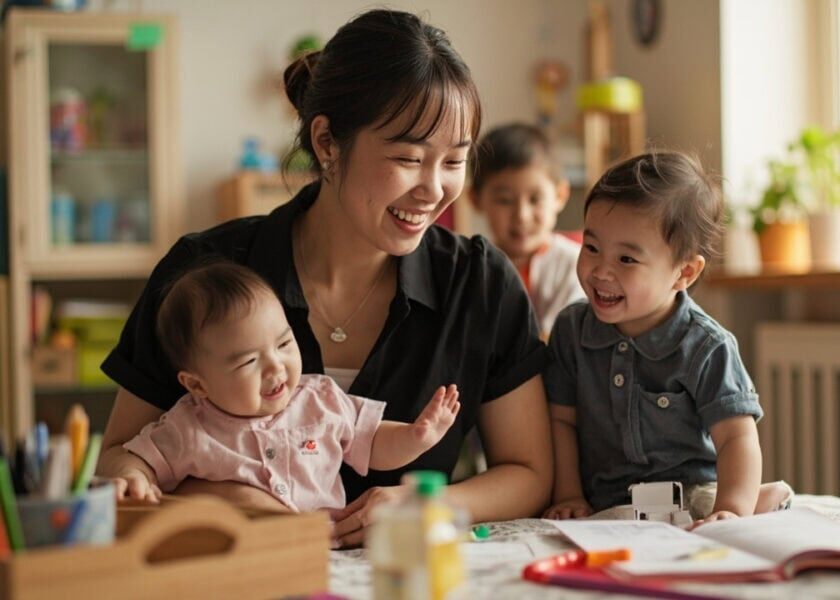
What does responsive caregiving look like in practice? It looks like a caregiver who notices when a child’s gaze lingers on a toy, and names it—extending the moment into language. It looks like the mirror response: when a toddler falls and looks up, the caregiver’s face matches the child’s inner experience, communicating “I see you, I understand, you are not alone.”
In quality infant care settings, small groups of up to three infants per caregiver create space to attune. Time to notice. You are not leaving your child with a babysitter. You are placing your child’s developing brain in an environment designed to support its most fundamental task: learning that the world is safe enough to explore.
Play and the Developing Toddler Brain
If language exposure builds vocabulary scaffolding and responsive caregiving builds secure attachment—play is where all of these converge.
Watch a child engaged in purposeful play and you are watching a masterclass in neural development:
- When a toddler pours water from one cup to another, she is not merely playing. She is learning the physics of volume, of cause and effect, of trial and error.
- When a preschooler constructs a tower of blocks, she is not merely stacking. She is developing spatial reasoning, persistence, the ability to hold a goal in mind and work toward it despite setbacks.
- When children engage in imaginative play—pretending to be doctors, or mothers, or explorers—they are practicing social roles, testing boundaries, processing emotions, and building cognitive flexibility.
Building Executive Function
Toddlers and preschoolers are in the midst of their own construction projects—ones that are perhaps less visible but no less significant.
By the time a child is two, the prefrontal cortex—the region responsible for executive function, for planning, for impulse control, for the ability to pause before acting—has only begun to develop. It will not be fully mature until the mid-twenties.
This is not a design flaw. It is an evolved feature. The human brain is built to learn, and a long childhood is the brain’s strategy for gathering the maximum amount of information from its environment before committing to permanent structure.
What this means in practice: young children are not capable, without support, of regulating their own emotions, of waiting, of sharing, of managing frustration. These are not moral failures. They are developmental facts.
Guided Conflict: Scaffolding in Action
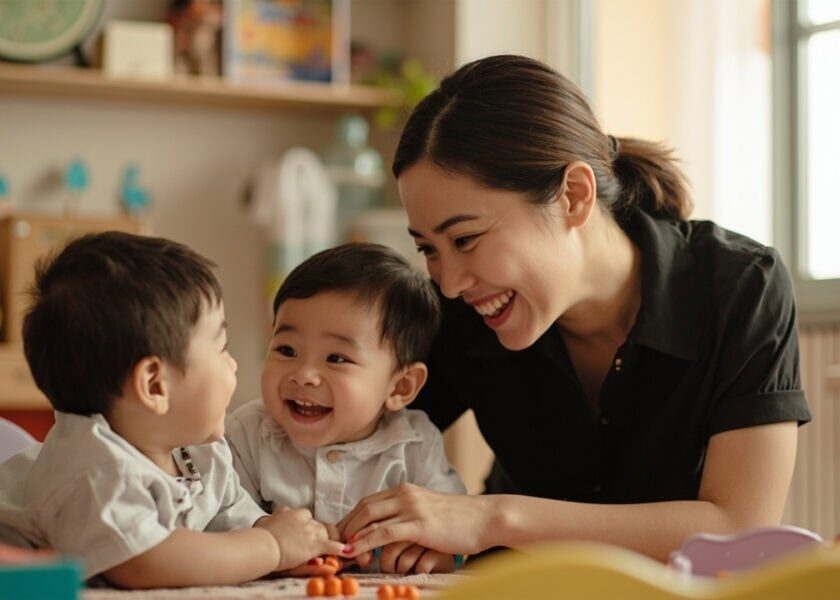
In a quality childcare environment, guided peer interaction is not left to chance. When two children reach for the same toy, a caregiver does not simply intervene with a solution. The caregiver enters the moment as a bridge—narrating the conflict in language the children can absorb, modeling the pause between impulse and action, holding space for the emotion while redirecting attention.
“I see you both want the red truck. It is hard to wait. Let’s take a deep breath together.”
This is not magic. It is the repeated, patient, intentional practice of a skill that will, over months and years, become internalized. The child’s prefrontal cortex, with each guided interaction, grows stronger.
This is what developmental researchers call scaffolding—the temporary support that allows a child to perform at a level slightly beyond what they could achieve alone, with the explicit intention of withdrawing that support as competence grows. The goal is never dependency. The goal is the progressive internalization of capacities that will serve the child for life.
Intentional Environment Design
At quality developmental settings, play is never an afterthought. It is the curriculum—but a curriculum that does not look like school. It looks like childhood: rich in sensory exploration, in gross motor challenge, in the quiet concentration of a child figuring out how a new toy works, in the joyful chaos of a group game with rules that shift and evolve.
The environment itself is designed to invite this kind of play. Materials are selected not for their flashiness but for their developmental potential. Open-ended toys—blocks, sand, water, natural materials—offer endless possibilities for construction and reconstruction. The space is arranged to allow for both active movement and quiet focus, recognizing that children need both, sometimes within the same hour.
This is not accidental. It is intentional design, grounded in the understanding that the developing brain needs variety, challenge, and precisely calibrated support—not too much, not too little, but precisely matched to the child’s current abilities and emerging potential.
What This Means for Singapore Parents
I want to speak directly to something I know you are thinking.
You are wondering how this relates to you. To your life. To the specific realities of raising a child in Singapore, where the pace is relentless, where the cost of living makes two incomes a necessity for most families, where the gap between what you want for your child and what the calendar allows can feel impossibly wide.
Removing Unnecessary Guilt
Singapore parents are not failing their children by working. This needs to be said clearly, because somewhere along the way, guilt crept into the conversation about childcare, and it has no place there.
The science is unambiguous: what matters is not whether a child is in parental care or quality alternative care. What matters is the quality of that care. A child raised in a home where a parent is physically present but emotionally unavailable, or where stress poisons the relational environment, is not better served than a child in a warm, responsive, developmentally rich setting with trained caregivers.
This is not a moral argument. It is a scientific one. And it matters, because Singapore parents carry enough weight without adding unnecessary guilt.
The Bilingual Advantage
What matters is what happens during the hours of care. And for Singapore parents, that means something specific: your child is growing up bilingual—not because of formal lessons, but because of daily exposure to English and Mandarin, to the cadence of different languages, to the world of a multilingual city.
At quality developmental settings, this is not treated as an add-on. It is woven into the environment, into caregiver interactions, into the rhythm of the day.
Research consistently shows that children exposed to multiple languages in early childhood develop not just linguistic flexibility, but enhanced executive function, better problem-solving, and greater cognitive adaptability. Your child’s bilingualism is not just a cultural asset. It is a neurological advantage.
Cultural Coherence
There is also the question of cultural context—of what it means to raise a Singaporean child in a city that is simultaneously global and rooted. This balance is not a challenge to be managed but a richness to be embraced.
Festivals, stories, foods, traditions—these are not peripheral. They are part of what makes a child feel that their world is coherent, that their identity has a place, that belonging is possible.
Making Quality Care Accessible
And then there is the practical question, the one that no amount of philosophy can ignore: how does this fit into the budget, the schedule, the logistics of a Singapore family life?
Settings operating under the ECDA Childminding Pilot are structured to be accessible. Monday to Friday care blocks align with the rhythm of the working week. CDA and Baby Bonus funds, where applicable, can be utilized. Fee structures are designed with affordability in mind—not as charity, but as a recognition that developmental investment should not be the exclusive privilege of the wealthy.
Because every child in Singapore deserves a start that sets them up for everything that comes after.
The Caregivers Who Shape Tomorrow
In Singapore, the word “childminder” has sometimes carried a shadow of diminishment—the sense that this is not quite a profession, not quite a vocation, not quite deserving of the dignity that word implies. This must be rejected entirely.
The caregivers who work with your children are not babysitters. They are developmental partners. They are the adults who spend waking hours with your child during a window of time that will never come again.
They are the ones who notice when your child is frustrated and help them find words. Who read the same book for the fifteenth time because repetition is how the brain learns. Who scaffold a social interaction, model curiosity, respond to a setback with patience that the child will slowly, over time, internalize as their own.
These are skills. They are learned. They are practiced. They deserve recognition.
Training That Goes Beyond the Surface
Caregivers in quality developmental settings are trained not just in the mechanics of childcare—the safety protocols, the hygiene standards, the feeding schedules—but in the science of child development. They understand what is happening in a child’s brain when they tantrum, and why a calm, connected response is more effective than any punishment. They understand why language matters, why play matters, why the thousand small interactions of a day add up to something greater than their parts.
Transparency: Bringing the Invisible Into View
For parents, the gap between morning handoff and home time can feel like a void—hours spent wondering, imagining, worrying. Quality developmental settings understand this and build communication into their systems.
When CCTV measures are deployed, they are not surveillance tools. They are transparency tools, offering parents a window into the day that their child is experiencing.
Daily updates, photographs, narratives of small moments—they are not extras. They are the bridge between the world of care and the world of home, a thread of connection that makes the hours apart feel less like a gap and more like a continuation.
Support Beyond the Nursery Gate
Parenting does not pause at the nursery gate. It continues at home, in the evenings, on weekends. Resources that offer developmental guidance, help parents understand milestones, and answer the ordinary questions that arise when you cannot easily ask anyone else—all of this matters.
This is innovation in service of families, not the other way around.
Choosing Infant Care: What to Look For
If you are researching infant care options in Singapore, these are the questions that matter most—not based on marketing promises, but on developmental science:
Caregiver Understanding
- Do caregivers understand why they respond in certain ways, not just how?
- Is there ongoing professional development, or just initial training?
- Do they understand sensitive windows and what passes through them?
Attunement in Practice
- What are the infant-to-caregiver ratios? Small groups allow for attunement.
- Can caregivers distinguish between different types of cries—hunger, fatigue, overstimulation, frustration?
- Is there evidence of mirror response—caregivers matching and reflecting the child’s emotional state?
Language Environment
- Is language exposure intentional, not accidental?
- Do caregivers narrate, name, and extend interactions rather than simply direct?
- Is bilingual exposure woven naturally into daily routines?
Guided Social Interaction
- How are conflicts handled? Is there scaffolding, or just intervention?
- Do caregivers model the pause between impulse and response?
- Is emotional language explicitly taught during moments of dysregulation?
Play as Curriculum
- Is play open-ended and child-directed, or rigidly scheduled?
- Are materials selected for developmental potential, not flashiness?
- Does the environment allow for both active movement and quiet focus?
The Question to Ask Yourself
When evaluating any setting, ask this: Do these caregivers understand what they are cultivating?
If the answer is yes—if you sense genuine understanding of developmental science, of the why behind every interaction—then you have found something valuable. Because credentials can be verified. Background checks can be completed. But the understanding that makes every hour count? That is harder to find, and harder to fake.
The Answer That Was Always There
So let me return to where we began.
There is a moment, every morning, when you hand your child to someone else. And for a long time, that moment may feel like a question without an answer. Where does the time go? What is happening? Is this investment—financial, emotional, temporal—actually worth it?
You have been given a lot of information here. But I want to give you one more thing: permission to trust what you already know.
You know that your child’s brain is extraordinary. You know that these early years are not a prelude to the real work of life—they are the real work of life. You know that the love you feel when you look at your child is not just an emotion. It is a neurological imperative, a force that has shaped evolution, a drive that will not let you rest until you are certain your child is safe, seen, and given every opportunity to become who they are meant to be.
You are right to ask questions. You are right to demand answers. And you are right to look for a place where those questions are taken seriously—not as bureaucratic requirements, but as the sacred inquiries they are.
Quality developmental care is not a service. It is a developmental environment. It is a place where the science of how children grow is not an abstraction but a daily practice. It is a place where caregivers are trained, supported, and treated as the professionals they are. It is a place where your child’s brain—still building, still reaching, still learning what the world is and what they can do in it—is held in hands that understand what they are holding.
When you walk away each morning, the question does not disappear. But the answer is there, waiting. In every interaction your child has. In every word spoken to them. In every moment of guided play, of supported conflict, of responsive care. In every hour that is designed, with intention and with love, around the science of how children actually grow.
Your child is building their future, hour by hour, day by day.
Let those hours be worthy of the work that is being done within them.
At EduNanny, we believe that every family deserves access to childcare that understands what it is cultivating. Our approach is grounded in developmental science, delivered by trained caregivers who see their work as a vocation, and designed to give parents the confidence that comes from knowing their child is in the right hands. Learn more about our team and philosophy.