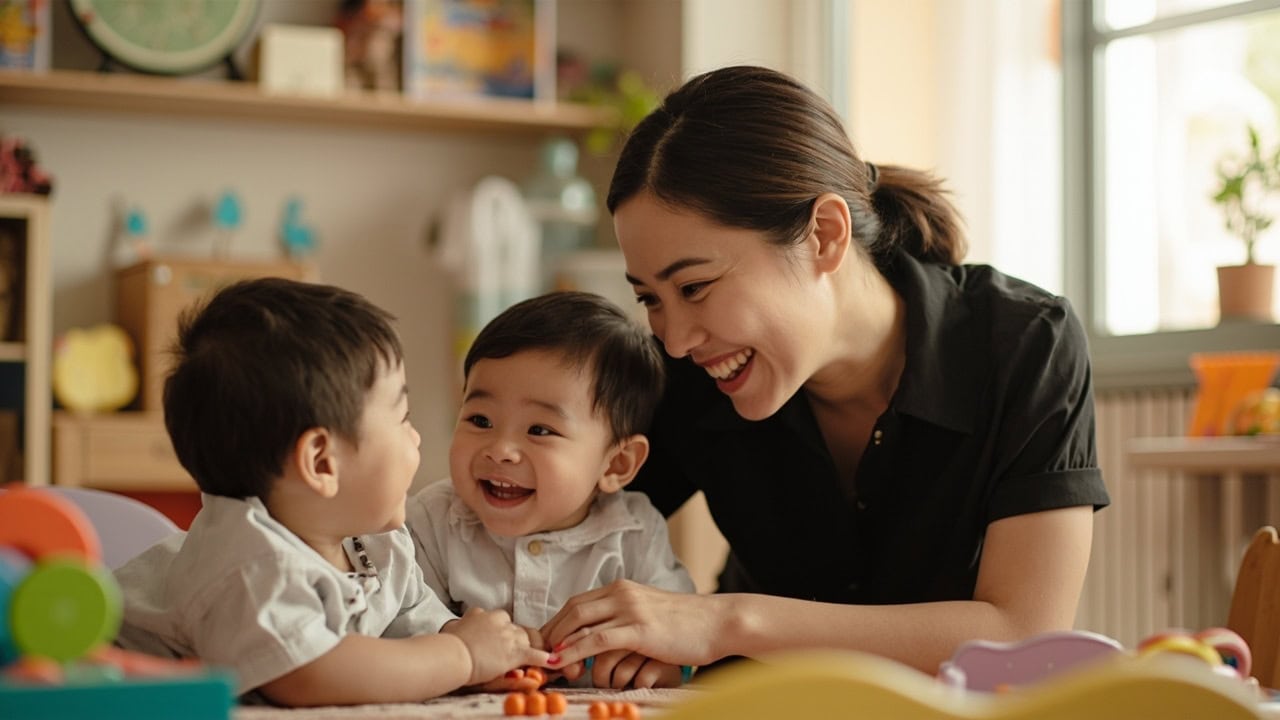
Why the Right Childcare Makes You a More Curious Parent
The Pickup Moment: Why Quality Childcare Should Leave You Curious, Not Guilty
There is a moment, familiar to every parent who has placed their child in someone else’s hands, that most childcare conversations treat as either relief or guilt. The pickup. The reunion. The brief exchange at the gate where a few sentences attempt to bridge the hours that separated you from your child’s waking world.
But what if that moment could be something different? What if what you felt at pickup was not worry, not anxiety, not even gratitude—but curiosity?
You lean in because you want to know what your child discovered today. What made her laugh. What challenged him. What small thing she did that surprised everyone, including herself. You want to know if the caregiver noticed what you have been noticing at home—and what she noticed that you missed.
This curiosity, this genuine desire to understand your child better through the eyes of someone else—this is not a sign that you have outsourced your parenting. It is a sign that you have found the right kind of partnership.
And it is precisely what Singapore families deserve.
The World Singapore Parents Are Living In
Singapore parents are navigating one of the most demanding parenting environments in the world. The expectations are high. The support structures are present, but they are also complicated—subsidies and schemes and options that require research, decision-making, and often a kind of administrative literacy that feels separate from the actual work of raising a child.
You are told to be present, to be attuned, to read the research on the first thousand days, to build attachment and stimulate development and prepare your child for a world that moves faster every year. And you want to do all of this. Deeply, genuinely, you want to do all of this.
The reality of modern Singapore family life means that most parents, at some point, need help. Professional help. Someone trained, qualified, and committed to caring for your child with the same attention you would give them yourself.
This is not an admission of failure. This is simply the world you are living in—a world where two working parents is the norm, where extended family is not always nearby, where the demands of a career and the demands of early childhood both require presence, and presence is finite.
So the question becomes not whether you will seek help, but what kind of help you will seek. And more importantly, what you will expect that help to do.
Service or Partnership: The Most Important Distinction in Early Childhood Care
Here is a distinction that matters more than almost any other: the difference between childcare as a service and childcare as a partnership.
The Service Model
Most childcare arrangements operate on a transaction. You leave your child. Someone watches your child. You return, and your child is alive, fed, changed, and hopefully happy.
This is not nothing. The peace of mind that comes from knowing your child is safe, secure, and cared for is real. It allows you to do the work that provides for your family.
But it is also, if we are honest, somewhat limited. In this model, the caregiver is a buffer between you and the stress of finding care. They absorb the difficulty of the early years so that you can function. And if that is all you are looking for, then any qualified, trustworthy person will do.
The Partnership Model
There is another model. One that asks a different question.
Not “who will watch my child?” but “who will help me understand my child?”
Not “how do I find care so I can work?” but “how do I find a partner who will make me a better parent?”
The first years of life are a period of extraordinary, unprecedented development. Every interaction a child has—with a parent, a caregiver, a grandparent—shapes the architecture of their brain.
The words they hear, the responsiveness they experience, the security they feel in being known and held and seen—these accumulate into the kind of person they are becoming.
The neural pathways that govern emotional regulation, language acquisition, social cognition, even the capacity for abstract thinking later in life, are all being built in these early years. And they are being built through relationship. Not through screens. Not through workbooks. Through the quality of attention that trusted adults pay to this small, extraordinary person.
Which means that the adults in a child’s life are not just providing care. They are providing development. And the question is whether they are doing so in isolation, or in communication with the other adults in the child’s life.
The Developmental Map: Where Co-Observation Becomes Powerful
When a professional caregiver observes your child not just to keep them safe, but to understand them—to notice their rhythms, their preferences, their emerging curiosities, their moments of frustration, the way they engage with other children, the way she processes new information—something remarkable happens.
They start to see patterns.
Patterns that you might see at home but have no framework for interpreting. Patterns that only become legible when seen from a slightly different angle, by someone who has been watching your child in a different context, with different eyes, with the training to notice what untrained attention might miss.
And when that caregiver shares those patterns with you—not in a formal report, not in a checkbox, but in a genuine conversation—something begins to form. A shared understanding. A developmental map.
Where the Map Lives
This map is not something that exists at the childcare setting or at home. It exists in the space between them.
It is co-created by parent and caregiver, through daily dialogue, through observation and re-observation, through the back-and-forth that happens at pickup and drop-off and in messages throughout the day. It is the living, growing document of what this particular child is like, what they need, what they are working toward, what their unique developmental journey looks like.
Who the Map Is For
This map is not for the caregiver. It is not for any institution or administrative purpose. It is for you. For your evenings and your weekends. For the conversations you have with your child at dinner, in the bath, in the moments before sleep.
For the way you play with them, the way you respond to their big feelings, the way you structure their environment, the way you challenge them and support them. The caregiver’s observations sharpen your intuition. They give you language for what you have been sensing. They help you see your child more clearly by showing you what they look like when you are not in the room.
Co-Observation in Action: What Partnership Looks Like Daily
Example 1: The Emerging Pattern of Focus
Your caregiver notices that your toddler becomes unusually focused when given small objects to sort. She notices that he spends longer periods in this activity than in others, that his frustration tolerance is higher, that he seems to experience genuine satisfaction when he completes a task successfully.
You go home. You think about this. You have some small wooden blocks in your cupboard that you had not thought to give him. You try it on the weekend. You watch him sort them by color, then by size, then by some category only he seems to understand.
You see what she saw. You understand it better now. You begin to see his emerging love of order and pattern. You start to provide more opportunities for this kind of play. You talk to him about what he is doing. You name his satisfaction. You are scaffolding his cognitive development in a way that feels natural and intuitive because you understand him better now.
Example 2: Reading Social Sensitivity
Your caregiver notices that your daughter becomes quiet and withdrawn when a certain child is in the room. She does not jump to conclusions. She observes over several weeks. She notices the pattern. She shares it with you—not as a diagnosis, not as a problem, but as an observation.
You go home. You think about this. You ask questions at dinner. You start to notice the same thing at home, in different contexts. You begin to understand that your daughter is sensitive to certain types of social energy, that she needs more processing time than other children, that she has preferences she has not yet learned to articulate.
You adjust your expectations. You give her more space. You talk to her about her feelings in a way that helps her name what she is experiencing.
Example 3: The Ongoing Dialogue
You message your caregiver through the day—not because you are worried, but because you are curious. You ask about something you noticed at home. You share a question. The caregiver responds with something they observed that might be related.
A picture is shared. A small insight is exchanged. A thread of understanding is added to the map.
This is not administrative overhead. This is not compliance. This is the substance of partnership.
Addressing the Fear That Lives Underneath
Let me address something directly, because if we are speaking honestly, there is a fear that lives underneath a lot of parenting decisions around childcare.
It is the fear that by seeking professional help, by placing your child in someone else’s care, you are somehow lessening your role. That you are becoming a lesser parent. That the hours your child spends with their caregiver are hours spent without you, and that the lessons learned, the bonds formed, the development that happens in those hours is a subtraction from what you are building together.
This fear is understandable. It is real. And it is, in most cases, unfounded.
The Relationship Is Not a Zero-Sum Game
The relationship between a parent and a child is not a zero-sum game. The love and attention a caregiver provides does not diminish the love and attention you provide. The insights a caregiver gains do not replace the insights you gain. The bond your child forms with their caregiver is not in competition with the bond they form with you.
It is additive. It is developmental. It is part of the ecosystem of care that all children need to thrive.
Two Kinds of Parents at Pickup
The parent who approaches pickup with genuine curiosity, who asks real questions, who takes the caregiver’s observations seriously, who reflects on what they learn and integrates it into their parenting—that parent is not being replaced by their caregiver. They are being sharpened by them. They are becoming more themselves as a parent, not less.
The parent who approaches pickup with guilt, who does not ask questions, who sees the caregiver as a separate world from their own, who goes home and does not think about what happened during the day—that parent is missing an opportunity. Not because they are a bad parent. But because they have not yet discovered what is possible when partnership is real.
The Best Childcare Outcome: A Surprising Answer
Here is the insight that sits at the heart of everything we believe about quality care.
The best childcare outcome is not a well-cared-for child. The best childcare outcome is a more attuned, more knowledgeable, more confident parent.
When you leave pickup feeling not guilty but curious, not anxious but capable, not worried about whether your child is okay but excited about what you are learning about who they are becoming—that is success. That is the partnership working. That is the system doing what it is supposed to do.
Most childcare arrangements are designed around the child. They measure their success by the child’s safety, the child’s happiness, the child’s developmental milestones. These are important measures. They matter enormously.
But they are incomplete. Because they do not account for you.
They do not ask whether you are growing as a parent. Whether your understanding of your child is deepening. Whether you are becoming more attuned, more responsive, more attuned to the particular frequencies of this particular person you are raising.
What EduNanny Offers: Partnership, Not Just Care
EduNanny was designed around a different question. A question that asks: what does it mean to care for a family, not just a child? What does it mean to be in partnership with parents, not just providers of a service?
These questions led us to align our approach with the ECDA Childminding Pilot, and with the standards and values that Singapore’s regulatory framework is designed to protect. The pilot fee structures, the subsidies available through CDA and Baby Bonus, the Monday to Friday care blocks that give families predictability and continuity—all of these are not just administrative details. They are the scaffolding that allows partnership to happen. They are what makes it possible for parents to plan, to budget, to commit to a care arrangement for the long term.
Because partnership requires time. It requires the accumulation of shared observation. It requires the kind of trust that develops not in a single meeting but in weeks and months of consistent, reliable, transparent exchange.
How We Built Our Model
- Ratios that allow for genuine attention: Up to one-to-three infant ratios mean not just supervision but actual observation
- Pathways that fit different families: Home-based, community-based, and centre-based options because the right structure varies
- Communication and transparency: Daily exchanges that go beyond “they had a good day” to “they tried something new today and I want to tell you about it”
- Ongoing dialogue tools: Thomas AI Chatbot keeps the conversation going—not replacing the human relationship but making it easier to stay engaged even on the busiest days
Questions Worth Asking Any Caregiver
If you are considering your childcare options, here are the questions we believe are worth asking—not just about EduNanny, but about any care arrangement you are exploring.
Questions About Observation
- How does the caregiver understand my child’s individual patterns, rhythms, and emerging needs?
- What does a typical day of observation and documentation look like?
- How are these observations shared with parents, and how often?
Questions About Partnership
- Will I be treated as a client receiving a service, or as a partner in my child’s development?
- Is ongoing dialogue between parent and caregiver encouraged and structured into the arrangement?
- Will I leave pickup feeling informed and connected, or just handed back my child?
Questions About Your Growth
- Will this arrangement help me understand my child better over time?
- Will I become a more attuned, more confident parent—or just a more relieved one?
- Am I being offered tools and insights I can use at home, or just reassured that everything is fine?
The Gift of Good Childcare
There is a way of thinking about childcare that says: find the best you can afford, trust them, and get on with your life. This is not wrong. It is practical. It is sensible. It keeps your child safe and allows you to function.
But there is another way of thinking about childcare that says: find a partner who will help you understand your child. Find someone who will sharpen your intuition, deepen your knowledge, expand your vision of who your child is becoming. Find a relationship where both of you are committed to the same map, building it together, day by day, observation by observation.
This second way is harder. It requires more of you. It asks you to engage, to be curious, to stay open, to receive feedback, to grow.
But it is also the way that leads to the kind of parenting you actually want to do. The kind that leaves you feeling capable, not inadequate. The kind that deepens your relationship with your child, rather than creating distance. The kind that makes you not just a caretaker but an attuner. Not just a provider but an understander.
If you are considering your options, we want you to ask not just “who will keep my child safe?” but “who will help me see my child more clearly?”
If you are already in a care arrangement, we want you to ask whether you are being treated as a client or as a partner. Whether your observations are welcome. Whether the developmental map is being shared.
And if you choose to join us, we want you to know what you are choosing. You are choosing a commitment to partnership. You are choosing to be sharpened, not replaced. You are choosing to be part of a relationship that will change how you understand your child and, in doing so, change how you parent.
That is what quality care can offer a family in Singapore. That is why the work we do matters—not just for the children in our care, but for the parents who trust us with them. For the families who leave pickup not with guilt, not with relief, but with curiosity. With questions. With a new piece of the puzzle. With the quiet, growing confidence that comes from understanding your child more deeply than you did the day before.
That is the gift of good childcare. That is the partnership we are building. And that is what EduNanny is here to offer you.
Ready to explore what partnership looks like for your family?
Learn more about EduNanny’s childminding services and how we support parents in Singapore through the ECDA Childminding Pilot. You can also read more about our approach or get in touch to begin a conversation.
EduNanny is a Singapore-based childminding service built on partnership, observation, and the belief that quality childcare strengthens families.