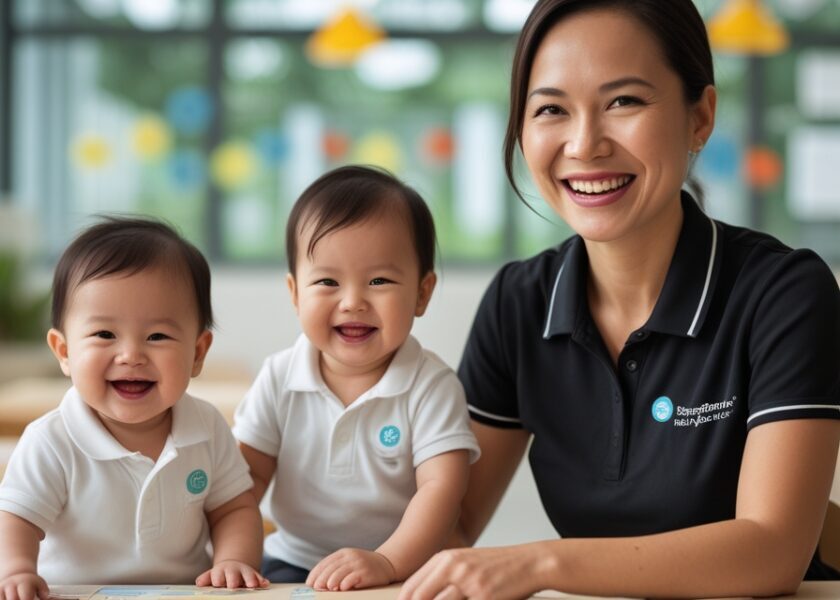
Choosing Hope Over Fear: The Partnership Singapore Parents Trust
The Silence Before the First Day
There is a particular quality to the silence in a car before the first day of childcare. Parents know it. That space where the world feels very large and your child feels very small, and you are trying to make a decision that you will live with—not just evaluate, but live with—through tantrums and breakthroughs, through mornings when drop-off is easy and the mornings when it isn’t, through the long afternoons when you wonder what they are learning and the evenings when they come home saying a word you did not teach them.
Singapore parents carry something specific in that silence. You carry the weight of a culture that values education deeply. You carry the awareness that these early years matter—that neuroscience has told us what intuition already knew, that the architecture of a brain is built in the first thousand days, that the connections formed in infancy become the foundation for everything that follows.
You carry the knowledge that you are making a choice that will touch your child’s sense of security, their language, their capacity to trust, their first experience of the world beyond you.
And beneath all of that, a question you might not even say aloud:
Will I still be the most important person in my child’s life?
This is not weakness. This is love, asking itself a necessary question. And here is what years of walking alongside families in Singapore has taught us: that question is not a liability. It is, in fact, the beginning of wisdom.
The parents who ask it—who take seriously the emotional weight of entrusting their child’s care to another—are the parents who choose more carefully, who engage more deeply, who stay more present to what is happening in their child’s life. The question itself is proof that you are paying attention. And it is the parents who pay attention who make the best partners in this work.
What That Partnership Looks Like in Practice
In the beginning, it looks like a small hand releasing yours. It looks like the caregiver kneeling down to meet your child at eye level, speaking softly, offering warmth without rushing. It looks like you, standing at the threshold longer than you need to, watching through a window or a doorway, wondering if the tears will stop, if the laughter will come, if your child will be safe and seen and known.
The ECDA Childminding Pilot, which EduNanny is part of, was built on a recognition that families in Singapore need real options—not just centre-based pathways, but home-based care that brings the caregiver into a familiar environment. It allows ratios that mean your infant is one of one to three children receiving attention, not one of fifteen.
This matters. Not as a checkbox, but because your child is learning, in those early weeks, that the world can be safe. That strangers can be kind. That you left, but you came back. That the person caring for them was expecting you to come back.
Routines Are the Grammar of Security
You begin to notice things. Small things at first.
Your child reaches for the caregiver when you drop them off—not with distress, but with recognition. There is a routine now, a rhythm of mornings that makes sense to them. They know where their cubby is. They know where the small potty is. They know that after circle time comes snack time, and after snack time there is outdoor play, and after outdoor play their parent will arrive.
Routines are not just organizational conveniences. For a young child, routine is the grammar of security. It tells them: the world is predictable. I can anticipate what happens next. I am held by patterns that do not change just because I changed.
The First Words
And then, something more.
Your child comes home one day and says a word you have never taught them. Not ma-ma. Not da-da. Something else. A word from a song they sing at childcare, or a name of a friend, or a concept that has no business emerging from a two-year-old mouth but there it is, perfectly pronounced, perfectly understood.
Language is the first great miracle of early childhood. And it does not emerge in isolation. It emerges in relationship—in back-and-forth, in conversation, in the caregiver naming the world to your child and your child naming it back. When the ratio is one to three, that conversation happens. Your child is not waiting for attention. They are receiving it.
Growing Into the World
Now you are months in, perhaps a year, perhaps longer. Your child is changing in ways you can see.
They play with other children. Not beside them—with them. They negotiate. They share, or they practice sharing, which is not the same as succeeding but is the necessary first step. They express preferences. They say no. They develop a sense of self that is separate from yours, which is both exhilarating and a little bit tender, because this is the work of parenting: to raise someone who does not need you in the same way, who will leave you in the most beautiful sense of the word.
Your caregiver is part of this. Not replacing you—never replacing you—but contributing to it. Reflecting your child’s emerging personality back to them. Celebrating their growing independence. Creating, in that small community of children and caregivers, a laboratory for social development that your child will carry into preschool, into school, into every human relationship that follows.
This is what we mean when we speak of the caregiver as a developmental ally. It is not a slogan. It is an observable reality. You can see it in the way your child enters a room, the way they speak to adults, the way they navigate the small conflicts and big joys of early social life.
How EduNanny Adapts Across Your Child’s Development
EduNanny’s approach was designed with this evolution in mind. Not as a service that handles infants and then graduates them into a different service, but as a partnership that adapts alongside your family.
Infant Stage (0–18 months)
In the infant stage, the emphasis is on care that mirrors attunement—the caregiver noticing cues, responding to rhythms, supporting the neural development that happens through warm, consistent interaction. Your baby learns that their needs will be met. That the world is reliable. That crying leads to comfort.
Toddler Stage (18 months–3 years)
In the toddler stage, the emphasis shifts toward language-rich environments, to the structured chaos of emerging autonomy, to the gentle but firm setting of boundaries that help children learn that the world has rules and that rules are not punishments but the architecture of freedom. Your toddler practices independence in a safe space.
Preschool Years (3–6 years)
In the preschool years, the emphasis moves toward school readiness—not in the anxious, push-down sense, but in the sense of genuine readiness: curiosity about learning, comfort in a group, the capacity to ask questions and persist in finding answers.
Your Family’s Needs Evolve Too
In those first months, you may need flexibility, understanding, the reassurance that your child is not just safe but thriving. Later, you may need more communication—regular updates, photographs, the small daily reassurances that bridge the gap of your working hours.
EduNanny offers transparent communication, updates that let you see what is happening in your child’s day, not because parents need to be monitored but because parents deserve to be included. Where deployed, measures such as CCTV serve not as surveillance of caregivers but as transparency for families—an open door, virtually, when the physical door is necessarily closed.
And there are practical realities that matter:
- The pilot offers fee structures designed to be affordable for Singapore families
- Monday to Friday care blocks align with working life
- CDA and Baby Bonus funds can be used
- The family’s financial planning can extend naturally to include quality care
These are not glamorous details. They are the unglamorous architecture of sustainability—the things that make it possible for a partnership to last not just weeks but years.
What to Look for When Choosing Infant Care in Singapore
We cannot promise that every day will be easy. Drop-off will not always go smoothly. There will be days when your child protests and you feel the pull of guilt, even though you know—intellectually, rationally, entirely—that you are doing the right thing. There will be days when you wonder if you are doing enough, being enough, giving enough.
Here is what we want you to know: you are not outsourcing your parenting. You are not becoming peripheral to your child’s development. You are making a choice to include another trusted voice in the village it takes to raise a child—a voice that will speak to your child when you cannot, that will celebrate their discoveries, that will comfort them when you are not there, that will tell you what they saw so that you can build on it when you are.
The parent who asks the question—Will I still be important?—is the parent who remains important. Because that question means you are paying attention. It means you will notice when your child comes home changed in small ways. It means you will ask about their day and listen to the answers, even when those answers are three words and a made-up name.
If you are researching options in Singapore, here are some questions worth asking a potential care partner:
- What is the caregiver-to-child ratio? Lower ratios mean more individualized attention. In the ECDA Childminding Pilot, this is one to three for infants.
- How does the caregiver approach the transition period? A quality care partner will not rush this. They will work with you to make drop-offs gradual and responsive to your child’s needs.
- What does a typical day look like? Routines matter. Ask how the day is structured and how it adapts to each child’s rhythms.
- How will I know what is happening while I am away? Transparent communication is essential. Ask about daily updates, photographs, and how the caregiver shares observations about your child’s development.
- How does the care approach evolve as my child grows? Your child’s needs at six months will differ from their needs at two years. Your care partner should be able to meet you at each stage.
- Can I use CDA or Baby Bonus funds? For many Singapore families, this is a practical consideration that affects sustainability.
The Moment You Recognize Everything Changed
There is a moment, and if you have been on this journey you will recognize it, when you see your child in a new context.
Perhaps it is at a playdate, or a family gathering, or the first day of primary school. Your child walks into a room full of strangers and does not freeze. They look around, they assess, they approach. They speak to an adult with confidence, not deference. They join a group of children already playing and find a way to belong.
You stand at the edge of the room, watching. And something moves in your chest—not relief exactly, though there is that. Something closer to pride, but quieter. Pride in who they are. Pride in who you are together.
That moment did not happen by accident. It was built, brick by brick, in a thousand small days. In the first drop-off and the hundredth. In the caregiver who texted you a photo on a hard day. In the routine that gave your child the grammar of the world. In the songs and the stories and the small conflicts resolved with patience. In you, showing up, every day, to receive what your child had become.
That is what a partnership looks like. That is what it becomes.
Standing With Families Who Choose to Trust
EduNanny was built for this. Not for the transaction of childcare, but for the relationship of it. For the families who want a partner that will grow with them, that will adapt as their child’s needs evolve, that will treat them as the capable, attentive parents they are rather than consumers to be managed.
The ECDA Childminding Pilot represents something important in Singapore’s approach to early childhood: the recognition that families are diverse, that children develop differently, that one pathway does not serve all. Home-based care, with its intimate ratios and personalized attention, is not a lesser option. It is a different path, one that suits some families beautifully, and that suits many families at certain stages of their journey.
EduNanny is honored to walk that path alongside them.
On the days when drop-off is hard, when the question returns, when you wonder if you are doing enough—we want you to remember something.
You chose this. Not in a moment of resignation, but in a moment of hope. You chose to find partners who would help you raise your child. You chose to trust. You chose to stay present, even when the doing was hard.
And your child is becoming someone extraordinary.
You are becoming, together, a family that knows how to love and let go. That knows how to trust and stay connected. That knows that raising a child is not a solo journey, but it is, in the end, your journey—one that you walk with others, but that is unmistakably yours.
That is the partnership we are honored to be part of. That is the work we do. And it is, in every sense, a privilege.
If you are ready to explore what a long-term partnership in your child’s care could look like for your family, we welcome the conversation. Because the right choice is not just about today. It is about the years ahead, and the person your child is becoming within them.
Begin a conversation with EduNanny.
Home-based childcare in Singapore. Thoughtful, development-oriented childminding for families who want more than a service—they want a partner.