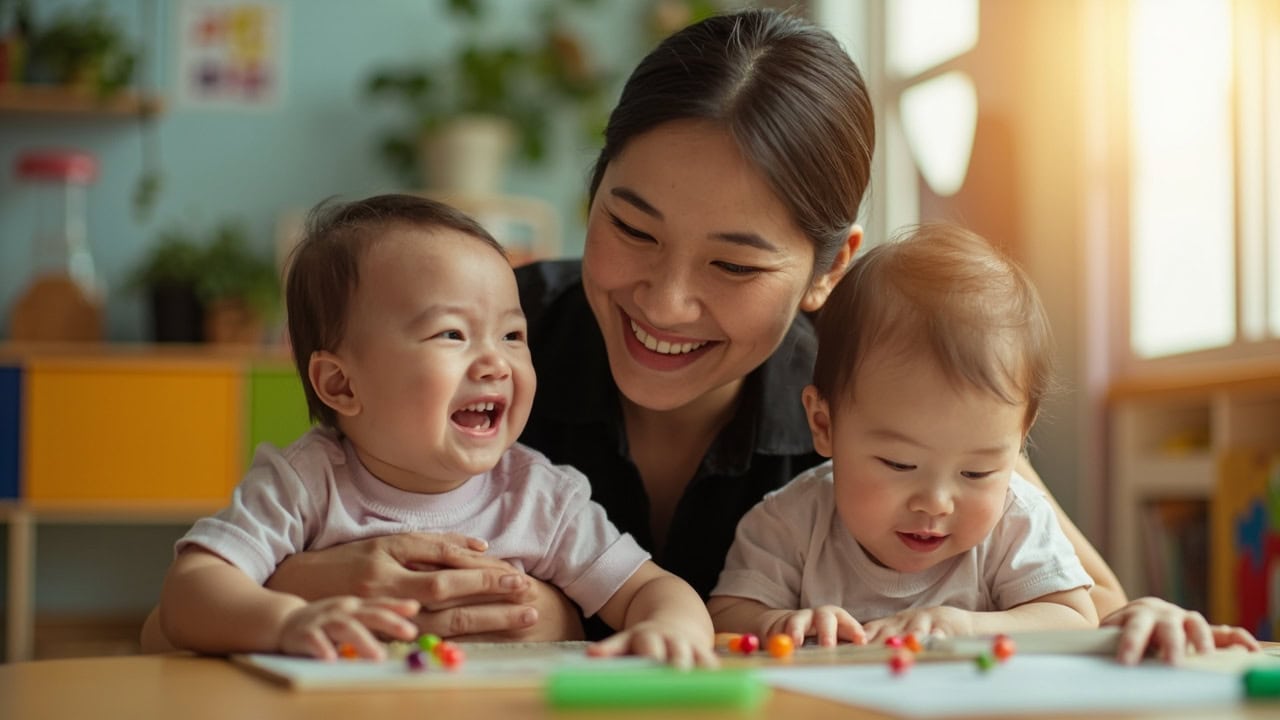
Beyond the Door: What Your Child Truly Experiences at Childcare
The Invisible Hours: What Your Child Really Experiences at Childcare
There is a moment, isn’t there, that every parent in Singapore knows intimately. It happens in the morning, somewhere between the car seat click and the classroom threshold. Your child’s hand slips from yours—or it doesn’t, and that refusal is its own kind of ache. You kiss the top of their head. You say the words you always say. And then you turn and walk away.
You do not see what happens next.
For the next eight or nine or ten hours, your child enters a world you cannot enter. They are there, and you are here, and the space between you is not just physical. It is a gap filled with unknowns. A gap where your child’s entire inner experience is unfolding without you.
This is the quiet anxiety that lives beneath the surface of every Singapore parent who makes the choice to place their child in care. It is not the guilt that people warn you about—not the social media guilt or the well-meaning auntie guilt. It is something deeper and more honest than that. It is the ache of loving someone whose world you cannot see.
It is the quiet question that surfaces on the drive to work: Are they okay? Are they really okay?
We do not talk enough about this specific anxiety. We talk about whether to choose centre-based or home-based care. We talk about infant ratios and teacher qualifications and curriculum frameworks. But we rarely sit with the parent and say: You are not wrong to worry about what you cannot see. And here is what is actually happening in those invisible hours.
What Is Actually Happening During the Hours You Are Apart
When a child enters a quality care environment, they do not simply wait for you to return. This is the first thing to understand, because it is the thing that most eases the ache. Your child is not passively marking time. They are actively living. They are building a world in that room—a world with its own textures, rhythms, relationships, and small victories.
From the child’s perspective, those hours are enormous.
For a child under three, the experience of time is not the same as yours. An hour to you is a breath. An hour to a two-year-old is an entire emotional landscape. In that hour, they may cycle through wonder and boredom, frustration and delight, loneliness and connection.
They may fixate on a truck wheel, and that wheel becomes the most important thing in the universe for twenty minutes. They may have a meltdown over a sandbox lid, and that moment may feel to them like the end of everything. Then it passes. They are handed a snack. The world rebuilds itself.
Secondary Attachment: What Children Build While You Are Away
When a child is in a care environment where the adults are genuinely present—where they notice the small distress before it becomes a big one, where they respond to the child’s cues rather than imposing a rigid schedule, where they hold the emotional climate of the room with care—something remarkable begins to happen. The child begins to build what developmental psychologists call secondary attachment.
This is not a replacement for you. It cannot and should not be. But it is an additional source of safety, a secondary anchor that your child can reach for when the waves get high.
This happens slowly. It does not happen in a day or a week. But over weeks and months, the trusted caregiver becomes someone your child looks for. Someone whose voice carries comfort. Someone who knows how they like their sandwich cut and which blanket they reach for at rest time.
This is not a betrayal of your bond with your child. It is an expansion of it. Your child is learning that the world contains more than you—and that is exactly what healthy development requires.
The Social World of the Care Room
But attachment to caregivers is only one thread in the fabric of your child’s day. There is also the social world of the room itself—the other children, the shared toys, the tiny negotiations and collisions and alliances that make up early social life.
Watch a room of toddlers sometime, and you will see a complex society in miniature. A child takes a toy. Another child protests. An adult steps in, not to solve the problem, but to hold the space while the children find their way through it.
These moments—and there are dozens of them every day—are where your child is learning what relationships feel like:
- What happens when I want something someone else has?
- What happens when someone pushes me?
- What happens when I reach for connection and another child reaches back?
The quality of the environment determines whether these moments become opportunities for growth or sources of overwhelm. In a room that is understaffed, underprepared, or emotionally chaotic, these social moments can become overwhelming. The child is flooded, dysregulated, and no one has the bandwidth to help them come back down.
But in a care environment where there are enough attuned adults—where the ratio allows for real attention—these moments become the raw material of social development. The child learns: I can survive frustration. Someone will help me. I can try again.
Why Staffing Ratio Matters More Than You Think
This is why the ratio matters so deeply, though we rarely explain it in these terms. It is not just about safety, though safety matters. It is about emotional capacity.
When there are three children to one adult, that adult can notice the child who is slipping toward dysregulation before the storm breaks. They can offer a word, a touch, a redirection that brings the child back. But when there are eight children to one adult, that moment of noticing is missed, and the child falls into the storm alone.
Over time, this matters enormously for how your child learns to regulate their emotions—and for how they carry those lessons home to you at night.
Reading the Signals: What Your Child Brings Home
Here is the part that most parents are hungry for: the signals. The fragments. The clues that tell you what was really happening during the hours you were not there.
At pickup, your child is not a blank slate. They are carrying an entire day’s worth of experience in their body, in their voice, in the way they do or do not meet your eyes. Learning to read these signals is one of the most important skills a parent can develop—not because you need to monitor every moment of your child’s inner life, but because your attunement to these signals is itself a gift you give your child.
It tells them: I see you. I am paying attention. Your experience matters to me.
The Greeting
How does your child respond when they see you?
The child who runs to you with full-body joy, who melts into you and then pulls back with a grin—this child is coming home with a sense of security. They have used the hours apart to confirm what they already knew: you come back. You are reliable. The world is safe enough.
The child who is strangely quiet, who seems flat or distant, who takes a long moment to register that you are there—this child may be telling you something important. They may have had a hard day. They may have been holding themselves together in a way that required enormous effort. They are not necessarily telling you the care is bad. But they are telling you: I need something from you right now. I need to be held and not asked to perform.
Verbal Fragments
Pay attention to the verbal fragments too. Two-year-olds are not reliable narrators, but they are excellent emotional reporters. The sentences that tumble out at pickup—“Mia took my truck” or “Teacher said no” or “I played with the blocks”—these are windows. Not complete pictures, but real glimpses into the texture of their day.
When you receive these fragments, receive them with interest rather than alarm. Ask simple questions. Listen more than you probe. Let them tell you what they want to tell you.
The Body
And then there is the body. The child’s body carries their emotional state in ways they cannot yet articulate.
A child who is relaxed, regulated, and internally at ease will move through the world with a kind of ease—loose shoulders, open hands, a willingness to engage. A child who has been under strain, who has been holding too much without enough support, may come home with a rigid quality to their movements. They may be more prone to tears, more easily frustrated, more clinging.
This is not misbehavior. This is their nervous system telling you the truth about how the day felt.
What to Do With What They Bring Home
What you do with these signals matters. You do not need to interrogate or fix. You simply need to receive. When you see your child’s hard day, meet it with presence.
Say: It sounds like today was tricky. I’m here. You can tell me more if you want, or we can just be together.
This is what secure attachment looks like in practice—not grand gestures, but daily attunement. The small, consistent moments where your child learns that you see them and hold them and do not abandon them to their distress.
What Quality Childminding Actually Looks Like
Not all care environments make reading your child easy. In some settings, the child’s inner experience is genuinely invisible. The child goes in one person and comes out another, and you are left to piece together what happened from fragments and intuition.
But in a quality care environment, you are given windows. You are given words and images and stories. You are given a bridge across that invisible gap.
Quality care, simply stated, is care where someone is paying the kind of attention you pay at home—who notices when a child’s eyes light up at a new book, who sees when a child is wobbling emotionally and offers a steadying presence, who logs the small milestones and the everyday moments with equal care.
It is care where the ratio allows for real attention. Where the emotional climate of the room is held with intention. Where your child’s inner experience is treated as important—not just whether they ate and slept, but how they felt, who they connected with, what challenged them, what delighted them.
It is care where you receive genuine windows into your child’s day—not perfunctory checkboxes, but real glimpses into their experience. This is not about surveillance. It is about trust. It is about giving parents the information they need to stay connected to their child’s inner life even when they are physically apart.
How EduNanny Bridges the Invisible Gap
EduNanny by BUTLER was built on a simple premise: the child’s inner experience during care hours should not be invisible to their parents. Every parent who entrusts their child to care deserves to know what is happening in those hours—not just that their child was fed and changed and kept safe, but how their child felt, who they connected with, what challenged them, what delighted them.
Through the ECDA Childminding Pilot, EduNanny operates with small ratios that allow caregivers to truly know each child. With up to one to three infants in care, there is space to notice. There is space to listen. There is space to hold the child’s inner world with the same care the parents hold it at home.
EduNanny’s caregivers are not just minders. They are documenters of experience. They are bridge-builders between the child’s world at home and their world at care. When you drop your child in the morning, you are not dropping them into a void. You are placing them in a space where someone is paying the kind of attention you pay—who notices when a child’s eyes light up at a new book, who sees when a child is wobbling emotionally and offers a steadying presence.
Parents receive regular updates—not just perfunctory checkboxes, but genuine windows into the child’s day. This is not about surveillance. It is about trust.
Built for Singapore Families
EduNanny bridges the home-based and community-based pathways. For many Singapore families, the question is not just whether to choose centre-based or home-based care, but which environment will help their child thrive. EduNanny understands that every family is different, and that the right fit depends on the child’s temperament, the family’s rhythm, and the specific needs of the moment.
Through the ECDA Pilot, EduNanny offers flexibility while maintaining the same standard of attention and care across settings. CDA and Baby Bonus funds can be utilized. The Monday to Friday care blocks are designed with working parents in mind. This is not an afterthought. It is a deliberate choice to make quality care accessible to families across Singapore, because every child deserves to be emotionally seen during the hours their parents are away.
Common Questions From Parents Like You
How do I know what really happened all day?
You cannot know everything—and that is okay. But you can build a relationship with the care environment that gives you windows. Ask questions. Request updates. Notice how the caregivers talk about your child. Do they know your child’s rhythms? Do they mention specific moments from the day? This is how you begin to close the gap.
What if my child seems off at pickup?
Sometimes a child who seems flat or irritable at pickup has simply had a big day. They have been using energy to regulate, to adapt, to be part of the group. When they come home to safety, they let down. This is not a sign of bad care. It is a sign that home is a safe place to be themselves. Hold them. Don’t rush to fix. Just be present.
Am I damaging my child by placing them in care?
Quality care does not damage children. What shapes development is what happens within the care—not the fact of care itself. Children can and do thrive in care environments where they are seen, held, and attuned to. What they need is not your perpetual presence, but your reliable return and the knowledge that someone is paying attention while you are away.
Is home-based or centre-based better?
The answer depends on your child and your family. What matters most is the quality of the relationship and the environment, not the setting. Look for small ratios, attuned caregivers, and genuine communication. Trust your instincts about whether your child seems settled and known.
The Difference Between Being Minded and Being Emotionally Seen
What is the difference between a child who is adequately minded and a child who is emotionally seen and held?
It is not always visible in the moment. It does not always announce itself in photographs or daily reports. But over time, it becomes visible in the child themselves. The child who is emotionally seen learns something profound about their own worth. They learn: I matter. My feelings matter. There are people in this world who can hold my inner experience and not be overwhelmed by it.
They learn that relationships can be safe, that the world can be navigated, that they are not alone even when they are apart from the people they love most.
This is not a small thing. This is the foundation on which a lifetime of emotional health is built.
You do not have to guess alone. The right care environment makes that reading easier, richer, and more reassuring over time. The right caregivers become your partners in understanding your child. And your own attunement—your willingness to pay attention to the signals, to receive your child’s fragments, to meet their hard days with presence—this is itself a form of quality parenting.
It does not matter that you were not in the room. What matters is what you do with what your child brings home.
So the next time you drop your child at care and feel that familiar ache, pause for a moment. Take a breath. Know that your child is not in a void. Know that there are people on the other side of that door who are paying attention—who are seeing them, holding them, documenting their experience, and building a bridge back to you.
And when you pick them up, slow down. Look at their face. Receive their fragments. Listen to what their body is telling you.
This is the work of parenting in the early years—not grand gestures, but daily presence. Not perfect knowledge, but willing attention.
You are already doing it. You are already that parent. And your child is already telling you everything you need to know.
If you are looking for a childminding arrangement in Singapore where your child’s inner experience is genuinely seen—where small ratios allow for real attention, where daily updates give you windows into their day, and where caregivers become partners in understanding your child—EduNanny by BUTLER may be the right fit for your family.
Through the ECDA Childminding Pilot, EduNanny offers flexible, quality care designed for working parents. CDA and Baby Bonus funds can be utilized.
Explore EduNanny’s childminding services and discover how we can help bridge the invisible gap between you and your child.