The Architecture of Early Learning Every Singapore Parent Deserves to Understand
The Question Singapore Parents Carry Quietly
There is a question many Singapore parents carry quietly, often late at night, after the children have finally slept. It is not about logistics or schedules or which service to choose. It is deeper than that. It is the question of whether choosing professional childcare means their child will simply be kept, or whether they will be grown.
It is the question beneath all the other questions.
And here is what matters, because you deserve to hear it plainly: that question you have been asking yourself is not a sign of doubt. It is a sign of how much you care. Singapore parents feel this weight more acutely than most, and that is not weakness. That is love doing what love does—taking responsibility seriously, wanting to get it right, refusing to settle for less than what their child deserves.
But here is the thing about that question. The worry that your child is merely being kept rather than genuinely growing tells me one thing clearly. You have been trusting your instincts about what your child needs. Now let me show you something your instincts have already seen, but perhaps not yet named.
How Young Children Actually Learn Before School
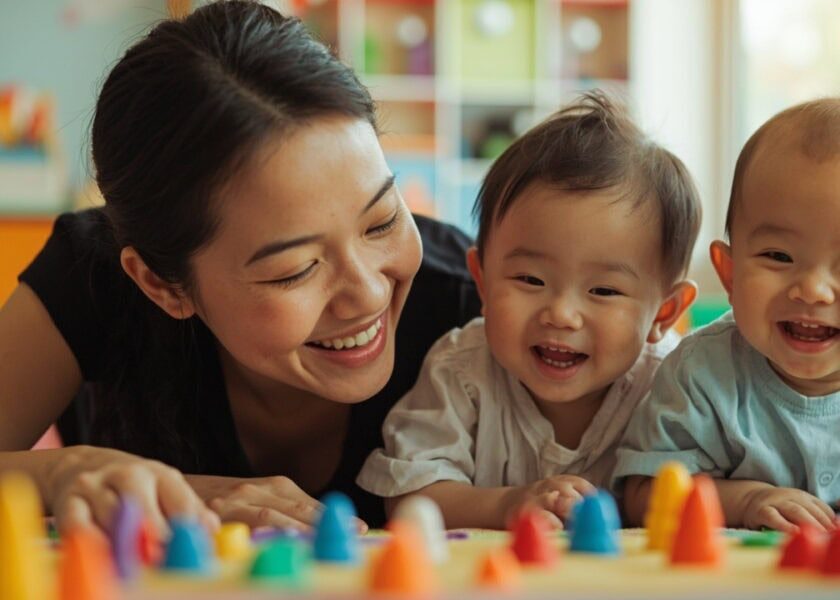
There is a classroom your child attends before school. It has no walls, or rather, its walls are lined with low shelves holding wooden blocks and puzzle pieces and books with thick, turnable pages. Its curriculum is not written on a whiteboard. It is hidden in the rhythm of a morning, embedded in the way a caregiver bends to a child’s level when a tower of blocks comes crashing down, the way she mirrors the child’s frustration, names it, and asks, “Should we try again?”
That question, asked sincerely with patience, is not small talk. It is the architecture of resilience being built one exchange at a time.
What the Research Shows
You may have heard the phrase “hidden curriculum” before, perhaps in the context of schools, of the unwritten rules and social learning that happens alongside formal lessons. But here is what many Singapore parents have not been told: your child’s most important hidden curriculum begins long before primary school. It begins in infancy. It begins now, in the setting you are wondering about choosing.
Decades of early childhood research have shown that quality interactions in the early years do not merely feel good. They change the architecture of the developing brain, strengthening the connections that underlie everything from impulse control to empathy to the ability to sit still and pay attention in a classroom ten years from now.
Walking Through an Ordinary Morning
Walk with me for a moment through an ordinary morning in a high-quality Singapore childcare environment. It may not look like learning at first.
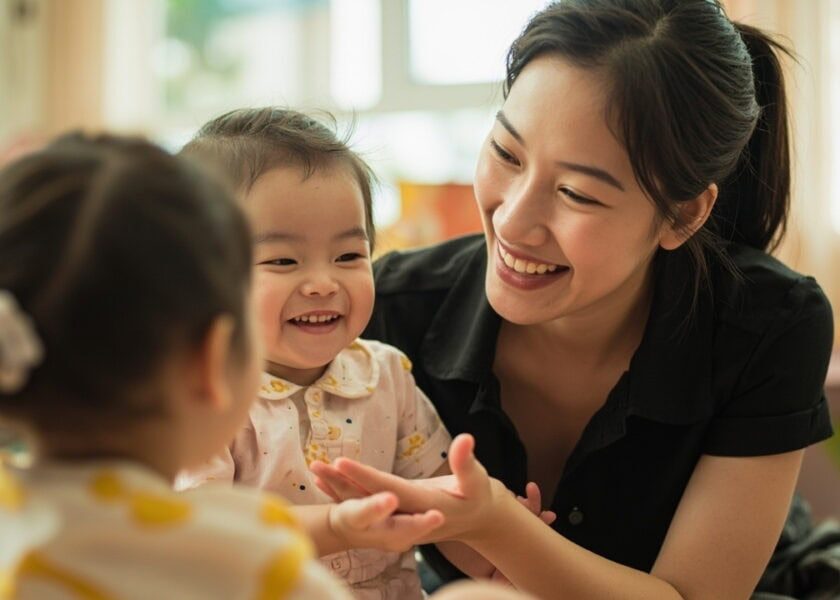
A toddler is stacking cups. A caregiver is nearby, not hovering, not intervening, but present. The toddler looks up and says something that sounds like gibberish but carries intention. The caregiver leans in and responds as if she heard every word.
“You want to put the blue cup on top of the yellow one? That’s a great idea.”
Language is happening here. Not the vocabulary lists you will see later, but the foundational architecture of communication—the understanding that words have power, that this person listens, that what I say matters. This is the beginning of a conversation, and conversations are how human beings learn to think.
Now watch what happens when two children reach for the same toy. In a setting staffed by supervisors, this is a problem to be solved quickly. In a setting designed for learning, this is a lesson.
The caregiver does not rush in. She kneels beside them, not above them, and asks, “What happened?” She listens to both sides. She mirrors back what she hears.
“Siti wants the truck. Wei also wants the truck. How can we solve this?”
These words are teaching something that no worksheet will ever teach: that other people have feelings, that those feelings matter, that problems have solutions when we listen and think together. This is social intelligence being constructed in real time, and it is happening at an age when the brain is most malleable, most ready to absorb these lessons.
Supervision Versus Intentional Care
Let me speak directly to a distinction that changes everything.
Supervision keeps children safe. It watches. It prevents accidents. It is necessary, but it is not sufficient.
Intentional care does all of that and something more. It looks at a child’s day and asks, “What is this child learning? How can I make this moment richer? What does this child need to grow, not just today, but into the kind of person who can think, and adapt, and feel, and connect?”
That question requires training. It requires small ratios. It requires caregivers who have been taught to see learning in the ordinary moments, because that is where it lives.
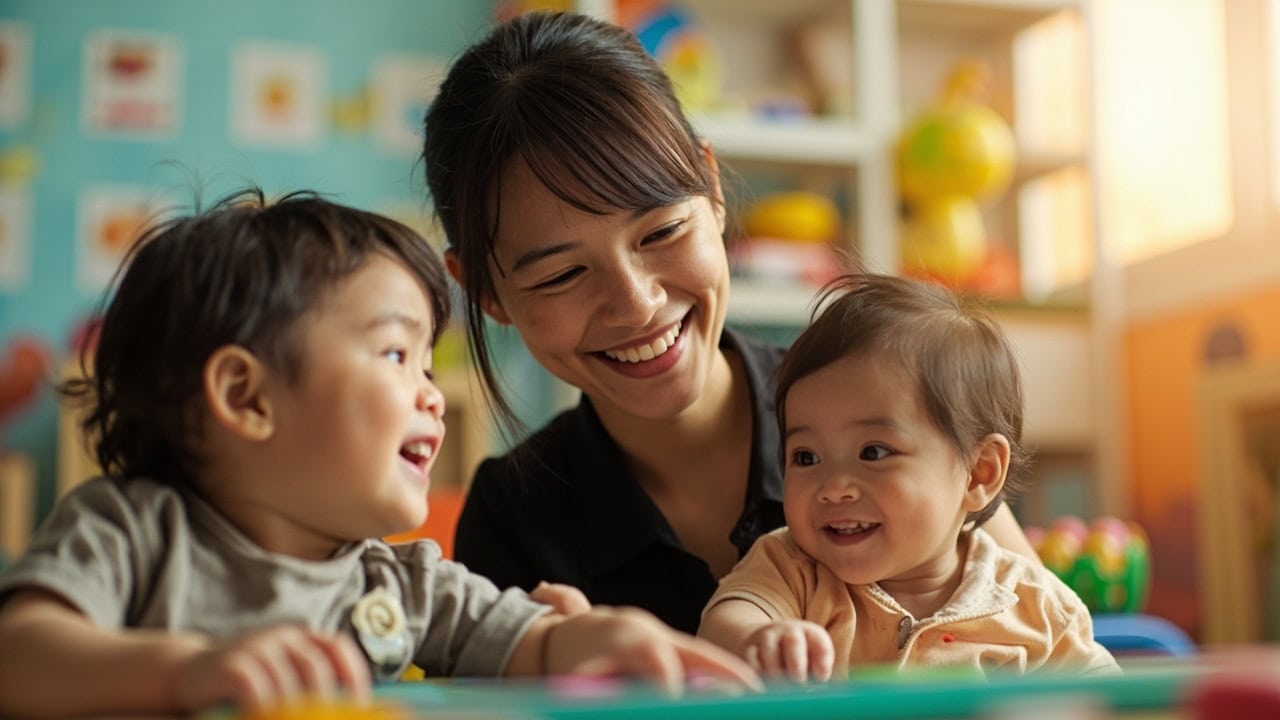
A caregiver who is responsible for three children can respond with warmth and intention. A caregiver who is responsible for eight or ten cannot, no matter how skilled. That is not a judgment on caregivers. It is arithmetic. When ratios are kept small, every interaction becomes an opportunity. When a child spills a cup of water, the caregiver nearby can turn it into a conversation about cause and effect. When a child attempts a new word, it can be noticed and celebrated.
What Quality Care Looks Like: A Practical Guide
Here is what you should look for, because you deserve something concrete, something you can observe and trust.
- Watch how a caregiver responds to frustration. Does she name the frustration? Does she stay close? Does she help the child find words for what he is feeling? That is emotional regulation scaffolding, and children who learn to name their feelings early develop the capacity to manage them later.
- Watch how a caregiver talks during routine activities. Is she narrating, describing, asking questions during handwashing or snack time? That is language exposure, building the neural pathways that will one day carry your child’s thoughts.
- Watch how children are given time. Are children given time to solve their own small problems before an adult steps in? That is not neglect. That is respect for a child’s emerging competence.
- Watch the daily rhythm. Are transitions prepared for rather than rushed? Is there unhurried time for child-led exploration? Free play is not idleness. It is the work of childhood, where children practice decision-making, creativity, and social negotiation.
A child who trusts the predictability of their environment develops the security that makes exploration possible. A child who is rushed from activity to activity learns to feel anxious in transition. The difference is in the design.
Why This Matters More in Singapore
I know the world you are navigating. I know the hours you are working, the commutes you are enduring, the conversations you are having about differentiation and streaming and the K2 syllabus. I know that Singapore is a place where educational ambition is not a luxury but a cultural reality, where parents plan for their children’s futures with a seriousness that other societies sometimes mistake for pressure.
This ambition, this love expressed through planning and sacrifice, can make the question of childcare feel especially weighty. You want to give your child every advantage. You are afraid that choosing care outside the family means choosing less.
Let me address that fear directly, because it deserves a direct answer.
The Anxiety Is Not a Warning Sign
The anxiety you feel about choosing professional care is not a sign that you are making the wrong choice. It is a sign that you understand the stakes. Singapore parents do not agonize over childcare because they are uncertain. They agonize because they care, and they care because they know that the early years matter in ways that science is only beginning to illuminate.
That care, that attention to detail, that refusal to settle—that is exactly the instinct that will guide you to quality when you find it.
What Actually Predicts School Readiness
Your child’s brain is not waiting for school to begin learning. It is learning right now, at this very moment, in every environment that surrounds it. The question is not whether learning is happening. The question is whether the environment is designed for learning to happen well.
For Singapore parents navigating the pressures of a demanding academic culture, this distinction matters. The temptation is to look for the most structured program, the most impressive-looking curriculum, the earliest introduction to formal learning. But the research is clear: what predicts school readiness is not early literacy. It is executive function—the ability to focus, to remember, to control impulses, to adapt. It is social-emotional competence—the ability to cooperate, to resolve conflict, to understand what others feel. It is language richness—the breadth of vocabulary, the complexity of sentences, the joy of communication.
These are not taught. They are caught. They are caught in the quality of daily interactions, in the rhythm of a predictable and loving environment, in the experience of being truly seen by attentive adults who believe that every moment with a young child is an opportunity.
Common Concerns, Direct Answers
Am I choosing less by choosing professional care?
No. You are choosing a different kind of learning—one that complements and extends what you provide at home. The best childcare settings are designed to be an extension of family life, not a substitute for it.
Will my child feel less attached to me?
Secure attachment develops when children have consistent, responsive care. Quality childcare provides another environment where your child can build security, which actually supports their overall sense of safety and confidence. Children who experience secure environments—regardless of how many environments—develop stronger attachments, not weaker ones.
Should I wait until my child is older?
The early years are not a gap to be filled later. They are a foundation to be built now. Every month of quality interaction matters for brain development. Waiting does not mean avoiding the question; it means answering it later, when there is less time.
What This Looks Like at EduNanny
EduNanny was built on this understanding. The ECDA Childminding Pilot was designed with these principles at its center, not as an afterthought but as the foundation.
Small Ratios Are Not a Feature. They Are a Prerequisite.
The ratio of up to one caregiver to three infants in the infant care setting allows for the quality of interaction described above. This is how a caregiver can respond with warmth and intention to every child’s emerging needs—not because she is extraordinary, but because she has the time and support to be present.
Daily Rhythm Reflects Intentional Design
The schedule is designed to give children unhurried time for child-led exploration. Transitions between activities are not rushed. They are prepared for, because a child who trusts the predictability of their environment develops the security that makes exploration possible.
Caregivers Trained to See Learning in the Ordinary
The caregivers at EduNanny are trained to see learning in ordinary moments. They know that a spilled cup of water is an opportunity for cause and effect. They know that a child’s attempt to say a new word is a neural event worth celebrating. They know that the way they hold a crying infant, the way they name what that infant cannot yet express, builds the foundations of trust and security that every other kind of learning rests upon.
Transparency Serves Trust
Communication with parents is not a courtesy. It is a commitment. When CCTV measures are in place, it is not because trust is absent but because transparency serves trust. When regular updates are given, it is because parents deserve to see what their child is doing, to feel connected to the daily life that is shaping their child’s understanding of the world.
This is not about replacing what you do as a parent. It is about extending it. The best childcare does not compete with family. It aligns with it. It is a continuation of the warm, responsive, growth-oriented environment you are already creating at home. When you choose a setting that understands this, you are not dividing your child’s world. You are enriching it.
How to Know If a Setting Is Truly Quality
Observe. Watch how caregivers respond to frustration, how they speak during routines, how children are given time to solve problems. Ask about ratios. Ask about caregiver training. Ask about the daily rhythm. Quality is observable, and the questions you are already asking are the right ones.
- Do caregivers kneel to a child’s level? Do they name emotions?
- Is there time for free play? Are transitions calm and prepared for?
- How many children is each caregiver responsible for?
- Do caregivers narrate, ask questions, expand on what children say?
- Do caregivers step back and let children try before intervening?
- Will you know what your child is doing each day?
You Are Already Choosing Intention
Here is what I know about Singapore parents, because I have sat with you, because I have heard your questions, because I have seen the weight you carry and the care you take: you are already giving your children this. You are already choosing intention over convenience, thoughtfulness over habit, love over ease.
The question of childcare is not a test of your devotion. It is simply another decision, made with the same care you bring to all the others.
What happens in a quality childcare setting is this: a hidden curriculum unfolds every single day. Children learn that they are safe. They learn that their needs will be met. They learn that words connect them to others and that their curiosity is met with interest. They learn that when they struggle, someone is nearby. They learn to feel what others feel, to solve problems, to try again, to discover that the world is full of things worth exploring.
These are not skills for school. They are skills for life.
And when you choose this kind of care, you are not choosing babysitting. You are choosing education. You are choosing to invest in the person your child is becoming, from the very beginning, in the way you always intended.
That is not something to worry about. That is something to know.
Your child is learning right now, in the setting you are considering. The question is simply whether that setting is designed for learning to happen beautifully.
And now, you know what beautiful looks like.
Begin the Conversation
If you are researching infant care or childminding in Singapore, you owe it to yourself to understand what quality really means. Not the quality that looks impressive on paper, but the quality that unfolds in ordinary mornings, in the way a caregiver kneels beside your child, in the patience of a question like “Should we try again?”
EduNanny was built on this understanding. We invite you to visit and observe, to ask questions—because the parents who ask these questions are the parents who find what they are looking for.
Your child is learning right now. Make sure that learning environment is designed for something beautiful.
Learn more about EduNanny’s approach to infant care and childminding in Singapore, or read about our story.