Secure Attachment and Professional Childcare What Singapore Parents Need to Know
Secure Attachment and Professional Childcare: What Singapore Parents Need to Know
There is a moment, quiet and unremarkable on the surface, that most Singapore parents know well. It arrives just after you have walked away from the drop-off point, when the school gates have closed behind you and you are already moving toward the MRT station, the office, or the next appointment on a schedule that leaves little room for hesitation.
In that moment, somewhere beneath the logistics and the productivity and the ordinary machinery of your day, a question surfaces. It is not dramatic. It does not announce itself. But it is there:
Is my child truly secure right now? Is the person caring for my child the kind of person who holds them the way I would?
This is not a failing on your part. This is the most fundamental expression of parental love—the instinct to ensure that your child’s world is safe, that the hands you are not holding are still held by someone worthy of trust.
And yet this question often carries with it an unspoken weight: the fear that the answer might be no, that the separation itself is doing damage, that in entrusting your child to a caregiver you are somehow placing something irreplaceable at risk.
I want to speak to that weight. Not to dismiss it, because it deserves to be taken seriously. But to offer something that most parents searching for childcare in Singapore rarely find: clarity. The clarity of understanding.
Because once you understand what attachment science has taught us about how children develop emotional security, everything changes. The guilt you carry becomes unnecessary. The worry you feel transforms into something purposeful. And the choice you have made—to seek quality professional care for your child—reveals itself not as a compromise but as a profound act of love.
The Science of Secure Attachment: A Foundation for Understanding
When developmental psychologists first began studying the bond between young children and their caregivers, they discovered something that seemed counterintuitive. Children do not form attachment with only one person. From the earliest months of life, a child’s brain is wired to develop multiple significant attachments—attachments that are not in competition with one another, but that exist in a hierarchy of security, each one contributing something essential to the child’s developing sense of the world.
The pioneering work of John Bowlby gave us the concept of the secure base: the foundation from which a child can explore their environment with confidence, knowing that there is a reliable figure who will respond to their needs, comfort them in distress, and welcome them back after every venture into uncertainty.
A secure base is not a single person. It is a function. And that function can be fulfilled, at least in part, by more than one consistent, trained, emotionally attuned caregiver.
What This Means for Your Child
When your child forms a secure attachment with a consistent, well-trained professional caregiver, something remarkable happens. Your child is not dividing their love. Your child is expanding their sense of security. They are learning, at a neurological level, that the world contains reliable people who will respond to them with care.
This does not replace the attachment they have with you. It deepens and extends the template for trust that you have already established.
In Singapore’s context—where extended family is often geographically distant, where dual-income households are the norm rather than the exception, and where the early years of a child’s life coincide with some of the most demanding professional years of the parents’ lives—the professional caregiver is not an optional convenience. For many families, the professional caregiver is a primary attachment figure in the daily life of the child.
The Three Pillars of Quality Caregiving
What distinguishes a caregiving relationship that supports secure attachment from one that does not? Three factors emerge consistently across the research:
- Consistency means your child encounters the same caregiver, day after day, in a predictable rhythm of care. For an infant or toddler, whose sense of time is measured in routines rather than calendars, this predictability is foundational to the development of trust.
- Sensitivity means the caregiver’s ability to notice, interpret, and respond appropriately to a child’s signals. A baby’s cry is communication, and a sensitive caregiver learns to distinguish between the cry of hunger, the cry of fatigue, the cry that means discomfort, and the cry that means loneliness.
- Continuity means the caregiver relationship persists over time, allowing the attachment bond to deepen from surface familiarity into genuine security. Short-term caregivers, rotating staff, and high turnover undermine this process at a neurological level.
Every time a caregiver responds to a child’s needs with warmth and accuracy, the child’s brain is learning: I matter. My needs are valid. People will respond to me.
Why the First Thousand Days Matter Most
The first thousand days of your child’s life are not simply a period of rapid physical growth. They are a period of extraordinary neural architecture, when the circuits that govern emotional regulation, social connection, and stress response are being laid down with a speed and plasticity that will never be matched again.
During these first thousand days, your child’s brain is learning, through every interaction with a caregiver, whether the world is a safe place, whether people are trustworthy, whether their cries will be answered and their needs will be met.
A caregiver who is trained to read a baby’s cues, who responds consistently to distress, who creates an environment of warmth and predictable routine, is not a substitute for you. A caregiver like this is a secondary attachment figure who provides what researchers call a “haven of safety”—a place your child can retreat to when the world feels overwhelming, knowing they will be held, understood, and comforted.
Recognizing Secure Attachment: Signs and What Quality Care Looks Like
How do you know whether your child is forming a secure attachment with their caregiver? There are observable signals, rooted in attachment research, that you can learn to recognize:
- Clear preference for familiar adults over unfamiliar ones—which is actually a sign of health, not dependency
- The ability to be comforted by the caregiver when distressed, rather than remaining inconsolable
- Curiosity and engagement with the environment when the caregiver is present and calm
- Genuine warmth toward the caregiver—not just tolerance, but something that looks like pleasure in the relationship
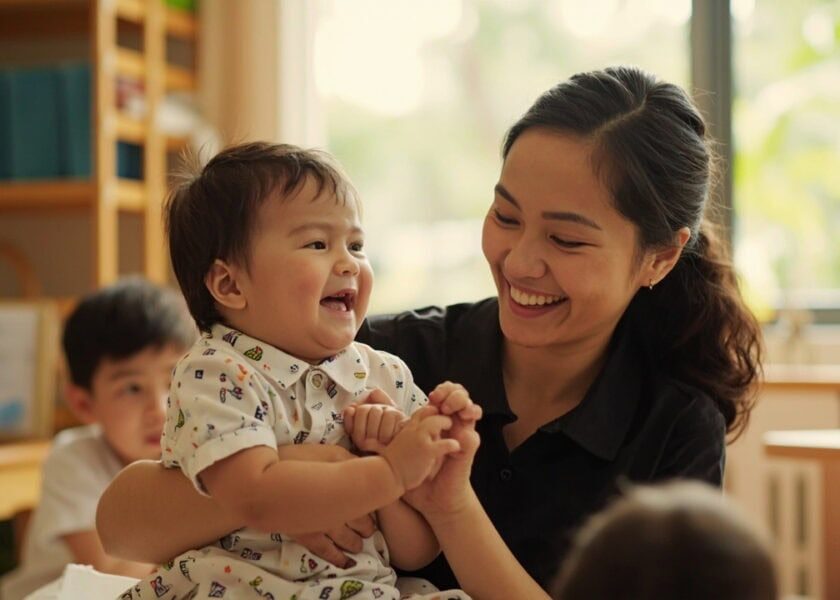
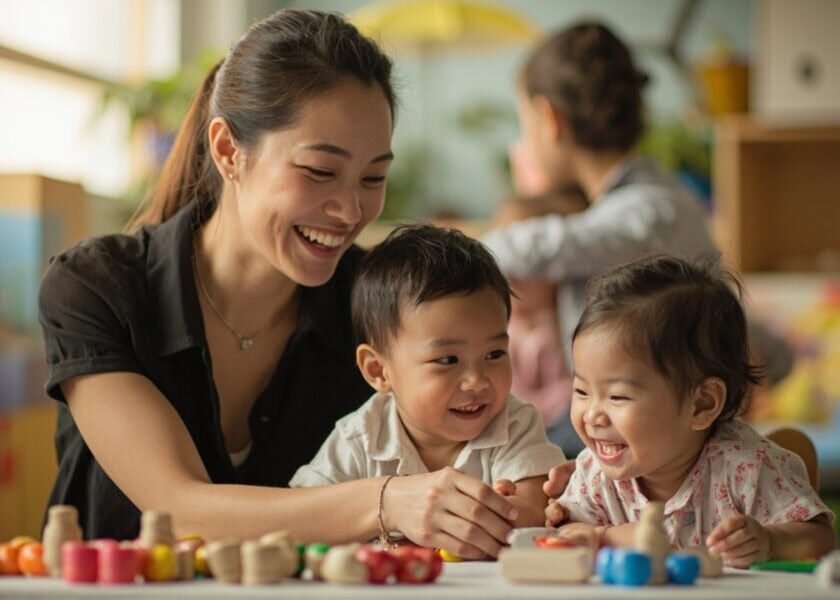
You might notice, after some weeks or months, that your child seems genuinely happy to see their caregiver. Not just familiar, not just neutral, but happy. This is not a betrayal of you. This is your child practicing the experience of secure attachment with a new figure, and that practice will serve them throughout their lives.
Research suggests that children who have multiple secure attachment relationships—with parents, grandparents, consistent professional caregivers, and other trusted figures—tend to show greater social competence, greater emotional resilience, and greater capacity for forming healthy relationships later in life. They have learned, from direct experience, that love is not a finite resource that must be hoarded and protected. They have learned that love multiplies, that it extends, that it can be trusted to flow through multiple channels without being diminished in any of them.
What to Look For When Evaluating Childcare
Understanding attachment science is the first step. Knowing how to identify care that supports healthy attachment is the second. When evaluating childcare options in Singapore, these are the factors that matter most for your child’s emotional development:
| Factor | Why It Matters for Attachment |
|---|---|
| Caregiver consistency | Same caregiver daily builds familiarity and trust. Rotating staff disrupts attachment formation. |
| Group size and ratios | Smaller ratios allow for genuine attunement. Larger groups dilute individual attention. |
| Caregiver training | Trained caregivers read cues better and respond with warmth and accuracy to children’s needs. |
| Routine and predictability | Predictable daily rhythms help children feel secure enough to explore and learn. |
| Environment warmth | Home-like settings reduce sensory overwhelm and support natural attachment behaviors. |
| Parent communication | Transparent, regular updates reduce parent anxiety, which children sense and absorb. |
These are not luxuries. These are the conditions under which secure attachment actually develops.
Questions to Ask When Choosing Infant Care
Armed with this knowledge, here are the questions that will help you evaluate whether a childcare arrangement is truly supporting your child’s attachment development:
- Who will actually be caring for my child day-to-day? Will it be the same person consistently, or do they rotate staff?
- What is the caregiver-to-infant ratio? Can the caregiver realistically attune to my child’s individual signals throughout the day?
- What training have the caregivers received? Do they understand infant cues, emotional regulation, and attachment science?
- What does a typical day look like? Is there predictable routine, or is the schedule chaotic?
- How will I know what is happening during the day? What communication can I expect?
- What happens if my child is distressed? How do caregivers respond to crying, separation anxiety, or overwhelm?
- How long have caregivers typically been in their roles? High turnover is a warning sign.
These questions are not intrusive. They are the questions of a parent who understands what is at stake. Any quality provider will welcome them.
EduNanny: Quality Childminding Within the ECDA Framework
EduNanny by BUTLER participates in the ECDA Childminding Pilot, aligning our approach with national standards designed to prioritize the developmental needs of young children. This is not a bureaucratic detail. It is a signal of seriousness—the Pilot framework reflects current understanding of what young children need, and it shapes how EduNanny structures its care.
What This Looks Like in Practice
- Home-based care: Your child is cared for in a familiar, domestic environment rather than a large institutional setting. Home-based care reduces sensory overwhelm, allows for more flexible and individualized routines, and creates the kind of warm, predictable atmosphere in which secure attachment flourishes naturally.
- Intentionally small caregiver ratios: Up to one to three infants in care, depending on the arrangement. This reflects what attachment science tells us: that caregivers can only truly attune to a small number of children at once, that quality of attention matters more than quantity of supervision, and that every moment of consistent, warm engagement is building the neural architecture of your child’s emotional life.
- Consistent caregiver relationships: The Pilot framework prioritizes continuity. Your child encounters the same caregiver, day after day, building from surface familiarity into genuine security.
- Transparent communication: Where visibility measures are deployed, they are deployed not as surveillance but as reassurance. We understand that parents need connection to their child’s daily experience. Parents who feel connected carry less anxiety, communicate that lower anxiety to their child, and are better able to support the caregiver relationship from a place of confidence rather than doubt.
- Accessible fee structures: Arrangements are designed to be accessible within the Pilot framework, knowing that financial stress is one of the silent disruptors of family wellbeing. Where CDA and Baby Bonus funds can be applied, we ensure parents can use them.
None of this is accidental. All of it is built on a single conviction: that the early years matter profoundly, that the caregiver-child relationship is not a peripheral concern but a central one, and that parents who choose quality professional care deserve to feel not guilt but pride—not anxiety but confidence.
Reframing the Narrative: You Are Building a Village
Let me speak directly to the guilt that many Singapore parents carry when they entrust their child to professional care.
The guilt is understandable. We live in a culture that often equates presence with love, that suggests a good parent is one who is always there, who never chooses work over their child.
But this framing misunderstands what attachment actually is. Attachment is not about physical proximity. Attachment is about emotional responsiveness. It is about the reliability of connection, the consistency of care, the felt sense in a child’s body that they are known and valued by someone who will not abandon them.
When you choose a professional caregiver carefully—when you prioritize training, consistency, and warmth; when you select a service that understands attachment science and builds its model around it—you are not choosing absence over presence. You are choosing to create a second secure base for your child, one that operates alongside the secure base you provide at home.
Your child does not experience this as a betrayal of your bond. Your child experiences this as an expansion of their world, a deepening of their sense that there are good people in it who will care for them.
You Are the Attachment Architect
Here is the reframe that I want to offer you: you are not competing with your child’s caregiver for your child’s affection. You are not a presence being replaced by an absence. You are building, brick by brick, a village of attachment figures who collectively support your child’s emotional security.
And in doing so, you are giving your child something precious—not just care, but a model of how trustworthy relationships work.
Singapore parents carry more than most. The cost of living, the demands of dual careers, the distance from extended family, the fierce desire to give their children every possible advantage—these are real pressures, and they shape the choices parents make in ways that are often invisible to the wider world.
But within those pressures, within the daily reality of balancing work and family and self, there is a quiet act of faith that most Singapore parents perform without recognition: the faith that the people they leave their children with are worthy of that trust.
That faith deserves to be justified. And it can be, when parents have the knowledge to choose well and the framework to understand what they are building.
You can ask questions of your caregiver. You can observe the signals of secure attachment. You can communicate with confidence and curiosity rather than anxiety and doubt. You can see your child’s happiness at the sight of their caregiver and recognize it not as a threat, but as evidence that your village of attachment figures is growing exactly as it should.
You Are Building Something That Will Last
You are building something precious. Not just in the sense that all children are precious, though they are. You are building, day by day and interaction by interaction, the architecture of your child’s inner life.
The circuits that will govern their ability to regulate emotion, to form healthy relationships, to trust others, to venture into the world with confidence—this architecture is being built right now, in the first thousand days, in the routines and the responses and the small, repeated moments of care that may seem ordinary but are, in fact, extraordinary in their developmental weight.
The caregiver your child sees each day is a collaborator in this building. And so are you. Not as a sole architect working alone, but as part of a village—one that includes you, your partner, your extended family where they are present, and the thoughtful, trained, consistent caregivers you have chosen to join your child’s world.
This is not a compromise. This is not a sacrifice. This is what it looks like to love a child in the modern world—not by being present every moment, but by being purposeful every day. By choosing care that is worthy of your child’s developing trust. By understanding what secure attachment means and ensuring your child experiences it, in your home and beyond it.
Your child is secure. Your child is held. Your child is building something that will last a lifetime, with you and with the people you have chosen to walk alongside you in this extraordinary, exhausting, irreplaceable work of raising a human being.
And you, parent, are not failing. You are doing exactly what the best parents have always done, in every era and every configuration of family life:
You are building a village.
If you are ready to take the next step in finding care that supports your child’s secure attachment, we invite you to speak with our team or learn more about EduNanny and how we approach infant care within the ECDA Childminding Pilot framework.
At EduNanny, we believe that every child deserves a village—and that parents deserve to feel confident in the people who help build it. Learn about our story and our standards.