Seeing Clearly: The Moment Singapore Parents Trust Their Observation
The Moment You Stop Checking Boxes and Start Seeing Clearly
There is a particular kind of exhaustion that comes with searching for childcare in Singapore. It is not the exhaustion of sleepless nights or the physical demands of caring for an infant. It is the exhaustion of not knowing what you are looking for while knowing you must find it.
It is the fatigue that settles in after the fifth visit, the seventh centre, the third home-based option. You have taken notes. Compared ratios. Reviewed credentials. Walked through environments that blur into one another because you have not yet learned how to see what makes them different.
Here is what most parents do not recognize when they are in this searching: you are not just gathering information. You are not just evaluating options. You are, without knowing it, developing a skill. You are learning to see.
And once you see what you were looking for, everything changes.
This article is about that moment of seeing. It is about the trained observation you are already developing, the perception you already possess, and why trusting yourself is not naivety—it is the beginning of wisdom.
When Observation Begins: The Shift from Analyzing to Perceiving
Consider your first visits. You walk into childcare environments with your infant against your chest, immediately flooded with input. The colour of the walls. The height of the shelves. The smell of the room—whether it carries the faint sweetness of warm bodies or the sharp cleanliness of industrial disinfectant. The sounds: the hum of air conditioning, the murmur of older children, the specific quality of a teacher’s voice as she speaks to a child.
What do you do with all of this? If you are like most parents, you try to organize it. You ask about ratios, certifications, meal plans, curriculum frameworks. You take photographs because something about them might matter but you cannot yet say what.
You leave feeling as though you have absorbed something, but you cannot articulate what it was. This is not a failure of intelligence. This is the natural condition of attempting to evaluate something without a framework for observation.
You are like someone who has never learned to identify birds trying to catalog species in a forest. You know there are birds. You know they are different. But you do not yet know what differences matter.
And then—slowly, almost imperceptibly—something shifts.
What You Begin to Notice
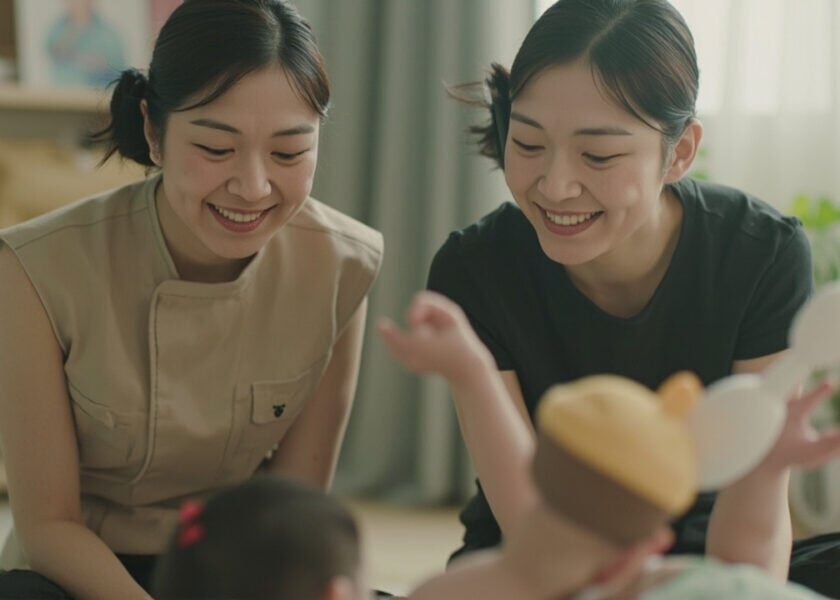
There is a visit where you notice the caregiver before you notice the room. You notice the specific way she kneels down to speak with a child. Not the fact that she kneels, which you have learned to check off, but the particular quality of that kneeling.
Ask yourself as you watch:
- How long does she stay at the child’s level?
- Is she waiting for the child’s response or already moving to the next task?
- When a child hands her a block, does she take it with both hands, the way you might receive something precious? Or does she accept it with one hand while glancing at the next thing?
These are not questions you came with. They are questions that arise from looking. And they matter in a way that ratios and certifications do not—because ratios tell you what is possible; this tells you what is actually happening.
Atmosphere Is Not Abstract
You begin to notice atmosphere as a felt experience. The temperature of a room is not only about climate control—it is about whether children are calm enough to rest comfortably. The noise level is not about preference—it is about whether sounds are responsive or chaotic, whether they include the small sounds children make when they are experimenting with their voices.
The Face Tells the Truth
You begin to notice faces. Not expressions frozen into happiness—which is a performance—but the subtle range of a caregiver’s face as she moves through an hour:
- Frustration that passes through and is replaced by patience
- Interest that lights up when a child discovers something
- The quiet steadiness that says: I am here. You are safe.
This is not instinct, though it may feel like it. This is trained observation. And you are training yourself without realizing it.
The Moment of Knowing
There is a moment when you stop analyzing and start perceiving. It is quiet. One moment you are evaluating, and the next you are simply seeing what is there.
The room is not a checklist anymore. The caregiver is not a credential anymore. The children are not statistics. They are themselves. And what you see is real.
You see a child engaged in something that matters to her. You see a caregiver who responds by joining that engagement—bringing language to what the child is experiencing, widening the circle of attention without narrowing it. You see children present with each other, learning from each other, in an environment that trusts them to be children.
And you know.
This is the knowing that does not require explanation. This is the knowing that will not be shaken by someone asking you to justify it. You have not evaluated this environment. You have perceived it.
Why Trusting Your Perception Is the Hardest Step
Most parents in Singapore are searching for this moment without knowing it. They are not searching for the highest ratio or the newest curriculum. They are searching for the confidence to trust what they themselves are seeing.
The irony is that they already possess this capacity. What they lack is permission to trust it.
The Problem with Expertise
We live in a culture that values expertise. We defer to those who have studied, trained, certified—the people who can tell us what is right because they have earned the right to tell us.
And there is wisdom in this. When it comes to our children’s health, we want doctors. When it comes to their safety, we want systems that have been tested.
But when you walk into a room and watch a caregiver with a child, you are not watching someone perform for a checklist. You are watching a relationship. And you know what good relationships look like, because you have been in them. You know what responsive care feels like, because you have felt it. You know what safety looks like in a face, because you have seen it.
What Trained Observation Actually Is
The trained observation you are developing is not about learning new skills. It is about learning to trust skills you already have:
- Understanding that the discomfort you felt in one environment was not anxiety—it was your perception telling you something your mind had not yet articulated
- Recognizing that the ease you felt in another environment was not naivety or desperation—it was your deeper knowing asserting itself
The childcare search, if you allow it, is the training ground. And the gift it gives is not the decision itself—it is the capacity to make decisions you will not second-guess.
What Quality Actually Looks Like in Infant Care
Before you can trust your observation, you need to know what you are looking for. Here is what genuine quality in infant care actually looks like—not as a checklist, but as a framework for perception.
In Caregiver-Child Interaction
- Responsiveness over redirection: A caregiver who joins what a child is doing rather than constantly steering them toward something else
- Physical presence: Kneeling to a child’s level, staying there, waiting for the child to process and respond
- Language expansion: Bringing words to a child’s experience—”You found the yellow one. That’s a sunflower.”
- Accepting what a child offers: Receiving a toy or object with both hands, as if it matters
In the Emotional Environment
- Children who are calm but not silenced: A room where children can make noise, experiment with their voices, and be heard
- Regulated adults: Caregivers who model emotional steadiness and recovery from frustration
- Warmth that is genuine: Faces that show the full range of human response—patience, interest, quiet presence—not performance smiles
- Children engaged with each other: Not isolated in separate activities, but aware of one another, learning alongside each other
In the Physical Space
- Child-height access: Shelves and materials at a level where children can reach what interests them
- Natural light and smell: Spaces that smell like children, not industrial disinfectant
- Appropriate temperature: Children who can rest comfortably without being too cold or too warm
EduNanny: Built Around the Parent Who Sees
This is what makes EduNanny different. Not because we have discovered something no one else knows, but because we have built our entire approach around the understanding that trained observation leads to decisions parents never second-guess.
EduNanny by BUTLER was founded on a simple premise: that parents can be trained to observe, and that when they observe well, they choose well. We do not offer you a decision. We offer you the capacity to make a decision you will trust.
How Our Caregivers Are Different
Our caregivers are trained not only in the technical aspects of infant care—though those matter—but in the subtler dimensions that checklists cannot capture:
- The quality of presence: Knowing how to be fully attentive without being intrusive
- The art of response: Joining a child’s experience rather than directing it
- Environment creation: Spaces where children can be fully themselves, where curiosity is not managed but released, where emotions are not suppressed but accompanied
The ECDA Childminding Pilot: Why the Structure Matters
We are part of the ECDA Childminding Pilot because we believe infant care should be relationship-centred, observation-based, and grounded in trusting the parent as a partner rather than a problem to be managed.
Why ratios matter: One caregiver for every three infants is the ratio that allows for genuine attention. It is the ratio that allows a caregiver to know each child as an individual, to notice the small changes that signal hunger or fatigue, to respond with specificity rather than generality.
Why rhythm matters: Children thrive on predictability—on routines that do not shift according to adult convenience. Our Monday to Friday care blocks give children the stability they need to explore and grow.
Why affordability matters: Quality care should not be the privilege of those who can afford premium pricing. CDA and Baby Bonus usability make this possible, and we help families navigate these mechanisms because we believe in them.
What You Will Notice When You Visit
When you visit an EduNanny home, you will notice how your child responds to the space—not performatively, not after being prompted, but genuinely. You will notice the caregiver’s face and how it changes through interactions. You will notice the atmosphere, which will feel different from other places—because it is created for children, and you will see that.
Addressing What Singapore Parents Actually Worry About
“What happens when I’m not in the room?”
We know that trust is built on transparency. Parents carry a deep fear of not knowing what happens when they are not present. This fear is legitimate.
We address this fear not by dismissing it but by meeting it. Our communication protocols exist not as surveillance but as partnership. When you receive updates from your EduNanny caregiver, you are not receiving data. You are receiving information that confirms what you already know how to see. You read the update and think: yes, that is what I would have noticed if I had been there. And you trust it, not because it is documented, but because you recognize the quality of attention it represents.
“How do I know if my child is actually safe?”
Safety is not a feeling. It is a quality of relationship. Watch for this: Does your child reach for the caregiver? Do they seek proximity? When they are upset, do they move toward the caregiver rather than away? These are signs of genuine attachment—not compliance, not performance, but the real thing.
“What if I make the wrong choice?”
The parent who has learned to observe does not stop observing when the decision is made. You have developed a capacity that serves you not only in evaluating childcare but in every interaction with your child across the years ahead.
You learn to see the meaning in your infant’s cry—not the generic cry of discomfort but the specific cry of frustration versus fatigue versus hunger. You learn to see the moment your toddler is about to hit not as bad behaviour but as a communication of something they do not yet have words for. Observation is a parent skill. And the childcare search, if you allow it, is its training ground.
Using Your Observation Skills During Visits
- Arrive with your senses open. What do you smell? What do you hear? What is the temperature?
- Watch the caregiver before you speak to her. How does she move through the room? How does she respond to children who are not hers?
- Notice children’s faces, not just their activities. Are they absorbed? At ease? Anxious?
- Sit with your discomfort. If something feels wrong, do not dismiss it as anxiety—let it be information.
- Sit with your ease. If something feels right, do not dismiss it as desperation—let it be perception.
Begin Your Observation
We have watched many parents move through the searching process. We have seen the confusion at the beginning, the growing awareness in the middle, and the quiet knowing at the end.
The parents who arrive at that knowing are never the same.
- They are more confident—not because they have found perfect childcare, but because they have found the confidence to recognize good enough when they see it. They notice. And when something changes, they see it early.
- They are more present. Observation is a practice of presence. The skills they develop do not disappear when they leave the childcare environment. They take them home. They become parents who truly see their children.
- They are more trusting—not in the sense of having faith that everything will work out, but in the sense of believing that their perception matters. That what they notice is real. That they can act on what they see without waiting for someone else to confirm it.
The First Thousand Days
We understand that an infant does not need to be educated. They need to be seen. We understand that a caregiver is not a service provider performing a task. She is a person forming a bond that will shape how this child understands safety, trust, and connection for the rest of their life.
The first thousand days matter. It is not a platitude. It is a neurological fact. The brain is being built. The nervous system is being calibrated. The capacity for relationship is being established. What happens in these days matters in ways that cannot be reversed.
We are not in the business of childcare. We are in the business of early relationship. And we understand that the parent is the primary relationship in any child’s life.
What Would Change If You Trusted What You Notice?
Not what you think, which is often anxious and second-guessing. Not what you feel, which can be overwhelmed and uncertain. What you notice. The specific, concrete, sensory observations your eyes and ears and body are making right now, in any childcare environment you enter.
If you trusted those observations, would you know what to choose?
We believe you would.
We believe that the moment you allow yourself to trust them, you will look back on this searching process and see it not as a stressful ordeal but as a kind of awakening. The moment you stopped checking boxes and started seeing clearly. The moment you realized that the parent you were becoming was not someone who needed to be told what quality looks like—but someone who already knew, and who had finally learned to trust themselves enough to act on it.
The gift of this work is not the service itself, though the service is built with care. Not the training, though the training is rigorous. The gift is the permission to see.
You were never lacking the capacity to make this decision. You were only lacking the permission to trust that capacity.
You have that permission now.
And once you see what you are looking for, you will not unsee it. You will see it in every room you enter. You will see it in every caregiver you meet. You will see it in your own child, who has been showing you who they are since the moment they were born—waiting for you to notice.
The searching ends. The seeing begins.
Welcome to EduNanny.
At EduNanny, we believe quality childcare begins with trust—for parents and children alike. Learn more about our approach or get in touch to begin your observation.