Holding Two Loves at Once: The Honest Guide to Returning to Work
The Morning You Will Not Forget
There is a morning you will not forget. You stand at the door of your home, or at the threshold of the childcare space, and your child looks up at you with a face that does not yet know what leaving means. You kneel down. You kiss the top of their head. You say the words you have practiced all week, the ones that are supposed to sound calm, and you walk out.
And the distance between the door you just closed and the MRT platform you are walking toward feels like the longest walk of your adult life.
No one tells you how much that morning will reorganize you.
We talk a great deal in Singapore about returning to work after maternity or parental leave. We talk about logistics, about back-to-work checklists, about finding the right care arrangement, about managing the guilt that surfaces when your child reaches for someone else in the afternoon and you are sitting in a meeting room across the city.
But beneath all of that conversation is something quieter and more significant. Not the checklist. Not the guilt. The threshold.
Because that is what this is. This is a threshold. And it will teach you more about your child, about yourself, and about what quality childcare actually means than almost any other decision you will make.
Who You Were Before, and Who You Are Becoming
Here is what no one says plainly enough: when you return to work after your maternity or parental leave, you are not simply going back to a job. You are crossing a boundary between one version of yourself and another.
Before leave, you were becoming a parent. Now, on this side of the threshold, you are a parent who works. These are not the same thing. The first is a passage. The second is a life. And navigating that passage well requires more than logistics. It requires honesty about what you are feeling, and it requires the right kind of support holding the space for your child while you learn to hold two loves at once.
We know this because we have sat with parents in Singapore in those first weeks of return. We have heard the same things repeated across living rooms and kitchen tables and quiet phone calls, always in the same hesitant voice, as if the parent is not sure they are allowed to say it.
They say: I did not expect to feel this much.
They say: I thought I would be relieved to be back at work, and I am, but I also feel like I am grieving something.
They say: I keep wondering if my child understands, and then I feel foolish for wondering that, and then I wonder some more.
What Your Child Is Doing in Those First Weeks
When you return to work, your child enters a new relationship with the world. Up until now, their primary understanding of safety has been you. Your face, your voice, the particular rhythm of how you hold them. And now, someone else holds them.
And your child is doing something extraordinary in those first weeks—something that deserves to be recognised with the full weight of its importance. They are generalising trust. They are learning that safety can exist beyond one person, that the world can hold them well.
That is not a small thing. That is the beginning of a whole way of being in the world.
You cannot see this from your desk or your meeting room or the seat on the MRT where you are reading this right now. But your child is building something foundational in those hours apart from you—and the caregiver who sits with them during that building matters enormously.
The Grief You Are Allowed to Feel
And here is what you also cannot see, because you are in the middle of it: you are tending to the parent you are becoming while honouring the parent you were. You are refusing to collapse your whole identity into the care of one small person, not because you love that person less, but because you love them with more.
You are showing your child, in the only way you currently can, that a parent is a whole human being with purpose and presence and a life that extends beyond the nursery walls.
That is not abandonment. That is a form of love so honest it is almost terrifying.
And yet, in the middle of that honest and terrifying love, there is grief. We want to name it clearly, because unnamed grief does not disappear. It just finds other places to live.
The return to work after parental leave is a genuine loss. It is the loss of the intimacy of those first months, the loss of being the sole witness to your child’s small developments, the loss of a rhythm that, however exhausting, had become deeply familiar.
It is also, at the same time, a genuine hope. It is the hope of returning to work that you may genuinely love, or need, or both. It is the hope of a self that exists in the world beyond your child. It is the hope that you can be whole and still be a good parent.
These two things—grief and hope—are not contradictions. They are simply both true, and they are both yours, and you do not have to resolve them before you walk through the door.
What Quality Childcare Actually Looks Like
What you do need, and what this article is really about, is a childcare arrangement that understands all of this. Not one that tells you to stop feeling what you are feeling. Not one that frames itself as a convenience while you get on with things. But one that understands, with real clarity, what this threshold moment demands.
Because here is the truth about quality childcare that most content in Singapore only gestures toward without fully landing: quality childcare does not simply look after your child while you work. It holds the transition. It becomes part of the emotional architecture of your family during the most sensitive reorganisation you will go through as a parent.
The caregiver is not a replacement for your presence. They are an extension of the conditions that allow your child to thrive while you tend to the other important work of your life.
Here is what that means in practical terms:
- Consistent, familiar faces. A child learning to generalise trust needs stability. When the caregiver relationship is consistent, your child can build the security that makes curiosity possible.
- Small ratios that allow for real attention. In the first weeks of care, your child is learning something delicate. They need an environment where they are not one among many, but one of very few—where the caregiver has the bandwidth to notice the small things that matter.
- Communication that keeps you connected. You deserve to leave in the morning feeling informed and confident, not anxious. You deserve to hear about your child’s day in a way that makes you feel close to them even though you were apart.
- Transparency you can trust. Where monitoring measures are in place, they should function as quiet assurance—not surveillance, but openness that lets you trust what you cannot see.
- Routine that your child can count on. Consistent schedules matter more than we often acknowledge. They are one of the ways children know the world is safe.
The Evening Reveal
You walked out the door that morning, and your child waved, or cried, or did not quite register what was happening yet because they are still too young to understand the grammar of departure. And you walked toward your own work with a strange mixture of grief and relief and determination and doubt, and you sat at your desk and you tried to focus and you could not stop thinking about whether the caregiver would notice the way your child likes to be held on their left side, the one where they can hear your heartbeat.
Let us tell you what quality care makes possible.
In those first weeks, a child in quality care begins to generalise. The caregiver’s voice becomes a second safe harbour. The new environment becomes a place where curiosity is possible, because safety has been established.
And your child begins to show you, in the evenings, in the way they come to you more settled, more curious, more themselves—that they have been held well.
That is the evening reveal. That is the thing that tells you the choice you made was right. Not because your child stopped needing you—they have never needed you more—but because they have discovered that the world has more to offer them than you alone could provide. And that is not a failure of your early months together. That is the gift of them.
EduNanny Singapore: Built Around This Understanding
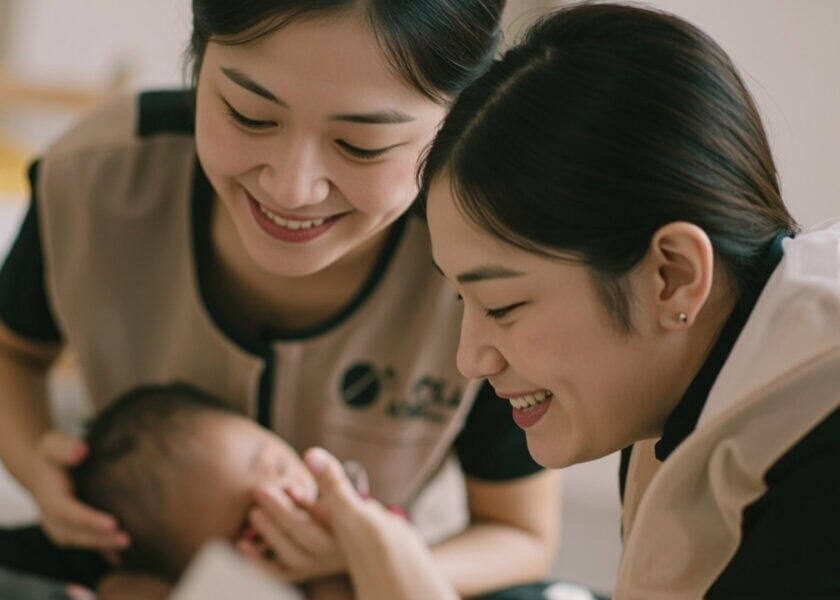
That is what EduNanny Singapore is built to be. Not a convenience. Not a placeholder. A partner in this threshold.
We know, because we have built EduNanny Singapore around this understanding, that the caregiver relationship is not a background feature. It is the relationship your child will model their understanding of trust on. It is the relationship you will lean on every single morning when you hand your child over and walk away. It is the relationship that will either ease the ache in your chest or sharpen it.
The ECDA Childminding Pilot
EduNanny Singapore is part of the ECDA Childminding Pilot, and we say that not as a credential alone, but as a commitment. The pilot gives us a framework that keeps your child’s safety and development at the centre of everything we do—a framework built on standards that have been thoughtfully designed, not hastily assembled.
It means our home-based and community-based pathways operate within a structure that prioritises your child’s wellbeing over everything else.
Small Ratios That Matter
When we talk about ratios of up to one to three infants in our care, we are talking about something that matters enormously to the quality of attention your child receives, and we take that ratio seriously because we know what is at stake.
Practically, that means when your child is in our care, they are not one among many. They are one of very few. And that is not a marketing statement. That is a structural commitment to the kind of attention that makes a difference in the first thousand days of a child’s life, when the architecture of their brain and their capacity for trust and curiosity and security is being laid down faster than it ever will again.
Making Quality Care Accessible
We also know that for Singapore families, affordability is not an abstraction. It is a real pressure, and a real concern, and pretending otherwise does a disservice to parents who are already carrying so much.
Within the pilot fee structures, EduNanny is designed to be accessible to families who need quality care without adding untenable financial strain. We make it easier to plan around by working with the Child Development Account and Baby Bonus arrangements, so that the practical side of this decision does not add to the emotional weight you are already carrying.
Communication as Philosophy
Here is the thing that we believe most deeply, and that shapes everything we do at EduNanny Singapore: the caregiver who holds your child through this threshold is not just a service provider. They are a partner in the most important work of your family.
So communication is not a feature we added to a checklist. It is a philosophy. When you drop your child off in the morning, you deserve to leave feeling informed and confident, not anxious. When you pick them up in the evening, you deserve to hear about their day in a way that makes you feel close to them even though you were apart.
Where CCTV measures are deployed, they are deployed not as surveillance but as transparency—a quiet assurance that the space where your child spends their day is open to your trust.
Your Questions, Answered Honestly
Will my child feel abandoned?
Your child is building the capacity to generalise trust—a developmental milestone that will serve them throughout their life. What they need is not your perpetual physical presence, but your emotional availability when you are together, and a caregiver who can hold them well in the hours apart. Quality care supports this transition rather than disrupting it.
How do I know the caregiver will notice my child’s needs?
Small ratios make attentiveness possible. When a caregiver is responsible for one, two, or three infants rather than a larger group, they have the capacity to learn your child’s rhythms, preferences, and signals. The left-side hold. The way they like to be sung to. The small things that make them feel safe.
What if I still feel guilty after making this choice?
Guilt is not a sign that you have made the wrong choice. It is a sign that you care deeply. The goal is not to eliminate guilt but to build a care arrangement that earns your trust—so that even when the feelings arise, you can return to a quiet knowing that your child is in good hands. That is what makes the threshold bearable.
How do I evaluate whether a care arrangement is truly quality?
Ask about ratios. Ask about caregiver consistency. Ask how they communicate with parents. Ask what happens in the first days and weeks of transition. Ask what you should expect to see in the evenings. Quality care providers will not just answer these questions—they will anticipate them, because they understand what is at stake.
Walking Through the Door Together
You are not failing your child by returning to work. You are not choosing yourself over them. You are walking through a door with them, even though you are walking in different directions.
And on the other side of that door, in the hours you are apart, there is a space—a warm, attentive, thoughtfully designed space—where your child is being seen for exactly who they are. Where the caregiver notices the left-side hold. Where the ratios allow for real attention. Where your child’s thousand days are being tended to with the seriousness they deserve.
Your child is learning something important, and so are you. You are learning that proximity is not the same as presence. That your child does not need you to be with them every waking moment in order to know that you love them.
The parent they are building their sense of self around is not the parent who is physically beside them every second, but the parent who models, with their own life, what it means to be a whole person—a person who works, who thinks, who grows, who comes home at the end of the day with stories and weariness and a love that is not diminished by distance but deepened by it.
There is a version of this experience that breaks a family apart—where the return to work becomes a source of guilt that curdles into resentment, where the childcare choice becomes a source of anxiety that undermines the very trust the child needs to generalise.
And there is a version of this experience that becomes one of the most profound acts of intentional parenting you will ever do.
The difference is not whether you feel the weight of the threshold. The difference is whether the people holding your child alongside you understand the weight of what they are holding.
You came back to work, and in coming back, you brought something with you that your child will one day recognise. Not the absence of a parent, but the presence of a whole one. A parent who chose love in the form of honesty, and growth, and the courage to walk through the door twice—once away from your child in the morning, and once back toward them in the evening, carrying everything you are becoming, ready to be met fully.
That is what this threshold teaches. That is what quality childcare makes possible. And that is what EduNanny Singapore is here to hold.
Ready to Explore Your Options?
If you are in Singapore and looking for infant care or childminding that understands what this transition demands, we invite you to start a conversation with us. We are here to answer your questions honestly, walk you through our approach, and help you think through what quality care could look like for your family at this particular threshold.
The door you are walking through is significant. You do not have to walk through it alone.
Connect with EduNanny Singapore today