What Quality Childcare Builds in Your Child Before Primary One
What School Readiness Actually Means
Let me be direct about what your child will actually need when the school gates open — not the version of this conversation that focuses on worksheets and academic acceleration, but the real one.
Consider for a moment what your child is navigating in the years between toddlerhood and the start of formal schooling. By three, most children have moved beyond the immediate orbit of the family. Their world is beginning to expand. There are other children in it — children who want the same toys, who have different ideas about how a game should go, who do not always share, who do not always listen.
Learning to exist in a world alongside other people who have their own needs and feelings is one of the most demanding cognitive and emotional tasks a young child faces. It does not happen automatically. It is learned. It is practiced. It is taught, sometimes explicitly, sometimes through the gentle guidance of someone who understands what a four-year-old can handle and what they need to stretch toward next.
When you imagine your child on their first day of Primary One, what do you see? They walk into a room full of strangers. The teacher is new. The expectations are unfamiliar. Everything is structured differently from what they have known.
The children who thrive in that moment are rarely the ones who could read earlier or count higher. They are the ones who have learned, in the years before, that other people’s feelings matter. That problems between people can be solved with words. That difficult moments can be survived. That the world is, on balance, an interesting place to be.
That is the school readiness you are working toward. It was never really about reading or numbers. It was about building a child who could walk into a new world and belong there.
The Early Years: What Actually Gets Built
Here is something that gets lost too often in conversations about childcare. When we talk about the early years, we are not talking about a period of waiting. We are not talking about a few years to fill until school gets serious.
We are talking about the period in which the most fundamental aspects of a human being are being constructed.
- The neural pathways that govern stress response
- The relational templates that shape how a person will approach connection throughout their life
- The habits of curiosity, or resilience, or fragility that will travel with your child into every classroom, every friendship, every challenge they ever face
These are not soft outcomes. These are the hard, measurable foundations of everything that comes after.
The remarkable thing — the thing that I want you to hold onto — is that these foundations do not build themselves. They are built. Deliberately, intentionally, by people who understand child development and who bring both knowledge and genuine care to the daily work of being with your child.
Social Confidence and Emotional Literacy: The Foundations Inside
Two things develop in quality care that matter more than any academic head start. The first is social confidence.
A child who has spent three years in an environment where peers are present, where play is facilitated, where conflict is managed with skill and patience — that child has learned something extraordinary. They have learned that other people are real. That their feelings matter. That problems between people can be solved with words, with negotiation, with the help of a calm adult who does not rescue but guides.
They have learned how to enter a group. How to share space. How to manage the inevitable disappointments of a world that does not always give them what they want, exactly when they want it.
Alongside social confidence, something equally important is taking root: emotional literacy. This is the capacity to know what you are feeling, to name it, and eventually to manage it.
Here is what is so often misunderstood about emotional regulation in young children. It is not about suppressing feelings. It is about building the internal architecture that allows a child to feel something big and not be destroyed by it.
- To feel disappointment and still move forward
- To feel frustration and find a way to express it that does not harm themselves or others
- To feel fear and tell someone
- To feel joy and share it
In the early years, this architecture is built almost entirely through relationships. Through the moments when a caregiver sits with a crying child and says, not “stop crying,” but “I can see you are really upset. Can you tell me what happened?” Through the moments when a child’s anger is met not with anger in return but with steady, calm presence that says, “I am not afraid of your big feelings. We can handle this together.”
Research bears this out. The early capacities that predict school success and long-term wellbeing are not linguistic or cognitive in nature. They are social and emotional. A child who can manage frustration, communicate needs, resolve conflict, and recover from setback will not merely survive Primary One. They will thrive in it.
What Quality Childminding Actually Looks Like
So what does this look like in practice? When we talk about quality care, we are describing something specific. It is not supervision. It is not entertainment. It is not a holding pattern until school begins.
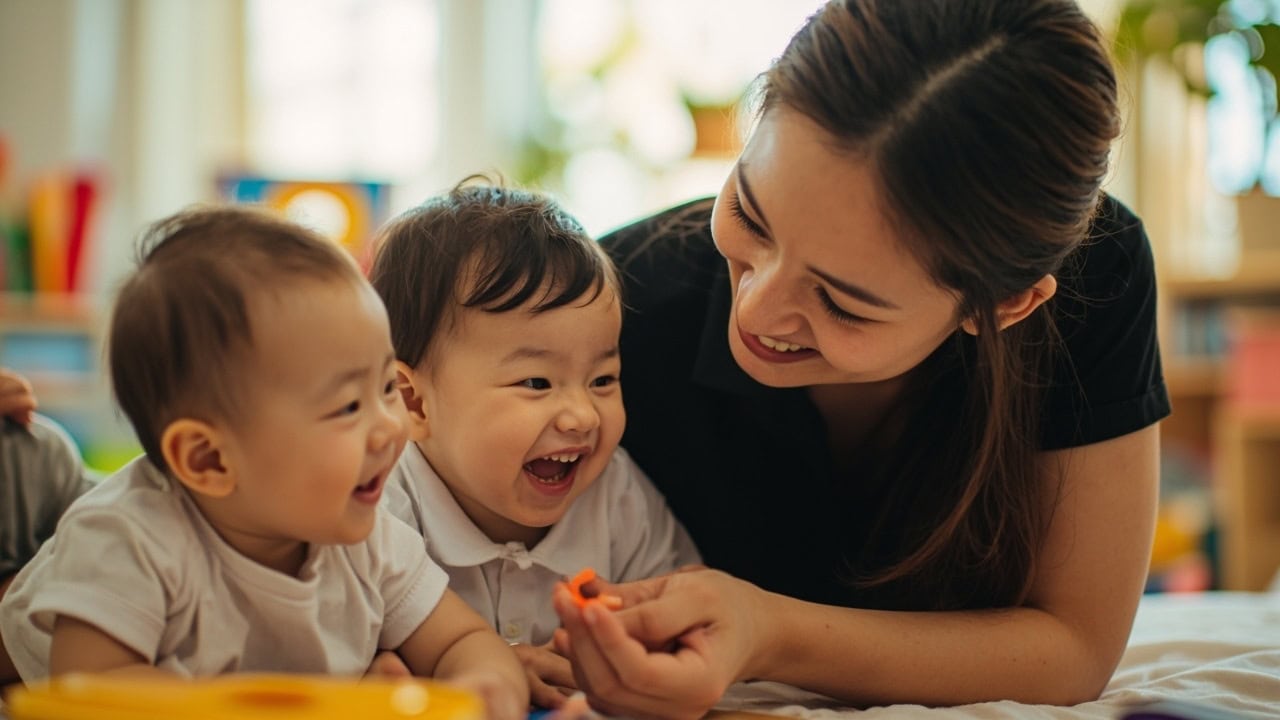
It is attunement — a word that captures something essential. Attunement is the quality of being genuinely present with a child, of noticing what they are feeling before they can name it, of responding in a way that validates their experience and helps them understand themselves better.
This requires certain conditions to exist:
- Small ratios. A caregiver who can actually see and know each child cannot do so in a group of twenty. When ratios are kept small, your child is not a name on a register. They are a person whose rhythms, preferences, emerging personality, and developmental trajectory are understood deeply.
- Trained caregivers. Responding to a toddler’s tantrum with genuine attunement is a skill. It can be learned. It can be practiced. And it makes a measurable difference in how a child’s emotional architecture develops.
- Consistent presence. Children build security through predictability. Knowing that Monday through Friday, in the hours that matter most, your child is in a place that is safe, warm, and designed for them — that reliability is itself a foundation for emotional security.
- Transparent communication. You should know what is happening in your child’s day. Not just what they ate and when they slept, but what they seemed curious about. What they struggled with. What made them laugh. What new skill they practiced.
How EduNanny by BUTLER Serves This Arc
EduNanny by BUTLER operates within the ECDA Childminding Pilot, and understanding what that means matters. The Childminding Pilot was established with a clear understanding of what young children need, and the model reflects that understanding at every level.
When we talk about ratios — up to one to three infants — that number exists because of what science and experience tell us about how much individualized attention a young child requires in order to feel secure, to be known, to have their development tracked and nurtured in a way that a larger group setting simply cannot provide.
With that ratio, when your child is frustrated, someone notices. When a developmental leap is happening, it is seen and built upon. When something is wrong, it is noticed quickly, because the person in the room has the space and the training to pay attention.
Caregivers in the EduNanny model are trained in the principles of early childhood development, in responsive caregiving, in the kind of attunement that tells a child — through a thousand small interactions — that they matter. That their feelings are real and valid. That someone in this world is paying close attention to who they are becoming.
For many families in Singapore, cost is a genuine and legitimate concern. The Childminding Pilot addresses this directly. EduNanny’s structure is designed to be accessible, and families can draw on CDA and Baby Bonus funds to support their child’s care. These are practical provisions that reflect an understanding that quality childcare should not be accessible only to the wealthy. Every child deserves an environment that is built for their development.
Choosing With Your Eyes Open
Choosing quality care is not a guarantee that every day will be easy. Your child will still have hard mornings. They will still cry sometimes at drop-off. They will still go through phases of difficulty, of regression, of emotional turbulence that feels discouraging.
What quality care offers is not perfection. It offers a partnership — someone who observes, who tracks, who communicates, who flags concerns and celebrates milestones. You are not alone in this. You have found people who take the daily work of your child’s development seriously.
When you visit a potential caregiver or childminding service, here is what to pay attention to:
- Does the caregiver seem genuinely interested in your child as a person?
- Can they describe your child’s temperament, interests, and current challenges with specificity?
- How do they talk about difficult moments — discipline, conflict, distress?
- What does a typical day look like? Is there space for child-led play, or is every moment structured?
- How will you know what is happening during the day? What does communication look like?
- What training do the caregivers have, and how does it show up in their practice?
The Morning at the School Gate
There will come a morning when you bring your child to the school gate. Primary One. Everything is new. The uniform is stiff and the bag is heavy and the corridors are wide and full of faces you have never seen.
Your child looks up at you, and there is a flicker of something in their eyes. Not fear, exactly. Something more like readiness.
And then they let go of your hand and they walk in.
Something in the way they carry themselves — the confidence in their posture, the openness in their face, the quiet steadiness they have carried with them from years of being loved and guided and challenged in the right ways — tells you everything you need to know.
They are ready.
Not because they could read before their peers. Not because they had a head start in mathematics. But because they are a human being who has been tended to with care and skill, and who has therefore become a human being who can face the world with curiosity and resilience and the deep, quiet knowledge that they are capable.
That is what you are building. That is what these years are for.
The choice you are making right now — to think carefully, to ask hard questions, to look beyond the surface of what childcare appears to offer and to seek out the quality that actually matters — that choice is already an act of love. It is an act of faith in your child’s future.
And it is one of the most consequential decisions you will make as a parent, because these years do not come back. The window is now.
If you are exploring childminding options for your child in Singapore, EduNanny by BUTLER invites you to connect with the team to learn more about how their model is designed around the developmental arc that matters most — the one that begins now and reveals itself fully when your child walks through the school gate.
Learn more about who EduNanny is and the standards behind their approach.