How Singapore Parents Raise Siblings Who Become Partners
The Quiet Hope Every Singapore Parent Carries (But Rarely Speaks About)
There’s a particular kind of silence that falls over a living room at the end of a long day — when two children have finally fallen asleep. It’s not the silence of exhaustion, though you are exhausted. It’s the silence of watching from the doorway: two small bodies arranged somewhere between tangled and apart, breathing in the rhythm of siblings at rest.
In that silence, if you let yourself, you think about twenty years from now. You wonder whether they’ll still be close. Whether the arguments about borrowed toys and said-it-first and who-gets-the-bigger-piece will become the stories they tell at weddings. Whether the person your child calls at two in the morning with a crisis won’t be a friend, but a sister. A brother. The one who grew up in the same house. The one who remembers.
That quiet hope — that your children will grow up as partners, not just people who happen to share a surname and a bathroom — is one of the most universal and least discussed hopes that Singapore parents carry.
We talk endlessly about school choices, about enrichment classes, about whether they’re hitting their developmental milestones on time. We talk about raising independent children and confident children and children who are ready for a world we can barely imagine. But underneath all of that, there is a tender aspiration we don’t always voice because it feels too precious to put into words: the hope that your children will genuinely like each other. That they will choose each other. That the sibling bond will be something they carry forward not as an obligation, but as a gift.
And yet — there is an unspoken fear that lives alongside that hope. A fear that is equally universal and equally unvoiced.
It’s the fear that the very things we do to care for our children might, inadvertently, pull them apart rather than bring them together.
The Hidden Anxiety Behind Singapore’s Rushed Family Life
If you are raising children in Singapore today, you are navigating something genuinely complex. You are likely a dual-income household — not because you don’t value family time, but because the mathematics of raising a family in this city requires two incomes. You are navigating small family structures, often with grandparents nearby but not always available or able. You are balancing school runs, work deadlines, extracurricular schedules, and the bone-deep desire to be present for the moments that matter.
And if you have more than one child, you are also navigating the sibling relationship itself. The way two children can love each other with a ferocity that breaks your heart and wound each other with a precision that also breaks your heart. The way they oscillate between devotion and destruction in the span of an afternoon.
You find yourself, sometimes, lying awake at night wondering: Are the dynamics I’m seeing — the competition for attention, the need to be first, the way one child’s meltdown triggers the other — simply the natural texture of siblinghood? Or are they signs of something that, left unchecked, might calcify into something harder to repair?
The Anxiety Is Real — But It’s Often Misdirected
Here is what years of observing families reveals: the anxiety underneath siblinghood in Singapore is real, and it is justified. But in most cases, it is also misdirected.
Parents worry that divided attention is eroding their children’s bond. They worry that the logistics of childcare — the different pickup times, the different nap schedules, the different caregiver relationships — are creating distance between siblings rather than closeness. They worry that the pace of modern family life, the structured days, the screen time, the adult-managed activities, are replacing something essential: the organic, unscripted hours where siblings used to learn each other, negotiate with each other, discover that they were, despite everything, in this together.
This fear is understandable. What needs to be understood is that it is also, in important ways, misdirected — because the real issue isn’t whether siblings have enough unstructured time together. It’s what happens when conflict arises in that unstructured time.
What Quality Childcare Actually Does for Sibling Bonds
Let’s start with an honest look at unstructured sibling time. When children are left to their own devices at home, they do learn from each other. They develop shared languages and private jokes and alliances that can feel sacred. But they also learn rivalry. They learn that there is a finite supply of parental attention, and that getting there first matters. They learn how to push each other’s buttons with surgical precision, because they know exactly where those buttons are.
What children learn from unstructured sibling time depends almost entirely on what happens when conflict arises. In most home environments, one of three things happens:
- One child wins and one loses — creating resentment that accumulates over time
- Parents intervene and adjudicate — which teaches children to involve adults rather than resolve things themselves
- The conflict simmers unresolved until it explodes — which teaches children that feelings are dangerous and unmanageable
None of these outcomes builds the kind of sibling partnership that parents hope for.
Now consider what happens in a quality childcare environment — one that is designed with intention, staffed by trained caregivers, and understands its role in the whole child, not just the child in isolation.
Guided Peer Interaction and Conflict Resolution
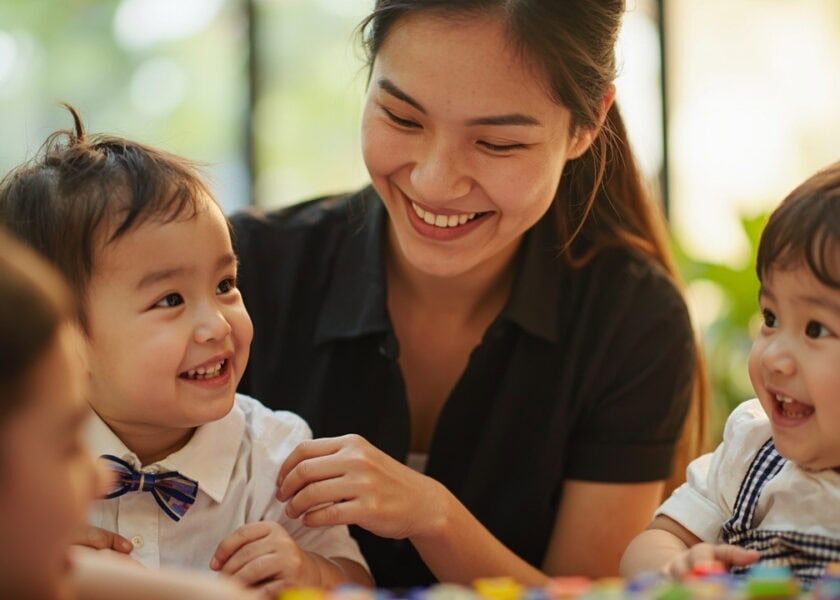
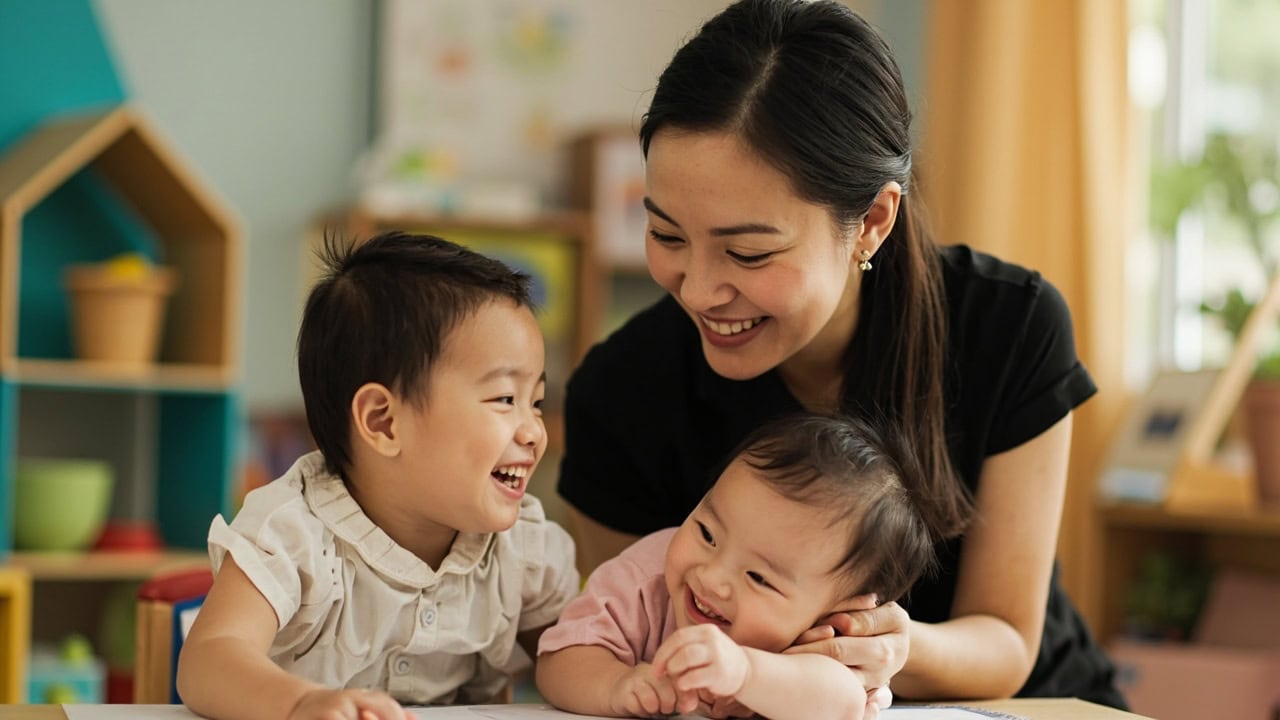
In a well-designed care setting, children are not simply present alongside each other. They are guided into interaction that builds skills. Play is facilitated, not just supervised. Activities are structured to create natural collaboration, turn-taking, and the social negotiation that builds real friendship.
Conflict is not ignored or punished. It is an opportunity. Trained caregivers step in not to adjudicate who was right and who was wrong, but to guide children through the process of resolving disagreement themselves. Children learn that conflict is normal, that feelings are valid, and that resolution is possible. They learn these lessons repeatedly, in real time, with support.
Co-Regulation: The Most Powerful Outcome of Quality Group Care
Co-regulation is one of the most powerful and least understood outcomes of quality group care. It is what happens when one child helps another child regulate their emotional state — not because an adult told them to, but because they have learned, through repetition and modeling, that this is what partners do.
A toddler in a well-designed care environment learns to notice when another child is distressed. They learn to offer comfort — a pat on the back, a toy, a presence. They learn that their own calm can influence someone else’s calm. This is not a skill that is taught through instruction. It is a skill that is caught through thousands of small, guided interactions over months and years.
And when siblings are part of that environment together, they become fluent in each other’s emotional languages in a way that simply does not happen at home.
The Sibling Partnership Incubator: Connection Across Rooms
Here is something that may surprise you: some of the most powerful sibling bonding does not happen when siblings are together. It happens when siblings are apart but connected by the same trusted adults.
When an infant in one room and a toddler in another room are both cared for by caregivers who understand their individual developmental needs and their relational needs as siblings, something remarkable occurs. The caregivers become bridges.
They carry stories between rooms. They notice when the older child is working on a skill that the younger child will soon encounter, and they set up intentional moments of connection — a shared activity, a visit, a story told about what the other sibling is doing. They do not simply manage two separate children in two separate spaces. They cultivate a sibling relationship across spaces, understanding that the bond between these two children will outlast their time in care.
Modeling of Secure Relationships
Perhaps most importantly, children in quality care observe secure relationships between caregivers and children — every day, in every interaction. They see what it looks like to be genuinely heard, to be comforted when distressed, to be supported in independence. They internalize these patterns, and they bring them into their sibling relationships.
What You’ll Notice Over Time: Signs the Bond Is Growing
What does this look like in practice? If you are a parent placing your children in quality care, there are signals you will notice over time. Not immediately — this work is slow, and sibling bonds deepen gradually, and you will not see transformation overnight. But over weeks and months, you will notice things.
- A shared language of play — a way of communicating with each other that is faster than words, involving glances and gestures and an entire vocabulary of inside references they didn’t have before
- Different kinds of fights — the conflicts, when they come, resolve faster, because they have learned conflict resolution skills in an environment where conflict was not allowed to fester
- Unexpected tenderness — the older child is gentler with the younger than you feared. The younger child looks to the older not with envy, but with genuine admiration
- A different kind of tired — at pickup, the exhaustion is the full, satisfied tired of a day spent in the company of people who know them — not the cranky, screen-desperate tired of a day spent in unresolved conflict
- A reunion that isn’t competitive — they are glad to see you, and they are also, importantly, glad to see each other. The reunion is not a competition for your attention, but a reunion of a small team
How to Choose Infant Care That Supports Sibling Partnership
If you are researching infant care and childminding options in Singapore, here are the questions that matter most when it comes to supporting — rather than undermining — the sibling bond:
- How do caregivers handle conflict between children? Look for answers that involve guidance, not just supervision. Conflict should be an opportunity for learning, not just something to be stopped.
- What is the caregiver-to-child ratio? Meaningful ratios (such as 1:3 for younger infants) allow for the individual attention and co-regulation that builds sibling bonds.
- How do caregivers communicate with parents? Transparency matters. You should have windows into the hours you cannot see — not just a daily summary, but a real sense of what is happening.
- How do you support siblings in different rooms? The best care arrangements understand that siblings are connected even when apart. Ask how caregivers bridge the experiences of siblings in different groups.
- What does a typical day look like? Look for a balance of structured activities and free play. Both matter for sibling development.
- How do you support individual children’s needs while also supporting sibling relationships? The best care doesn’t treat siblings as a unit. It sees each child as an individual while also cultivating their relationship with each other.
EduNanny by BUTLER: Built Around the Bond Singapore Parents Hope For
These are the principles that shape how EduNanny by BUTLER approaches childcare and childminding in Singapore. Not just supervision. Not just safety. Not just developmental enrichment in isolation. Partnership — the understanding that when you place your children in care, you are making a decision that will shape, in some of the most formative hours of their young lives, the relationship they carry with each other into the world.
A Structured Framework for Quality
EduNanny operates under the ECDA Childminding Pilot, which places it within a structured, supported framework designed to raise the quality of home-based and community-based childcare across Singapore. This is not a pilot in the sense of something experimental or untested. It is a pilot in the sense of something being carefully developed and refined — with oversight, with standards, and with the resources to ensure that the care delivered meets the needs of modern Singapore families.
Pathways That Fit Real Family Lives
EduNanny offers two care pathways designed to work with the realities of Singapore family life:
- Home-based care — where a trained caregiver comes to your home and provides care in an environment familiar to your children
- Community-based care — where children are cared for in a setting designed for small groups and intentional interaction
Ratios That Actually Matter
Both pathways maintain ratios that allow for meaningful attention. Up to one caregiver to three infants in the younger infant range — not a bureaucratic number, but a ratio that supports the individual connection and the guided group interaction that sibling partnership requires.
Accessible Without Compromising Quality
EduNanny’s fee structures are designed to be accessible. For many Singapore families, the cost of quality childcare is a genuine concern, and the pilot framework allows pricing that considers this reality without sacrificing the quality of care that makes a difference. CDA and Baby Bonus funds can be used, which means Singapore’s family support system is aligned with the choice you are making.
Transparency You Can Trust
When you entrust your children to care — especially when you are entrusting siblings, and especially when you are entrusting them to people who will shape the bond between them — you need to know what is happening. You need windows, not just walls. CCTV where deployed, regular updates, and the confidence that the hours you cannot see are hours you can still trust.
What Quality Childcare Cannot Do
Quality childcare cannot manufacture a bond that does not exist. It cannot override temperament differences or developmental challenges or family dynamics that extend far beyond the hours of care. It cannot make two children who are fundamentally mismatched in personality into best friends.
What it can do — and this is not a small thing — is create the conditions where the sibling bond has the best possible chance to develop into what it is meant to become. It can provide the environment, the guidance, the modeling, and the structure that allow siblings to discover what they are capable of together.
Everything else — the love that is already there, the shared history that cannot be replicated, the thousand small moments of connection that happen outside of childcare — that is yours. That is what you bring. EduNanny’s role is not to replace that. It is to strengthen it.
The Image You Carry With You
Let me close with a scene you may recognise. Because that is what stays with you.
Imagine — and if you have two children, you may not have to imagine — a moment at the end of a day. A parent arrives to pick up two children from care. The door opens. The children look up. There is a moment — brief, ordinary, unrepeatable — where something passes between the three of them.
The children are tired. They have been busy all day — busy learning, busy playing, busy figuring out who they are and who they are with. They have been busy becoming.
And in that tired, full moment, they reach for each other. Not competing for the parent’s hand, but reaching for each other first. The older one adjusts the younger one’s shoe. The younger one leans into the older one for a moment of rest. They walk out together, slightly apart from the parent, in a conversation that is only for them.
That is what quality care can support. Not a miracle, but a practice. Not an outcome guaranteed, but a possibility cultivated. The sibling bond, shaped in the hours you cannot see, strong enough to carry them through the years you will.
This is the unspoken hope you carry. This is why you make the choices you make. And this is what EduNanny is here to walk alongside you in — not just the children in your care, but the relationship between them. The partnership that begins in childhood and, if we are fortunate, lasts a lifetime.
If you would like to learn more about EduNanny’s approach to quality childminding and how intentional care can support your children’s sibling bond from the earliest months, we welcome you to start a conversation.
Explore EduNanny’s childminding pathways and discover what thoughtful, standards-driven care can make possible for the sibling bond you are cultivating.