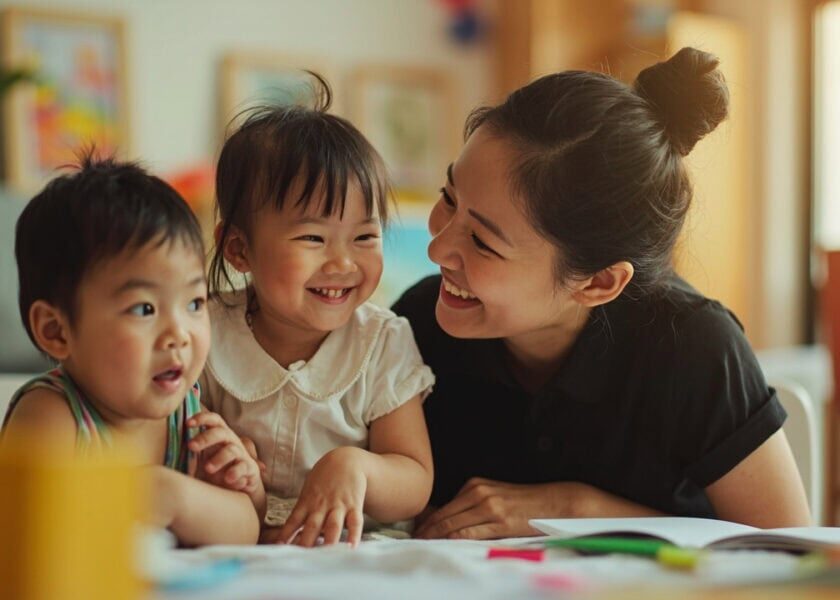
What Singapore Children Sense in a Childcare Centre
The First Assessment: What Your Child Notices That You Might Miss
Close your eyes for a moment. Picture your child walking through a door — not into a polished tour environment, but into a space where care happens every single day, with all the beautiful mess and warmth that real life contains.
What does she notice first?
It has almost nothing to do with the welcome you receive as a parent. It has everything to do with sound. With the temperature of the air. With whether the ground beneath her feet feels steady or strange. With whether the sounds she hears are familiar rhythms or sharp, unfamiliar noise.
She is, in that moment, conducting an assessment with senses that are sharper than yours. More honest. Less filtered through years of adult politeness and social interpretation. She is asking a single question, over and over, with every breath:
Is this place safe?
This is the question that matters most to your child. And it is the question that most childcare evaluation frameworks fail to address.
The Physical Environment as Your Child’s First Educator
When we talk about finding quality childcare in Singapore, we spend a lot of time asking whether a centre is licensed, whether teachers are certified, whether the curriculum meets standards. These are valid questions. But we rarely ask the question that matters most to the child herself: Does this environment feel like a place where I can stop holding my guard up?
The answer begins before any human being speaks a word.
Sound: The Architecture of Comfort
The first thing your child registers is sound. In a thoughtfully designed environment, the acoustics are considered — not by accident, but by design. Voices are warm without being harsh. There is chatter, yes, the lovely disorder of children learning language, but it does not echo. It absorbs.
Soft furnishings, thoughtful spatial design, rugs and cushions — these are not decorations. They are acoustic architecture. They tell a child’s nervous system: this is a place where loud does not mean danger.
When you visit a childcare space, pay attention to how it sounds. Does noise bounce off walls and tile floors? Or does it feel contained, warm — the way a well-loved home sounds?
Smell: The Language the Nose Knows
A well-maintained childcare environment smells like life — like the gentle, clean scent of a thoughtfully cared-for home, like food being prepared, like the faint, reassuring smell of fabric softener on clean clothes. It does not smell of antiseptic. It does not smell of nothing. It smells human.
That humanity is not accidental. It is a choice, maintained daily, because the developing brain is exquisitely sensitive to olfactory cues. The child who feels safe in a space — who is not fighting her nervous system — is the child who can learn.
Light: Biology, Not Aesthetics
Natural light transforms a space. It is not a luxury. It is biology. Children in environments with natural light are calmer, more alert during learning periods, more settled during rest. Curtains that soften rather than block. Windows that allow glimpses of sky. These are not aesthetic preferences. They are developmental choices.
Texture: What the Hands Teach
Every surface your child touches is teaching her something about whether the world is a place that was made with her in mind.
Are the chairs sized for small bodies? Are the mats soft enough for comfortable sitting and lying? Are the toys varied in material — wood, fabric, smooth plastic, rubber? A child’s understanding of the world comes through her hands before it comes through her eyes.
This is what the physical environment is. It is not a backdrop. It is a first educator.
The Caregiver’s Voice: Where Quality Is Actually Found
The physical environment, however thoughtfully designed, is only the stage. The performance that matters happens between caregiver and child.
Listen to how a caregiver speaks to a child who has just fallen and is not yet crying. The response of a trained, attuned caregiver is immediate — not necessarily in words, but in presence. The caregiver’s body turns toward the child. Her voice shifts: softer, lower, closer to the frequency of comfort rather than instruction.
I see you tripped. That was a surprise, wasn’t it?
The child’s nervous system, still on the edge of alarm, receives a signal that someone saw what happened. And that it was, in fact, okay.
The Distinction That Matters
Listen to how a caregiver speaks to a child who is not in distress. Does the voice carry the warmth of genuine interest, or the warmth of performance? This is a difficult distinction to articulate, but if you have ever been in the presence of someone who truly sees you and someone who is merely being polite, you know the difference in your body. Your child knows this difference too.
Physical warmth matters equally — in the everyday, ordinary sense of a hand on a back during a story, a gentle adjustment of a bib, the way a caregiver sits close enough to be a presence without crowding. These are not gestures. They are language. They say: you are not alone here.
Working Versus Being With
What distinguishes a caregiver who genuinely cares from one who is merely doing a job is not credentials alone — though ECDA certification and training matter. It is the quality of presence. It is the willingness to be fully there, in a way that is demanding and exhausting and beautiful.
Watch the caregiver’s face when she is not directly interacting with a child. This is where the truth is. Does she look settled, engaged, alive — even during moments that might seem dull, like wiping down a table or folding laundry? Or does she look like she is waiting for the task to end?
The caregiver who can find contentment in the ordinary moments of caregiving has understood something essential about what infants need. They need a presence, not a performance.
The Invisible Indicators of Genuine Nurturing
Genuine nurturing is visible in the small moments that no one is evaluating. It is the caregiver who notices that a child has been reaching for the red block repeatedly and quietly adds more red blocks to the play area. It is the caregiver who, during tummy time, lies on the floor beside the infant, face to face — not because the infant needs to be supervised, but because the caregiver understands that what the infant needs is face. Human face. Human presence.
The caregiver who takes a moment to kneel at a child’s level and simply watch what the child is watching — to enter that small world for a moment rather than pulling the child into the adult world — this is the caregiver who is genuinely nurturing.
These are the invisible indicators of quality. They are not on any checklist. They are not captured in any tour. But they are felt, profoundly, by the children who experience them.
Rhythm: The Scaffolding That Makes Everything Else Possible
Every parent knows that their child thrives on routine. But we often misunderstand what routine is for.
We think of it as a scheduling tool — a way to ensure that meals happen at predictable times and naps are not missed. These are practical considerations, and they matter. But they are not the deepest reason for routine.
Routine exists because children, especially infants and toddlers, do not yet have the internal architecture to organize their experience of the world. The world is a flood of sensation — sounds, images, temperatures, hunger, fatigue, wonder, fear — and a young child has no way to sort it.
Routine is the scaffolding that makes the flood survivable. It says: after this, comes this. After we wash our hands, we eat. After we eat, we rest. After rest, we play.
This is not about control. It is about prediction. And prediction is one of the fundamental needs of the developing brain.
What Good Rhythm Feels Like
In a warm and developmentally supportive childcare environment, you can feel the rhythm. It is not rigid — it is not military precision — but it is present. Transitions between activities are signaled in advance, so a child is not ambushed by change.
A caregiver will say, while singing a cleanup song: In a few minutes, we are going to wash our hands for lunch.
The child who has learned to trust this rhythm does not resist cleanup because she knows what comes next. She participates willingly because she has been prepared.
This is what safety feels like for a child. Not the absence of change, but the presence of predictability. Not the absence of challenge, but the presence of a hand that will be there when the challenge feels too big.
The routines of a quality childcare day — arrival, play, meal, rest, play, departure — are not administrative conveniences. They are gifts of orientation. They tell a child: time has shape here. I can find my way.
Your Four-Question Observation Framework
All of this — the environment, the voice, the rhythm, the presence — can feel overwhelming to evaluate. You are not a childcare expert. You are a parent, trying to make the best decision you can. And the world of childcare evaluation is full of checklists and metrics and tours that tell you almost nothing about what your child will actually experience.
Here is a simple framework. Four questions to hold in your mind when observing any childcare environment, whether home-based or centre-based.
- Does the space feel warm? Not just clean, not just organized, but warm. Is there evidence that children live here, not just that children are kept here? Are there photographs at child height? Is the furniture sized for small bodies? Are there soft spaces as well as activity spaces? Warmth is not about temperature alone. It is about the presence of care.
- Does the caregiver’s voice carry warmth when she is not performing for visitors? Many caregivers are excellent at being warm and engaging during a tour. What you want to observe is what happens during ordinary moments — when she is tired, when no one is watching, when a child is being difficult. Does her voice remain gentle? The caregiver who is warm only when observed is not the caregiver you want with your child for eight hours a day.
- Can you feel the rhythm? When you are in the space, even briefly, can you sense that time has structure here? Are transitions calm or chaotic? A room with good rhythm feels almost peaceful, even when it is full of active children. Chaos is not the same as liveliness. Rhythm feels like breath.
- Do the children look like they belong here? Not in the sense that they are perfectly well-behaved — well-behaved children are sometimes children who have learned that their needs do not matter. I mean: do they look comfortable? Do they move freely? Do they seek out the caregivers, or do they avoid them? The children will not perform for you. They are too honest for that. Their bodies will tell you the truth.
These four questions are not a checklist that guarantees quality. But they are a beginning. They train your attention. And your attention is the most powerful tool you have as a parent.
What Singapore Parents Really Need to Know
Singapore parents face a tension that is rarely acknowledged in public conversation. On one hand, you want the best for your child — care that is warm, professional, developmental, safe. You want your child to be seen, not just supervised.
On the other hand, you are navigating one of the most demanding urban environments in the world. The cost of living is real. The pressures of dual-income households are real. The guilt that many parents feel about returning to work is real — and often unnecessary.
Here is what research consistently tells us: what matters is not the quantity of time a child spends with parents, but the quality of care they receive in all settings. A child who receives attuned, warm, professional care in a childcare setting is not being deprived. She is being enriched.
The Childminding Pilot and What It Means for Your Family
Singapore parents deserve better than having to choose between quality and affordability. This is why the ECDA Childminding Pilot is so important.
It is not just a licensing pathway. It is a recognition that home-based care, when held to high standards and supported with proper training and oversight, can offer something that large centres sometimes struggle to provide: the intimacy of a smaller environment.
A ratio of one caregiver to three infants — as maintained in quality infant care settings — is not a bureaucratic requirement. It is a promise. It is the promise that your child will not be one of twenty. She will be one of three. She will be known.
And that knowing is not a luxury. It is the whole point.
Finding a Partner You Can Trust
EduNanny operates within the ECDA Childminding Pilot framework, and what that means for you as a parent is concrete.
It means that the caregivers who come into your home — or who welcome you into a community setting — have been vetted, trained, and supported. It means there is a structure of accountability that protects your child. It means the fees are structured to be accessible, with support mechanisms like CDA and Baby Bonus usable to ease the financial commitment. It means the care is not a compromise. It is a choice you can feel good about.
EduNanny was built on a specific understanding: the first thousand days of your child’s life are not preparation for the future. They are the foundation of everything.
This understanding shows up in the choice of natural light. In the training of caregiver voices. In the design of rhythms that honor a child’s need for predictability. In the ratios that ensure every infant can be truly seen.
The communication protocols — the updates, the transparency measures, the CCTV arrangements where deployed — are not surveillance tools. They are bridges. They are the infrastructure of trust. Because EduNanny understands that the hardest part of returning to work as a parent is not the logistics. It is the letting go. And anything that makes that letting go a little easier, a little more grounded in confidence, is doing something genuinely valuable.
Your Next Step
If you are researching infant care or childminding in Singapore, here is what I want you to carry with you: quality childcare is not a product you purchase. It is a relationship your child enters into — a relationship that will shape her understanding of safety, of trust, of whether the world is a place that will catch her when she falls.
When you walk into a quality childcare space — whether it is a home environment or a community setting — you are not just looking at a building. You are looking at the answer to a question your child has been asking since she was born:
Is there someone here who will be fully present to me?
The answer, in the right place, is yes. There is someone here who will notice which color you reach for. There is someone here who will catch you when you stumble. There is someone here who will sing the same song at the same moment every day because she knows it helps you feel oriented, safe, at home.
This is not a small thing. This is everything.
EduNanny by BUTLER welcomes Singapore parents to visit, observe, and ask the questions that matter most to you. Our caregivers are trained, our environments are designed with your child’s sensory experience in mind, and our ratios reflect our belief that every infant deserves to be known.
We are here to answer the question you came with: Is my child safe? Is my child seen? Is my child nurtured?
Further reading:
- Understanding ECDA’s Childminding Pilot: What Singapore Parents Need to Know
- Infant Care vs Childminding: Finding the Right Fit for Your Family
- The First 1000 Days: Why Early Care Shapes Everything