The Love Alignment Framework for Thoughtful Singapore Parents
Understanding the Weight of This Decision
In Singapore, we do not talk enough about what it actually costs a parent to make childcare decisions. Not financially—though we know that cost well—but emotionally. Spiritually.
We live in a society where the presence of parents, particularly mothers, is still often equated with the quality of parenting. Many of us grew up watching our own parents, grandparents, and extended families raise children in close quarters, with generations under one roof and the village always near. There is deep wisdom in that model. There is comfort in it. And there is also, for many of us now living different lives, a quiet grief for something we may never have had and cannot easily recreate.
The economic realities are undeniable. Singapore is one of the most expensive cities in the world to raise a child. Housing, healthcare, education—the numbers are real, and they are relentless. For most families, dual income is not a lifestyle choice but a mathematical necessity.
And so we arrive at the impossible arithmetic: we must work to provide, but we fear that working takes us away from the very thing we are working to provide for.
The conflict is not weakness. The conflict is honest. It is two truths pressing against each other with equal force, and we have been given no permission to hold both.
This is where most of us get stuck. We think we have to resolve the conflict—to prove that childcare is fine, that it does not matter, that our children will be okay despite our absence. We armor ourselves with research, with statistics, with expert opinions.
And none of it works, because underneath the rational arguments, we are still sitting in that 11 p.m. quiet, asking: but is this love?
Let me offer you something different. Instead of arguing away your conflict, let me help you understand what it actually means.
Concerns That Deserve Honest Answers
Before we go further, it is worth naming the worries that sit beneath the surface. You are not wrong to have them. They deserve honest answers.
- “Will my child feel abandoned?” Children are remarkably adaptive when their care environment is warm, consistent, and responsive. What children sense is not whether you are present every moment, but whether they are safe, seen, and loved.
- “Am I letting someone else raise my child?” No one else will raise your child. You will make thousands of decisions that shape who they become. The hours you spend together, the conversations you have, the values you model—none of that is replaced by childcare.
- “What if the caregiver doesn’t love them the way I do?” No one will love your child the way you do—and that is not what you are asking for. You are asking for skilled, warm, attentive care. That is not a lesser love. It is a different kind of care, and it has its own value.
- “What if I feel guilty forever?” The guilt may not disappear entirely, because you are a parent and you will always carry some of that beautiful weight. But it can transform. Guilt that paralyzes becomes guilt that moves you toward better choices.
Presence Versus Attunement: The Reframe That Changes Everything
There is a concept in developmental psychology that I find necessary for every parent in Singapore to understand, and it comes down to a single distinction: presence versus attunement.
These are not the same thing. They have never been the same thing, but in our cultural moment, we have confused them almost completely.
What Presence Really Means
Presence is physical availability. It is being in the room. It is the hours on the clock. It is the visible fact of a parent near their child.
What Attunement Really Means
Attunement is emotional presence. It is the quality of attention. It is the ability to see your child—not just watch them, but truly see them—how they respond to the world, what they are feeling beneath their behavior, what they need before they can articulate it.
Attunement is love that is perceptive, responsive, and deeply present even in its quietest forms.
What Children Actually Need
Here is what the research tells us, and what every experienced parent eventually learns: children do not need maximum hours. They need maximum presence.
A parent who is physically present for eighteen hours a day but emotionally scattered, distracted, anxious, or running on guilt is not giving their child what they need. They are giving them presence, but not attunement. They are in the room, but not with the child.
Conversely, a parent who spends fewer hours physically near their child but who is emotionally available, who shows up with full attention during the hours they do have, who has made thoughtful, intentional choices about their child’s care—that parent is providing something profoundly valuable.
Love is not measured in minutes, but in the quality of what we bring to the time we have.
This is not a license to be absent. It is a reframing of what presence actually means.
Choosing Childcare as an Act of Love
Now let me ask you to consider something that may feel uncomfortable at first but, I believe, holds the key to everything:
What if the act of choosing quality childcare—what if the very decision you are agonizing over—is itself one of the most loving things you will ever do as a parent?
Think about what this decision requires. It requires you to:
- Look at your child and ask, not what is easiest for me, but what is best for them
- Seek out environments that support their development
- Find caregivers who will nurture them with skill and warmth
- Build structures that honor their need for safety and stimulation
- Do research, visit centers, ask difficult questions
- Be vulnerable with your hope that you are making the right choice
- Negotiate your own discomfort in service of their wellbeing
That is not compromise. That is not giving up. That is love in its most active, intentional, and courageous form.
Love Is Also a Verb
We have been taught to think of love as something passive—as a feeling, a state, a quality of being. But love, especially parental love, is also a verb. It is something you do.
It is the choices you make when no one is watching. It is the effort you put into building a life where your child can thrive, even when thriving requires you to stretch yourself thin, to negotiate impossible tensions, to sit with discomfort because you believe, deeply, that your child deserves more than what the easy path would give them.
Choosing childcare is not choosing between your child and your career. It is choosing both. It is refusing to accept the false binary that modern parenting has tried to trap us in.
It is saying: I will find a way to be present in my attention and my absence. I will build a team around my child because one person alone—even me, even their mother, even their father—cannot be everything a child needs, and that was never the standard anyway.
The village is not a failure of family. The village is how children have always been raised well.
The Love Alignment Framework: A Lens for Confident Decision
So let me offer you a framework—not a checklist, because you have enough checklists, but a lens. When you evaluate any childcare decision, I want you to ask not just whether it is convenient, affordable, or logistically feasible, but whether it aligns with love.
Question 1: Does This Choice Allow My Child to Be Seen?
Not just watched, not just supervised, but truly seen by attentive, trained, emotionally attuned adults who notice who they are?
- The ratio of caregivers to children allows for genuine observation and response
- A child crying is not just managed but understood
- Individual temperament, emerging personality, and specific needs are noticed and honored
Question 2: Does This Choice Allow My Child to Be Safe?
Not just physically, though that is non-negotiable, but emotionally safe?
- A place where they will be treated with consistency and warmth
- Their developing sense of trust is supported rather than strained
- Open communication—where you are not kept at a distance from your child’s day but invited into it
Question 3: Does This Choice Allow Me to Show Up as My Best Self?
Not a perfect parent—there is no such thing—but the version of you who is present, patient, emotionally available, and capable of genuine joy with your child.
If the anxiety of financial pressure or the exhaustion of impossible schedules is making you someone you do not want to be around your child, then the childcare choice that enables you to be more fully yourself is actually a choice for connection, not against it.
The Love Alignment Summary
| Question | What It Measures | Look For |
|---|---|---|
| Can my child be seen? | Attunement capacity | Low ratios, attentive caregivers, individualized care |
| Can my child be safe? | Emotional security | Consistency, warmth, transparent communication |
| Can I show up as my best self? | Parental sustainability | Realistic schedules, reduced anxiety, genuine connection |
Ask these questions. Not as judgment, but as compass. Not as perfectionism, but as care. The answer will not always be simple, but the questions themselves will move you toward clarity.
What Quality Childminding Looks Like
For parents in Singapore evaluating infant care options, it helps to understand what sets genuine quality apart from adequate supervision.
Infant-to-Caregiver Ratios Matter
In quality infant programs, the caregiver-to-child ratio is not just a regulatory number—it is the foundation of everything else. When one caregiver is responsible for fewer infants, each child receives the attention their developing brain and forming attachments require.
Ask potential providers directly:
- What is the infant-to-caregiver ratio in your program?
- How do caregivers learn individual children’s cues and rhythms?
- What does a typical day look like for my infant?
Emotional Climate Over Physical Environment
A beautiful facility with bright colors and modern equipment means less than you might think. What matters more is the emotional climate:
- Do caregivers speak warmly and responsively to infants?
- Are children’s cries met with gentle attention rather than routine handling?
- Is there genuine interaction, or primarily task-focused care?
Communication as Partnership
Quality childcare should leave you feeling connected, not disconnected. Look for providers who:
- Offer regular, meaningful updates about your child’s day
- Welcome your questions and observations
- Share both milestones and small daily moments
- Treat you as the primary expert on your child
EduNanny by BUTLER: A Partner Who Understands the Question
I want to talk now about what it means to find a partner in this—because that is what you are doing when you choose childcare. You are not outsourcing love. You are building a team.
And here is where I want to speak about EduNanny by BUTLER, not as a service announcement, but because what they offer reflects something I believe matters deeply: the understanding that parents need more than logistics. They need to be understood.
The ECDA Childminding Pilot Context
EduNanny operates within the ECDA Childminding Pilot, and if you are not familiar with what this means, here is what is essential: this is Singapore’s own recognition that quality home-based and community-based childcare options are not just nice-to-have but essential for families.
The pilot exists because Singapore knows that the one-size-fits-all center model does not serve every family well, and that children benefit from varied environments—some families need center-based care, some need home-based support, and some need something in between.
Not the option everyone else has, but the option that works for your family.
Care Ratios That Honor Infant Development
EduNanny’s care structure offers up to a one-to-three infant ratio in their programs, which is remarkable in an industry where ratios often stretch much further.
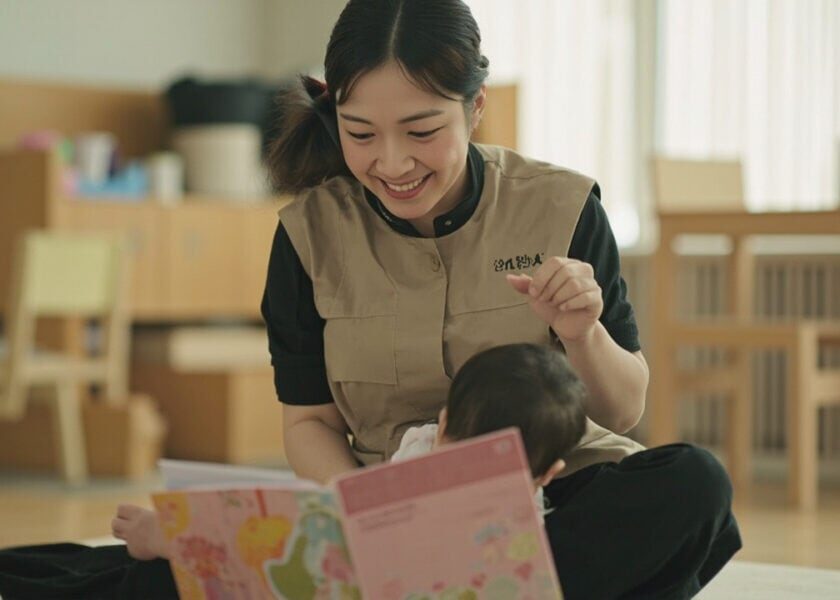
What does that ratio mean for your child? It means each infant receives the attention that their developing brain and forming attachments require. A caregiver can learn your child’s cues and respond to their needs with specificity. The quality of attention is not diluted by numbers. Your child is seen as a person, not as one of many to be managed.
Built on Trust and Communication
Their approach is grounded in something straightforward: they understand that the relationship between a family and their childcare provider is built on trust, and trust is built on communication.
This is why their model emphasizes transparency—regular updates, open dialogue, and visibility into your child’s day. Not because parents need to be in constant surveillance of their child’s caregivers, but because parents need to feel connected even when they are not present.
That connection is what transforms anxiety into peace. It is what allows you to drop your child at the door and leave feeling confident instead of guilty.
Practical Support for Singapore Families
EduNanny’s care blocks run Monday through Friday, because they understand that modern Singapore families need consistency, not patchwork solutions.
They have worked to keep fees within the pilot structure’s accessible range, because quality care should not be only for those who can afford premium pricing. For families using CDA or Baby Bonus funds, those resources can often be applied, because Singapore has built these mechanisms precisely to support parents in making choices that work for them.
Permission to Choose Confidently
I want to close by speaking directly to that inner conversation you have been having—the one that happens in the quiet, in the moments when you doubt yourself most.
You are not failing your child by needing to work. You are not failing by struggling with this choice. You are not less of a parent because you cannot be everything all the time in every moment.
You are a parent who is navigating reality—the real, complex, imperfect reality of raising a child in Singapore in this generation, with all the pressures and possibilities that entails.
The decision you make about childcare is not the sum total of your parenting. It is one decision—one important decision—in a lifetime of decisions you will make for and with your child.
What matters most is not whether you achieve some impossible standard of constant presence, but whether the choices you make are driven by love. Not the passive kind that feels good but asks nothing of you. The active kind. The kind that costs something. The kind that researches and deliberates and chooses with eyes open.
The kind that says: I may not be able to do everything alone, but what I do, I will do with my whole heart.
Your child does not need a perfect parent. They need a parent who loves them enough to be honest about their limits, brave enough to ask for help, and thoughtful enough to build a village that reflects the care they cannot always give alone.
If you are sitting with the weight of a childcare decision right now, I want you to take a breath. I want you to know that the very fact that you care this much—that you feel the conflict, that you question yourself, that you want so desperately to get it right—is proof of how much love you have already given.
The guilt you feel is not your enemy. It is your heart’s way of saying: this matters. You matter. Your child matters.
Now let that love do what love does: not paralyze you, but move you. Move you toward a decision that serves your child, that honors your family’s needs, that acknowledges reality without surrendering to it. Move you toward partners who will see and support what you are building.
Move you toward the quiet conviction that confident, intentional choice is not the opposite of love—it is love’s highest expression.
You have permission to choose. Not perfectly. Not without doubt. But fully, and with the confidence that comes from knowing your choice is made in love, not despite it.
EduNanny by BUTLER is here to walk this road with you—not because they have all the answers, but because they understand the question. They know what you are carrying. They respect it. And they are ready to be the kind of partner that earns your trust by meeting you exactly where you are.
Take that step. Not because the guilt is gone—it may not be, not entirely, because you are a parent and you will always carry some of that beautiful weight—but because you have made the choice to move forward with your eyes open, your heart full, and your love leading the way.
That is who you are. That is what you are doing. And it is more than enough.
To learn more about EduNanny’s infant care and childminding options, explore how they support Singapore families navigating this decision with honesty, care, and genuine partnership.