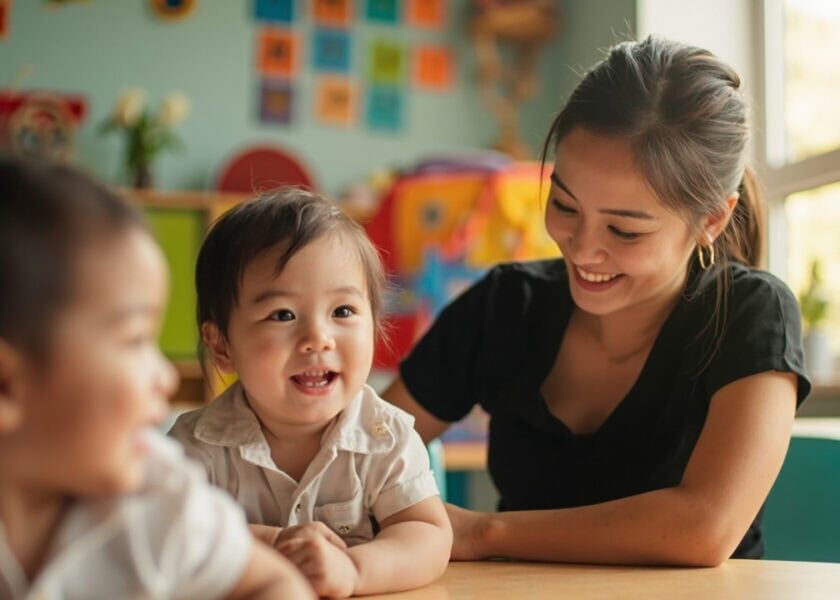
Finding Childcare Where Your Child Will Be Known
The Gap Between What You Can See and What You Need to Know
Here is the quiet truth no one tells you when you start researching infant care in Singapore: you are being asked to choose the most important relationship in your child’s early life based on what a tour can show you.
But the most important things about that relationship—the daily warmth, the responsiveness when your child is tired or frustrated, the way a caregiver notices a developmental milestone before you do, the texture of genuine attentiveness versus professional performance—those things simply cannot be toured.
They emerge over months. They reveal themselves in moments that no inspection checklist captures.
And this creates a gap that every thoughtful parent eventually confronts: you must judge quality you cannot yet see, in a decision you cannot afford to get wrong.
Understanding this is the beginning of navigating it well.
Why Credentials Matter—but Not as Much as You Hope
Most childcare conversations either ignore this tension or rush past it with reassurances that never quite land. They offer checklists of credentials, ratios, and accreditations, as if the answer lies somewhere in the fine print.
And yes, credentials matter. ECDA licensing, training certifications, infant-to-caregiver ratios—these are not trivial. They establish a floor of safety and competence, and a responsible parent should ask about them.
But they do not answer the question your gut is actually asking.
The question is not whether this childcare meets minimum standards. The question is whether this is the place where your child will be known. Whether the people caring for your infant will see her not as one of many but as the particular, irreplaceable person she already is.
The difference between these two questions is everything.
Four Patterns That Distinguish Genuine Quality
Parents who feel confident about their childcare choices are not parents who found the perfect checklist. They are parents who developed the capacity to recognize quality when they finally see it in action.
Once you know what to look for, the invisible becomes legible. Here are the patterns that matter most.
Responsiveness Before the Signal Becomes a Scream
Watch how caregivers respond to a child who is not crying but is quietly distressed—a furrowed brow, a hesitation at the door, a hand reaching back toward a parent.
A high-quality caregiver notices before the signal escalates. They move toward the child not with the practiced calm of someone managing a situation but with the natural attentiveness of someone who is genuinely present.
This is difficult to fake on a tour, but it is not impossible to ask about. Ask directly: what does a typical morning look like when a child is having a difficult adjustment? Listen not just to the answer but to the ease with which it is given. Caregivers who have genuinely thought about this will answer with specifics. Those performing an answer will offer generalities.
How Caregivers Speak to Infants
Listen to the language caregivers use—not at children, not about them in their presence, but to them.
The language of quality care is specific, respectful, and reciprocal. A caregiver who says “Good job, Emma” with genuine warmth is giving something different from one who says it the same way twenty times in a morning. Listen for variation. Listen for the caregiver who narrates what the child is experiencing, who names emotions, who treats even the youngest infant as a person whose inner life is worth acknowledging.
This is not about sophisticated vocabulary. It is about a certain quality of attention translated into words.
A Culture of Noticing Development
Ask how caregivers track and support developmental milestones—not in the abstract but in practice.
Who notices if a child has not been reaching for objects as frequently? What happens when a developmental concern is identified?
A quality childcare relationship is not just about warmth and safety, though those are foundational. It is about your child’s growth, about the quiet partnership between caregiver and parent in observing who this child is becoming. When you ask these questions, you are looking for a culture of noticing—people who care about your child’s development not as a metric but as a responsibility.
The Energy of the Space
This pattern is harder to articulate but easy to feel. Spend a few minutes just being present in the environment—not in a formal observation, but genuinely noticing.
Is it hurried or settled? Are there moments when the children are simply present, without scheduled activity, without the pressure of constant stimulation?
Quality care has an unhurried quality. It allows for boredom, for slow transitions, for the kind of quiet that infants actually need. A space that feels frantic, even if it is clean and well-staffed, is a space that is managing children rather than caring for them. These are different things.
Questions That Reveal More Than Tours Can Show
You will not see all of these patterns clearly on a single visit. But you can ask questions that reveal more than tours alone can show. Consider asking:
- What does a typical morning look like when a child is having a difficult adjustment?
- How do caregivers describe their relationship with the families they serve?
- What happens when a child is ill, when a family is going through a difficult period, when a child is struggling with separation?
- What does communication look like—not in the abstract but in specifics? How often do parents hear from caregivers?
- What does that communication contain? Is it transactional—sleep times, feeding times, diaper changes—or is it relational? Does the caregiver share observations about your child’s day that suggest genuine engagement?
These questions will not give you the complete answer. Nothing can. But they will begin to close the gap between what you can observe and what you need to know.
What Quality Childcare Can Feel Like
Choosing childcare in Singapore is not a small decision. It is an act of faith, undertaken with incomplete information, by people who care deeply and want the best. We do not pretend to eliminate the difficulty of that act. But we do believe we can help you make it better—not by giving you certainty, but by giving you clarity.
At EduNanny, our approach was shaped by a simple recognition: infants do not thrive in institutional isolation. They need proximity, continuity, and individual attention. This is why we participate in the ECDA Childminding Pilot and why we maintain infant ratios of up to one to three—not as a marketing point, but as a structural commitment to the attentiveness that genuine care requires.
We understand that affordability matters. The pilot fee structures, the usability of CDA funds and Baby Bonus schemes—these are not peripheral concerns for Singapore families. They are often central to whether quality care is accessible. We have designed our model to take both quality and accessibility seriously, because every child deserves to be known. That should not be a privilege reserved for families with unlimited resources.
We understand, too, that communication is not optional. When parents entrust their infants to our care, they are not disengaging from their child’s day. They are entering a partnership. Where transparency measures are in place, they serve a purpose beyond monitoring: they create accountability and trust on both sides. Parents can see what is happening. Caregivers can be supported in what they are doing. The relationship between family and childcare is not a handoff. It is a collaboration that deepens over time.
Confidence in childcare comes not from finding the perfect answer but from finding partners—people who welcome your involvement, who communicate with honesty and warmth, who treat the relationship between family and caregiver as something worth building.
You may not fully see this on a tour, or in the first week, or the first month. But you will begin to see it, and when you do, you will recognize it. The way a caregiver greets your child by name. The way your child’s face changes when she sees her caregiver—not the performance of daycare recognition but the genuine anticipation of someone who matters. The way your caregiver speaks about your child’s day with specificity and care, as if your child is the most interesting person she has encountered that morning, because perhaps she is.
These moments accumulate into something that cannot be faked and cannot be toured. But it can be trusted, once you have learned to recognize it.
If you are exploring childcare options and would like to understand how EduNanny approaches infant care and childminding in Singapore, we invite you to reach out. Ask your questions. Share your concerns. Let us show you what partnership in childcare looks like.
Because choosing childcare should not mean choosing between your peace of mind and your child’s wellbeing. It should mean finding people who earn both, every day.