The Body-Brain Foundation Your Child Needs Before Primary One
Every Parent in Singapore Wants the Same Thing
You want your child to flourish. Not just survive school, but genuinely thrive within it. Not just memorize facts, but develop the kind of inner stability that allows them to sit with a problem, think through it, and emerge with confidence rather than anxiety. You want them to be the child who raises their hand not because they are certain of the answer, but because they trust that making a mistake is part of learning.
And so you do what Singapore parents have always done. You read the parenting forums. You ask your friends. You research enrichment programmes the way you once researched graduate programmes. You sign up for music classes and speech drama and mathematics readiness and Mandarin tuition. You want your child to be prepared. You want them to have every advantage.
Here is what most parenting conversations in Singapore are quietly missing: your child cannot fully benefit from any of those enrichment programmes without first building the physical and sensory foundations that make learning possible.
There is a quiet anxiety that many parents feel but rarely articulate. It sounds something like this:
- My child seems stiff when they climb.
- My child gets overwhelmed in loud places.
- My child struggles to sit still.
- My child seems clumsy.
- My child doesn’t seem to know where their body is in space.
- My child falls apart when routines change.
- My child can’t focus for more than a few minutes.
Is something wrong with them? Is something wrong with what I am doing?
What you are sensing, without always having the framework to name it, is your child’s sensory system at work. Sensory processing and physical development have been almost entirely absent from the Singapore parenting conversation. We talk endlessly about cognitive milestones and school readiness and academic preparation. We talk about emotional attachment and building secure bonds. We have far less vocabulary for what is happening in a child’s body during those critical early years, and why it matters so profoundly for everything that comes after.
The body is where learning begins. For the first years of your child’s life, the most important work happening inside any childcare setting is not the flashcards. It is not the worksheets. It is the whole-body, sensory-rich, movement-filled experience of a child learning to inhabit their own physical self with confidence and regulation. This is the foundation that everything else stands on.
What Is Sensory Processing, and Why Does It Matter?
Sensory processing is the way your child’s nervous system takes in information from their body and their environment, organizes that information, and uses it to respond adaptively. When a child processes sensory information well, they can attend to a teacher’s voice in a noisy classroom, sit upright in a chair without fidgeting, navigate a crowded playground without anxiety, and calm themselves after a frustrating moment.
They can hold a pencil with the right amount of pressure, write legibly, and complete a worksheet without their hand tiring after five minutes. They can wait. They can transition. They can regulate.
When a child’s sensory system is underdeveloped or dysregulated, none of this is automatic. Sensory and physical development are not side effects of growing up. They are not things that just happen if a child eats well and sleeps enough. They are skills that require intentional environments, purposeful movement experiences, and trained adults who understand how to scaffold a child’s physical development across every stage from infancy through the preschool years.
The Three Sensory Systems Shaping Your Child’s Early Years
During your child’s early years, three interconnected sensory systems are developing simultaneously. Each one serves specific functions that will shape their ability to learn and navigate the world.
The Vestibular System is housed in the inner ear and tells your baby whether they are upright or upside down, moving fast or slow, steady or off-balance. When your infant learns to hold their head up, roll over, and eventually walk across uneven ground, they are building this system. This sense will later enable your child to sit still in a chair, ride a bicycle, and move through space with physical composure. It is the foundation of physical equilibrium.
The Proprioceptive Sense is the body’s ability to know where it is in space without looking. When a baby reaches for a toy and grasps it, when they push up on their arms during tummy time, when they eventually crawl and pull to stand and take those first unsteady steps, they are building proprioception. This sense will later allow your child to write within the lines, use scissors, dress themselves, and move through a crowded room without bumping into everyone. It is the sense that gives a child physical self-awareness.
The Tactile System, mediated through the skin, is the largest sensory system in the body. Your baby’s need to touch everything, to feel textures and temperatures and surfaces, is not a behavioral nuisance. It is a neurological imperative. Tactile input helps children distinguish between friendly touch and uncomfortable touch, between their own body and another person’s body, between the floor beneath their feet and the air around them. A child with well-developed tactile processing can tolerate messy play, can wear clothing with seams without discomfort, and can navigate sensory-rich environments without becoming dysregulated.
None of these systems develop in isolation. They develop together, through movement, through play, through the messy, physical business of being a young child in a body that is learning what it can do.
What Quality Childcare Actually Looks Like
Here is what quality childcare does that no enrichment class can replicate. It gives your child hours of unstructured, supervised physical experience every single day. It gives them gross motor play that builds strength, coordination, and balance. Fine motor activities that refine the small muscles of the hands and develop the intricate hand-eye coordination they will need for writing, drawing, cutting, and eventually typing. Rhythmic movement that regulates their nervous system. Outdoor sensory experiences, exposure to light and air and sound and texture and the unpredictable physicality of natural environments.
And proprioceptive and vestibular input that accumulates through climbing and jumping and spinning and balancing and carrying heavy objects and burying their hands in sand. In quality childcare, your child’s body is not sitting still. It is learning. And that physical learning is building the very architecture that their brain will use for every cognitive task that follows.
What You Might Observe in a High-Quality Setting
When you observe a child in a high-quality childcare environment, you might see them climbing a small ladder to a slide, navigating the sensory complexity of height and momentum and balance and trust. You might see them engaged in water play, feeling the weight and temperature and texture of a substance that shifts between states. You might see them mixing paint, manipulating a brush, coordinating vision and movement in ways that strengthen neural pathways.
You might see them engaged in messy play with sand or clay or rice, tactile experiences that are not merely recreational but fundamentally developmental. You might see them running and chasing and wrestling with other children, experiencing the proprioceptive input of rough-and-tumble play that calms and organizes the nervous system in ways that no quiet activity can replicate.
These are not break periods between the real learning. These are the real learning.
Why Enrichment Classes Cannot Replace This
When parents sign their three-year-old up for an external sensory class or a motor skills programme, they are often paying for one or two hours per week of what quality childcare provides every single day, embedded naturally into the rhythm of a child’s morning and afternoon.
The enrichment class becomes redundant not because it is harmful, but because the foundation it promises to build is already being built better, more consistently, and more holistically in the right childcare environment. Parents who understand this are not being neglectful. They are being efficient. They are directing their resources toward the setting that actually provides what their child needs.
What to Look For When Choosing Infant Care or Childminding
Not all childcare settings are created equal when it comes to physical and sensory development. This is the question that matters most: what is your child’s childcare actually doing with their body every day?
The Physical Environment
In a premium childcare environment, the answer is specific and intentional. It is not accidental. The physical environment itself is designed to offer sensory-rich experiences: varied textures underfoot, spaces for climbing, hiding, and rolling, access to outdoor play that engages multiple sensory systems simultaneously, and materials that invite fine motor manipulation and hand-eye coordination.
The Daily Rhythm
The daily schedule includes structured and unstructured movement, quiet activities and active ones, individual exploration and group physical play. The adults understand developmental milestones across the infant, toddler, and preschool years.
They know that a twelve-month-old is building the strength to stand and cruise, and they provide the supervised opportunities for that development to unfold. They know that an eighteen-month-old is refining their pincer grip and developing hand strength to scribble with intention, and they offer the materials and guidance for that refinement. They know that a three-year-old is consolidating balance and coordination and needs opportunities for sustained gross motor play that challenges their growing bodies in progressive ways.
Questions to Ask When Visiting
When you visit a potential childcare setting, observe and ask:
- Is the floor varied in texture?
- Is there space for gross motor play?
- Is there outdoor access?
- What does a typical morning look like in terms of movement and physical activity?
- Are the children sitting for long periods or engaged in active, physical exploration?
- How do the adults interact with children’s physical play? Do they scaffold and encourage, or merely supervise?
- Are there opportunities for sensory-rich play with water, sand, clay, paint, and other tactile materials?
These are not superficial questions. They reveal whether a childcare setting understands that development happens in a body, not just in a mind.
How EduNanny Builds This Foundation
EduNanny by BUTLER operates within the ECDA Childminding Pilot, a framework designed to bring professional, structured, home-based and community-based childcare to families across Singapore. What this means in practice is a childcare arrangement that offers something increasingly rare: meaningful adult attention.
Individual Attention That Makes a Difference
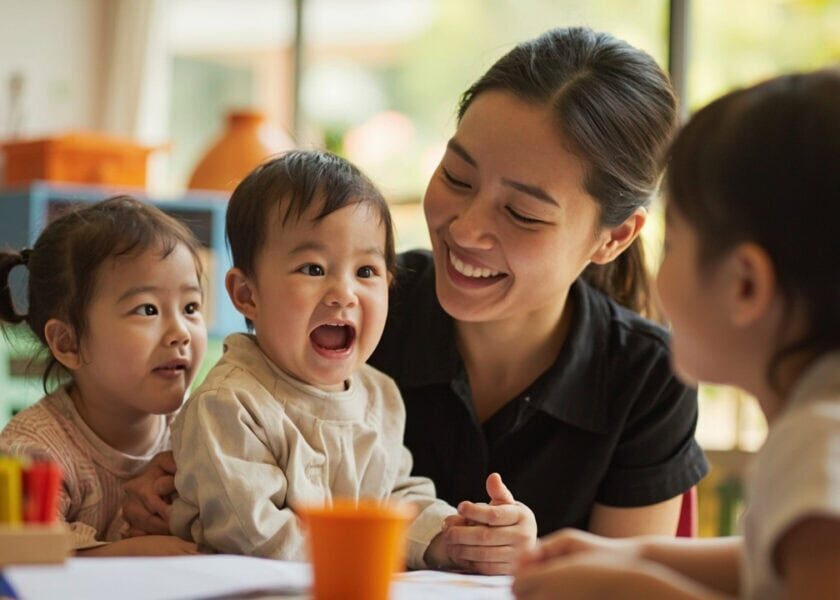
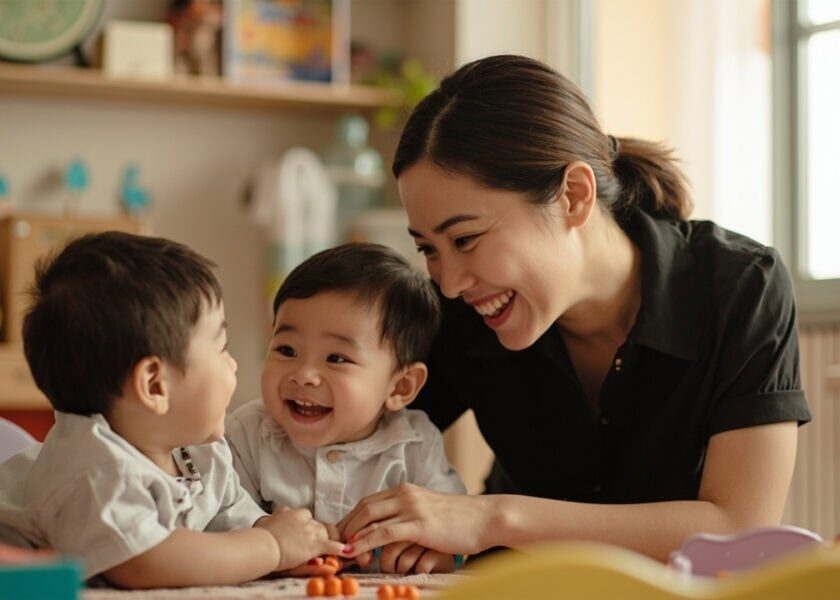
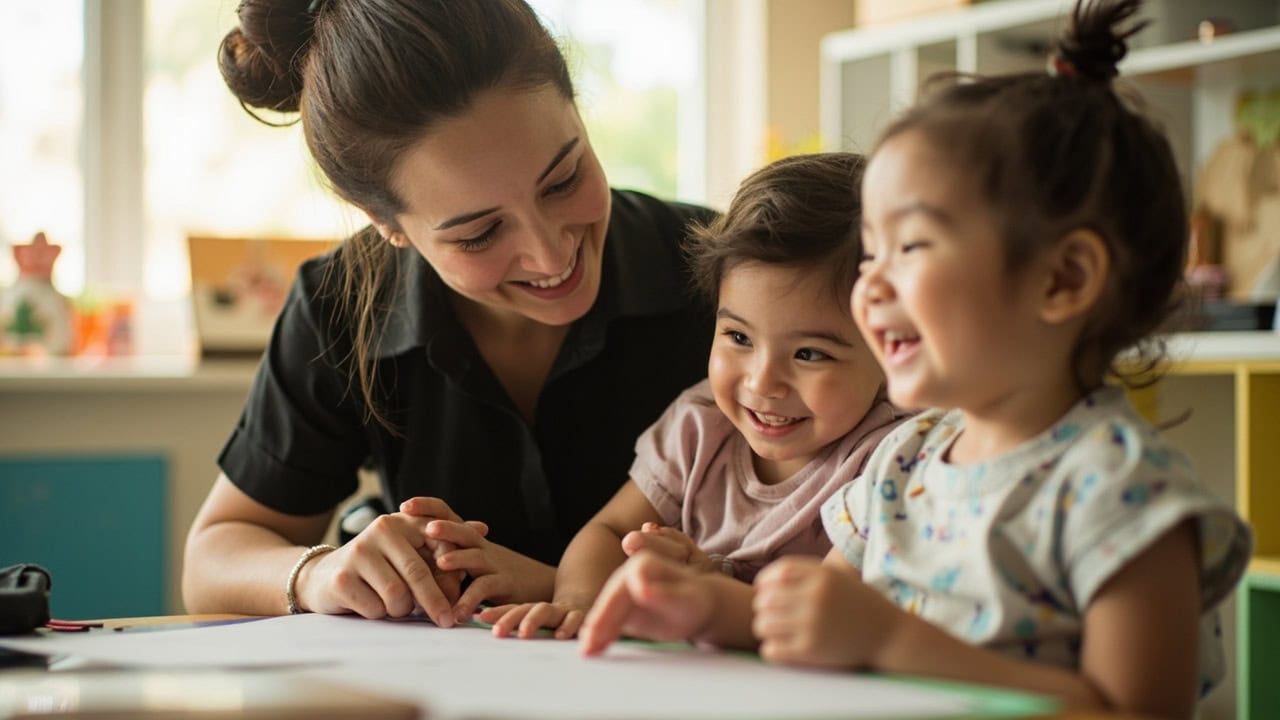
With ratios of up to one to three in the infant years, every child receives the kind of individual observation and responsive caregiving that larger centre settings cannot easily provide. This matters enormously for physical development.
When a caregiver can notice that a toddler is wobbling a little more than usual, or that an infant is not yet rolling in ways that match their developmental window, that caregiver can offer targeted support. They can create the conditions for physical exploration. They can scaffold movement. They can notice when a child’s physical development needs encouragement and when it needs patience.
The EduNanny model is built on the understanding that physical development does not happen passively. It happens when trained, attentive adults create the right environment, offer the right challenges, and respond to each child as an individual with their own trajectory of growth.
Transparency and Practical Support
Because EduNanny operates as part of a structured pilot with transparent communication practices, you are never guessing about what is happening during the day. Regular updates give you visibility into your child’s experiences. The communication culture within EduNanny is built on the principle that parents deserve to know, not just to hope.
For Singapore parents, logistics are not separate from quality. They are part of it.
- Monday to Friday care blocks align with the rhythm of working family life.
- Pilot fee structures are designed with affordability in mind, recognizing that premium care should not be accessible only to the affluent.
- CDA and Baby Bonus mechanisms further reduce the financial burden, making quality childcare a realistic option across income levels.
Real School Readiness: Beyond Literacy and Numeracy
School readiness in Singapore has become almost synonymous with literacy and numeracy. Can your child recognize letters? Count to twenty? Write their name? Hold a pencil correctly? These are not unimportant. But they are incomplete.
Consider this: a child who arrives at Primary One with strong pre-literacy skills but poor vestibular development may struggle to sit upright at a desk for extended periods. A child who can recite numbers but lacks the fine motor control for legible handwriting may become frustrated and discouraged within weeks. A child who is academically advanced but physically dysregulated may lose focus in the sensory complexity of a classroom full of moving, talking, active children.
Real school readiness is whole-child readiness. It includes the physical confidence to navigate a school environment, the sensory regulation to attend despite noise and movement and distraction, the body awareness to manage personal belongings, move through hallways, use the bathroom independently, and participate in physical education.
It includes the proprioceptive foundation that allows a child to sit, stand, walk, and move with the ease and self-possession that learning requires. And the emotional regulation that comes from a well-developed sensory system, enabling a child to manage transitions, handle frustration, and return to a calm state after moments of arousal.
A child who has built these foundations in their early years arrives at Primary One not just with knowledge but with the physical capacity to learn. This is the readiness that premium childcare builds. Not instead of academic preparation, but beneath it. As the necessary platform on which all academic learning stands.
Practical Guidance for Singapore Parents
Supporting Physical Development at Home
Beyond choosing quality childcare, there is much you can do at home to support your child’s sensory and physical development. When your child comes home, observe their physical state. Are they tired in the way that physical exertion produces, not just screen fatigue? Are they physically confident, willing to climb and jump and explore? Do they sleep well, an outcome of adequate physical activity during the day? Do they seem regulated, able to transition between activities without prolonged distress?
You can support this development by providing opportunities for messy play. Let your child get dirty. Allow them to climb and fall and get back up. Give them toys that require two-handed manipulation, that build hand strength and coordination. Create environments where physical exploration is encouraged, not constantly redirected to quiet, seated activities. Trust that the body learns through movement, and that your child’s need to move is not a deficit to be managed but a developmental drive to be supported.
Common Questions Answered
“Is something wrong with my child?”
The anxiety you may feel about whether your childcare is doing enough is not a sign of parental failure. It is a sign of awareness. You are asking the right question. If your child struggles with any of the signs mentioned earlier, this does not mean something is wrong with them. It means their sensory and physical development may need additional support. Quality childcare with trained caregivers can provide that support. So can informed parenting and, when needed, consultation with a developmental specialist.
“Should I add more enrichment classes?”
The answer is not to add more enrichment classes on top of whatever already exists. The answer is to ask, specifically, what is happening with your child’s body during the hours they are in care. If the answer is not much, then the priority is finding a childcare setting that makes physical and sensory development a central part of the daily experience. Enrichment classes cannot compensate for a childcare environment that keeps children sitting for long periods or does not provide adequate movement opportunities.
“How do I know if my child’s physical development is on track?”
Every child develops at their own pace, but there are general milestones worth understanding. If you have concerns, discuss them with your childcare provider, your pediatrician, or an early childhood development professional. The key is to notice whether your child is progressing, not to compare them rigidly against a checklist. Consistent, patient support in a sensory-rich environment is what helps most children build the foundations they need.
Your Child Is Ready to Learn
The work that happens in quality childcare is quiet work. You will not always see it on a daily report. You will not always hear about it in parent-teacher meetings. But you will see its effects.
You will see a child who arrives at Primary One with physical confidence. Who can sit and attend because their body is regulated. Who can write and manipulate tools because their fine motor skills are refined. Who can navigate a school environment with ease because their body-brain connection is strong. Who can handle the sensory complexity of a classroom because their nervous system has been built to accommodate it.
This is the foundation that EduNanny builds. Not the visible foundation of academic achievement, which Singapore culture already celebrates. The invisible foundation that makes all academic achievement possible. The sensory, physical, embodied foundation that your child is building right now, in every moment of movement and sensation and physical exploration.
Choose childcare that understands this. Choose a partner who is building what matters most. Your child’s body is ready to learn.
Next Steps for Singapore Parents
If you are researching infant care or childminding in Singapore, here is what you can do today:
- Observe your current childcare setting with new eyes. What is happening with your child’s body during the day?
- Visit EduNanny by BUTLER to understand how their model approaches physical and sensory development as foundational, not incidental.
- Ask questions when evaluating any childcare option. Use the guidance in this article to assess whether physical development is genuinely prioritized.
- Trust your instincts. If something feels off about your child’s physical confidence or sensory regulation, that feeling deserves attention.
The early years are not a waiting period before formal education begins. They are a critical developmental window that will shape everything that follows. Make those years count.
EduNanny by BUTLER is here to help you build that foundation with intention, expertise, and genuine care for your whole child.