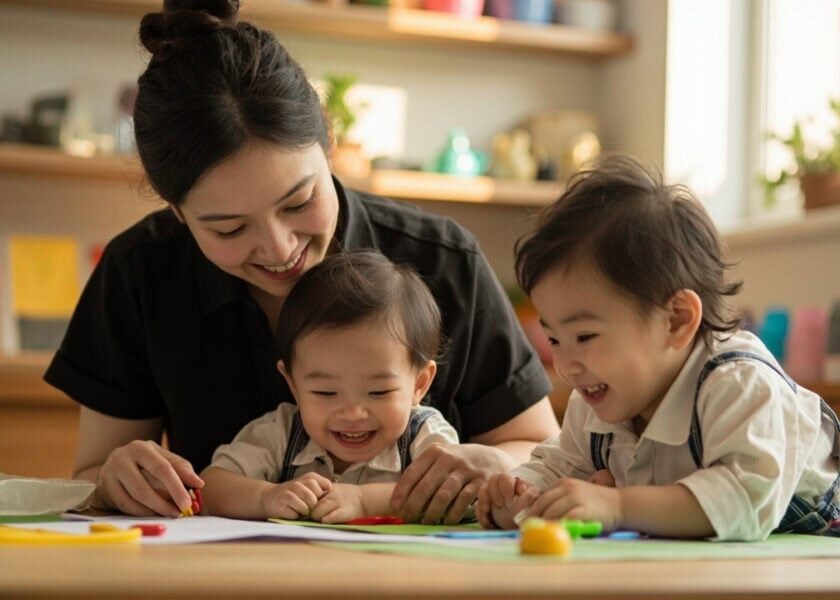
Why Your Role in Childcare Deepens After the Decision Is Made
The Truth About Choosing Childcare in Singapore: Why the Decision Is Only the Beginning
There is a version of the childcare story that Singapore parents hear often. You do your research, visit a few centres, ask the right questions during the tour, trust your instincts, and when you find the one that feels right — you exhale. The hard part is over. You made the decision. The rest is execution.
It is a reassuring story. It also happens to be incomplete.
The truth is that choosing well is one of the most important things a parent can do. But for families who have walked this path — who have enrolled their infant, settled into a routine, and watched their child grow over weeks and months — there comes a quieter realisation. The decision was not the ending. It was the beginning of something that requires just as much attention, intention, and courage.
Here is what many parents discover: the quality they saw during that first tour, the warmth they sensed in the caregiver’s smile, the sense of safety they felt in the environment — that quality does not simply maintain itself. It deepens, or it drifts. And which direction it takes depends, in large part, on something that happens after enrolment.
It depends on the parent.
What Parents Discover After Enrolment: The Quiet Shift
If you are a parent in Singapore who has already enrolled your child in care, you may already be doing this. You may already be the parent who notices the shift in your baby’s cry when a familiar caregiver enters the room. You may already be the one who asks the thoughtful question during pick-up — not out of anxiety, but out of genuine curiosity about your child’s day.
If that is you, you are doing something remarkable. And you may not even realise how rare and valuable that instinct is.
But there is also a chance — and I say this with warmth, because I have seen it so many times — that you fell into a different pattern. The pattern of the relieved parent. You found good care, you felt peace settle over you, and you allowed yourself to step back. Not entirely. Never entirely — you are a parent, after all, and your child’s wellbeing lives in your chest. But you stepped back from active curiosity. You trusted the arrangement to run on its own. You told yourself that the right decision would take care of itself.
This is understandable. Singapore parents carry so much already. The pressure to research, evaluate, and choose well is enormous. And once that work is done, there is a deep human impulse to rest. To assume that the chapter is closed.
But the truth is that the most confident, most satisfied parents I have encountered — the ones who speak about their childcare arrangement not just with relief but with genuine warmth — are not the ones who simply chose well. They are the ones who stayed close. They are the ones who treated the caregiver relationship as an ongoing conversation rather than a one-time transaction. They are the ones who understood that their attention, over time, was one of the most powerful forces sustaining the quality of care their child received.
Sustained Curiosity: How Engaged Parents Stay Close Without Overreaching
It begins with something that may seem obvious, but is often underutilised: your own child. More specifically, your own observation of your child’s behaviour, development, and signals.
You know your baby in a way no caregiver, however excellent, ever will. You have watched your child since before birth. You have mapped the landscape of their temperament, their likes, their dislikes, the texture of their cry in hunger versus fatigue versus overstimulation.
This knowledge is not just yours to enjoy in private. It is information that belongs in the conversation with your caregiver. When you arrive at pick-up and your child seems unusually clingy, when they are sleeping differently than usual, when their language seems to have shifted overnight — these are not small talk observations. These are data points. And the parents who get the most out of their childcare partnership are the ones who bring these observations forward, not as complaints or concerns, but as contributions to a shared understanding.
Over time, this two-way observation builds something extraordinary: a caregiver who knows your child not just as a child in their care, but as a specific, individual person whose nuances have been mapped by someone who loves them most.
At EduNanny Singapore, this is not an accident. It is the intention behind their approach. Whether you are part of the ECDA Childminding Pilot with its home-based pathway, or accessing care through community and centre-based arrangements, the framework is built around small ratios — sometimes just one caregiver for one or two infants — that allow this kind of deep familiarity to form. When there are fewer children to attend to, the caregiver can hold the small details. When parents arrive with their own observations, those details can be cross-referenced, understood, and responded to. The quality of care does not plateau after enrolment. It continues to deepen — but only if the relationship remains alive.
What Meaningful Communication Actually Looks Like
There is a question that comes up often among parents who have been in care for a few months: what should communication from childcare actually look like?
This is where many parents, without realising it, have quietly settled for less than they need.
Daily updates that say “Baby had a good day, napped well, ate all meals” are not nothing. They are reassuring. But they are also surface-level. They tell you that your child was managed — that basic needs were met.
What they often do not tell you is what emerged during the day:
- What new sound did your baby attempt?
- What texture did they explore with their fingers?
- How did they respond when another child came close?
- What made them laugh?
These are the details that distinguish care that is merely competent from care that is genuinely developmental. You do not have to wait for a centre to offer this kind of communication unprompted. You can ask for it — not in a demanding way, but in a curious one. “I noticed Maya has been really interested in dropping things and watching where they fall — are you seeing that too?”
These questions do two things. They give the caregiver an opening to share what they have observed, and they signal — without ever needing to say it aloud — that you are paying attention. That your child’s day at childcare is not separate from your life as a parent. That you are still there, even when you are not in the room.
EduNanny Singapore’s Thomas AI Chatbot is one tool designed to support this kind of ongoing communication. It gives parents a way to raise questions, track patterns, and stay connected to their child’s care between formal check-ins — not as a replacement for the caregiver relationship, but as a bridge.
The Questions Worth Asking at Every Stage
The questions worth asking change over time. Here is a framework for what to look for as your child grows:
| Timeframe | Key Questions to Ask |
|---|---|
| First Month | How is my child settling in? Are they eating and sleeping on a manageable schedule? Who are the caregivers my child seems most comfortable with? |
| Three Months | How is my child’s development progressing? Are they meeting milestones consistently with what I see at home? What does play look like during the day — are they engaged, curious, stimulated? |
| Six Months | Is my child forming secure attachments with their caregivers? Do they seem happy to go in the mornings and happy to see me at pick-up? Is the care adapting to my child’s evolving needs — not just continuing the same patterns, but responding to who my child is becoming? |
| One Year | Is this arrangement still serving my child well? Is the quality I sensed during enrolment still present? Is my child growing in the ways I hoped — socially, emotionally, cognitively? |
These are not questions that a childcare centre can answer for you. They require your own sustained attention. They require you to stay in the conversation, to keep asking, to keep noticing.
Observation Versus Interference: Holding the Distinction
There is another dimension to this that deserves its own attention, because it is where many well-intentioned parents quietly veer off course.
It is the difference between observation and interference.
Observation is what I have been describing: the gentle, curious, ongoing attention you bring to your child’s care. The questions you ask. The patterns you notice and share. The partnership you offer.
Interference is something else. It is the impulse — usually born of love and anxiety — to manage every detail, to second-guess decisions that were made in your absence, to treat the caregiver as an extension of yourself rather than a professional with their own expertise and judgment.
The line between these two is not always obvious, and that is precisely why it is worth naming:
- The parent who observes asks: “How did Jonah respond to the new activity you tried this morning?”
- The parent who interferes asks: “Why did you not use the approach I recommended in the book I sent you?”
- The parent who observes notices a change in sleep patterns and brings it up as a data point for the caregiver to consider.
- The parent who interferes sends a detailed protocol for naptime and expects it to be followed without discussion.
One of the most valuable things you can do as a parent in an ongoing childcare relationship is to hold your own expertise and your caregiver’s expertise in equal respect. You know your child deeply. Your caregiver knows early childhood development deeply. When these two bodies of knowledge are in genuine conversation, the child benefits in ways that neither party could achieve alone.
The parents who seem to navigate this most gracefully are not the ones who figured out the perfect balance on day one. They are the ones who kept showing up with curiosity, adjusted their approach when they noticed friction, and treated the relationship itself as something that required ongoing learning.
Caregiver Consistency: The Overlooked Quality Indicator
Sustained caregiver consistency is one of the most reliable quality indicators in childcare — and also one of the most overlooked once the initial decision is made.
During the search phase, parents ask about caregiver qualifications, ratios, and turnover. They want to know that the person holding their baby is trained, trusted, and likely to be there for the long haul. This is sensible. But once enrolment happens, attention often drifts. Parents stop asking about the caregiver team. They stop noticing whether the faces in the room are the same faces they met during the tour. They assume continuity unless something dramatic happens.
Here is what the most engaged parents do differently: they notice. They notice when a caregiver who typically greets their child at drop-off is absent for a few days. They notice when the rhythm of care seems off. They ask — gently, but clearly — whether everything is all right. Not because they suspect something is wrong, but because they understand that consistency is the soil in which trust grows.
Small caregiver-to-infant ratios, like those maintained through EduNanny’s approach, make this kind of consistency more possible. When there are fewer children to manage, caregivers are less likely to leave due to burnout. When the environment feels like a genuine community rather than a throughput operation, the relationships tend to last. And when parents are actively noticing and appreciating that consistency, it reinforces the conditions that made it possible.
Why Staying Engaged Is Not Guilt — It Is Partnership
There is a kind of guilt that hovers around remaining engaged with your child’s childcare after enrolment. A voice — sometimes internal, sometimes from well-meaning relatives or friends — that says: you chose well, so trust the choice. You went back to work, so let go. You are not supposed to be the one worrying about every detail anymore. That is what you pay people for.
I want to gently push back against that voice, not because the people who say it are wrong, but because the premise is incomplete.
You do not stop being your child’s parent when you drop them off. You do not stop caring about the quality of their environment because someone else is physically present in it. And you do not diminish the caregivers’ professionalism by continuing to show up with curiosity and care.
In fact, the opposite is true. Caregivers — the best ones, the ones who stayed in this work not because it is easy but because they find meaning in it — tend to flourish when they are in genuine partnership with the families they serve. When a parent notices what the caregiver noticed and brings it back into conversation, the caregiver feels seen. When a parent asks a thoughtful question that reveals real attention to the child’s development, the caregiver feels respected. When a parent treats the relationship as a collaboration rather than a transaction, the quality of care tends to rise, not fall.
This is what separates good childcare from great childcare: not just the initial quality, but the sustained commitment to partnership on both sides.
EduNanny Singapore: Built for the Long-Term Partnership
EduNanny Singapore was built around a belief that childcare is not a product you purchase and then consume passively. It is a relationship that you enter, contribute to, and help shape over time.
The ECDA Childminding Pilot, the home-based pathway, the small ratios, the emphasis on caregiver consistency — all of these are not just features. They are enablers of the kind of sustained partnership I have been describing.
When a childcare arrangement is built for one to three infants per caregiver, the caregiver has the capacity to know each child deeply. When families can use CDA and Baby Bonus funds to access care that is genuinely affordable within the pilot structure, the arrangement becomes sustainable over the long term rather than just the short term. When communication tools like the Thomas AI Chatbot are designed to keep parents in the loop between formal check-ins, the infrastructure of trust becomes stronger, not weaker.
Monday to Friday care blocks provide the regularity that deep engagement requires. The small-scale, relationship-centred approach means that when you arrive with questions at six months or one year, there is actually someone who can answer them — someone who has been there all along, who knows your child, who has been part of the same ongoing story.
These are not marketing promises. They are structural commitments that make sustained parental engagement possible. And they are the reason that EduNanny Singapore can genuinely say: we are not just here for the decision. We are here for the years that follow.
Six Months From Now: An Image of What Is Possible
Imagine yourself six months from now. It is a Tuesday morning. You drop your child at care, and the caregiver greets you both by name. Your child reaches for them — not out of anxiety, but out of the easy recognition of someone who is familiar, someone who is known.
You mention, almost as an afterthought, that your child has been doing something new at home — a sound, a gesture, a way of interacting with a toy. The caregiver’s face lights up. They have seen it too. They describe what happened during care yesterday, and suddenly this small observation from your home is part of a larger picture that you are building together.
This is not a fantasy. This is what sustained engagement makes possible. This is what it looks like when the relationship continues after the decision is made.
You are not the parent who chose and stepped back. You are the parent who chose and stayed close. And in staying close, you have done something remarkable — you have helped to create, day by day, question by question, observation by observation, the very quality you originally came looking for.
Start the Conversation That Lasts
If you are a parent in Singapore who is researching infant care and childminding — whether your child is already enrolled or you are preparing for that next chapter — I want to leave you with this.
The decision matters. The research matters. The tours and the questions and the instincts you bring to them — all of that matters.
But what matters just as much is what comes after. The staying close. The sustained curiosity. The partnership with the people who care for your child. The belief that your attention — consistent, informed, warm — is not a burden on the system, but one of the most powerful ingredients in it.
EduNanny Singapore is here for that. For the months and years that follow enrolment. For the conversations that deepen over time. For the partnership that grows as your child grows.
If you are ready to explore what sustained quality looks like — and what your role in it could be — we welcome the conversation.
To learn more about EduNanny Singapore and our approach to development-focused childminding, visit our homepage or read about the ECDA Childminding Pilot.