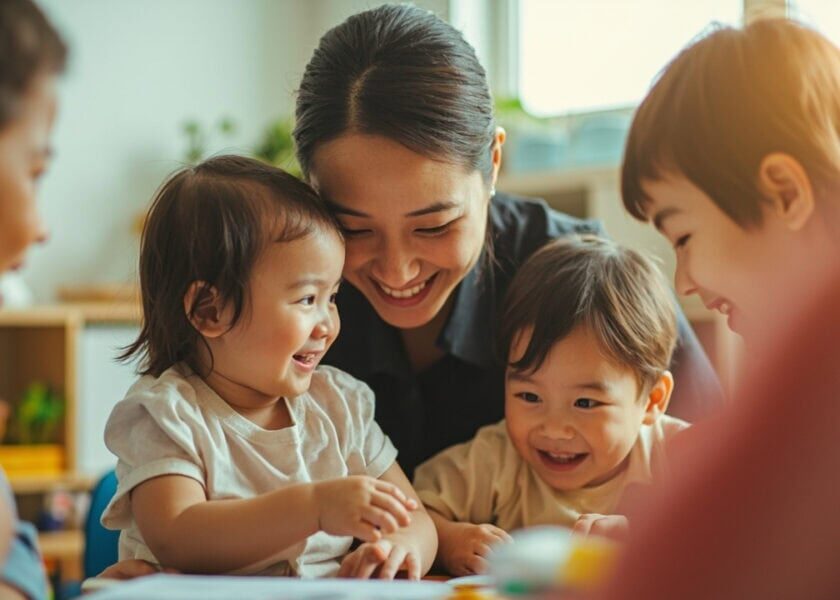
More Than One Kind of Love Singapore’s Modern Approach to Childcare
The Question No One Is Asking
There is a particular silence that Singapore parents know well. It is the pause that follows when your mother watches you prepare your child’s bag for their first week at childcare, and asks, gently but pointedly, “Are you sure?” It is the way your mother-in-law rearranges her face into something she thinks is supportive while asking whether the baby might not be better off with family.
These moments do not announce themselves as conflict. They arrive quietly, wrapped in love, in concern, in the genuine bewilderment of a generation that raised children differently and cannot quite understand why you would choose otherwise. And because they arrive wrapped in love, you cannot simply dismiss them.
If you have felt this, I want you to know something before anything else: you are not wrong. And neither are they.
That is the truth that sits at the center of everything we are going to speak about today, and it is the truth that Singapore’s childcare conversation almost never names directly. Because the narrative that usually plays out is one of two sides, of tradition against modernity, of old ways and new ways. And that narrative, however well-intentioned, misses the point entirely.
What Your Family Is Really Asking
When your mother says, “In my day, we managed,” she is not simply making a factual claim about the past. She is telling you something about who she is, about what she accomplished, about the strength she found when she had no other option.
When your father-in-law wonders aloud whether your child might not thrive better with family, he is not criticizing your decision. He is grieving, in a small and private way, a role that he expected to play and is uncertain how to play in this new configuration.
When grandparents express concern about external childcare, they are often asking a question that has very little to do with childcare at all. They are asking: do you still need us? Are we still important? Does our love still matter?
These are not unreasonable questions. They are, in fact, the most reasonable questions in the world.
Wisdom Versus Methodology
Here is an idea that can change the way you hold this entire conversation with your family. It is the distinction between elder wisdom and elder methodology. This distinction is not about dismissing what your parents know. It is about recognizing that wisdom and method are not the same thing.
Elder Wisdom
Elder wisdom is the understanding that children need consistency, that they need to feel secure, that they need to know they are loved beyond any shadow of doubt. Elder wisdom is the knowledge that a child’s first relationships shape the architecture of their capacity to love and be loved for their entire lives. Elder wisdom is the insight that a child who feels held will take bigger risks, explore more freely, and return to base more confidently when the world becomes uncertain.
This wisdom is timeless. It belongs to no particular era. Your grandmother possessed it. Your grandchildren will possess it. It is the inheritance that passes through generations not because it is taught, but because it is caught.
Elder Methodology
Elder methodology, on the other hand, is the specific way that this wisdom was expressed in a particular time and place. The foods that were believed to be strengthening. The sleep arrangements that were standard practice. The pace at which children were expected to meet milestones. The assumption that mothers, in particular, should be the primary caregivers in the earliest years.
These are not wisdom. These are conventions. They were the best understanding available at the time, shaped by the knowledge, the resources, and the social structures of that era. And they shifted. They will continue to shift. That is not a betrayal of wisdom. That is wisdom in motion.
Two Chapters, One Story
Your parents raised their children in a Singapore that was still finding its footing, in a society where options were fewer, where extended family was often closer at hand, where the formal childcare sector looked nothing like it does today. They made the best choices they could with what they had. You are making the best choices you can with what you have.
These are not contradictions. These are chapters in the same story.
What you are seeking, when you search for quality childcare, is not someone to love your child more. No one will ever love your child more than you do. What you are seeking is a complement to the love you already give. You are seeking support that enables you to be present when you are present, and excellent care when you are not.
You are seeking a village. Because it takes a village, and the village has changed shape but not purpose.
What Quality Childminding Actually Looks Like
Before exploring how to bridge the generational gap, it helps to be clear about what you are actually looking for — and what differentiates quality care from the kind of care your grandparents may be imagining when they express concern.
Quality infant and childminding care, in the contemporary Singapore context, means several things that are worth naming plainly:
- Small ratios. Your child is known, seen, and responded to as an individual rather than as one among many. Caregivers have the capacity to notice the nuances of infant communication, the shifts in mood, the small victories of new skills.
- Developmentally intentional care. Warmth is necessary but not sufficient. Quality care means caregivers who understand early childhood development as a discipline — who know what infants and toddlers need at each stage, and who create environments and interactions that actively support that development.
- Consistent, responsive relationships. Your child builds trust not through the presence of any single caregiver but through the reliable presence of caring adults who respond consistently. This is not so different from what grandparents instinctively know about holding a baby: that responsiveness builds security.
- Safe exploration. A quality care environment gives your child the freedom to explore, to experiment, to fail and try again, within boundaries that keep them safe. This is where child development research and grandparent intuition genuinely converge.
- Transparent communication. Modern quality care providers offer families genuine insight into the child’s day — not because parents cannot trust, but because sharing that window strengthens the web of care surrounding your child.
EduNanny: Expanding the Circle
EduNanny, as part of the ECDA Childminding Pilot, represents a thoughtful answer to the question Singapore families are quietly asking. It is an approach designed specifically for infants and young children, understanding that the first years of life carry a weight and a significance that contemporary research continues to illuminate.
With small ratios that ensure your child is known and seen as an individual, EduNanny creates the conditions for the kind of consistent, responsive care that elder wisdom has always known children need — delivered through a methodology shaped by current understanding.
And here is what matters enormously in the conversation you are having with your family: EduNanny is not asking your child to forget where they came from. It is not asking your child to love their grandparents less. It is doing something more interesting and, frankly, more aligned with Singapore’s deepest values. It is expanding the circle.
In Singapore, we understand this instinctively in other domains. We understand that a child can have grandparents who teach them Mandarin and a school that teaches them English and both are true additions to their life, not subtractions from each other. We understand that family is not diminished by friendship but enlarged by it.
And yet, when it comes to childcare, we suddenly act as though adding professional care must mean subtracting family involvement, as though the pie is only so large and someone must lose.
It is not a pie. It is a garden. And a garden does not suffer from having more than one person who tends it.
When your child spends their day in quality care, they are not spending their day learning to love someone else more. They are spending their day in a carefully designed environment where their development is actively supported. And then your child comes home. And your mother, or your mother-in-law, or both, are there.
And they read to your child in Mandarin. Or they cook the food that your child will only eat at their house. Or they simply hold your child in a way that is different from any other holding, that carries the weight of generations, that says without words: you come from here, you belong to us, we have been waiting for you your whole life.
No childcare programme can replicate that. And EduNanny does not pretend to. What EduNanny does is trust that this relationship exists, and build its approach in recognition of it.
Addressing What Grandparents Actually Worry About
There is another dimension to this that deserves attention. When you choose premium childcare in a Singapore multigenerational family, you are not just making a decision about your child. You are navigating a web of expectations about what a good daughter or son-in-law looks like, what filial piety requires of you, how you balance respect for elders with the responsibility you feel toward your own child.
Here is what I want to say to you about this, as clearly as I can. Filial piety, at its most profound, is not about obeying your parents in every particular. It is about honoring them. And honoring them means taking seriously the responsibility they entrusted to you when they gave you the gift of your own child.
If your parents truly raised you well, then they raised you to think for yourself, to evaluate evidence, to make decisions that you can stand behind. That is the gift. The child is what you do with it.
For grandparents themselves: what your own children are really asking for when they seek quality childcare is not to push you away. They are asking you to trust them. They are asking you to see them not as the child you raised, but as the parent they are becoming. This transition is not always comfortable. It requires you to let go of certainty, to accept that the world has changed and that what was right for your children may not be what is right for your grandchildren — not because you did anything wrong, but because the world itself has changed.
Practical Language for Difficult Conversations
When grandparents are concerned, the natural impulse is to feel defensive, to close ranks, to present a unified front that inadvertently deepens the divide. EduNanny operates differently. It invites families in. When you share your child’s day with those who love them most, you are not building walls. You are opening windows.
Practical language that can help:
- Acknowledge what they gave you. “Mum, the reason I know how to look for quality care is because you taught me what good care looks like. I’m using that.”
- Name what they still do. “The way you hold James — the way he lights up when he sees you — nothing can replace that. That’s not what I’m looking for. That’s yours.”
- Share the day, not the defense. Rather than defending your choice, simply share what your child experiences. Let the quality speak.
- Invite, don’t convince. “Would you like to see where she goes during the day? I’d love to show you.”
You Are Not Torn
There is a question that Singapore parents often find themselves asking in the middle of the night, when the house is quiet and the weight of family expectations presses down and they wonder whether they are doing the right thing.
The question is: am I enough? Am I a good parent? Will my child be okay? Will my parents ever understand?
I cannot promise you that your parents will understand. Some wounds of incomprehension take time, and some never fully heal. But I can promise you this: your child will be okay. Not because any single choice guarantees a particular outcome, but because your child is loved.
Your child is loved by you, fiercely and completely. Your child is loved by grandparents who may not agree with your choices but who would move mountains for that small person. Your child is loved by caregivers who chose this work because they believe that every child deserves to be known, to be held, to be helped to grow.
Your child has more people who love them, not fewer. That is not a problem. That is the answer.
You are not torn. You are not divided against yourself.
You are a parent who loves your child and a child who loves your parents. Both of those things are true. Both of them matter. You do not have to choose. You only have to hold the tension long enough to see that it was never a tension at all. It was always a harmony. It just needed a different arrangement of voices to hear it.
Starting a Conversation
If you are a Singapore parent standing at the beginning of this decision — researching infant care, weighing your options, feeling the weight of what your family might think — here is where I would encourage you to start.
- Get clear on your why. Not to defend it to others, but because knowing why you are making this choice will give you the steadiness to hold it with grace when others question it.
- Assume your parents’ love is real. When they express concern, they are not attacking you. They are asking a question about their own place in your child’s life. Answer that question, not the one you think they are asking.
- Look for programmes that invite family in. Transparency, communication, and openness are not signs of weakness. They are the architecture of trust — and trust is what allows a village to function.
- Give it time. Family acceptance often comes not from winning an argument but from demonstrating, day after day, that your choice has made your child more loved, not less.
- Know that you are allowed to want more than one kind of care. You are allowed to want professional, developmentally intentional care and grandparent love. You are allowed to build a bigger table.
EduNanny understands all of this. That is why the programme is designed not just around the child, but around the family. Within the ECDA Childminding Pilot, there is flexibility about pathways — whether home-based or community-based care best serves a particular family’s circumstances. There is attention to the practical realities that Singapore families face, to making quality care accessible through structures like CDA and Baby Bonus usability, to offering care blocks that match working parents’ actual lives.
These are not peripheral concerns. They are part of a vision that says: we see you as you are. We see your mortgage and your commute and your multigenerational household and the way your mother-in-law drops by unannounced on Tuesdays. EduNanny is not asking you to become a different kind of family. EduNanny is asking to join the family you already are, in a role that you define, that complements rather than competes.
EduNanny is proud to serve Singapore families in all their complexity, their multigenerational tenderness, their quiet tensions and their fierce loyalties. We know that you did not choose this path because you wanted to leave anyone behind, but because you wanted to bring everyone forward.
We are here for that. For all of it. For the child, and for the family, and for the complicated, beautiful act of loving both at the same time.
If you are ready to explore what quality childminding looks like for your family — with all its complexity, its multigenerational texture, its fierce and tender love — EduNanny is ready to listen. Not to convince you, but to understand. Because the right choice for your child is the one you make with your whole heart, with your family’s love, and with all the information you need to feel confident.
Ready to learn more? Reach out to speak with the EduNanny team about your family’s circumstances, your child’s needs, and how they can walk this path alongside you. You can also learn more about EduNanny and their approach to infant care and childminding within the ECDA Childminding Pilot.