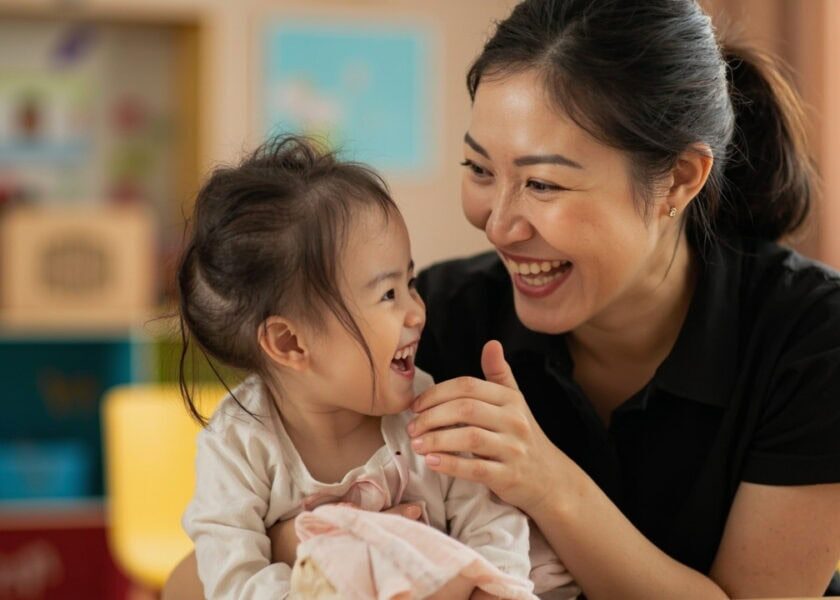
What Science Reveals About Your Baby’s First 12 Months
The Unspoken Truth About Infant Care in Singapore: Why the First 12 Months Are Not Like Any Other
There is a moment — you may remember it already, or you may be standing at the edge of it right now — when you place your baby into someone else’s arms and walk away. Not out of indifference. Not out of convenience. Out of necessity, out of love, out of the quiet understanding that providing for your child sometimes means leaving them.
And in that moment, something inside you cracks open in a way nothing else ever has.
It is not like leaving a toddler. Toddlers wave, they cry, they run to the window. Toddlers protest in a language you can understand. An infant offers you nothing like that. An infant cannot tell you if they are frightened. They cannot describe the quality of the voice that soothes them. They cannot point to a stranger’s face and ask who that person is. They can only feel. And in that feeling, so can you.
This is where the conversation about infant care in Singapore must begin — not with ratios or curricula or facility tours, but with the honesty of that moment. Because if we do not start there, we miss everything that matters about why infant care is not simply childcare for smaller people.
Quick Summary: The first 12 months represent the most rapid period of brain development in a human lifetime. Infant care is a distinct discipline requiring different ratios, training, and relational approaches. Caregiver attunement — the ability to read and respond to non-verbal cues — is the foundation of quality care. Choosing quality infant care is an act of love and courage, not a compromise.
The Science Behind Infant Care: Why These 12 Months Are Different
The first twelve months of a human life exist in a category of their own. This is not a marketing phrase — it is a neuroscientific reality.
Between birth and your baby’s first birthday, their brain is forming more than one million new neural connections every single second. That number is not a metaphor. It is a measurement, and it means that your infant is in the middle of the most rapid and consequential period of brain development they will ever experience — more impactful than any year of schooling, any enrichment program, any structured lesson that comes later.
The architecture of cognition, the wiring of emotional regulation, the foundations of trust and security — these are all being built now, in a period your baby cannot remember, in a language they have not yet learned.
Before your baby speaks, before they crawl, before they gesture intentionally, they communicate through physiology. Through the tone of a voice. Through the warmth of skin. Through the rhythm of being held.
An infant’s nervous system is exquisitely attuned to the quality of care it receives — not just whether needs are met, but how quickly they are met, with what emotional texture, in what state of presence.
What Attunement Means for Your Baby’s Development
Researchers call this attunement. It is the caregiver’s ability to read the baby’s cues — the slight stiffening of the body, the turning away, the rooting reflex, the way an infant’s breathing changes when they are overstimulated — and to respond with calibrated precision.
When a caregiver attunes to an infant, something remarkable happens at the neurobiological level. The baby’s stress response system learns that distress is temporary, that it is followed by comfort, that the world is a place where needs are heard even when they cannot be spoken.
This is not sentiment. It is the foundational science of attachment, and it is laid down in the first year of life with a permanence that no intervention can fully replicate later.
When attunement happens consistently, the infant’s developing brain allocates resources toward exploration, curiosity, and social engagement rather than toward hypervigilance and fear. The difference is measurable — visible in brain imaging, showing up in cortisol patterns, shaping the trajectory of a child’s capacity for relationships and learning for the rest of their life.
Why Infant Care Requires Different Mathematics
Consider the ratio. In many childcare settings designed for older children, a single caregiver may be responsible for several toddlers at once. For infants, the mathematics of attention are different because an infant cannot self-regulate, cannot wait, cannot signal need in a way that tolerates delay.
When a six-month-old is hungry, they are not experiencing a manageable inconvenience. They are experiencing a full neurological emergency. Their nervous system is designed to signal that need with urgency, and it requires a response that is immediate, warm, and attuned.
The difference between one-to-three and one-to-five is not merely a number. It is the difference between a caregiver who can read a baby’s microexpression and one who cannot. It is the difference between comfort that arrives in seconds and comfort that arrives in minutes. For a baby in the first year of life, those minutes are an eternity.
The Sensory Environment Is the Curriculum
Think about what your baby actually experiences in a care environment. The smell of it — whether it carries the neutral cleanliness of an institution or the lived-in warmth of a space where infants have been held and fed and comforted. The sound — whether it is the ambient hum of a television in the background or the responsive soundscape of a caregiver who narrates, hums, and mirrors your baby’s coos. The touch — whether it is the clinical efficiency of a routine or the slow, deliberate holding that allows an infant’s nervous system to settle.
These sensory details are not luxuries. They are the medium through which your baby’s brain is being built. The environment of infant care is not a backdrop. It is the curriculum.
What Quality Infant Care Actually Looks Like
What does this look like in practice, on a Tuesday morning in Singapore, when you drop your seven-month-old at a caregiver’s home?
It looks like a caregiver who knows your baby’s sleep cues — the way your baby’s eyelids grow heavy after the third yawn, the specific silence that means they are about to cry from tiredness rather than hunger.
It looks like a feeding rhythm that has been learned and documented and respected, because in the first year of life, feeding is not a logistical task. It is a relational act. It is where an infant learns that the world responds to them, that their signals mean something, that when they root and swallow, someone is receiving and honouring that communication.
It looks like a caregiver who holds your baby after a feed for the ten or fifteen minutes it takes for their digestion to settle, because a baby laid down too soon will wake in discomfort, and a caregiver who is rushed or overextended does not have those fifteen minutes to give.
It looks like a caregiver who sends you a photograph not because it is required, but because they understand that your day is structured around the moments when you receive proof that your child is okay.
Communication and transparency are not just words on a page. They are commitments enacted through regular updates, through documented developmental tracking, and through measures that give parents sight into their child’s day. Not surveillance — but trust-building.
The Human Element That Cannot Be Engineered
This is where the human element cannot be engineered or automated. Quality childminding programs invest in caregiver training and development — not just in compliance terms, but in the deeper sense of preparing a person to be present with an infant in a way that is skilled, responsive, and warm.
A great infant caregiver is not someone who simply follows a protocol. They are someone who can read a baby’s face the way a musician reads a rest — not as an absence of sound, but as a meaningful silence that shapes everything around it.
They know when to stimulate and when to still. They know the difference between a baby’s curious fussing and their distressed crying, and they respond to each with precision. This is attunement as a professional practice, and it is the heart of what makes infant care effective.
The Grief You Did Not Expect
And then there is the matter that no brochure can capture: the grief of the handoff.
Placing your infant in someone else’s care is an act of love that requires mourning. There is a grief in it — a letting go of the physical closeness that defined the first months of your child’s life, a grief for the version of yourself that felt fully sufficient.
And alongside that grief, there is a love so fierce it is almost indistinguishable from fear. You love your baby enough to be terrified. You love them enough to second-guess every decision. You love them enough to lie awake at three in the morning, one hand on your phone, reading everything you can find about infant development, about cortisol, about secure attachment, about whether you are destroying your child or giving them exactly what they need.
Here is what the evidence actually says: children whose parents make thoughtful, informed decisions about quality infant care do not suffer harm. They benefit. They benefit from the social richness of a stimulating environment, from the attunement of skilled caregivers, from the structure and rhythm that supports their developing nervous systems.
Guilt is not a signal that you are failing. It is a signal that you care deeply about getting this right. The courage it takes to place your infant in care is not smaller than the courage it takes to raise a child at home. It is a different courage, but it is not smaller.
It is the courage to trust that your love is not diminished by the presence of another caregiver. It is the courage to believe that your child can thrive in the arms of someone who is not you. It is the courage to act on evidence rather than guilt.
The Singapore Context and Your Real Concerns
Singapore parents are some of the most informed, most deliberate parents in the world. They research extensively, compare options carefully, and approach decisions about their children with a level of thoughtfulness that demands a corresponding level of seriousness from the services they choose.
This is precisely why the ECDA Childminding Pilot matters. It is not merely a policy initiative. It is a recognition — long overdue — that infant care in Singapore has deserved a higher standard and that parents have deserved a real choice in how and where that care is delivered.
The pilot creates pathways for home-based childminding and community-based care that treat infant care as what it is: a specialised practice requiring training, oversight, and genuine dedication.
Premium infant care should not be available only to those who can afford to treat it as a luxury. Every infant deserves a caregiver who is trained, ratios that are safe, and an environment that is designed for their specific developmental needs.
Common Concerns, Answered Honestly
“How do I know my baby is safe when I cannot see them?”
This is the central anxiety of infant care, and it deserves a real answer rather than reassurance. Quality infant care providers build trust through transparency: documented daily updates, feeding and sleeping logs, developmental tracking, and regular photographs that let you piece together your baby’s day. The goal is not to replace your presence but to extend your awareness into the hours you are apart.
“My baby cannot tell me anything. How do I know the caregiver is reading them correctly?”
You choose a caregiver based on their training, their demonstrated ability to articulate what they observe in infants, and the consistency of their care. Ask potential caregivers specific questions: How do you know when a baby is overstimulated? What does a hungry cry sound like versus a tired cry? How do you document a baby’s day? The answers will tell you whether attunement is a practiced discipline or an assumed quality.
“Am I damaging my child by placing them in care?”
The evidence is clear: children in quality infant care settings show no developmental harm and demonstrate benefits in social engagement, exploration, and secure attachment — provided the care is genuinely high-quality. Quality is the operative word. The question is not whether to place your child in care, but how to choose care that meets the developmental demands of the first twelve months.
How to Choose Quality Infant Care in Singapore
Here is what to look for when evaluating your options:
- Ratio that allows for attunement. For infants under twelve months, look for a maximum of three infants per caregiver. This is not a luxury — it is a developmental necessity.
- Trained caregivers who understand infant neuroscience. Ask about their training specifically in infant development, not just general childcare certifications.
- Evidence of attunement in practice. Ask how they read and respond to non-verbal cues. Look for documentation of your baby’s rhythms, not just schedules.
- Transparent communication systems. Daily updates, feeding and sleeping logs, and photographs are not extras — they are trust-building tools.
- Environment designed for infants. The space should feel warm and responsive, not institutional. Smell, sound, and touch matter.
- Consistency of caregiver. Infants cannot generalise caregivers the way older children can. A primary caregiver relationship is essential for secure attachment.
- Support for you as a parent. Quality care providers understand that your anxiety is real and provide resources, not just reassurances.
The Promise of Infant Care
There is a moment when you place your baby into someone else’s arms. Their skin is warm. They smell of milk and sleep. They do not know what is about to happen in their brain — the million neural connections forming every second, the attachment system wiring itself into permanence, the person they are becoming taking shape in response to the quality of care they are about to receive.
They do not know this. But you are beginning to.
And what you are beginning to understand is that this moment — this terrifying, loving, necessary moment — is not the end of your role in your child’s life. It is the beginning of a new one.
It is the moment when your parental love grows large enough to include another trusted adult. It is the moment when your trust extends beyond what you can see. It is the moment when your child begins to learn that the world is safe, that they are held, that someone is reading their signals and responding with care — and that their parents chose that person with more deliberation, more anguish, and more love than they have ever brought to any other decision.
That is what infant care is. It is not a service you purchase. It is a promise you make — to your child, to yourself, and to the caregiver you trust to stand in the gap between now and the day your child can tell you, in words, exactly how their day was.
If you are standing at the edge of this decision, EduNanny is here to help you make that choice with clarity and confidence. We approach infant care as a specialised practice — built around attunement, developmental responsiveness, and the standards Singapore families deserve.
Explore how EduNanny works with families through the ECDA Childminding Pilot, designed for the realities of Singapore family life with Monday to Friday care blocks, sustainable fee structures, and CDA and Baby Bonus usability so that the financial architecture of parenting does not add another layer of stress.
Your questions deserve thoughtful answers. Your baby deserves care that matches the seriousness of their development. And you deserve support that treats this decision — as it should be — as one of the most important you will ever make.
Begin the conversation with EduNanny.