Finding Childcare Where Your Child Will Truly Flourish
The Question Every Singapore Parent Carries to Childcare
There is a moment, every morning, that every parent in Singapore knows.
It happens when you hand your child over. Not the handover itself—you’ve prepared for that, you’ve done it a hundred times, you know which words to say and how to smile so your face matches your voice. The moment I’m talking about comes after. It arrives in the car, or on the MRT, or in the quiet of your office before the day begins. Uninvited, it asks a question that no tour of a childcare centre, no matter how thorough, can fully answer.
The question is this: what is my child’s day actually like?
Not what the routine says. Not what the photos show. Not what the teacher tells you at pickup when she says your child had a good day. What does it feel like in there, from inside your child’s small body, in that room full of other children, with other hands and other voices and an environment you cannot fully see?
You are not looking for a babysitter. You already know that. You are looking for something much deeper. You are looking for a place where your child will not merely be safe—though safety is the floor, not the ceiling. You are looking for a place where your child will flourish. Where the hours you are apart will be hours of growth, of joy, of the kind of rich experience that shapes a young mind in ways that will last.
This is what we want to speak to you about—not as a promise, not as a sales pitch, but as an invitation to see your childcare search through a different lens. The lens of your child’s experience.
What Quality Care Feels Like: A Child’s Sensory World
When a child walks into a quality childcare environment, they do not experience it the way an adult does. They do not notice the wall displays or the furniture arrangement. They do not read the mission statement on the entrance wall. They experience it with their whole body, all at once, through senses that are far more porous and present than ours.
They feel the temperature of the room against their skin. They register the sound level—whether it is calm and predictable or loud and unpredictable. They notice the smell, which sounds like a small thing until you remember that smell is one of the most powerful triggers of memory and emotion that we possess. A room that smells of clean laundry and warm food and something faintly floral, something like the scent of care—that is already a room that is speaking a language to a child before anyone has said a word.
They notice the light. Harsh overhead fluorescence is a different world from natural light filtering through windows, from the soft glow of a well-designed interior. Children in rooms with gentle, natural lighting are calmer. They are more able to settle. They are more available for learning and play, not because they have been taught to be, but because their bodies are not fighting against an environment that feels wrong.
They notice the textures available to them—the toys they can touch, the surfaces they can crawl on, the fabrics they can wrap around themselves. A quality environment is one that has been thought about not just in terms of what activities are scheduled, but in terms of what it feels like to inhabit that space with a child’s senses.
And perhaps most importantly, they notice the people.
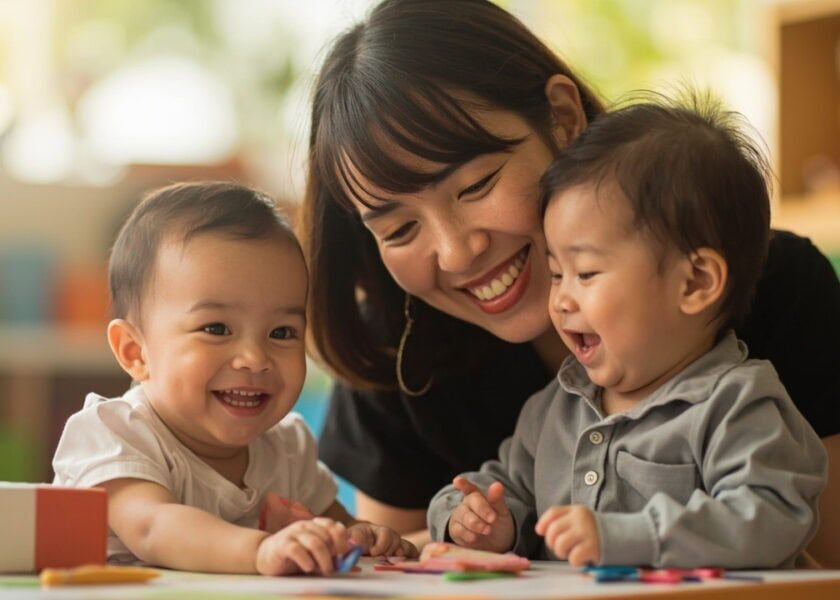
This is where the child’s experience diverges most sharply from anything a parent can evaluate on a tour. On a tour, you see the rooms, the ratios on paper, the qualifications displayed on a wall. What you cannot see—what only your child can feel—is whether the caregivers in that room are truly present. Whether they are warm in a way that registers in a child’s nervous system. Whether they speak in tones that soothe rather than startle. Whether, when a child falls and looks up with that sudden, startled cry, the response comes quickly, comes gently, comes with a voice and a touch that says: I am here, you are safe, I have got you.
That felt response. That sensory experience of being met with warmth in moments of distress—this is what creates the foundation for everything else.
The First Thousand Days: Why Environment and Relationships Shape Everything
In the first thousand days of life, a child’s brain is building connections at a rate it will never again achieve. Every experience, every interaction, every moment of feeling safe or feeling uncertain, is shaping the neural architecture that will underpin how that child learns, relates, and grows for the rest of their life.
This is not an exaggeration or an abstraction. It is the science of early childhood development, and it is the reason why the environment we provide for young children matters so profoundly.
In quality childcare, a child’s day is not a series of activities designed to fill time. It is a carefully considered rhythm—a sequence of states that mirrors what a young child actually needs. High-energy play followed by quiet time. Active engagement followed by rest. Group interaction followed by independent exploration. This rhythm is not a curriculum. It is an understanding of what a child’s body and mind need in order to feel regulated, to feel secure, and to be available for growth.
When a child feels this rhythm, when their day has a predictability that they can sense even before they have words for it, something remarkable happens. They begin to trust the environment. They begin to let go of the low-level vigilance that comes from not knowing what comes next. And in that safety, in that release of tension, they become free to explore.
You will see this in the way a child begins to move more confidently through a room. In the way they approach other children with curiosity rather than hesitation. In the way they reach for new toys, attempt new things, test their own capabilities. This is not random development. It is development that is only possible when the environment has given the child what they need to feel secure enough to grow.
The relationships in a quality childcare environment are not incidental. They are not simply the result of having enough staff to go around. They are designed, nurtured, and protected with intention.
In the ECDA Childminding Pilot, one of the key elements is the attention to caregiver ratios. With up to one caregiver for every three infants, there is space—actual, physical space—for the kind of responsiveness that young children need. A caregiver who is rushing between five or six children cannot respond in the way that a young child’s nervous system requires. But a caregiver who knows that they have the time to really listen, to really observe, to really respond—that caregiver becomes a source of security in a way that shapes the child’s developing brain.
In home-based pathways, this relationship goes even further. A childminder who comes into the family’s home, or who welcomes the child into their own home as part of a small community setting, becomes a familiar figure. The child’s world expands, but it expands safely, anchored by a relationship that the child knows and trusts. The caregiver learns the child’s rhythms, their preferences, the subtle cues that signal hunger or tiredness or the need for comfort. This knowledge is not written on a form. It is built over time, through daily presence, through the kind of attention that can only happen when the numbers allow it.
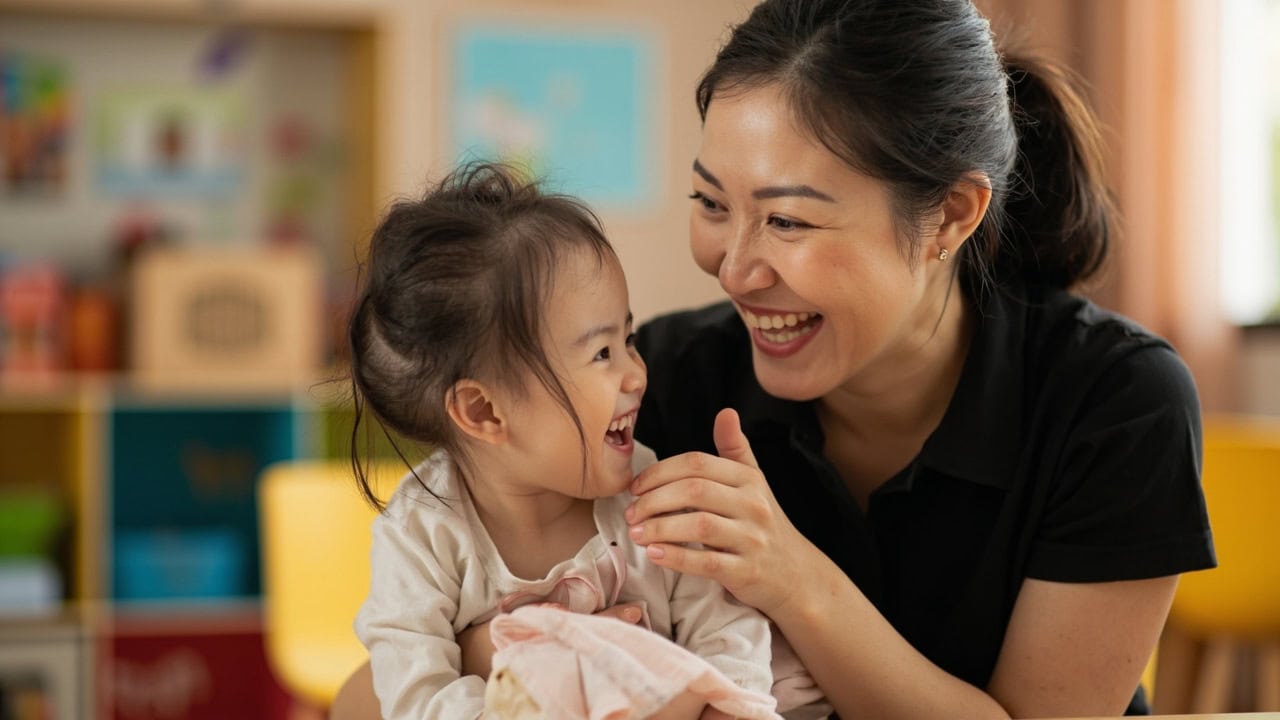
You will see the fruits of this consistency in small moments that may not seem significant but are, in fact, profound. The child who runs to their caregiver at drop-off, not with anxiety but with joy. The child who, after a moment of distress, seeks out that familiar figure for comfort and is soothed—not because the caregiver has special techniques, but because the child knows, in their body, that this person is safe. The child who looks up from their play and catches the caregiver’s eye and smiles, a small act of connection that speaks to a relationship built on trust.
Signs Your Child Is Thriving: What Parents Often Miss
Parents often wonder how they will know whether their child is thriving in childcare. They look for signs—Does my child seem happy when I pick them up? Are they meeting their developmental milestones? Do they seem to enjoy the routine?—and these signs are important. But there are other signs, subtler ones, that reveal a child’s internal experience in ways that the most detailed daily report cannot.
Increased Independence
A child who is thriving in quality care will often show increased independence over time. Not the forced independence of a child who has simply learned to manage without adequate support, but the natural independence of a child who has been given such a strong foundation of security that they feel confident exploring the world.
Watch for your child beginning to initiate play rather than waiting to be invited. For the child who starts to show interest in other children, who watches them, who eventually joins them. For the child who begins to show frustration and then, with time, begins to show the capacity to self-regulate that frustration with support from a caregiver.
Growing Curiosity
A child who is thriving will also often show increased curiosity. They will reach for new experiences, new textures, new sounds. They will show interest in the routines of the day, not because they have been trained to follow them, but because the routines have become a source of comfort and they feel ownership of them. They will begin to anticipate what comes next—not with anxiety but with the quiet pleasure of recognition.
Morning circle time. Wash-up before lunch. The story before nap. These rituals, when they are delivered with warmth and consistency, become the scaffolding for a child’s sense of security and their growing understanding of the world.
The Child Who Settles
And there is another sign, perhaps the most important one, though it is the hardest to articulate: the child who settles. Not just on the first day, but over weeks and months. The child who, despite the inevitable tears of separation at the beginning, settles into the rhythm of their childcare experience and begins to show, in a hundred small ways, that this has become a place that feels like theirs. That feels safe. That feels like a second home.
This settling is not the absence of challenge. Children in quality care are still learning to navigate the social world of other children. They still have moments of frustration and tears. But they return to equilibrium. They are supported through these moments by caregivers who are present, who are warm, who help the child to name and move through their feelings. And in this process, the child learns something essential: that big feelings are survivable, that they will be met with support, and that the world is ultimately a safe place to be.
Questions Worth Asking: How to Choose With Your Child in Mind
As you visit childcare centres and meet with childminders, here are some questions worth carrying with you—not as a checklist, but as a lens through which to observe:
- What does this room feel like to a small child? Close your eyes for a moment. What do you hear? What do you smell? How does the light feel against your skin?
- Watch the caregivers. Are they truly present with the children, or distracted? Do their voices sound warm when they speak to the children? Do they get down to the child’s level?
- Observe the children. Do they seem calm and engaged, or anxious and overstimulated? Do they move through the space with confidence?
- Notice the rhythm. Is there a predictable sequence to the day—active play, then quiet time, then rest? Does the environment feel ordered in a way that a child could learn to anticipate?
- Ask yourself: would my child feel safe here? Not safe in the sense of “no harm will come to them,” but safe in the deeper sense—safe to explore, to try new things, to be themselves.
The best childcare decisions are not made by parents who have found the most impressive facilities or the most comprehensive curriculum documents. They are made by parents who have learned to recognise what quality looks like from inside a child’s world.
For Parents in Singapore: Navigating Pressures and Guilt
Why does this matter for you, as you make a decision about childcare in Singapore?
Because Singapore is a city of pressures. The cost of living, the demands of careers, the expectations of families, the careful navigation of a society that moves quickly and values achievement. You are making childcare decisions not in a vacuum, but in the context of all of this, and it would be dishonest to pretend otherwise.
Many parents in Singapore carry a weight around this decision. They feel, in some corners of their mind, that they should be the ones providing this care. That leaving their child in anyone else’s hands is a concession, a compromise, a failure of some kind. This feeling is understandable. It comes from love. It comes from the fierce protectiveness that all parents feel for their children.
But here is what we want to offer, not as consolation, not as rationalisation, but as something more solid: quality childcare, when it is truly quality, is not a substitute for parental care. It is a complement to it. It is a gift to your child—a widening of their world, an enrichment of their experience, a set of relationships and environments that add to their life rather than replacing what you provide.
When your child walks into a quality childcare environment, they are not experiencing a lesser version of home. They are experiencing a different space, with different textures and sounds and faces, but one that has been designed with the same intention: to help them feel safe, to help them grow, to help them become who they are meant to be.
This reframing matters. It changes the question you are asking when you visit a childcare centre or meet with a childminder. You are not asking: Can I trust this person with my child? That is the baseline. You are asking: What will my child’s experience be here? What will they feel, learn, and become during the hours we are apart? Will this be a place that adds to their life in the way that they deserve?
This question requires a different kind of attention. It requires you to imagine, as best you can, what it is like to be inside your child’s body in that environment. It requires you to notice things—the tone of voice used by caregivers, the way children are positioned in the room, the quality of the light, the sounds of the space. It requires you to listen not just to what you are told, but to what you sense. To what your instincts, informed by love, are telling you.
And it requires you to ask the question that cuts through all the marketing and all the tours: Does this feel like a place where children are truly seen?
What EduNanny Offers
At EduNanny, this is the question that guides everything we do.
We participate in the ECDA Childminding Pilot because we believe in the model of care it represents. Small ratios. Consistent caregivers. Attention to the individual child. Flexibility in how care is delivered—home-based settings for families who want their child in familiar surroundings, centre-based pathways for families who value a different kind of community environment.
We offer Monday to Friday care blocks because we know that predictability matters to young children, and because we know that Singapore families need reliability they can count on.
Our fee structures are designed to be accessible, to remove cost as a barrier to quality. CDA and Baby Bonus funds can be used, as Singapore parents know, and we help families navigate these options because we believe that affordability should not mean compromise.
We have implemented communication and transparency measures, including CCTV where deployed, because we know that trust is built through openness. You should not have to wonder what is happening in your child’s day. You should be able to know.
But none of these—the ratios, the pathways, the communication tools—are the point in themselves. They are the conditions we have created so that something else can happen. So that something more important can take place.
What we are building, through EduNanny, is a model of childcare that begins with the child’s experience. That asks, at every decision point: what does this feel like for the child? What does this do for their sense of safety, their capacity to explore, their developing sense of self?
This is not a philosophy we arrived at lightly. It is the result of deep engagement with the science of early childhood development, with the experience of caregivers who have spent their careers in this work, and with the honest, sometimes painful, always illuminating feedback of parents who have trusted us with their children.
The Moment at Pickup—And the Decision That Follows
There is a moment at the end of every childcare day that is its own small miracle.
You arrive to pick up your child. The teacher or childminder smiles, hands over your little one, gives you a brief account of the hours in between. And your child—depending on their age, depending on their temperament—does something that tells you everything you need to know.
They reach for you. They bury their face in your shoulder. They are glad to see you, and in that gladness is an unspoken message: I was okay. I had a good day. You can relax.
But sometimes, if you are paying attention, there is something more. Sometimes, in the car or on the walk home, your child will say something—or gesture something, or simply look with a kind of quiet contentment—that tells you they experienced something good. A new toy. A new friend. The satisfaction of mastering something that was hard. The pleasure of a song they love or a story they have heard many times and want to hear again.
This is the experience you are seeking. Not just to know that your child was safe, not just to know that they were cared for, but to know that they had a day full of the kind of experiences that help a young human being to grow. That their hours without you were hours of richness, of learning, of the slow and beautiful work of becoming.
We know that choosing childcare is one of the most significant decisions you will make as a parent. Not because of the paperwork, not because of the logistics, but because of what it means for your child’s inner life. For the experiences they will have in your absence. For the relationships that will shape their sense of the world.
EduNanny is built around this experience. Around the belief that every child deserves a day that is more than just watched. That every child deserves to be in an environment where they are seen, known, and helped to flourish.
We would love to show you what this looks like. Not on paper, not in a tour, but in the experience itself—in the faces of the children, in the relationships you can feel when you walk into the room, in the quiet confidence that comes from knowing that your child is in a place that was built for them.
Ready to explore what a childcare experience built around your child’s world could look like? Get in touch with EduNanny to learn more about our home-based and centre-based pathways, our participation in the ECDA Childminding Pilot, and how we support Singapore families in finding the right fit for their child.
You can also learn more about EduNanny and our approach to quality, development-focused childcare.