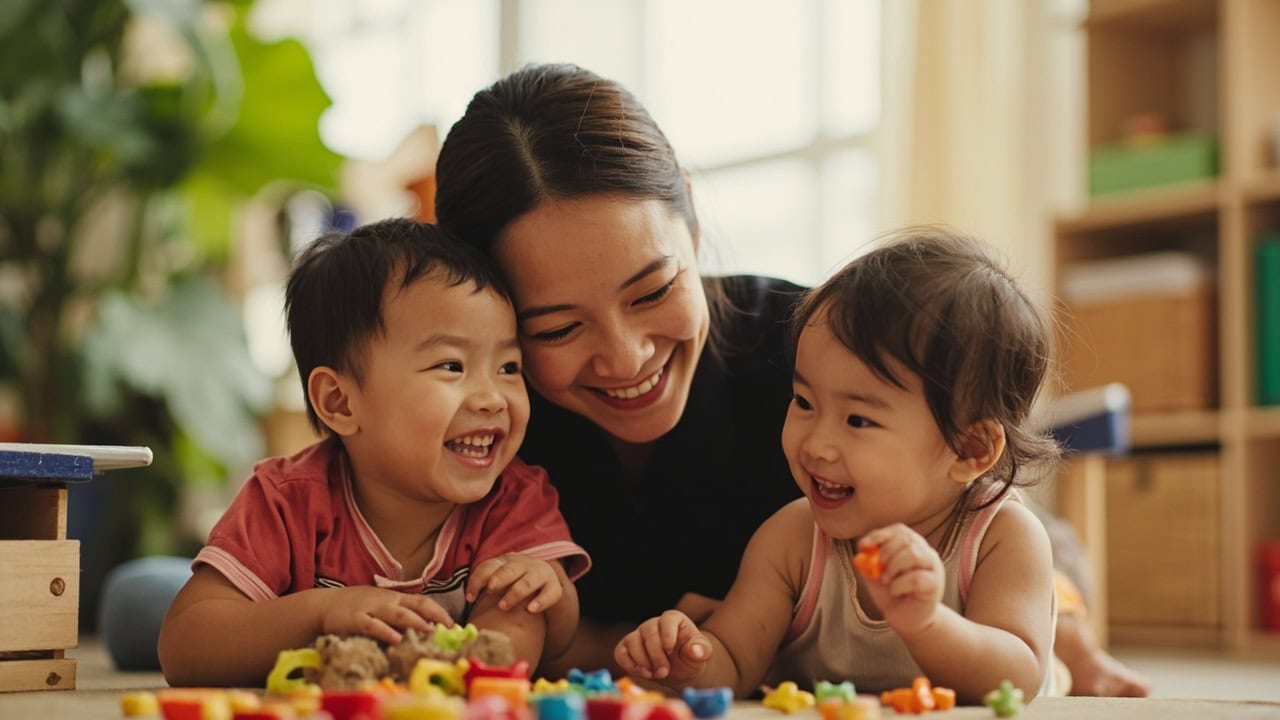
Your Child’s Growing Confidence Is the Proof That Matters
That Moment at the Door: When Trust Replaces Anxiety
There is a particular moment every parent who has chosen quality childcare learns to recognise, though no one ever tells them what to look for. It does not announce itself. It does not happen at the pickup window or in the first dramatic weeks of adjustment. It arrives quietly, somewhere between the second month and the fourth, on an ordinary morning when your child—who once clung and cried at every separation—turns back to wave at you from the door.
And instead of feeling relief that the separation is over, you feel something different. You feel trust.
That moment is not small. It is the evidence that matters most. And it is the moment many parents in Singapore never believe will come.
If you are a parent in Singapore researching infant care or childminding, this article is for you. It is for parents who have chosen carefully—and who still carry the quiet worry that quality care has not been able to settle. This article explores why that lingering anxiety is completely natural, what genuine trust in a care arrangement actually looks like, and how your child’s growing confidence is the truest sign that things are working.
Singapore Parents Are Not Uncertain People
Think about the parents who walk through the doors at EduNanny by BUTLER. They are not uncertain people. They are not careless. They have made thoughtful, deliberate choices about their children’s care. Many have done months of research. They have visited centres, spoken with childminders, read reviews, weighed costs against quality, navigated the landscape of infant care in Singapore with the same care they bring to everything in their lives.
And yet—even after they have chosen well, even after the arrangement is in place and the routine has begun—something does not let go.
The anxiety remains.
It lives in the background of their days. It shows up in the way they check the communication app more times than they need to. It is there in the second-guessing: was that nap long enough, was that texture introduced appropriately, is my child really happy or just tolerating?
Singapore parents carry enormous weight. The cost of living, the demands of dual-income households, the fierce ambition to give their children every advantage—all of it creates a pressure cooker of vigilance. And the cruel irony is that the very act of caring so deeply makes it harder to step back, even when stepping back is exactly what the child needs.
This is not weakness. This is love. Understanding that is the first step toward moving through it.
The Shift from Vigilance to Trust
Here is what most childcare conversations never address. They talk about the search. They talk about the decision. They talk about the first weeks and the first days and what to look for in a centre. What they do not talk about is what happens after—after the routine settles, after the child has been in care for months, after the family has had time to absorb the new reality.
What they do not talk about is the quiet, profound shift that happens in the best families, the one where something unlocks and everything changes.
The Signs You Are Still in Vigilance Mode
- You check the childcare communication app multiple times before noon
- You replay photos and updates looking for signs something is wrong
- You find yourself asking your child questions they cannot yet answer: “Were you happy? Did the teacher treat you well?”
- You feel guilty for being at work, even when you know the arrangement is the right one
- You second-guess decisions you made months ago
What Trust Looks Like When It Arrives
Trust is the parent who drops their child off in the morning and walks away with their shoulders settled, not because the world is simple but because they know—they know their child is in the right place.
Trust is the parent who receives a photo or a daily update and reads it not as evidence to be scrutinised but as a window into a happy moment.
Trust is the parent who picks up their child at the end of the day and is fully present, because their energy is not spent on monitoring—it is available for connection.
That is what quality childcare makes possible. Not by removing the parent’s role, but by restoring it. When the care arrangement is genuinely working, the parent is freed from the exhausting work of supervision and returned to the deeply human work of parenting—of being the steady, curious, present guide in their child’s life.
When a parent stops monitoring and starts trusting, they become a better partner in their child’s growth. They notice different things. They are no longer looking for evidence that the care is adequate; they are looking at their child—really looking—and what they see is astonishing. They see a little person who is curious, who is developing preferences, who is testing boundaries, who is becoming someone.
The shift is from managing anxiety to witnessing development. And that is not a minor thing. That is the relationship the parent came into this journey wanting to have.
Your Child’s Growing Confidence: The Evidence That Matters Most
We have seen this happen thousands of times at EduNanny. And the evidence is always the same, and it is always the child.
The child who, after months in the right environment, begins to explore. Not tentatively, not fearfully, but with the kind of confidence that comes only from genuine security.
This is the child who climbs and reaches and asks what happens if—because someone has taught them, through consistent, warm, responsive care, that the world is safe enough to explore. This is the child who will turn to their caregiver for comfort and then, moments later, run toward something new with abandon. This is the child whose sense of security is not fragile. It is rooted. It is real.
What Security Looks Like in a Young Child
- The child reaches for a caregiver’s hand when they need reassurance—and then lets go of that hand the next moment to walk ahead
- The child learns to manage small disappointments—the toy someone else picked up, the sand that does not pour the way they expected—because someone is there to name the feeling and stay with them through it
- The child ventures out from a safe base and returns, out and return, each time a little further, each time with a little more confidence
Developmental scientists call this psychological anchor a secure base—that place from which a child can venture out and return, again and again, growing in confidence with each cycle.
The Fear Beneath the Anxiety
Here is what we want every Singapore parent to understand: that confidence is not a sign that the child does not need you.
That is the fear. That is the quiet terror that lives beneath so much parental anxiety—the worry that someone else is becoming the primary attachment, that the bond is being diluted, that trust in the caregiver is somehow trust taken from the parent.
Nothing could be further from the truth.
The child’s confidence is proof of the foundation you built. The child who feels secure enough to explore has learned what security feels like—and that lesson began at home, with you. Quality care does not replace that lesson. It extends it. It reinforces it. It gives your child the lived experience of a second trusted adult, a consistent environment, a rhythm of responsiveness that deepens rather than divides the child’s sense of where they belong.
What Quality Childminding Actually Looks Like
This is what the first thousand days are actually about. Not the academic preparation that so much of the childcare conversation fixates on, but the building of a human being who believes—at the most fundamental, pre-verbal level—that the world is capable of meeting their needs, that they are worthy of care, and that it is safe to venture beyond what is familiar.
That belief, planted in the earliest years, shapes everything that follows. It shapes how a child learns, how they relate to others, how they handle disappointment, how they love.
And it is built not in a classroom. It is built in the small, daily, ordinary moments of responsive care.
The Details That Matter
- The way a childminder notices a child’s tiredness before the yawn
- The way she narrates what is happening in the child’s day with calm, warm language that wires language itself
- The way she adjusts the pace of the morning when she sees that a particular child needs more sensory time and less structure
- The way she responds consistently—so that the child begins to predict, to trust, to feel safe in the rhythm
This is not accidental. This is the work of a trained, dedicated caregiver who has been given the time and the ratios to actually see and respond to each child as an individual.
The Ratios That Make This Possible
In infant care, the number of children per caregiver matters enormously. It is the difference between a child being seen and a child being looked after.
At EduNanny, we are deliberate about this. Under the ECDA Childminding Pilot, our home-based and community-based pathways maintain the ratios that make this kind of care possible—up to one to three infants in our infant care settings.
That number is not arbitrary. It is the number that allows a caregiver to truly know each child, to notice what they notice, to build the continuity of relationship that makes a child feel known, not just looked after.
Addressing What Singapore Parents Really Worry About
“Will Quality Childcare Dilute My Bond with My Child?”
Many parents feel, in the early weeks and months of childcare, a strange guilt—as though trusting someone else with their child’s care is a kind of failure, or a subtraction. As though every hour spent in someone else’s presence is an hour they will never get back, a bond that is being quietly weakened.
We want to say this clearly: quality childcare does not take from your child. It adds to your child’s world. It adds a second set of eyes that loves them, a second environment that shapes them, a second set of hands that tends to them with skill and warmth.
And most importantly, it adds something to you—the parent. It returns to you the energy, the clarity, and the peace of mind that allow you to be fully present in the hours you do have together.
“Am I Just Supervising, or Am I Actually Parenting?”
Supervision is about keeping a child safe from harm. Parenting is about raising a human being—guiding them, learning who they are, discovering their temperament and their joys and their fears, and walking alongside them as they grow.
Supervision can be done by anyone with good intentions. Parenting requires a parent who has the capacity to be present. And that capacity is only available when the background anxiety has quieted enough to hear what your child is actually telling you.
“What If the Wrong Choice Damages My Child?”
Choosing childcare in Singapore is not simple. The costs feel significant. The options can feel overwhelming. The guilt is real. The second-guessing is understandable.
But we also know what is on the other side of that choice when it is made well—when the ratios are right, when the caregivers are trained and supported, when the communication is open, when the environment is warm and consistent and safe.
What is on the other side is your child waving at you from the door. Your child turning back with trust in their eyes. Your child running toward something new and looking back to make sure you are there—not because they are afraid you are not, but because you are the most important person in their world and they want to share the joy of discovery with you.
The Whole Family Thrives
We have seen siblings benefit from this shift too, in ways that are easy to underestimate. When the childcare foundation is solid, when parents are no longer carrying the weight of constant second-guessing, the family has more to give.
- There is more patience for the older child
- There is more presence at the dinner table
- There is a household rhythm that feels solid rather than frayed at the edges
The whole family benefits when the youngest member is genuinely thriving—not just surviving, but thriving—in their care environment.
Not a family where childcare fills a gap. A family where childcare strengthens the foundation so that the whole structure—parent, child, sibling, home—can stand taller.
What EduNanny Does Differently
We know that this matters enormously to Singapore parents in another, equally important way: the matter of trust in the arrangement itself.
We hear it constantly. Parents want to know what is happening in their child’s day. They want transparency. They want to feel connected to a world they cannot be inside of every hour.
At EduNanny, we take this seriously. Communication and transparency are built into how we operate—through regular updates, through open channels that keep parents informed, and through measures such as CCTV where deployed, because we believe parents deserve to feel confident, not just hopeful.
When EduNanny works the way it is designed to work, something shifts in the family. It is not dramatic. It does not announce itself. It is the difference between a household where someone is always on guard and a household where people can relax into being together. It is the difference between a parent who is managing and a parent who is leading—grounded, trusting, steady leadership of a family that knows, at its core, that it is secure.
That is what EduNanny does. And that is why, when you see your child growing in confidence, curiosity, and joy—you will know. Not because someone told you the choice was right. Because you can see it. In your child. Every single day.
The Moment Worth Waiting For
We know that choosing childcare in Singapore feels like one of the most consequential decisions you will make. It is. But on the other side of that decision—when it is made well—lies something extraordinary.
A family where parents can lead instead of manage. A child who explores with confidence because they know where they belong. A household where energy goes toward connection rather than anxiety. Siblings who benefit from parents who are present. A child who runs toward something new and looks back to share the joy with you.
That is the family we are building together at EduNanny by BUTLER. Not a childcare arrangement that merely functions, but a relational environment that transforms—that takes the anxiety that Singapore parents carry so bravely and so quietly, and replaces it with the kind of confidence that comes only from seeing your child thrive in the hands of someone you trust.
If you would like to learn more about how EduNanny approaches infant care and childminding in Singapore—and what the shift from vigilance to trust can look like for your family—we welcome you to begin a conversation with us.
At EduNanny, we believe that the right childcare arrangement should feel like an extension of your family—not a replacement for your role, but a trusted partner in your child’s earliest and most important years.
Learn more about our ECDA-approved childminding programme, or connect with our team to explore what quality, development-focused care looks like for your family.