What Real School Readiness Looks Like for Singapore Children
The Moment Every Singapore Parent Knows
You arrive at the childcare door a few minutes early. You stand back, watching. Your child is at the sensory table, or mid-sentence in a small group, or puzzling over something with the kind of concentration that surprises you. And for a moment, you feel it — not doubt, exactly, but something adjacent to it. A quiet wondering.
Is this, you ask yourself, the thing that is preparing my child for what school will actually ask of them? Is this daily experience — this play, this circle time, these small dramas with other children — building what Primary One will demand?
That question is one of the most honest questions a parent can ask. And it deserves more than a checklist of milestones or a brochure of curriculum outcomes. It deserves an answer that is true — not just reassuring, but genuinely, carefully true.
What School Readiness Actually Means
- Primary school asks more of your child’s social and emotional capacity than their academic knowledge. The real demands are sitting still when they want to move, waiting, navigating friendships, trying difficult things without knowing how to do them, and separating from you with trust.
- Academic preparation beyond a certain point does not produce children who do better in school. It produces children who are tired, bored, and arrive at Primary One having already learned that school is something to get through.
- Real school readiness is built in daily moments, not crash courses. It is the accumulation of feeling safe, supported, challenged at the right level, and genuinely curious about the world.
- Quality childcare achieves what parental effort alone often cannot. Not by replacing you, but by providing trained caregivers, intentional environments, and daily social practice with peers.
- Your child does not need you to be their teacher before Primary One. They need you to be their parent — and they need a trusted partner helping them build the foundations that will carry them through school and beyond.
What Primary One Actually Requires
Let us start with what Primary One really demands. Not the syllabus, not the assessments — those change, and they are not the real question anyway.
Primary school asks a child to sit still and pay attention when something inside them would rather be moving. It asks them to wait. It asks them to be in a room with twenty-five other children and navigate the invisible currents of social life — who sits with whom, who speaks first, who asks for help and who does not.
It asks them to try something difficult, and not yet know how to do it, and keep going anyway. It asks them to separate from you in the morning and trust that the day will be okay.
These are not academic skills. They are not things a child learns from a workbook or a tablet app. They are capacities — the kind of readiness that does not show up on a test but shows up every single day in a classroom: in a child’s willingness to raise their hand, to ask a question, to get something wrong and try again, to feel that school is a place where they belong.
| What Looks Like School Readiness | What Actually Matters in Primary One |
|---|---|
| Knowing numbers, letters, and colours before school | Arriving as a child who wants to learn |
| Being able to read simple words | Believing they are capable of learning |
| Completing worksheets quickly | Managing frustration when something is hard |
| Following instructions in a group | Navigating friendships and social dynamics independently |
| Staying quiet and seated | Regulating their own emotions and seeking help appropriately |
The Irony of School Readiness Anxiety
Here is what consistently emerges from research and the experience of early childhood educators: academic preparation in the earliest years, beyond a certain point, does not produce children who do better in school.
What it produces is children who are tired, children who are bored, and children who arrive at Primary One having already learned something deeply unfortunate — that school is something you have to get through before you can do what you love.
The readiness that actually matters — the readiness that will carry a child through their first year and well beyond — is not about knowing things before the teacher teaches them. It is about arriving at school as a child who wants to learn. A child who believes they are capable of learning. A child who has the emotional foundations to sit with discomfort, the social confidence to engage with peers and teachers, and the curiosity to find something genuinely interesting in the world around them.
That is a very different goal. And it is achieved in a very different way.
How Real School Readiness Is Built
So what does it actually take to build a child who approaches school with confidence instead of anxiety, with curiosity instead of exhaustion?
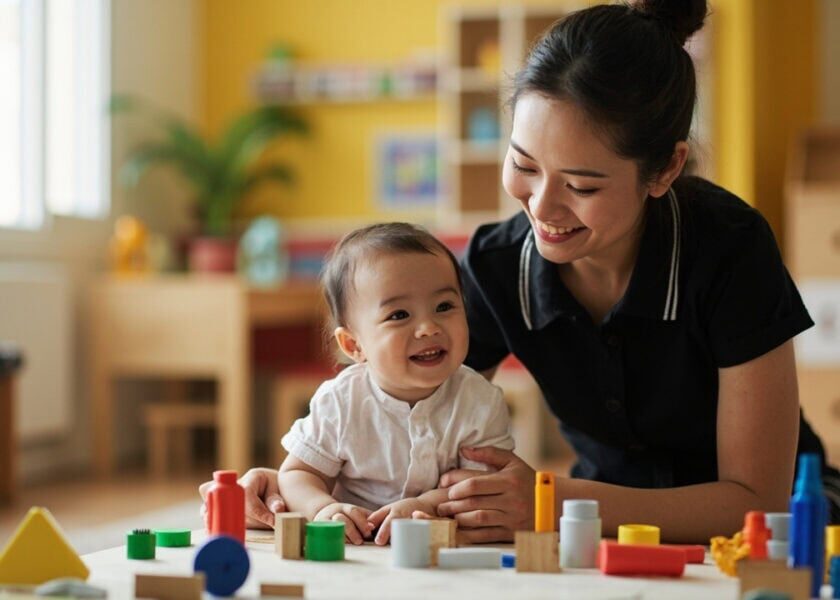
It is built in the daily accumulation of a childhood where a child feels safe. Where the environment is warm and consistent enough that exploring does not feel risky. Where a caregiver notices that a child is frustrated and helps them find words for what they are feeling instead of simply solving the problem for them.
Where a small conflict over a toy becomes a lesson in negotiation, and the caregiver is there — not hovering, not controlling, but present enough to guide and step back enough to let the lesson land.
The Power of Everyday Moments
Consider these scenarios that happen in quality care settings across Singapore every single day:
- The tower builder: A toddler has been struggling to build a tall tower for twenty minutes. The caregiver offers quiet acknowledgment — not loud praise, just a genuine “you worked really hard on that.” The child learns something profound about persistence and reward.
- The grumpy arrival: A three-year-old arrives at childcare clinging and resistant. The caregiver does not rush the goodbye. They give the child thirty extra seconds of closeness before gently turning attention to the play corner. The child learns that big feelings are survivable and the world is still trustworthy.
- The social puzzle: Two children want the same toy. The caregiver does not intervene immediately or declare a winner. Instead, they are nearby — ready to help problem-solve, but allowing the children to practice negotiation first. The children learn that relationships require give and take.
These are not dramatic interventions. They are ordinary. That is precisely what makes them powerful.
What Developmental Psychologists Call Scaffolding
In child development, scaffolding refers to the way a skilled caregiver adjusts the level of support to match what a child can currently do, then gently withdraws that support as the child grows more capable. It is borrowed from architecture, where a scaffold is not the building itself but the structure that supports the building while it grows.
Scaffolding is not doing things for the child. It is doing things with the child at the edge of what they can manage. And when it is done well, it is happening every single day in quality care.
What this produces is not a child who can recite numbers earlier than their peers. It produces:
- A child with attention — the capacity to focus on something meaningful
- A child with persistence — the willingness to try again after difficulty
- A child with emotional regulation — the ability to manage big feelings
- A child with social fluency — the skill to read a room, make friends, and advocate appropriately
- A child who understands that other people have needs and feelings too
These are the capacities that Primary One requires. And these are the capacities that no workbook builds. They are built through human relationship, through responsive care, through an environment that is intentionally designed to nurture the whole child.
A Different Kind of Early Childhood Care
You have read the articles. You have joined the parenting groups. You have seen the social media feeds of children doing science experiments and Mandarin immersion and violin lessons before the age of four, and some part of you wonders if you are falling behind.
The pressure to replicate developmental care at home is real, and it is exhausting. The energy you are spending trying to manufacture school readiness at home, under pressure, is not wasted because you are a bad parent or because you do not love your child enough. It is wasted because the goal you are reaching for — a child who is genuinely ready to thrive in school — cannot be achieved through effort alone, and certainly not through the effort of one exhausted adult trying to be teacher, entertainer, nutritionist, and emotional regulator all at once.
Quality childcare does not take over from you as a parent. What it does is provide something you cannot realistically replicate alone at home: a professionally designed environment, trained caregivers who understand developmental stages, a setting where your child learns to be part of a social world with other children, and daily practice of the skills that school will ask of them.
Our Framework and Approach
EduNanny is part of the ECDA Childminding Pilot, and that matters. It means we are operating within a framework designed by the people who understand early childhood development at a national level, and it means the standards we hold ourselves to are not self-defined but verified.
In our home-based care settings, we maintain ratios of up to one caregiver to three infants. That is not a marketing number. That is a promise that your child will not be one of twelve in a room.
It means when your infant is tired, someone notices. When your toddler is on the verge of a breakthrough in language or motor skill, someone is there to support it. When your child has a hard day, someone has the capacity to give them the individual attention they need to feel secure.
For families in the pilot, care is structured around Monday to Friday blocks, and fees are structured to be affordable within the pilot framework. Many families find that their Child Development Account and Baby Bonus can be applied, making quality care genuinely within reach.
Transparency and Trust
We believe that developmental care should not be a privilege reserved for families who can afford premium private programs. Every child in Singapore deserves to enter Primary One as a confident, curious learner, and that conviction shapes how we have designed our model.
Many of our settings have CCTV measures in place, not because we doubt our caregivers, but because we believe that parents deserve to feel genuinely confident about what happens during the day. You should be able to watch a clip of your child’s morning and see a caregiver on the floor with them, at their level, responding to what they are doing. You should be able to ask questions and receive real answers. You should be able to trust the people caring for your child — and we believe that trust is earned through openness, not guaranteed through silence.
We know that modern parenting comes with questions that do not always arise during business hours. Thomas, our AI-powered chatbot, is here for the questions that come at eleven p.m., the ones you are not sure are worth calling anyone about but that are keeping you awake anyway. Is this developmental milestone normal? How do I support my child’s separation anxiety this week? What should I be looking for in school readiness? Thomas is not a replacement for human guidance, but it is a reliable, thoughtful resource that makes the everyday navigation of parenting a little less lonely.
What We Are Not Offering
Let us be clear about what EduNanny does not offer: we do not give your child a head start on Primary One curriculum, we do not drill four-year-olds for streaming assessments, and we do not claim that children leave us reading at a Primary Two level.
That is not what matters, and we are not interested in performance metrics that flatter parents while exhausting children.
What we offer is something far more valuable and far more lasting: a daily environment where your child is known. Where their curiosities are noticed and built upon. Where their social conflicts are handled with skill and warmth. Where they are given just enough challenge to grow and just enough safety to take risks.
Where the people caring for them understand that their job is not to produce a finished product but to nurture the process — the process by which a child becomes someone who loves to learn, who believes in their own capacity, and who approaches new experiences with confidence instead of fear.
What to Look For: A Practical Guide for Parents
Whether or not EduNanny is the right fit for your family, these are the questions that actually matter when researching infant care or childminding in Singapore.
Questions to Ask Yourself
- Does my child come home energized rather than depleted?
- Do the caregivers seem attentive, warm, and genuinely engaged?
- Is the environment designed for exploration and meaningful play?
- Are children given space to struggle productively, with support nearby?
- Do I feel respected as a parent, and is there open communication?
Questions to Ask Potential Providers
- What is the caregiver-to-child ratio?
- How do you handle social conflicts between children?
- What does a typical day look like, and how much is child-directed versus structured?
- How do you support children who are struggling emotionally?
- Can I observe or visit to see how care actually happens?
- How do you communicate with parents about my child’s day and development?
Red Flags to Notice
- Promises of academic acceleration or curriculum drilling for under-fives
- Environments that prioritize order and compliance over exploration
- Caregivers who seem rushed, disconnected, or stressed
- Resistance to parental questions or observation
- Children who seem anxious, passive, or depleted at pickup
The Permission You Deserve
Choosing quality childcare is not checking a box. It is not outsourcing a responsibility. It is making one of the most thoughtful decisions a parent can make.
You are surrounding your child with people and experiences that are shaping them into someone who believes they can learn, who knows how to be with others, who can manage their feelings, who is curious about the world, and who will walk into Primary One not afraid, but ready.
Not because they have been drilled, but because they have been nurtured.
Here is what we want you to hear clearly: you have permission to stop second-guessing whether you are doing enough. Permission to trust that developmental care, done with intention and skill, is building exactly what your child needs. Permission to let go of the checklist and trust the process. Permission to enjoy these years instead of enduring them as a performance of parental due diligence.
Your child does not need you to be their teacher in the years before Primary One. They need you to be their parent. And they need a partner — a trustworthy, skilled, genuinely caring partner — to help them build the foundations that will carry them through school and far beyond.
That Pickup Door Moment
If your child is in a place that sees them — really sees them — if the caregivers are attentive and warm and intentional, if the environment is designed to support their development across every domain, then what you are watching is not just childcare.
It is the slow, daily, profoundly important work of building a human being who is ready for everything that comes next.
The readiness that lasts is not the one that shows up on a test. It is the one that shows up in a child’s eyes — the quiet confidence that says, I can do this. I am ready to learn. And I know that the people who love me are proud of who I am becoming.
That is the readiness we are building together at EduNanny. And it is the only one that truly matters.
If you are researching infant care or childminding in Singapore and want to understand how EduNanny can support your child’s developmental journey, we welcome you to reach out. Let us talk about what your family needs, answer your questions honestly, and help you make the decision that feels right for you.
Because when your child is ready — truly ready — it will not be because of a checklist. It will be because someone took the time to nurture who they are becoming.
And we would be honoured to walk that path with you.
Learn more about EduNanny’s home-based childminding services and our approach to early childhood care for Singapore families.