The Village You’re Building When You Choose Quality Childcare
The Moment at the Gate: What Quality Childcare Really Gives Your Child
There is a moment every parent knows. It happens at the gate. Your child is still adjusting to the weight of the small backpack, still blinking at the unfamiliar door, and you are already calculating the exact second you can turn around without making it worse.
You kneel down. You kiss the forehead. You say the words you have practiced — “I will be back. I love you. Have a beautiful day” — and your voice does not shake, but something inside you does.
And in that moment, a quiet thought surfaces, the one you do not say aloud because it sounds ungrateful: I should be enough.
That thought is not failure. It is love — the most honest expression of what you want for your child: that you would be everything to them if you could.
But what if the story you are telling yourself at that gate is not the story your child is living? What if, on the other side of that door, something remarkable is beginning?
What Quality Childcare Gives Your Child
For you, there is the ache of separation. For your child — when the environment is right — there is the beginning of something remarkable.
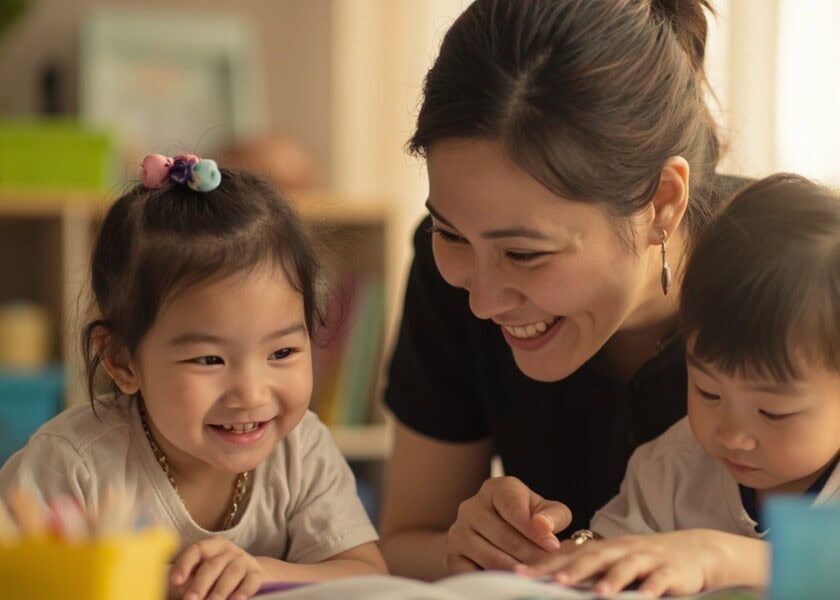
There is the moment a trained caregiver notices the way your toddler’s face lights up at a specific book, and quietly makes a note to bring it out again tomorrow. There is the child who learns, over weeks, that another adult can be trusted to wipe a tear, to celebrate a small victory, to know their name in the way that matters.
There is the quiet discovery that there is a world beyond the one they came from, and that world is not frightening. It is alive with other children, with textures and sounds and rhythms they have never encountered, with a kind of attention that is patient and curious and focused entirely on who they are becoming.
Quality childcare gives your child:
- A second trusted environment where they are known by name — not as a label, but as a recognition of who they are becoming
- Trained observers who notice developmental patterns that the intimacy of daily family life may not reveal
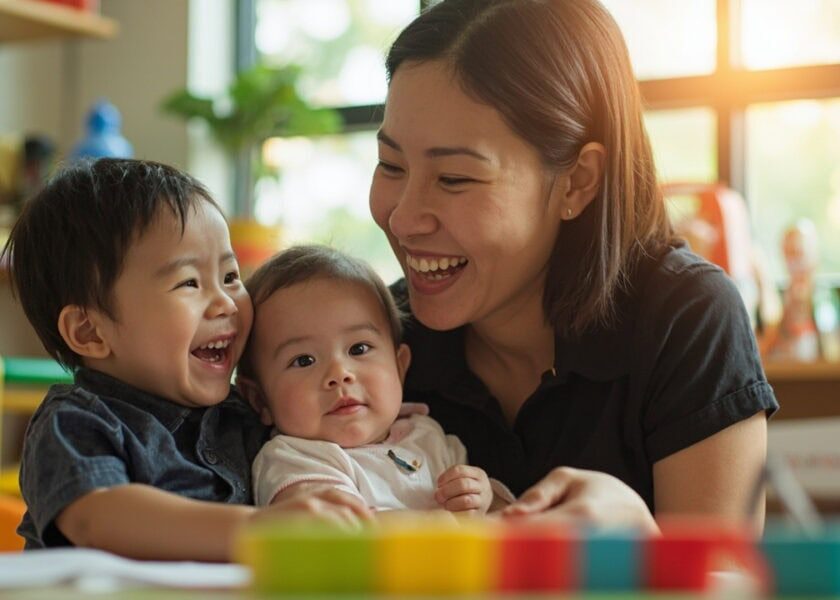
- Peer community — the first social world outside your family, where social intelligence develops through navigation, negotiation, and recovery
- Emotional resilience built through consistent, quality attachment in a secondary setting
- A stronger sense of self — children who thrive in quality care come home more themselves, not less
This is not a substitute for you. Not a stopgap until you return. It is a developmental environment you alone cannot replicate — no matter how present, how attentive, how devoted you are.
The Social World Only Peers Can Teach
When a child spends their early years primarily in the care of one or two adults, they develop beautifully in certain ways. They learn the rhythms of their home. They develop deep attachment. They know the sound of your voice in every register.
But there is something they cannot learn in that setting alone: who they are when they are not with you. The self that emerges in the presence of peers. The social intelligence that develops only through navigation — through the beautiful, messy negotiating of shared toys, of chosen friends, of the first heartbreak when someone takes the red truck, and the first lesson in recovery when a caregiver sits beside them and helps them find words for what happened.
A child in quality childcare is not just being cared for. They are being formed. They are building the first architecture of their social world — learning how to read a room, how to assert, how to share, how to recover, how to belong.
This happens not because you have failed to teach them these things, but because these lessons can only be learned through community. No matter how much you read to them, they will learn to navigate a storytime conflict better with other children present. No matter how much you model kindness, they will understand its power more fully when another child chooses them as a friend.
Building Your Child’s Village in Singapore
In Singapore, the demands on families are particular. The cost of living. The pace of work. The distances we travel. The way grandparents often live across the island rather than across the street.
Many Singapore parents are managing complex arrangements — long commutes, demanding careers, extended family who want to help but cannot always be present. The modern reality of family life here means that the traditional village is often not immediately available.
And yet, the developmental need for that village has not changed. Children still need multiple trusted environments. They still benefit from relationships beyond immediate family. They still grow through peer community and trained observation.
Choosing quality childcare is not a concession to circumstance. It is a deliberate act of building — constructing for your child the environment they deserve, one where they can belong, grow, discover, and become.
Trained Observation and Caregiver Ratios
What trained caregivers bring to this process is something families often underestimate. In a quality environment, the person holding your child is not just keeping them safe. They are observing. They are noticing the developmental patterns that you, in the intimacy of daily life, may not see.
The caregiver who has cared for dozens of children in this age range knows that a particular behavior — the way your infant reaches for certain objects, the sound pattern of your toddler’s frustration, the way your two-year-old navigates group play — connects to a larger picture. They have seen it before. They know what it means.
When the caregiver-to-child ratio is one to three, or better, the quality of attention is simply different. The child is not one of twelve. They are one of two or three.
This means the caregiver can notice the shift in mood before it becomes a meltdown. They can follow the child’s interest as it develops over days and weeks. They can build the kind of consistent, responsive relationship that research shows is the foundation of emotional security.
What EduNanny Singapore Offers
EduNanny Singapore was built with a clear truth at its center: when you choose an environment for your child, you are choosing the second pair of eyes on their development. You are choosing observers who bring training, patience, and professional curiosity about who your child is and who they are becoming.
The ECDA Childminding Pilot that EduNanny participates in reflects this commitment — an acknowledgment that home-based and community-based care, when delivered with professionalism and consistency, is not an inferior option. It is a different pathway, one that carries its own unique developmental benefits.
EduNanny’s fee structures are designed to be accessible within the pilot framework, and families can use the Child Development Account and Baby Bonus subsidies to manage costs. Monday to Friday care blocks are structured around the realities of working family life.
Communication is open and ongoing — whether through daily updates, transparent reporting, or in cases where deployed, CCTV access that allows you to feel the quiet reassurance of seeing your child in their environment. These are not peripheral details. They are the infrastructure of trust, and trust is the foundation of everything.
How to Choose Quality Infant Care in Singapore
If you are beginning to research your options, here are the questions worth asking:
- What is the caregiver-to-child ratio? Lower ratios mean more individual attention, more observation, more responsiveness to your child’s specific needs.
- What training do the caregivers have? Look for providers whose staff are equipped to observe developmental patterns and communicate them to you clearly.
- What does communication look like? How will you know what happened during the day? What is their approach to the handoff conversation at pickup?
- How does the environment feel? If possible, visit. Watch how the children move through the space. Notice whether they seem at ease, curious, engaged.
- What is the provider’s approach to transition? A quality provider will have a thoughtful process for helping your child — and you — adjust to this new arrangement.
The right choice is not the one that eliminates your hesitation. It is the one that, over weeks and months, you watch your child come home more themselves — more curious, more confident, more certain of who they are.
You Are Not Outsourcing. You Are Building.
There are voices — some external, some very internal — that tell you that the ideal is maternal presence, or at least the presence of one consistent family member until the child is much older.
I am not here to dismiss that voice entirely. There is a truth in it: children do need consistent, loving presence. They need to feel anchored to the people who brought them into the world. That is real, and it matters, and no childcare arrangement should ever undermine it.
But the question is not whether your child needs you. Of course they do.
The question is whether your child needs only you.
And the answer, grounded in decades of developmental science and in the lived experience of millions of families, is no.
Your child needs you. And your child needs what you alone cannot give them. And the bravest, most generous thing you can do as a parent is to acknowledge that and act on it — to build the village your child deserves, even when the construction involves your own discomfort, your own morning hesitations, your own moments at the gate where you wish you could be enough in the way you once thought you should be.
Every morning when you drop your child at quality care, you are not outsourcing a problem. You are constructing an environment that your child deserves — one where they can belong, grow, discover, and become.
You are investing in their developmental world the way you would invest in their nutrition, their sleep environment, the quality of the air they breathe. You are saying, through your choice, that your child matters enough to have more than one set of loving eyes on them.
That is not guilt. That is purpose. That is not compromise. That is commitment.
A Final Word to the Parent at the Gate
The next time you stand at the gate, and the quiet voice inside you says “I should be enough”, I want you to remember something.
You are enough. You are enough in ways that matter and will always matter. But your child deserves more than your enough.
Your child deserves the full, rich, varied, challenging, nurturing world that you — by your choice, by your trust, by your willingness to build beyond yourself — are giving them.
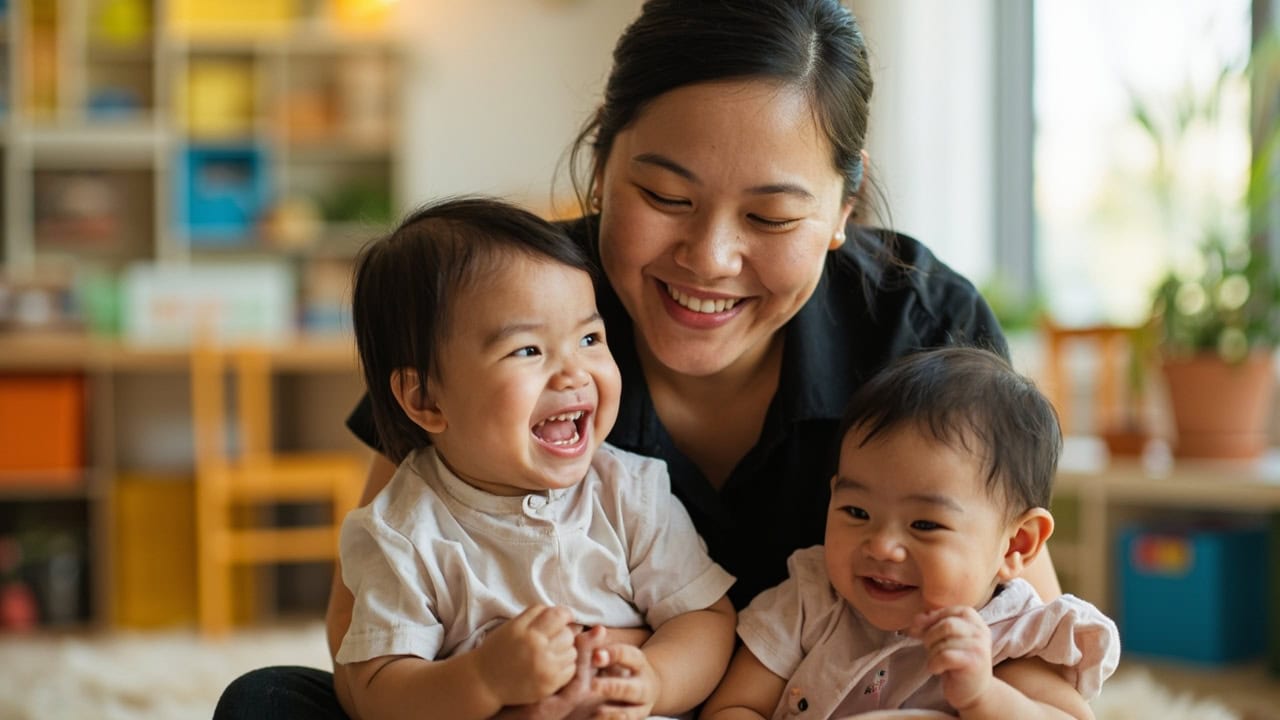
They deserve a village that will know their name, remember their favourite song, notice when they are tired or hungry or proud. They deserve a second home that belongs to them as much as the first.
They deserve to be seen. They deserve to be in a place where their curiosity is noticed, their frustration is met with patience, their small victories are celebrated, their emerging self is recognised and welcomed.
That is not compromise. That is love, at its most complete.
There is a quiet way to know whether your childcare arrangement is working: look at how your child carries themselves. Look at how they enter a room — whether they look around with curiosity rather than anxiety, whether they move toward other children, whether they trust that the adults in the room will be kind.
Look at whether they come home full of themselves — full of stories, full of small triumphs, full of the person they are becoming.
That is the measure that matters. And your child, in that village you have built for them, is becoming more themselves every single day.
If you are ready to explore what quality childminding looks like for your family, we invite you to speak with EduNanny Singapore about your child’s needs and what a partnership built on trust and developmental attention could look like for your family.
Tags: #QualityChildcareSingapore #InfantCareSingapore #ChildmindingSingapore #EarlyChildhoodDevelopment #EduNannySingapore