Beyond Hope: Learning to See Quality in Your Child’s Care
The Moment Every Singapore Parent Knows
There is a particular moment that every Singapore parent knows, even if they have never spoken it aloud. It comes after the tours and the brochures and the conversations with other parents who seem equally uncertain. It comes when you have made your choice, signed the forms, and brought your child through the door for the first time.
Is this right? Did I choose well? Will my child be okay here?
You tell yourself the questions will fade. Sometimes they do. But for many parents, they linger in the background of every pickup, every handover, every casual comment your child makes about their day.
You are hoping, quietly and constantly, that you chose correctly. And hope, while beautiful, is not the same as knowing.
What if there was another way? What if the doubt you carry was not a problem to suppress but a capacity to develop? What if, instead of hoping your child is thriving, you could learn to see it?
Learning to See Quality in Infant Care
Let me tell you what happens when parents begin to see.
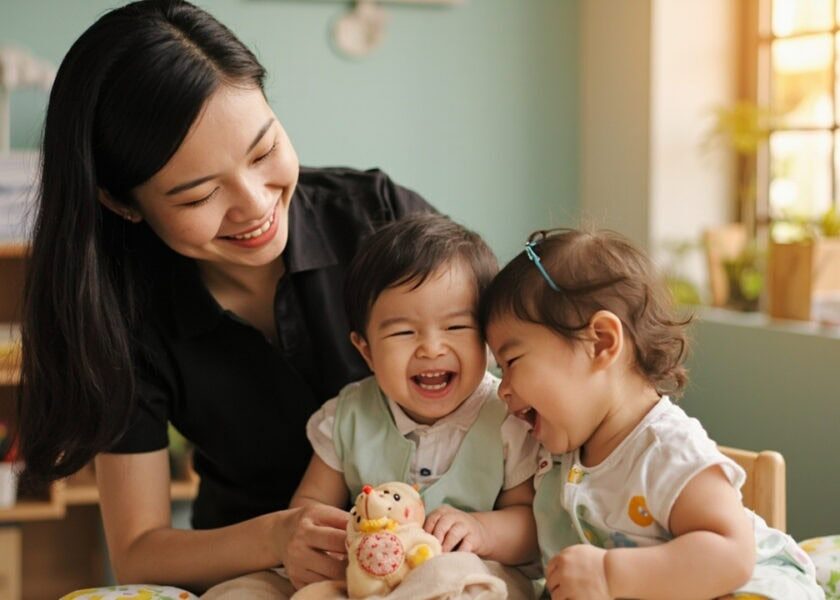
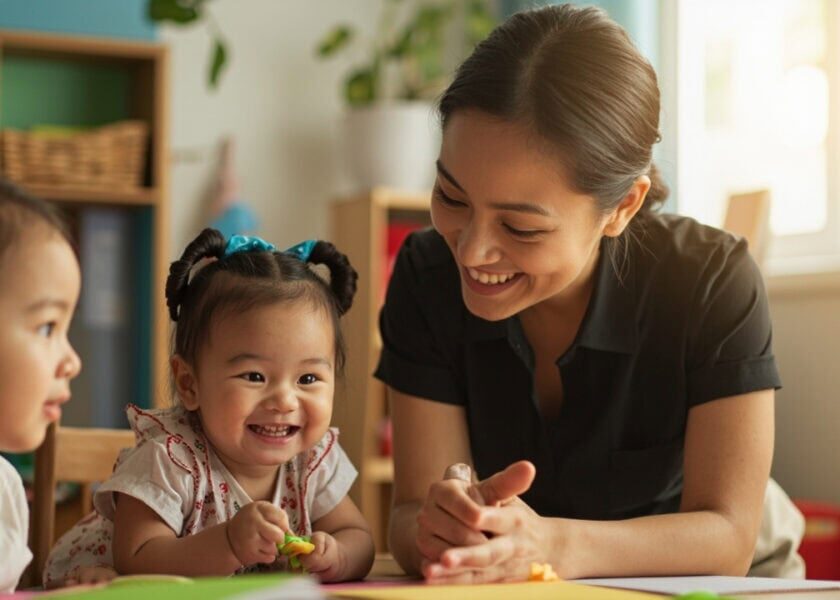
A mother walks into her child’s infant care room and, for the first time, does not just look—she observes. She notices that when her daughter approaches the caregiver, there is no hesitation in the woman’s body. She is already down at the child’s level, her hands free, her face open. The child reaches up and the caregiver responds not with a grab but with a slow, deliberate movement that says: I see you. You are in charge here.
This is not a scripted moment. It cannot be faked consistently. And once you have seen it once, you begin to see it everywhere in rooms where care is genuine.
You see it in the way a caregiver narrates what she is doing as she changes a diaper—not because she is performing, but because she has learned that infants understand far more than they can say. Naming their world is a form of respect. You see it in the way a toddler’s tantrum is met not with silence and waiting, but with a voice that names the feeling: You are so frustrated the tower fell. You worked so hard on it.
These are not techniques. These are habits of attention. And they are visible to any parent who has learned to look.
What Quality Actually Looks Like
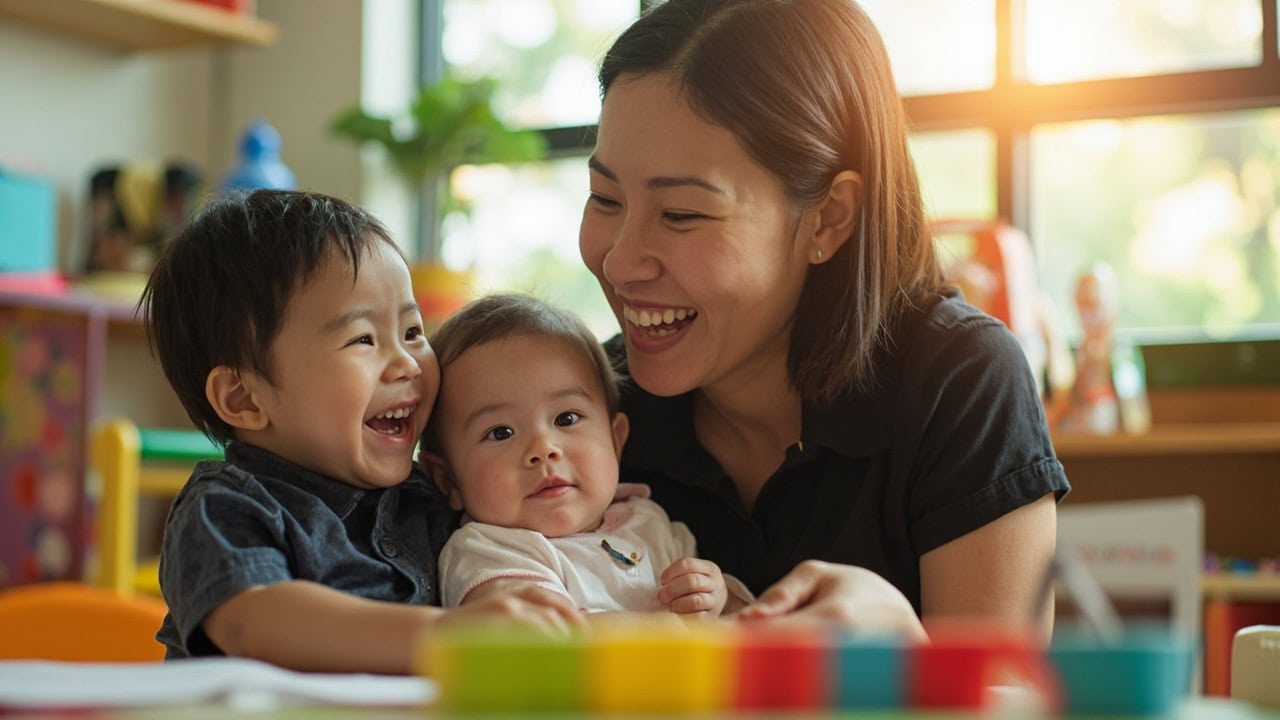
When you walk into a quality infant care space, the first thing you should notice is the children themselves. Are they tense or relaxed? Do they move through the room with a sense of ease, or are they constantly seeking the reassurance of a familiar body?
Some of the most settled rooms are relatively quiet, filled with the hum of focused play. What you are looking for is the quality of children’s engagement—with people, with materials, with the space itself.
A child who trusts her environment will explore. She will move away from her caregiver, then return, then move away again. This rhythm of departure and return is not a sign of insecurity. It is the signature of security. It means the child has internalised the knowledge that her caregiver is steady, that the door will not close, that she can widen her world because the centre holds.
The Ratio That Makes Attention Possible
Now look at the caregivers. Notice whether they move through the room with their attention already on the children, or whether their faces are turned toward each other, toward their phones, toward the door.
Attention is a resource. Where it flows, trust grows.
Infant care is not about supervision. It is about relationship. And relationship requires the kind of attention that only becomes possible when ratios are small enough for human beings to actually manage.
That is why EduNanny maintains ratios that allow caregivers to know each child—not just their name and their schedule, but their particular ways of expressing hunger or fatigue or the joy of mastering something new. One to three. Up to three infants for every attentive adult. This is not a number on a compliance checklist. It is the mathematical expression of what it means to truly see your child.
The Language Children Speak
Children communicate. They communicate constantly and eloquently. The problem is that their language is not words.
When a toddler bites another child, she is not being aggressive. She is expressing something she lacks the vocabulary to say. Perhaps she is overwhelmed by the noise and did not know another way to create space. Perhaps she is testing a caregiver’s response, trying to understand whether the adult will intervene, whether the world has rules she can trust.
The bite is not the message. The bite is the cry for help in a language the adults around her must learn to translate.
What you want to see in a quality childcare environment is not just children being happy. Happiness is an outcome, not a process. What you want to see is engagement, and what you want to hear is a caregiver who can interpret what she sees.
What Observation Looks Like in Practice
Watch what happens when a child falls. In a room where caregivers have been trained to observe, the adult does not rush immediately to comfort. She watches first. She reads the child’s face. She asks, Are you okay? And she waits for the child’s response before deciding whether to move closer.
This is not distance. This is respect. It is the caregiver giving the child the opportunity to be capable, to discover her own resilience, while remaining close enough to catch her if she is truly hurt.
The child who is allowed this small autonomy repeatedly becomes a child who knows she is competent. She develops what psychologists call self-efficacy—not the grand notion of believing in yourself, but the quieter, more foundational knowledge that you can affect your world, that your actions have consequences, that you are not merely a recipient of care but a participant in it.
When care ratios are manageable, when caregivers have time to observe before responding, when the environment is designed for this kind of attentiveness rather than merely for supervision—then your child is not just being kept safe. She is being known.
Your Anxiety Is Information
You have a childcare arrangement. Perhaps it is EduNanny, perhaps it is something else. You bring your child in the morning and there is that familiar tightness in your chest. You hand your baby to someone else and part of you wonders if you have made a mistake, if you are somehow failing as a parent by being here at all.
I want to say something to you about that tightness, because it deserves more than reassurance. It deserves respect.
The anxiety you feel is not irrational. It is the evidence of a bond. You are biologically and emotionally attuned to your child in a way that makes separation genuinely difficult. This is not weakness. This is what it means to love someone with your whole self.
At the same time, your anxiety is also information.
It tells you that this matters. That your child matters. That the quality of care she receives is not a logistical problem to solve but a moral responsibility to take seriously.
The parent who feels no anxiety about childcare may simply not be paying attention. The parent who feels anxiety and uses it as fuel to observe, to question, to look more carefully—that parent is doing exactly what good parenting requires.
The Signs of a Child Who Knows
So here is what the journey looks like when you begin to see.
You arrive at pickup and your child is playing quietly with some blocks. She looks up when she sees you, smiles, and returns to her play. She does not cry. She does not cling. She simply acknowledges you, like someone who trusts that you will be there, who has nothing to prove because she already knows where she stands.
This is not indifference. It is security.
A few months ago, this same child would have cried when you arrived—not because she was unhappy but because she was overwhelmed by the relief of seeing you. That crying was also a sign of health. It meant she felt safe enough to fall apart, to trust that you would put her back together.
But this new response, this calm acknowledgment, is the next stage. It means she has integrated her two worlds. She knows she belongs at home and she knows she belongs here. She is not torn between them.
What to Listen For at Pickup
Ask the caregiver what your child did today. Listen to the answer. Not the scripted version—Children played and learned and had snack time. But the specific version.
- Did she notice that your daughter was fascinated by the way the water moved in the tray this morning?
- Did she observe that your son seemed tired and was given more support during the group activity?
- Did she mention that she tried a new approach with your child during feeding, one that seemed to work better than the day before?
These are the details that tell you your child is known. They are not elaborate progress reports. They are the small, daily recognitions that a caregiver who has time and attention and genuine care would naturally notice.
What EduNanny Actually Offers
EduNanny by BUTLER operates under the ECDA Childminding Pilot, which means it is part of a national effort to expand the range of quality care options available to Singapore families. This is not a generic childcare service repackaged with a premium name. It is a deliberate experiment in what infant care can look like when ratios are designed for attention, when caregivers are trained not just to manage children but to know them.
Home-based and centre-based pathways are both available, because families are not all the same. Some children thrive in the intimacy of a home environment, with smaller groups and the rhythms of domestic life. Others respond to the richer social world of a centre. EduNanny does not insist on one model. It asks what your child needs and works from there.
| Feature | What This Means for You |
|---|---|
| ECDA Childminding Pilot | Aligned with national quality standards for infant care |
| 1:3 Care Ratio | Caregivers can truly know each child, not just manage them |
| Flexible Pathways | Home-based or centre-based based on your child’s needs |
| CDA and Baby Bonus Usability | Quality care accessible beyond premium pricing alone |
| Parent Partnership Model | Regular updates and honest communication built into the programme |
The practical details matter too. Monday to Friday care blocks that align with the rhythms of working parents. CDA and Baby Bonus usability that makes quality care accessible rather than a luxury reserved for those who can pay premium rates without question.
Being Seen Versus Being Kept
There is a caregiver I want you to imagine. She has been working with infants for years. She has learned to read the signals—the slight furrow that means tiredness coming, the reaching arms that mean a need for movement, the sudden stillness that can precede either deep concentration or the beginning of a meltdown. She has learned these signals not from a textbook but from hundreds of hours of attentive presence.
When she looks at your child, she is not just checking a box. She is noticing. And when she reports back to you—not because she has to but because she genuinely wants you to know—she is offering you something valuable. She is showing you that your child has been seen.
This is the dignity of care. Not just the physical meeting of needs—feeding and sleeping and keeping safe—but the relational meeting of souls. The recognition that this small person has an inner life, a way of experiencing the world that is particular and worth knowing.
You Are Not Failing Your Child
The guilt that Singapore parents carry about returning to work, about entrusting their infants to others, about not being the constant presence they feel they should be—this guilt is not yours to carry alone.
But here is what the evidence consistently shows: children do not need perfect parents. They do not need parents who are always there. They need parents who are reliably present when they are present, and who have made thoughtful, loving arrangements for the times when they are not.
The parent who drops her child at EduNanny in the morning, who has taken time to find a programme that takes her child’s development seriously, who asks questions and observes and stays engaged—this parent is providing. She is meeting her child’s need for security not just through her own presence but through the presence of a trusted environment that will support her child’s growth.
And here is the remarkable thing: when you find that environment, when you learn to see it clearly, the guilt begins to dissolve. Not because you have been told to stop feeling it, but because you have evidence. You have observable, specific, daily evidence that your child is not just being kept but is being known.
The Gift of Seeing
This is the gift of seeing. Not the elimination of doubt, but the transformation of it. Not the absence of questions, but the presence of answers you can trust.
EduNanny is here to walk this path with you. Not to replace your role as a parent, but to support it. Not to make decisions for you, but to give you the information you need to make decisions with confidence.
Perhaps it is time to schedule a visit. To walk through a door and begin to notice what you have always had the eyes to see.
EduNanny is a development-oriented childminding and childcare service for families in Singapore. Learn more about who we are or explore our approach to thoughtful, quality care.