The Question Behind Every Goodbye: Choosing Caregivers Who Truly Know Your Child
The Question Behind Every Goodbye
There is a moment that happens — more often than parents expect — in the driveway, at the door of a childcare centre, or in the living room before a caregiver arrives. It is brief. Sometimes barely a flicker. But it is there: the half-second when you look at your child and feel a small, quiet question rise in your chest.
Are you okay? Are you safe? Are you truly, genuinely okay?
Most parents do not speak this question aloud. It would feel strange to name it, even foolish. After all, you have chosen this caregiver. You have done the interviews, checked the references, trusted your instincts. You know, intellectually, that your child is fine. But that question persists — soft and stubborn — in the background of every morning goodbye.
This moment is not a failure of trust. It is not parental anxiety in the clinical sense. It is something older and more fundamental. It is the knowledge — written into our bodies and our species — that for a young child, the quality of their relational world is not a peripheral concern. It is the world itself.
When we leave our children, we are not simply entrusting them with supervision. We are asking someone else to be, for the hours we are apart, the emotional geography of our child’s inner life.
That is an enormous thing to ask of anyone. And it is an enormous thing to receive — to be trusted with the soul of a small person, their sense of safety, their first understanding of what it means to be known and responded to.
For parents in Singapore, this question carries additional weight. The cost of living means most families need two incomes. Grandparent support is a blessing but not a given. The network of reliable, quality childcare is a genuine and daily concern. You drop your child at 7:30 in the morning. You leave for work, for meetings, for the obligations of a city that does not slow down. And you cannot be in the room to see what happens.
You can only look for signs.
What Developmental Science Tells Us About Caregiver Bonds
In the first thousand days of life, a child’s brain builds more than a million neural connections per second. This fact has become familiar in parenting discourse, but what it means in practice is less often explored.
Those connections are not built by toys or curricula or even by the richness of visual stimulation. They are built, primarily, through relationship — through the quality of back-and-forth attunement between a child and the people who care for them. Through moments of cooing that are met with a warm voice. Moments of distress that are met with calm comfort. Moments of curiosity that are met with shared attention and delight.
The Secure Base: Foundation of Everything
Developmental psychologists call this the secure base — a concept first articulated by the British psychiatrist John Bowlby, whose work on attachment transformed our understanding of early childhood. The secure base is the platform from which a child explores the world, knowing they can return to safety. It is the relational foundation from which everything else grows: emotional regulation, social confidence, the capacity to trust, the willingness to try.
For decades, attachment theory focused almost exclusively on the bond between infant and primary caregiver — almost always, the mother. And this remains important. The primary attachment relationship is foundational.
But developmental science has moved beyond that narrower view. We now understand that children form attachment relationships with multiple caregivers, and that these secondary attachment relationships are not lesser versions of the first. They are genuine, meaningful, and consequential.
A child who has a warm, consistent, responsive relationship with a skilled caregiver is building the same neural architecture of trust and security. The pathways are being carved regardless of whether the hand holding theirs belongs to a parent or a caregiver.
What matters is the quality of that holding — the attunement, the consistency, the seeing.
What This Means for Singapore Parents
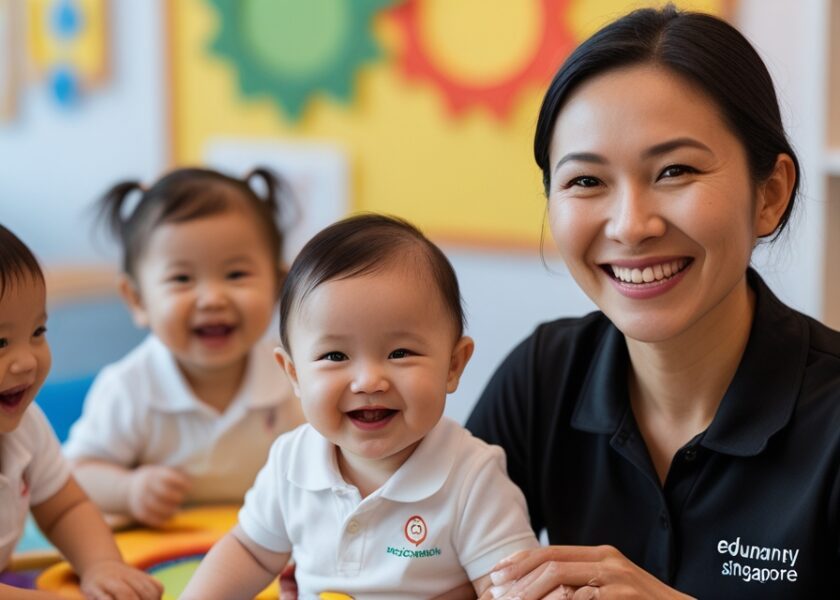
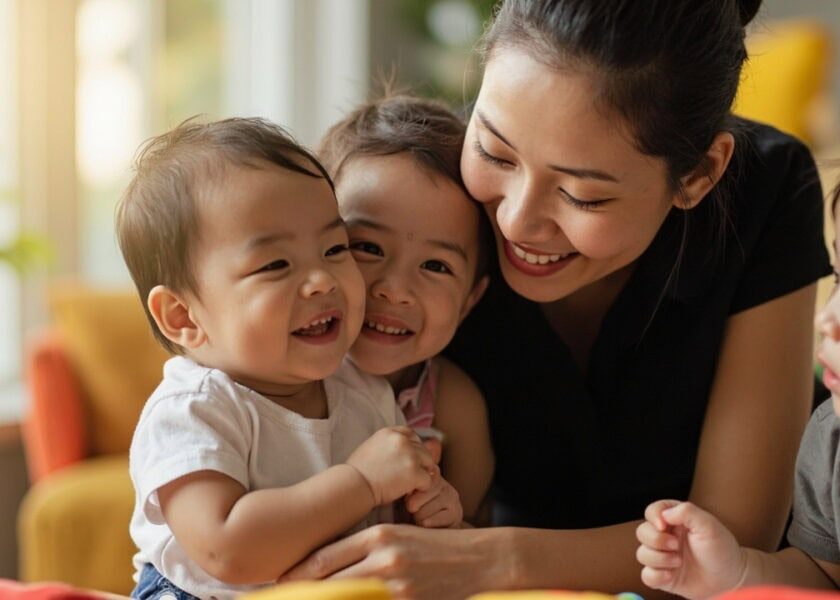
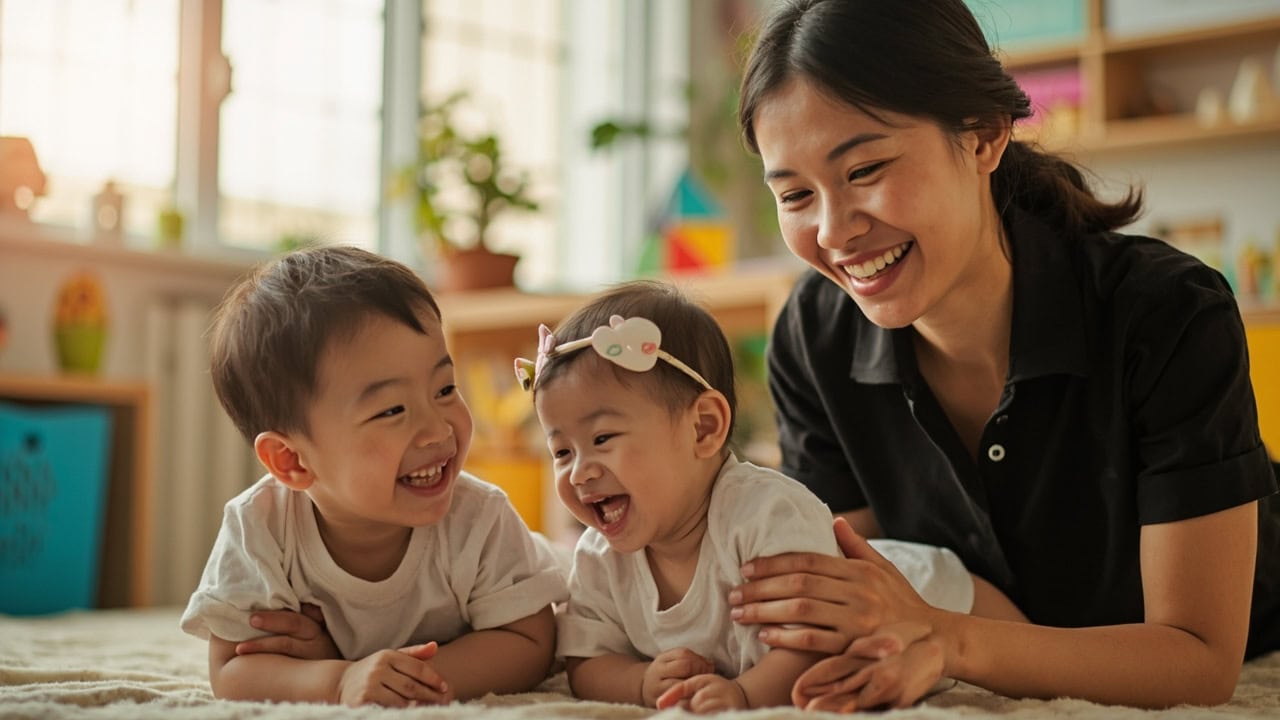
This finding should make parents feel relieved, not replaced. When you choose a caregiver who brings genuine relational skill — who is not simply present but truly attuned — you are giving your child something profound. You are giving them an additional secure base. You are expanding their relational world, not impoverishing it.
A child who feels securely held by their caregiver returns to their parents more available, not less. A child whose relational world is rich and consistent is a child who can tolerate the normal separations of daily life without the kind of anxiety that erodes security rather than building it.
The caregiver-child bond and the parent-child bond are not in competition. They are in partnership.
Signs Your Child Has Formed a Genuine Bond
We are taught to ask: Is the caregiver qualified? Do they have certificates? How many years of experience? These are reasonable questions. But they do not answer the deeper question — the one that sits in the driveway when you leave. They do not tell you whether this person will know your child. Truly know them.
Know that your daughter needs a moment of quiet before she can engage with a new activity. Know that your son signals hunger by getting quiet rather than fussy. Know that a certain tone of voice calms rather than escalates. Know your child as a specific, unrepeatable person — not as a category.
What to Watch For
The signs of a genuine caregiver-child bond are specific, sensory, and observable:
- Anticipation, not anxiety. The child who knows a caregiver’s arrival, who runs to greet them, who has learned that this person reliably shows up and is reliably warm. This is not dependency. This is the beginning of trust.
- Play after care. The child who comes home and re-enacts caregiving scenarios — the teddy being rocked, the baby being comforted — is a child processing the relational world they have experienced. This is developmental gold. It means the relationship is real enough to process, rich enough to represent.
- Sleep patterns. Securely attached children sleep differently — not perfectly, but with less vigilance, less hyperawareness. This is because they have internalized a sense of safety. They have learned, in the hours you were apart, that the world is responsive and reliable.
- Communication quality. Not just language, but the quality of their communication about their caregiver. The child who says, “Auntie Sarah says I can try the big slide,” is a child who has been seen and included in a relational world. The caregiver is not a stranger or an interchangeable figure. She is a known person who has opinions, warmth, and genuine investment in your child’s small life.
- The moment of proximity. Watch what happens in moments of arrival or proximity. Is there a lightening? A release? Does your child’s body become more relaxed, more open?
This is not wishful thinking. This is what secure base research calls proximity-seeking behavior — one of the primary markers of attachment. Your child is not just tolerating the caregiver’s presence. They are drawn to it. They seek it. Because they have learned, through consistency and attunement, that this person is safe.
If you see these signs, you can breathe a little easier — not because the anxiety disappears entirely (that is the human condition of parenting), but because you have evidence. Observable, relational evidence. Not a certificate on the wall, but a quality in your child’s eyes.
Why Continuity Is Not Optional
I know the reality of Singapore parenting. Flexi arrangements, backup plans, and the occasional swap are sometimes necessary. Life does not run on a perfect schedule. But I also want to tell you something that the research says clearly:
Caregiver continuity is not a luxury. For children in their first years, it is a developmental right.
Think about what attachment means in practice. It is not built in a single beautiful afternoon. It is built through repetition — through the child’s accumulating experience that this person returns, that this person is consistent, that the world behaves in predictable and warm ways.
The neural architecture of security is laid down through pattern. When a child has a caregiver who is present, week after week, month after month, they are not just building a relationship. They are building a brain that expects safety. That expects attunement. That expects the world to be reliably good.
What Disruption Costs
When that pattern is disrupted — when a child is passed between multiple caregivers, when the faces change so frequently that no bond can form — the child does not simply adapt. The child adapts in a specific way: by becoming less invested in relational bonds, by pulling back, by learning that people are not reliably present.
This is not a character flaw. It is a protective adaptation. But it is an adaptation that costs something. The capacity for trust, once withdrawn, is harder to rebuild than it was to establish.
This is why structures that support continuity matter — not just philosophically, but developmentally. Monday to Friday care blocks. Stable placement. A coherent relational environment. These are not logistical conveniences for parents. They are the conditions under which secure attachment can form.
What Quality Childminding Actually Looks Like
There is a difference — a significant one — between childcare that supervises and childcare that knows your child.
Supervision means the child is safe, fed, and entertained. The tasks are completed. The box is checked. The caregiver is present but not necessarily attuned.
Knowing means something different. It means understanding that one child is soothed by rhythmic movement while another needs stillness and a quiet voice. It means recognizing the subtle signals that precede tears — the quiet engagement that signals readiness for interaction, the withdrawal that signals overwhelm. It means building, over time, a picture of each child that goes beyond developmental milestones and enters the territory of genuine familiarity.
The Capacity to Attune
Relational skill is not the same as good intentions. A caregiver can love children and still not attune to them effectively. Attunement is a specific capacity — the ability to see behavior as communication, to infer the inner state behind the outer act, to ask not just “what is my child doing?” but “what is my child feeling, and why?”
Some people have a natural orientation toward attunement. They notice. They wonder. They respond to the whole child, not just the immediate need. Beyond natural disposition, attunement requires something else: manageable conditions. You cannot truly know a child if you are managing chaos. Attunement requires presence, and presence requires a load that allows for genuine attention.
Why Ratios Matter
Caregiver-to-child ratio matters not because regulations require it (though they do), but because it determines whether quality is even possible. An infant ratio of up to one to three means that for every three infants in care, there is one trained caregiver whose attention is not divided across six, eight, or ten children.
This is the minimum environment in which genuine attunement can occur. In higher-ratio settings, even the most skilled caregiver is essentially managing supervision rather than building relationships.
| Ratio | What Is Possible |
|---|---|
| 1:3 or better | Genuine attunement, individual knowledge, responsive care |
| 1:4 to 1:6 | Good supervision, limited individual responsiveness |
| 1:8 or higher | Task-focused care, reactive rather than proactive |
The EduNanny Approach: Built Around Bonds
EduNanny participates in the ECDA Childminding Pilot, which means the service operates within a framework designed to make quality childminding accessible and affordable for Singapore families. Within this framework, the approach has been built around a single conviction: the caregiver-child bond is the invisible developmental engine of quality childcare. Everything else — the training, the ratios, the communication practices, the continuity commitment — flows from this principle.
How Caregivers Are Selected and Trained
EduNanny caregivers are selected not only for their qualifications, which matter, but for what we call relational disposition. We look for the capacity to attune — the ability to see your child as a full person with inner states, preferences, rhythms, and signals worth reading.
Caregiver training goes beyond first aid and food hygiene. Through our programme, caregivers learn:
- The principles of attachment science and what secure base behavior looks like in practice
- How to read infant cues — the subtle signals that precede tears, the quiet engagement that signals readiness, the withdrawal that signals overwhelm
- How their own emotional regulation serves as the platform from which they can support the child
- The importance of knowing each child in their care as an individual — their rhythms, their preferences, their fears, their joys
Self-regulation is a prerequisite for relational skill. A caregiver who is anxious, rushed, or emotionally unavailable cannot attune to a child, no matter how much they want to. This is why the programme invests in caregivers’ wellbeing, not just their technical skills.
Communication as Partnership
Families receive honest, regular updates about their child’s day — not through formal reports alone, but through the channels that feel natural. Updates that show what your child was engaged in, moments that mattered, the small relational exchanges that make up a day.
You should have real visibility into your child’s relational world — not merely hoped for, but built into how we work.
Questions to Ask When Choosing Infant Care
As you evaluate your options, here are questions that go beyond credentials and logistics:
- How does this caregiver understand my child’s individual temperament, rhythms, and signals?
- What is the caregiver-to-infant ratio, and why does it matter for my child’s development?
- How is continuity maintained — both daily and over weeks and months?
- How will I know what my child’s day was like, beyond basic care tasks?
- What training have caregivers received in attachment and attunement — not just safety and logistics?
- How does this arrangement feel when I observe my child? Do they show signs of genuine familiarity and safety with this caregiver?
The answers to these questions will tell you far more about the quality of care than certificates on a wall.
Addressing Common Concerns
“Will my child form a bond with the caregiver instead of me?”
No. Research consistently shows that children with secure secondary attachments are not confused about their parents. They are richer in their relational world. A child who comes home from a day of warm, attuned care is a child who is more available for the evening — more present, more able to receive the warmth you offer, because they have already received it elsewhere.
“How do I know quality care is happening when I cannot see it?”
Watch your child’s behavior before and after care. Look for proximity-seeking. Look for the lightening when the caregiver arrives. Look for the quality of communication about the caregiver’s words and presence. Beyond your child, ask your caregiver about their day — not “what did you do?” but “how was she today?” Listen for specificity. Listen for genuine knowledge of your child as an individual.
“What if I need flexibility in my arrangement?”
Life in Singapore does not always follow a perfect schedule. Occasional variations are part of family reality. Our commitment to continuity is an organisational commitment to structure care around the developmental needs of children first. Within that structure, reasonable variations can be accommodated while protecting the consistency that makes secure attachment possible.
What We Stand For
The quiet anxiety you feel in the driveway is not foolish. It is the instinct of a good parent. It is your recognition that what happens in the hours apart matters deeply.
We feel the same weight. That is why we do this work.
When a child has a genuine bond with their caregiver, something shifts in the whole family. Parents feel it in their chest. The quiet worry of the driveway fades — not because you stop caring, but because you have evidence. Daily, observable, living evidence that your child is known. That their caregiver is not merely performing tasks but genuinely relating to your child as a full person. That in the hours you are apart, your child is not just safe but held.
Emotionally held. Relationally held.
This does not weaken your bond with your child. It strengthens it. Because a child who is securely attached in multiple relationships has more capacity for attachment, not less. They are simply richer in their relational world.
The caregiver becomes not a replacement or a substitute, but a partner in your child’s emotional development. And the family becomes not a competition for attachment, but a network of secure bases — each one supporting the others.
Every child deserves to be known. Every child deserves a caregiver who sees them as a full person. Every child deserves the developmental right of a secure, stable, attuned relationship in their earliest years.
Not because it will make them brilliant or successful — though it may. But because it will make them trusting. And a child who trusts is a child who can love. A child who can love is a child who can live.
It begins with you, making the choice to look for something deeper than supervision. To look for relationship. To trust that the bond your child forms in those first thousand days will shape not just their childhood, but their capacity to be in the world — open, confident, and warm.
If you are researching infant care or childminding in Singapore and want to understand how EduNanny’s trained caregivers support your child’s relational development, you are welcome to start a conversation with us.
Because the question you carry in the driveway is worth taking seriously. And so is the child you are asking someone else to know.
Learn more about EduNanny and our approach to quality childminding in Singapore.