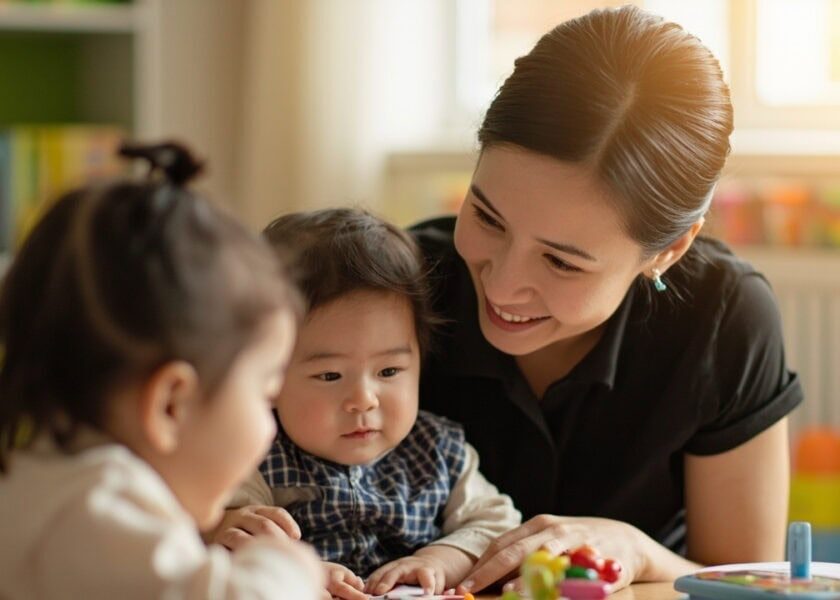
Choosing Childcare That Grows With Your Child
The Moment Every Singapore Parent Dreads (And Why It Means You’re Doing Something Right)
There is a moment, and if you are a parent in Singapore, you have likely had it. It usually arrives sometime between your child’s second and third year.
You are doing the pickup routine you have done hundreds of times before. The caregiver waves. Your child runs to you with the familiar ease of a child who feels safe and loved in this place.
And yet, something has shifted.
You notice it in small ways. The way your child speaks now, asking questions she did not ask six months ago. The way she protests when you try to leave—not with the desperate clinging of infancy but with the sharp insistence of a toddler who has opinions about her own schedule. The way she comes home and immediately wants to show you something she learned, to teach you, to have you witness her growing.
You love the arrangement. The caregiver has been wonderful. But you start to wonder whether the arrangement that served her so well at eighteen months is still the right arrangement for a child who is rapidly becoming someone new.
And you feel something uncomfortable. Something almost like guilt for noticing. Because why would you question something that is working? Why would you consider disrupting the stability your child has come to rely upon?
Here is what I want you to hear: the tension you feel is not a sign that something is wrong with your parenting or your choice. It is a sign that your child is doing exactly what children are supposed to do—grow. And genuine growth always eventually asks more of the systems around it.
Understanding Your Role as an Ongoing Architect, Not a One-Time Chooser
Let me offer you a way of thinking about childcare that honors the reality of child development, that takes seriously your role as an ongoing architect rather than a one-time chooser, and that may help you feel less alone in a moment of genuine uncertainty.
Singapore families navigate childcare decisions under a particular kind of pressure. The cost is real. The expectations from school systems arrive earlier than in many other places. The competition for certain centre-based placements can feel fierce. And the social landscape often assumes that there is a right choice to be made and that good parents find it.
But children are not static. The infant you brought home from the hospital three years ago is gone. In her place is a three-year-old with preferences and fears and intellectual curiosity that none of you could have predicted when you were choosing her childcare arrangement.
Most parents intuitively understand that a newborn needs different care than a preschooler. But understanding this intellectually and applying it practically to your own family’s arrangement are two very different things. The gap between understanding and action is where most parents find themselves stuck.
The question is not simply whether you chose well at the beginning. The question is whether the architecture of care you built can flex, can respond, can grow alongside the child it was built to serve.
What Quality Care Looks Like at Every Developmental Stage
The Infant: Building Security (Birth to 18 Months)
In infancy, the child’s primary developmental task is building security. The brain is developing at a speed it will never again reach. Attachment systems are forming. The infant needs consistency, responsiveness, warm physical contact, and the sense that the world is a predictable place where needs will be met.
At this stage, the quality of the individual relationship with a caregiver matters enormously. One-to-one attention, or very small group ratios, allows the caregiver to attune fully to the infant’s cues—to read the difference between a cry of hunger and a cry of overstimulation, to provide comfort in the way that particular child needs it.
What the infant needs from care:
- Consistent, warm physical contact
- Responsive caregiving that attunes to cues
- Predictable routines that build security
- Small ratios that allow for individual attention
- A safe, calm environment that does not overwhelm developing senses
The Toddler: Building Language and Social Foundation (18 Months to 3 Years)
Watch that same child at two and a half. The developmental picture has shifted dramatically.
Language is exploding. Symbolic thought is emerging. The child is beginning to understand that she is a separate person with her own wants and that other people have minds of their own.
Social development, which was essentially dormant in infancy, is now front and center. The two-year-old is interested in other children. She wants to play alongside them, to share space, to test the boundaries of social rules.
Cognitively, she needs stimulation, novelty, and challenges that stretch her growing capacities. Emotionally, she is learning to manage big feelings that arrive with increasing intensity and frequency.
The care arrangement that focused primarily on warmth and security must now also provide language-rich interaction, opportunities for peer engagement, and a curriculum of sorts—even if that curriculum is delivered through play.
What the toddler needs from care:
- Rich language exposure—conversations, not just commands
- Opportunities for peer interaction and parallel play
- Challenges that stretch growing capacities without overwhelming
- Support for emotional regulation of intensifying feelings
- Space to explore independence within safe boundaries
The Preschooler: Building Readiness for Formal School (3 to 5 Years)
By four or five years old, we are looking at a child who is preparing for something enormous: formal schooling. The expectations at Primary One are real, and they are coming sooner than it feels.
The child now needs to be comfortable in group settings, able to follow multi-step instructions, ready to sustain attention for longer periods. Social dynamics have become complex. The child is developing a sense of herself relative to others, comparing her abilities, her belongings, her family situation.
She needs caregivers who can support her growing independence while still providing the emotional scaffolding she needs to manage the pressures of that emerging self-concept.
What the preschooler needs from care:
- Structured group experiences that build classroom readiness
- Opportunities to develop patience, sharing, and negotiation skills
- Activities that stretch attention and follow multi-step directions
- Support for growing independence with appropriate challenges
- Caring adults who notice and nurture emerging self-concept
Signs Your Child’s Care Arrangement May Need to Evolve
So how do you know when the gap has become too wide? What are the signals that your child’s care arrangement has genuinely become misaligned with where she is developmentally?
The following is not a diagnostic tool. It is a starting point for honest reflection. The signals I am describing are invitations to look more carefully.
1. Cognitive and Linguistic Signals
Does your child’s caregiver still speak to her primarily in the simplified, nursery register that is appropriate for infants? Or has the conversation evolved?
When your three-year-old asks why the sky is blue, does the caregiver have the knowledge and the disposition to offer a genuine answer, to extend the conversation, to wonder alongside the child? Or does the response remain at the level of distraction and redirection?
The difference matters. Children at this age are hungry for language, for explanation, for the sense that their questions have weight. When that hunger goes unmet, you may notice your child seeking intellectual stimulation elsewhere—or acting out in search of any engagement she can find.
2. Social Signals
Is your child beginning to express frustration that she does not have enough peers to play with? Does she come home from care times that seem very small and very adult-focused, showing signs of social hunger?
Or is she thriving in a setting with more children but beginning to struggle with the noise and chaos of a large group?
Neither answer is wrong. But the mismatch between the child’s social needs and the social environment of her care is worth noticing. Some children bloom in larger groups; others need smaller settings to develop social confidence. The key is alignment, not any particular size.
3. Emotional Signals
Does your child seem to be regressing in certain ways? Acting out more at home? Having more difficulty with transitions or separations than she did a year ago?
Regression can be normal in response to stressors, but it can also be a signal that the child is not being challenged in ways that match her current capacities. When children are bored, when the environment is too simple for where they are developmentally, they often act up. They are looking for stimulation, for engagement, for the intellectual and emotional workout that their growing brain requires.
This is one of the most overlooked signs. We often assume that behavior problems mean something is wrong at care. Sometimes they mean something is missing.
4. The Intuition You Cannot Yet Name
This category is perhaps the most important, though it is the hardest to articulate. It is the sense, which you as a parent may feel before you can name it, that your child has simply outgrown the arrangement. That she is ready for something more. That she is being held back in some way.
Parents are exquisitely tuned to their children, even when we do not fully trust that tuning. If you have been feeling, quietly, that it is time for something to shift, I would invite you to take that feeling seriously, to examine it carefully, but not to dismiss it simply because you cannot articulate a specific reason.
Stable continuity vs. stagnant care. The tension between honoring your child’s changing needs and protecting the continuity she depends on is real, and it is not easily resolved.
Continuity matters. Children build their sense of security not just from the quality of individual moments but from the pattern, the rhythm, the predictability of their days. When you change a care arrangement, you are disrupting the entire ecosystem your child has built her life around.
The goal is not to avoid all change. The goal is to avoid the stagnation that comes from never changing.
Ask yourself: Is my child’s care arrangement preparing her for where she is going, or only for where she has been?
Your Options in the Singapore Context—and How to Evaluate the Fit
In Singapore, families typically navigate among several pathways. Each has its own characteristics, and the right choice depends not just on where your child is now but on where you anticipate your child going.
Centre-Based Care
Centre-based care offers structured programmes with regulatory frameworks and quality ratings. It provides peer interaction in larger group settings, which can be valuable for social development in the toddler and preschool years. For children approaching school entry, centre-based care often offers explicit preparation for the rhythms and expectations of formal schooling.
Home-Based and Childminding Arrangements
Home-based care, including arrangements through the ECDA Childminding Pilot, offers a different model—smaller ratios, more individualized attention, and a setting that can feel more like an extension of home. For infants and younger toddlers, this can provide the consistency and attunement that attachment requires.
Some families continue with home-based care as children grow, while others find that their child benefits from the social density that centre-based settings provide.
Having Honest Conversations With Your Caregiver
One practical step is to build relationships with caregivers and care environments where evolution is welcomed rather than resisted. When a caregiver understands that their role is not to keep the child in a comfortable holding pattern but to support the child’s growth toward the next stage, the arrangement becomes something that can flex.
The conversation between parent and caregiver shifts from a simple reporting relationship to a genuine partnership in the child’s development.
Questions worth asking your caregiver:
- What have you noticed about her in the past few months? What is she working on?
- Where do you think she might be ready for more challenge?
- What does a typical day look like for her now, and how has that changed from six months ago?
- If you could change one thing about her current experience here, what would it be?
These questions open the door to partnership. They signal that you see the caregiver as an observer of your child’s development, not just a supervisor of her safety.
EduNanny Singapore: A Care Partnership That Grows With Your Child
At EduNanny Singapore, this understanding shapes how we approach our work with families. We are not offering a single solution. We are offering a relationship that is designed to evolve.
We know that the early years, from birth through the first thousand days and beyond, set foundations that matter for a lifetime. We know that the quality of care in infancy—the warmth and attunement of the caregiver, the security the child develops in those early months and years—is not something that can be retrieved later if it is missed. We take that responsibility seriously.
We also know that responsibility extends beyond infancy. Our approach, our training, our model of care is built around the understanding that children grow, that stages change, and that good care must change with them.
When you partner with EduNanny, you are not entering a static arrangement. You are entering a relationship in which we commit to watching your child carefully, to noticing when the fit is beginning to shift, and to having honest conversations with you about what that shift might mean.
This is what the ECDA Childminding Pilot represents for us: not just a set of regulatory standards, but a philosophy of care that prioritizes the individual child, that maintains ratios that allow for genuine attunement, and that keeps the door open for honest communication between caregivers and families.
Financial Accessibility
We know that families in Singapore face real financial pressures, and that childcare costs are a significant part of household budgeting for most families with young children. Our pilot fee structures are designed with this reality in mind. We want quality care to be accessible, not a privilege reserved for families with unlimited resources.
Families can access our services using the Child Development Account and Baby Bonus schemes.
Transparency and Communication
Where deployed, our CCTV measures are in place not to create surveillance but to build trust—to give families confidence that they can see what is happening in their child’s day, and to support the open, honest culture we want to maintain with every family we serve.
We want you to feel that you know what is happening when your child is in our care. We want questions to be welcomed, not deflected. The Monday to Friday care blocks, the daily rhythms we build with your child, the moments of pickup and drop-off—all of these are opportunities for us to stay in relationship with you, to share what we are observing, and to listen to what you are seeing at home.
The best care decisions are made with good information from multiple sources. We see ourselves as one important source in your child’s life—not the final authority, but a trusted partner who is watching alongside you.
What If You Get It Wrong? And a Final Word
Let me close by speaking directly to something I know many of you are carrying.
The fear of getting it wrong. The fear that you will either stay too long in an arrangement that no longer fits your child’s needs, or disrupt stability unnecessarily.
This fear is not a weakness. It is evidence that you care deeply about your child’s wellbeing, that you are paying attention, that the weight of this responsibility rests on you in ways that are sometimes lonely and frightening.
I want to tell you that you do not have to be perfect. You do not have to make the right choice every time. What your child needs from you is not a flawless execution of an ideal childcare plan.
What your child needs is a parent who pays attention, who stays honest about what is working and what is not, who is willing to revisit decisions when the evidence suggests that revisiting is warranted, and who can tolerate the uncertainty of not always knowing the right answer.
The framework I have offered you in this article is not a guarantee. It will not tell you exactly when to make a change or what change to make. What it will do, I hope, is give you language for something you may already have been feeling, and structure for a conversation you may have been hesitant to begin.
Because here is what I have come to believe after many years of working with children and families: the parents who worry most about getting it right are often the parents who are getting it most right.
Your child is growing. She is becoming someone new every single day. And the care you provide for her, the systems you build around her, the relationships you cultivate on her behalf—all of these are acts of love that are worthy of the same careful, evolving attention you bring to everything else in her life.
We would be honored to grow alongside you. To be the care partner who notices when your child is ready for the next thing, who celebrates with you when she reaches new milestones, who sits with you honestly when the fit is beginning to shift.
If you leave this article with nothing else, I hope you carry this: you are not alone in this. The questions you are asking are the right questions. The fears you are feeling are the fears of a thoughtful, loving parent. And the fact that you are willing to look honestly at your child’s needs—even when that looking is uncomfortable—is exactly the kind of courage that children need most from the adults who love them.
Your child is going to be fine. And so are you.
EduNanny Singapore provides development-focused childminding and childcare for families across Singapore. If you are navigating a transition in your child’s care arrangement, we welcome the chance to think alongside you about what the right fit might look like for your family. Get in touch or learn more about who we are.