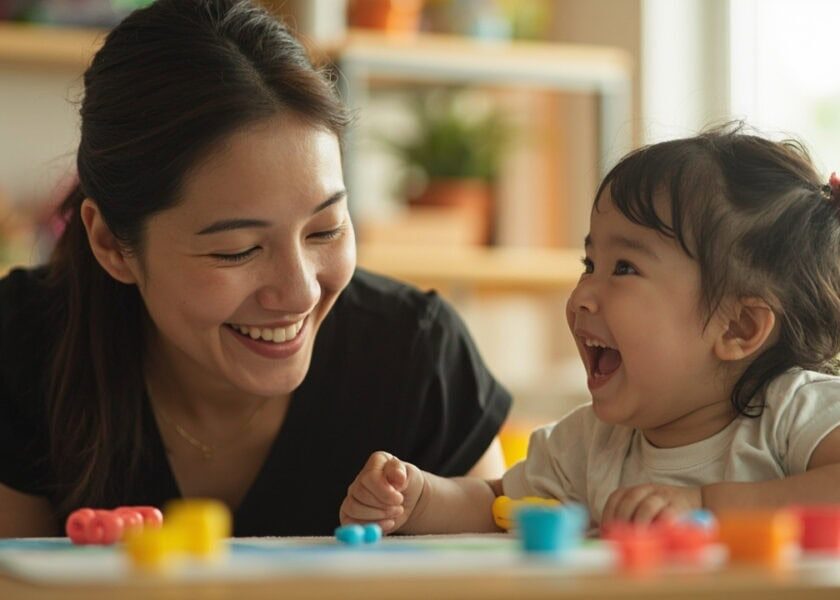
The Philosophy That Changes Everything About Early Childhood
The Philosophy That Changes Everything
Let us begin where all good educational programmes begin: with a fundamental belief about children.
EduNanny operates from a philosophy grounded in developmental science. We believe that infants are not simply in a waiting period before life begins. They are in the most active, most critical phase of human development.
The first thousand days of a child’s life are not a prelude to learning. They are learning. Neural pathways are forming at a rate that will never be matched again. Emotional regulation patterns are being established. Cognitive frameworks are being built.
If you believe that infants are simply waiting to be fed, changed, and entertained until they are old enough for real school, then childcare is logistics. Safety, schedules, hygiene, ratios. These matter, but they are the floor, not the ceiling.
If you believe that infants are in a critical developmental window where every interaction, every sensory experience, every moment of security or stress is shaping the architecture of a human brain, then childcare is education.
Every feeding is an opportunity for language. Every diaper change is an opportunity for connection. Every moment of free movement on the floor is an opportunity for motor development and cognitive exploration.
The caregiver who understands this does not simply keep the child safe. They create conditions for learning during every single interaction, across every single hour.
This is the philosophical foundation of EduNanny. But philosophy without practice is just talk. So let us move to what philosophy looks like when it is actually happening.
Seeing, Not Just Watching
One of the most important distinctions in quality childcare is the difference between supervision and observation.
A supervisor watches children to make sure nothing goes wrong. An observer watches children to understand what is happening developmentally. These sound similar. They are not.
What Supervision Looks Like
When a caregiver is primarily concerned with supervision, they are managing logistics. They are ensuring safety, maintaining schedules, keeping the environment clean. These are not unimportant tasks. But they do not require specialized knowledge of child development.
What Trained Observation Looks Like
When a caregiver is trained in observation, they are watching with purpose. They are noticing:
- Which toys a child returns to repeatedly and what that reveals about emerging interests
- The subtle progression in how a child manipulates objects, which indicates motor development
- The moments when a child reaches out for connection versus when they need space for independent exploration
- Behaviour as communication, as development, as the language through which a child expresses who they are becoming
When a caregiver narrates what a baby is experiencing—saying, “I see you found the wooden blocks. You are reaching for the red one”—they are not simply filling silence. They are validating the child’s experience, introducing vocabulary, and signalling that what the child is noticing matters.
This is what EduNanny’s educators are trained to do. Not to simply watch your child, but to see them.
How a Morning Actually Unfolds
Here is where the philosophy becomes something concrete, something you can witness when you visit.
Arrival and Transition
When your child arrives, there is not a rush to slot them into an activity. There is a transition, a settling-in period that acknowledges the real emotional work of separation and reconnection. There is greeting. There is presence. There is the acknowledgment that both you and your child have just done something difficult, and that requires attention.
The Prepared Environment
Once settled, your child is invited into a prepared environment. The materials on offer are not random. They are intentionally selected to invite exploration, provoke curiosity, and offer sensory and cognitive challenge at an appropriate level.
This includes textured fabrics for tactile discovery, objects of different weights for sensory comparison, and open-ended materials that can be combined, arranged, and explored without a predetermined outcome.
What the child does with these materials is not scripted. The purpose is to allow the child to investigate, to experiment, to build understanding through direct experience.
The Educator’s Role
Throughout this time, the educator is present. Not directing. Not interrupting. Observing. Noting. Documenting. They are recording what the child is drawn to, how long concentration lasts, what emerging skills are visible, what the child attempts versus what they achieve.
Transitions, Feeding, and Rest
The model extends throughout the entire day. Transitions are not moments to rush through. They are intentional. Feeding times are not purely nutritional. They are social, sensory, relational. Sleep times are about rhythm, about the sense of security that comes from predictable patterns, about the physical comfort of trusted care.
Diaper changes communicate something. The dignity with which a child is treated, the calm of the interaction, the respect for their developing sense of self. This is the daily model at EduNanny. Not just childcare. A deliberately designed environment where every element has been considered for its developmental purpose.
Documentation and Parent Partnership
Observation without record is incomplete. What an educator notices in a single moment is valuable, but what emerges over weeks and months of careful documentation is a narrative of growth.
EduNanny documents what it observes because documentation creates understanding. It reveals patterns. It shows the progression from where a child started to where they are heading. It becomes the foundation for everything that comes next.
When you receive communication from EduNanny, it is not just a summary of meals and naps. It is insight into your child’s day. It is information about what captured their attention, what challenged them, what they mastered, what they attempted, what they communicated through behaviour or sound or expression.
This is the difference between updates and understanding.
And this understanding is something you carry forward. Because your child’s development does not happen only at EduNanny. It happens in your home, on weekends, during holidays, throughout every context of their life.
When you understand the patterns, when you see what EduNanny sees, you become a more informed, more intentional participant in your child’s growth. You can extend the learning. You can reinforce the discoveries. You can speak the same language of observation and attention that EduNanny’s educators are speaking.
This is parent partnership. Not the passive receipt of photographs and summaries, but active participation in understanding and supporting your child’s development.
The Programme Grows With Your Child
The needs of a six-month-old infant and the needs of a toddler approaching two are profoundly different. The model must flex accordingly.
What EduNanny offers is not a single approach applied uniformly across all ages. It is a developmental framework that adapts as your child develops. The infant who needs responsive, attuned caregiving that supports attachment and early brain development moves into a phase where increasing mobility, language emergence, social interest, and cognitive complexity require different kinds of support and challenge.
EduNanny’s educators are trained to recognise where each child is in their developmental journey and to respond appropriately.
Continuity as an Advantage
This continuity of care, this relationship that spans from infancy through the early years, is itself a developmental advantage. Children who experience consistent, knowledgeable caregiving develop the security that enables exploration. They know their caregiver sees them, understands them, will respond when needed.
This security is not a luxury. It is the foundation upon which all subsequent development is built.
Pathways and Accessibility
EduNanny offers quality early childhood care through several pathways. For families who prefer home-based care, there is the ECDA Childminding Pilot, which places a trained caregiver in the familiar setting of your own home, with ratios and support structures designed to ensure quality.
For families who prefer a community or centre-based setting, there are options that bring small groups of children together under the same philosophical framework.
The setting may differ. The model does not.
The 1 to 3 infant ratio in EduNanny’s model is not simply a number. It is a guarantee of attention. With one caregiver for every three infants, each child receives the observation, the responsiveness, the individual engagement that development requires. This is structural design that makes the educational model possible.
Questions Parents Actually Ask
These are the questions that matter most, and EduNanny’s answers to them.
Can I afford quality care?
EduNanny’s pilot structure has been designed with affordability in mind. The fee structure is accessible. CDA and Baby Bonus funds can be utilised. Quality early childhood development should not be available only to families with significant financial resources.
How do I know what is happening when I am not there?
Transparency is a structural commitment. EduNanny provides communication and documentation systems that give parents genuine visibility into their child’s day. Where deployed, CCTV measures offer additional assurance.
But more than surveillance, EduNanny offers connection. The documentation, the regular updates, the sharing of observations, the conversations about development—these are the tools through which parents remain genuinely informed, not just reassured.
What if my child is sick or we have irregular schedules?
Quality programmes have protocols for these realities. When your child is sick, they need restorative care that differs from a typical day. When you are running late, transitions remain calm. When a new caregiver steps in, the framework ensures consistency because the model, not the individual, is what matters.
This is what distinguishes a system from a person. You are not relying on one individual’s charm or memory. You are relying on an intentional framework that persists across circumstances.
Choosing With Confidence
If you are evaluating childcare options in Singapore, here is what to look for beyond the tour and the brochures:
Ask About the Ratio
What is the actual caregiver-to-child ratio? For infants, lower numbers mean more individual attention. Ask specifically about ratios for different age groups, not just overall averages.
Ask How They Observe
What does a typical morning look like? How do caregivers spend their time when children are playing? Are they directing, supervising, or observing with purpose?
Ask About Documentation
How do they track your child’s development? What does communication look like? Is it activity logs and meal records, or is it insight into learning and growth?
Ask About the Framework
What is the educational philosophy? How does it translate into daily practice? Can they explain the connection between what they believe and what happens on a Tuesday morning?
Visit and Observe
The most important thing you can do is visit. Watch not just the environment, but the interactions. Are caregivers present and attentive? Are they seeing the children as individuals with developmental needs? Does the model make sense to you?
Singapore parents deserve more than reassurance. They deserve understanding. They deserve to know what is happening with their children, why it is happening, and how it connects to the person their child is becoming.
We believe that quality childcare is not a mystery to be felt. It is a system to be understood.
And when you understand EduNanny’s model, you will find something that is becoming increasingly rare in a world of generic options and hollow promises: a programme that knows what it does, why it does it, and what it is trying to achieve for your child.
We are not asking you to trust us. We are asking you to look. To ask questions. To visit and observe. To understand and then decide.
Ready to see how EduNanny’s educational model works in practice?
Schedule a visit to experience the prepared environment, meet our trained educators, and understand the framework for yourself. We welcome your questions because we believe informed parents make the best decisions.