How Quality Childcare Builds Lifelong Sibling Bonds in Singapore
The Question Every Parent of Multiple Children Carries
It’s evening. You’re sitting at the dining table, or perhaps on the sofa, and your two children are playing nearby—not the kind of playing that requires you to mediate every thirty seconds, but the real kind. Your older child is explaining something to your younger one. Your younger one is listening, genuinely listening, and then does something that makes your older child laugh.
You watch this happen and you feel something you rarely get to feel in the chaos of raising multiple children: quiet pride. And underneath it, a question you may never say out loud, but one that lives in the back of your mind every single day:
Will they have each other? Not just now, but in ten years, in twenty, when I’m not the centre of their world anymore. Will they be siblings who truly show up for each other?
That question is one of the most profound a parent can carry. And it is a question that childcare marketing almost never addresses.
What Childcare Marketing Usually Gets Wrong
We talk about development milestones and school readiness. We talk about brain architecture and trust and peace of mind for parents. All of those things matter. But there is something that sits at the very heart of what we are trying to build—not just for individual children, but for families—and that is the bond between siblings.
Siblings will have the longest relationship your children will ever experience. Your children will know each other for fifty, sixty, seventy years. They will be the witnesses to each other’s lives in a way that no friend, no partner, no colleague ever can be.
And yet, if you are a parent in Singapore with multiple children, there is a fear that lives just beneath the surface of every childcare decision you make: that time in childcare—time away from you, time in someone else’s care—will somehow create distance between your children.
It is a completely understandable fear. And in most cases, it is the opposite of the truth.
Why Quality Care Strengthens the Sibling Bond
When siblings are placed in a quality care environment, something remarkable happens that rarely gets talked about. They are not just being cared for alongside each other. They are learning, together, how to be siblings in the fullest sense.
Here is what the research and experience consistently show:
- Siblings in shared care environments practice cooperation in real, everyday situations—not in lessons, but in navigating shared space, shared resources, and shared attention
- They develop conflict resolution skills that are foundational to lasting relationships, learning to disagree and find their way back to each other
- They arrive home from quality care more regulated and ready to connect, rather than depleted or dysregulated
- They build a shared language of connection that travels home with them every evening
- They become each other’s social-emotional teachers in ways that no structured lesson can replicate
What Quality Childminding Actually Looks Like
Children who spend their days in a secure, warm, well-supported care environment arrive home more ready to connect. Not depleted. Not dysregulated. Ready.
Because they have been in a place where their emotional needs were met, where caregivers understood the difference between a child who needs comfort and a child who needs space, where the rhythms of the day were predictable and calm.
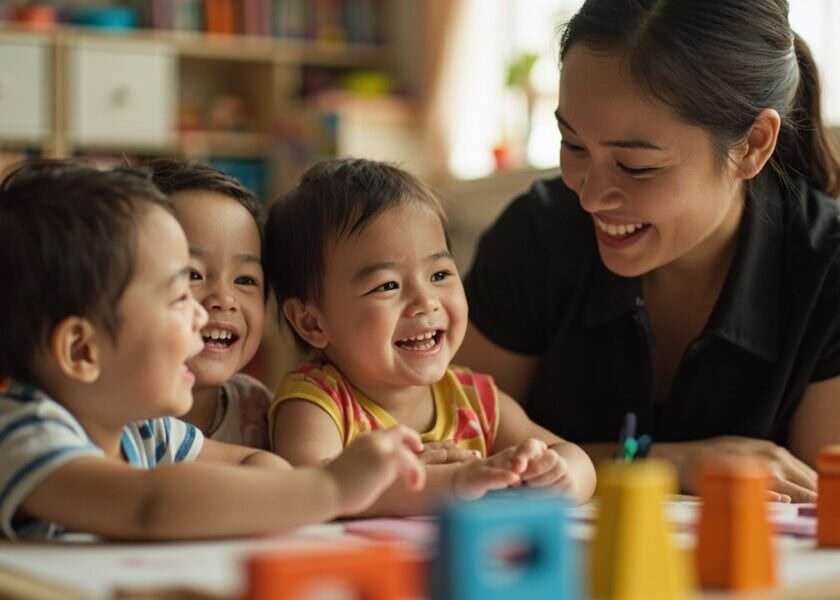
In a thoughtfully designed childcare environment, siblings become each other’s greatest teachers. Consider what this looks like in practice:
A younger child watches an older child manage a frustration—say, not getting a turn with a preferred toy—and something registers. That is how you can respond when things don’t go your way.
An older child experiences the vulnerability of having a younger sibling look up to them, and something softens. I am someone worth looking up to. That comes with responsibility.
These are not abstract developmental outcomes. These are real shifts in how children learn to regulate their emotions, how they learn to communicate, how they learn to care about someone else’s experience. And when both children are building these capacities together, in the same environment, at the same time, they are building a shared language of connection that travels home with them every evening.
This requires caregivers who understand sibling dynamics—who notice when one child is feeling overlooked, when another is stepping into a protector role too quickly, when two children need space to work something out and when they need an adult to help them name what they’re feeling. It requires ratios that allow for this kind of observation and attunement, not just supervision.
EduNanny by BUTLER: A Partner in Building the Sibling Bond
EduNanny is not simply a childcare service. It is a philosophy of care expressed through a structured, ECDA-supported framework—part of the Childminding Pilot—built for Singapore families who want more than supervision. They want their children to grow. They want their children to grow together.
In the EduNanny model, home-based care and community or centre-based pathways are both available, because every family is different and every family’s circumstances deserve a response that fits rather than a solution that forces.
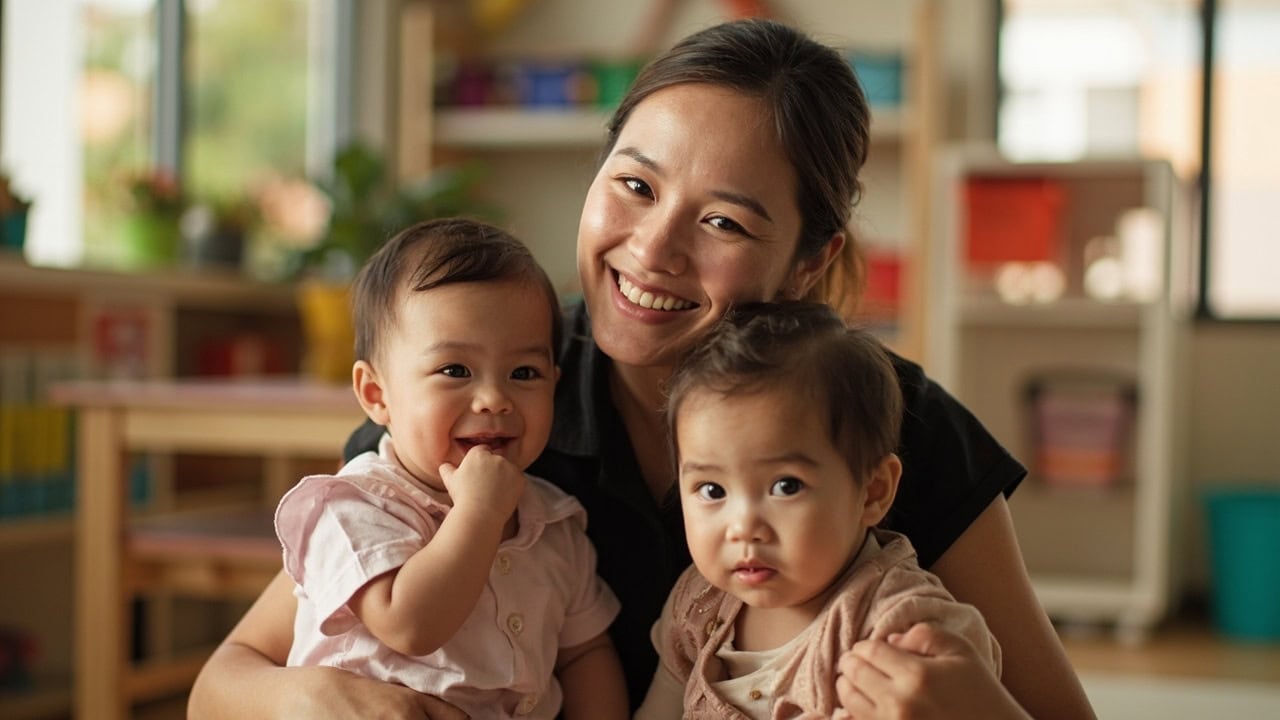
In infant care, EduNanny maintains ratios of up to one to three. This means caregivers can truly see each child—not as part of a crowd, but as an individual with specific needs, rhythms, and a specific place in their family story.
Because when a caregiver can truly attune to a child, they can also attune to the dynamic between siblings. They notice patterns. They create space for connection. They step in when needed and step back when siblings can find their own way. This is the work of trained caregivers who understand sibling dynamics, and it is work that EduNanny takes seriously.
The affordability of the pilot fee structures, combined with the usability of CDA and Baby Bonus, means that this quality of care is not reserved for families with significant financial resources. It is available across Singapore. Monday to Friday care blocks give families the consistency they need, and the communication structures—including transparency measures and CCTV where deployed—mean that parents are not left wondering what their children’s day looked like. They are part of it. They are informed. They are trusted as partners in their children’s care, not bystanders to a service they pay for.
And now, with the Thomas AI Chatbot, EduNanny is extending that care beyond the hours of the day. Parents can turn to Thomas for guidance, for clarity, for answers to the small urgent questions that arise between pickups—questions about development, about behaviour, about what a particular interaction might mean. Thomas is not replacing the caregiver or the community. It is a bridge, a resource, a quiet assurance that you are not navigating this alone.
Addressing the Real Concerns Singapore Parents Have
It is natural to have questions before entrusting your children to any care arrangement. Here are the concerns that matter most to Singapore parents, and what quality care addresses honestly:
“Will my children feel connected to each other, or will they feel like they’re being raised in parallel?”
In quality care, siblings are together, not just adjacent. They share experiences, navigate conflicts, and celebrate wins together. The bond is not assumed to develop on its own—it is actively supported by caregivers who understand sibling dynamics.
“How will I know what’s happening during the day?”
Transparency matters. Look for providers who communicate regularly, share observations, and include parents as partners in their children’s day.
“Can we afford quality care?”
Affordability should not limit access to quality. The EduNanny pilot fee structures are designed to be accessible, and CDA and Baby Bonus can be used to offset costs.
“What if my children have different needs?”
Look for care that sees each child as an individual. Ratios matter here. When caregivers can truly attune to each child, they can also support the sibling relationship—nurturing each child’s unique needs while honouring the bond between them.
The Work That Matters
The sibling bond is the longest relationship your children will carry into adulthood. It is not guaranteed by birth alone. It is built, day by day, in the moments of cooperation and conflict, in the experiences of being seen and supported alongside someone who shares your world.
There is a version of the sibling relationship shaped by competition—by who got more attention, who was the firstborn, who was the sensitive one. And there is another version shaped by something deeper: the experience of growing up alongside someone who shares your earliest memories, who was there when you took your first steps in a new environment, who learned to resolve conflict in the same room you did, who arrived home with you at the end of the day and was still there, still present, still your sibling.
That version—the one built on shared experience and emotional regulation and the quiet knowledge that someone in this world knows where you came from—that is the sibling relationship that quality childcare is working to protect and strengthen.
So if you are a parent in Singapore weighing your childcare options, if you are worried that choosing care means choosing distance between your children, consider this:
The hours your children spend in quality care are not hours lost to your family. They are hours in which your children are building the skills—cooperation, empathy, conflict resolution, emotional regulation—that will make them better siblings to each other for the rest of their lives.
They are hours in which the sibling bond is not being diluted. It is being formed into something durable, something resilient, something that will outlast your daily involvement in their lives and carry them through every season of adulthood.
EduNanny by BUTLER is not here to replace your role as a parent. No childcare service can or should. It is here to be the partner that builds the foundation your children need so that, when they are grown, they look at each other and know—really know—that they are brothers and sisters.
Not just by birth. By bond.
That is what we are here to protect. That is the work that matters.
If you are ready to explore what quality sibling care looks like for your family, EduNanny by BUTLER welcomes the conversation. Visit the EduNanny website or learn more about the team to understand how the Childminding Pilot can support your children’s bond—now and for all the years to come.