How Singapore Parents Are Protecting Heritage Languages Today
The Moment Every Singaporean Parent Knows
There is a moment, if you are a Singaporean parent, when you realize something has already begun to slip away.
It might happen when your three-year-old answers you in English and you notice the Malay you spoke growing up has no echo in their voice. It might happen at a family gathering, when your parents speak to your child in Mandarin or Tamil and you watch recognition flicker without quite landing.
It might happen quietly, in the ordinary rhythm of a weekday morning, when you drop your child at childcare and wonder what version of themselves will come home. What language they will have spoken. What stories they will have heard. What sense they will have made of who they are and where they belong.
This is not a dramatic fear. It does not announce itself with urgency. It is quieter than that—the persistent, gentle worry that lives beneath the surface of every Singaporean parent’s decisions about childcare, schooling, and the kind of home they want to build.
You want your child to thrive in this world—to move through it with confidence, capability, and every door open to them. But you also want them to know where they come from. To carry something with them that is older and deeper than Singapore’s gleaming skyline. To understand, in their bones, that they belong to a story that began long before they arrived and will continue long after.
This is not a small thing to ask of childcare. And yet, for too long, it is a thing that has gone unspoken in conversations about what quality early childhood care should actually deliver.
What Singapore Parents Are Actually Navigating
Let us be honest about the landscape you are raising children in. Singapore is one of the most multicultural, multigenerational, multilingual societies in the world. In almost every home in this country, families are quietly doing the work of cultural translation—deciding which traditions to keep, which languages to prioritize, which parts of their heritage are worth fighting for in a world that often moves faster than preservation can follow.
We are a nation of parents who understand, perhaps more intuitively than we admit, that language is not just communication. It is inheritance. When your grandmother speaks to your child in Hokkien and your child stares blankly, something has broken. Not irreparably—but something has broken. And you feel it in a place deeper than logic.
The Heritage Language Window Is Real
The fear is real. And it is not irrational. Research in early childhood development consistently shows that heritage language acquisition follows a critical window—most sharply in the first five years. Children who do not receive consistent, meaningful exposure to their home languages during this period often struggle to reclaim them later. The fluency that feels effortless at age three becomes effortful at age eight and, for many, simply never fully returns.
This is not a commentary on English. English is vital. English opens doors. Singaporean parents are not asking their children to choose between languages—they are asking their children to carry both. To be fluent in the language of their heritage and the language of their nation and the language of the world.
The question is not whether to raise bilingual children. The question is whether the structures around them—their daily environments—will support that aspiration or quietly undermine it.
Why Cultural Identity Is a Core Developmental Pillar
There is developmental science behind this, though I want to share it not as abstraction but as explanation for what parents already feel.
Cultural identity is not a soft concept. It is a core dimension of healthy human development. Psychologists have long understood that children who develop a strong, positive sense of their cultural identity in the early years demonstrate greater social-emotional resilience, higher self-esteem, and more adaptive coping skills as they grow. They are children who know where they stand—who carry an internal compass that helps them navigate unfamiliar territory without losing themselves.
Conversely, children who experience what researchers call cultural disconnection—who feel their heritage is invisible in the spaces where they spend their days—can develop a fragmented sense of self. They perform in one world and exist in another. They learn early that parts of who they are are not welcome, or not relevant, or not worth speaking about.
The Daily Messages Your Child Receives
This is not about ethnic pride as a slogan. It is about the daily, lived experience of a child who hears their grandmother’s language in the morning, goes to childcare, and never hears it again until evening. It is about the child who celebrates Hari Raya at home and returns to a childcare where that celebration is not acknowledged.
Quality childcare, when it is truly quality, understands that it is not neutral ground. Every environment sends messages. Every caregiver, whether they intend to or not, communicates something about what matters and what does not.
And so the question for parents is not simply: Is my child safe? Is my child learning? Is my child progressing? It is also: Does my child’s childcare see them—really see them—in the fullness of who they are?
What Quality, Culturally Intelligent Childcare Looks Like
When your child attends a childcare that understands cultural identity as foundational, something shifts. It shifts in the child, who begins to understand that their heritage is not a secret they keep at home. It shifts in the family, who sees the continuity they have been hoping for reflected back to them.
Over time, this shifts into a quiet, deep-seated confidence—a sense of self that does not fragment across languages and contexts but integrates, strengthens, and grows.
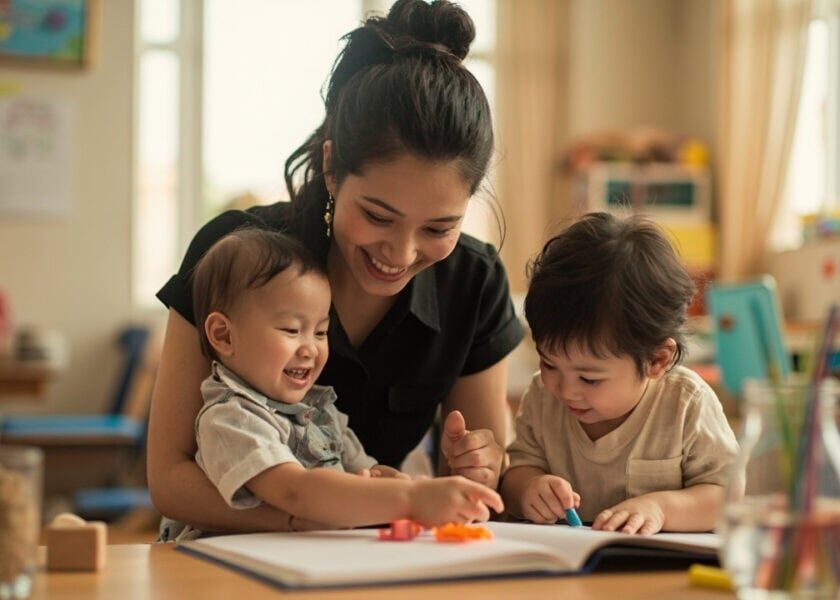
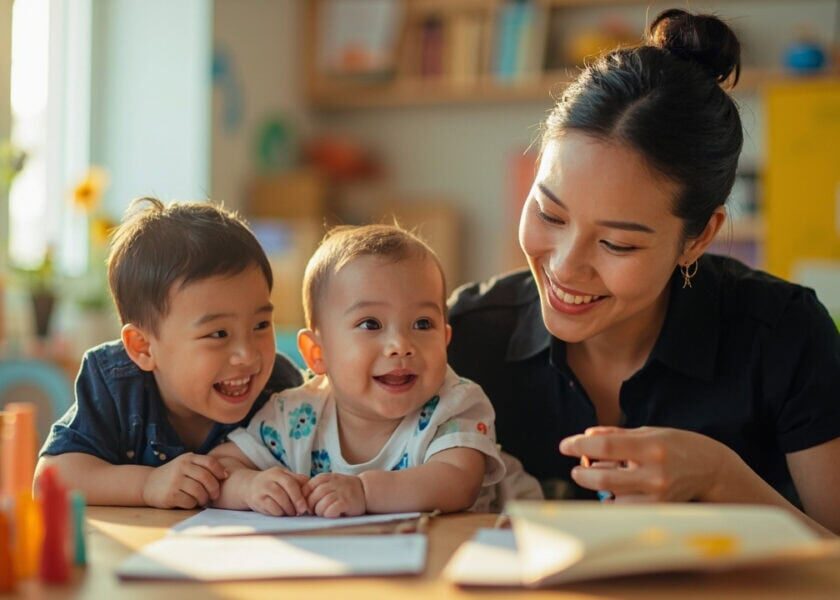
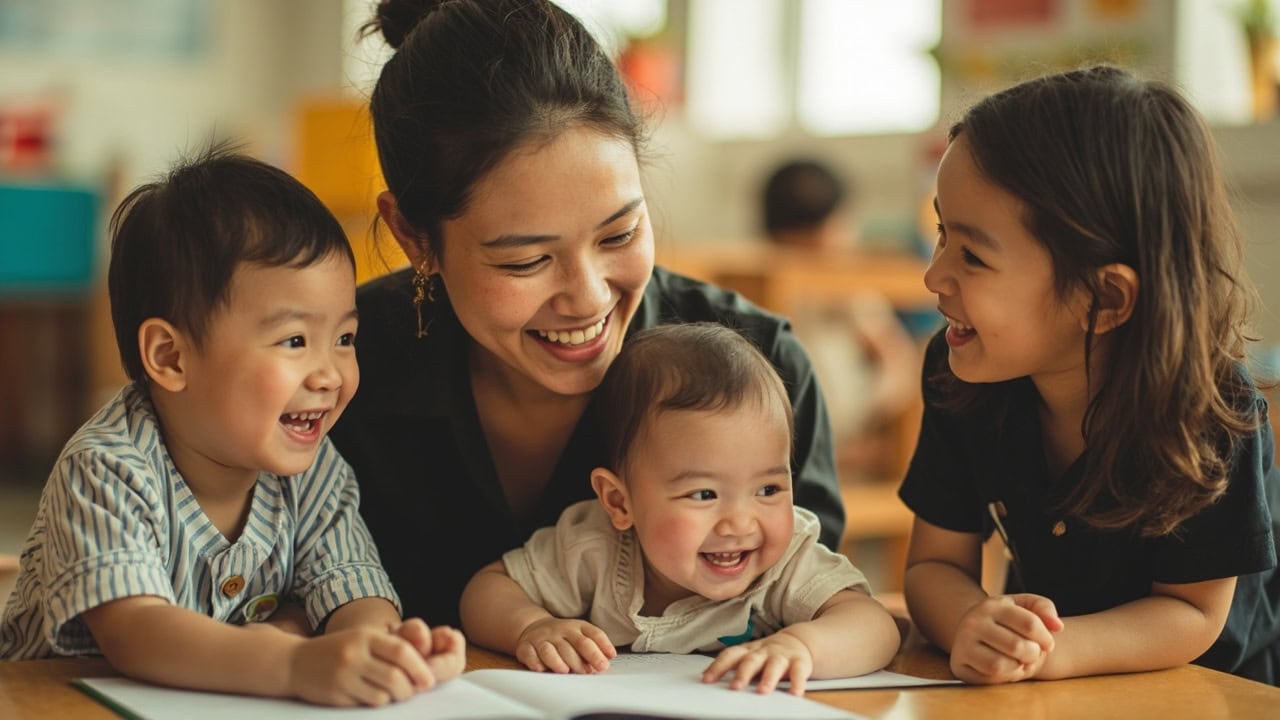
This is what we mean when we talk about cultural continuity as a developmental function. We are not asking childcare to replace the role of the family. We are asking it to partner with the family—to be a place where the languages your child speaks at home are welcomed, repeated, and built upon.
What This Looks Like in Practice
- A caregiver who greets your child in the language your family uses at home, because she has taken the time to learn it
- Your child’s Malay folk song finding a place in the weekly music rotation alongside English nursery rhymes
- Your child’s drawings of their family being displayed on the wall with the same pride as everyone else’s
- A festival calendar that includes Deepavali and Lunar New Year and Hari Raya, not as token gestures but as lived experiences the children participate in
- A caregiver who notices when your child is code-switching and finds gentle, natural ways to bridge those contexts, reinforcing that both languages belong to your child
This is not cultural tourism. It is not a language lesson or a holiday celebration for novelty’s sake. It is the quiet, daily work of a childcare that has made a choice: to see the child as a whole person, shaped by a specific family, a specific culture, a specific heritage—and to honor that shaping rather than work against it or ignore it entirely.
Building Cross-Cultural Competence
There is another dimension to this that is often overlooked. Children in Singapore are uniquely positioned to develop cross-cultural competence—the ability to move comfortably between cultural contexts, to understand difference without fear, to build friendships across ethnic and linguistic lines.
This does not happen automatically. It happens when children are placed in environments where diversity is present, normalized, and valued. Where they learn alongside peers who may speak different languages at home, celebrate different festivals, and carry different traditions—and where all of it is treated as part of the richness of being Singaporean.
Quality childcare, in this sense, is not just about preserving your child’s heritage. It is about giving your child the capacity to belong in more than one world—to carry their own culture with pride and to extend that same respect to others.
How EduNanny Singapore Approaches Cultural Continuity
This is the question EduNanny Singapore was built to answer. Operating as part of the EduNanny by BUTLER family within the ECDA Childminding Pilot framework, we are committed to bringing quality, culturally informed home-based childcare to families across Singapore.
We offer both home-based and centre-based pathways because we understand that families are not uniform, and the right fit matters more than a one-size-fits-all solution.
What Our Model Delivers
- Caregiver ratios of up to one to three infants mean that every child receives the attention, language engagement, and cultural responsiveness they deserve. Children develop cultural confidence not in large groups where they are one of many, but in intimate settings where they can be known.
- Monday to Friday care blocks because for working parents, consistency is not a luxury. It is the foundation on which everything else is built.
- CCTV measures where deployed give parents visibility into the daily life their child is living.
- The Thomas AI Chatbot offers parents a modern tool for navigating the questions and challenges of parenting and childcare.
These are not decorative additions. They are the infrastructure of trust. Because here is the truth that every parent knows: you cannot hand over your child’s cultural development to someone you do not trust. And you cannot trust someone who is not transparent about what they are actually doing with the hours you cannot be there.
Making Quality Care Accessible
For families navigating the financial realities of quality care, our pilot fee structures remain accessible, and parents can utilize their Child Development Account and Baby Bonus where applicable. We believe that culturally intelligent childcare should not be a privilege reserved for families with significant resources.
Questions to Ask and Concerns to Address
As you evaluate your options, here are the questions that will help you understand whether a childcare truly sees your child’s cultural identity as foundational or peripheral.
- How does the caregiver or centre incorporate heritage languages into daily routines—not just during specific language lessons?
- What festivals and cultural celebrations are observed, and how are children involved in them?
- How does the caregiver respond when a child speaks their home language?
- What is the caregiver-to-child ratio, and how does that affect individual language engagement?
- How does the setting support multicultural friendships and cross-cultural understanding?
- What communication does the parent receive about cultural activities and the child’s cultural engagement?
- How does the caregiver learn about and respect each family’s specific cultural context and preferences?
If a childcare cannot answer these questions with specificity and genuine understanding, it may not be the cultural continuity partner your child needs.
Common Concerns Singapore Parents Raise
Can I really trust someone else with my child’s cultural development?
This is the right question to ask. Trust is not automatic—it is built through transparency, communication, and demonstrated understanding. Before you commit to any childcare arrangement, ask how the caregiver will incorporate your family’s languages and traditions. Ask to see how festivals are observed. Ask what happens when your child speaks their home language—how does the caregiver respond? The answers you receive will tell you whether cultural continuity is a genuine priority or a marketing phrase.
Will my child be fluent in English if we prioritize their heritage language?
Research does not support the idea that bilingual development harms English acquisition. In fact, studies consistently show that children who develop strong heritage language skills often transfer cognitive and literacy benefits to their second language. Your child can carry both. The question is whether the environment supports that carrying.
What if my child resists speaking the heritage language?
This is common, and it is not a sign of failure. Children sometimes resist what feels unfamiliar, especially in social settings where they want to fit in. A culturally intelligent caregiver will create natural opportunities for heritage language use without forcing it—through songs, stories, games, and everyday interactions that make the home language feel like a normal, valued part of the day rather than a chore or a correction.
Is home-based care actually better for cultural development?
Home-based care offers specific advantages for cultural continuity: smaller ratios mean more individualized attention, more opportunities for language engagement, and closer observation of each child’s cultural context. But the quality of care matters more than the setting. What matters is that whoever cares for your child understands and respects your family’s cultural framework—and has the training and support to act on that understanding consistently.
The Vision Worth Fighting For
Imagine your child at eight, or ten, or grown. Imagine them moving through the world with ease—not because they have abandoned one culture for another, but because they carry both.
They speak your heritage language fluently, because it was nurtured when it mattered most. They understand their cultural traditions, not as obligations they resent but as gifts they inherit and choose to honor. They stand in two worlds—or many worlds—and feel at home in both.
They do not feel the fragmenting anxiety that comes from cultural disconnection. They do not feel the need to choose between their family and their nation, between their heritage and their ambitions. They are whole. They are rooted. And they are ready.
This is what we are working toward at EduNanny Singapore. Not just childcare. Not just education. Cultural continuity. Developmental wholeness. The quiet, daily work of raising children who belong fully to themselves—and to the rich, multicultural world they are inheriting.
Ready to Learn More?
If you are exploring infant care or childminding options in Singapore and want to understand how EduNanny Singapore approaches cultural continuity as a core part of early childhood development, we welcome you to start a conversation with us.
You can also learn more about our approach and the ECDA Childminding Pilot framework, or read more about who we are and what we stand for.
Because the question you are asking—whether your child’s care setting will honor who they are—is not a small question. It is not a secondary consideration. It is the question that shapes everything else.