Seeing Your Child Fully: The Invisible Hours of Quality Care
The Hours You Cannot See: What Quality Childcare Actually Looks Like
There is a moment, familiar to every parent in Singapore, that arrives with a particular quiet weight. It is the moment you hand your child to someone else and walk away. You do it because you must—the job, the commute, the obligations that require your presence elsewhere. You do it because you trust that this is right, that your child will be safe, that the hours ahead will be good for them.
But even as you turn toward your car or the MRT platform, something stays behind in that room. Something that tugs at you with questions you cannot answer because you are no longer there to see.
What is happening right now? Is my child upset? Is she being seen for who she is, or just managed? Are they playing in ways that matter, or just passing time? Is anyone noticing the small things that I notice—the way she tilts her head when she’s curious, the way she needs a moment before she joins the group?
These questions arrive not because you doubt yourself. They arrive because you love your child with a precision that no one else can match. And so you carry that ache of not being in the room, and in its place grows something else: the imagination that fills in the blanks. Sometimes that imagination is kind. More often, in the unguarded moments of a workday, it is not.
This is the tension that lives beneath the surface of every Singapore parent’s relationship with childcare. Not whether to entrust your child to others, but what happens during those invisible hours. Not whether you can find a place that is safe, but whether your child is known.
You are not wrong to want this. You are not being difficult or anxious or overprotective. You are being a parent. And this is exactly the question that quality care should be able to answer—not by asking you to simply trust, but by showing you what trust looks like when it is deserved.
Making the Invisible Visible
Let us tell you what those hours actually contain. Not in the abstract, but in the texture of a real morning. Because when you understand what is happening in those invisible hours, the doubt does not vanish—but it transforms into something else. It becomes the kind of informed awareness that allows you to release your child into the day with something closer to peace.
A quality environment does not simply occupy a child. It welcomes them. When a child enters a space designed with intention—where the lighting is calibrated for calm, where natural materials offer texture and temperature that the body recognizes as safe, where the arrangement invites movement without overwhelming—the nervous system responds before the mind does. The child does not need to be told this place is okay. The body knows.
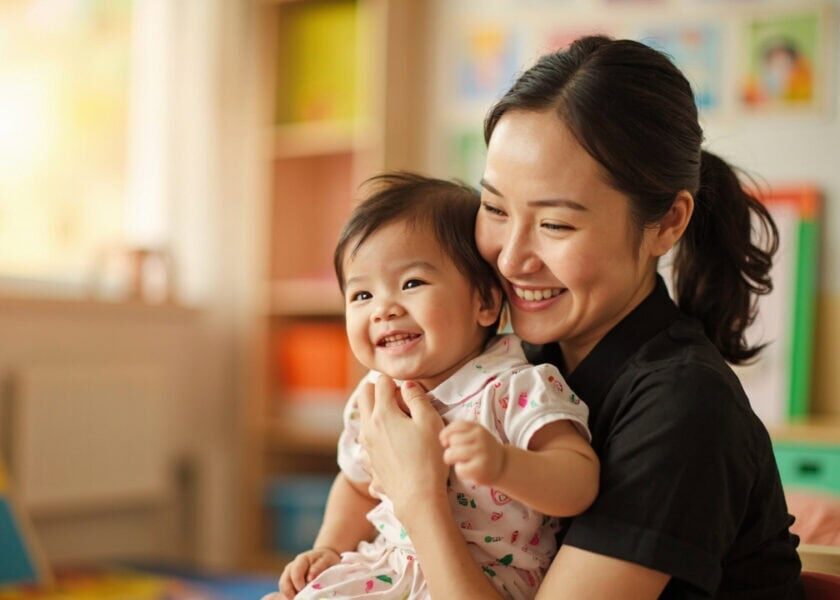
Inside that space, a trained caregiver is watching. Not supervising. Watching. The trained caregiver notices what most people miss: the slight hesitation before a child climbs, the change in breathing when a new adult enters the room, the way a toddler reaches for a toy and then withdraws, and what that withdrawal might mean—whether it is fatigue, uncertainty, or a small social calculation that deserves patient space rather than intervention.
These observations are professional knowledge in motion, made visible in a thousand micro-decisions across the day:
- When to step in and when to step back
- When to narrate what a child is doing in a voice that says I see you, and what you are doing matters
- When to remain silent and let the child discover something alone
- When to offer support and when to let struggle become the teacher
A parent cannot always see this happening. The moments are too small, too quick. But they accumulate. Over weeks and months, they become the foundation of a relationship between caregiver and child that is built on genuine knowledge rather than routine management.
The Social Curriculum: What Children Learn Together
The hours your child spends in quality care are also hours of social education that you cannot replicate at home, no matter how much love you bring to the work of raising them.
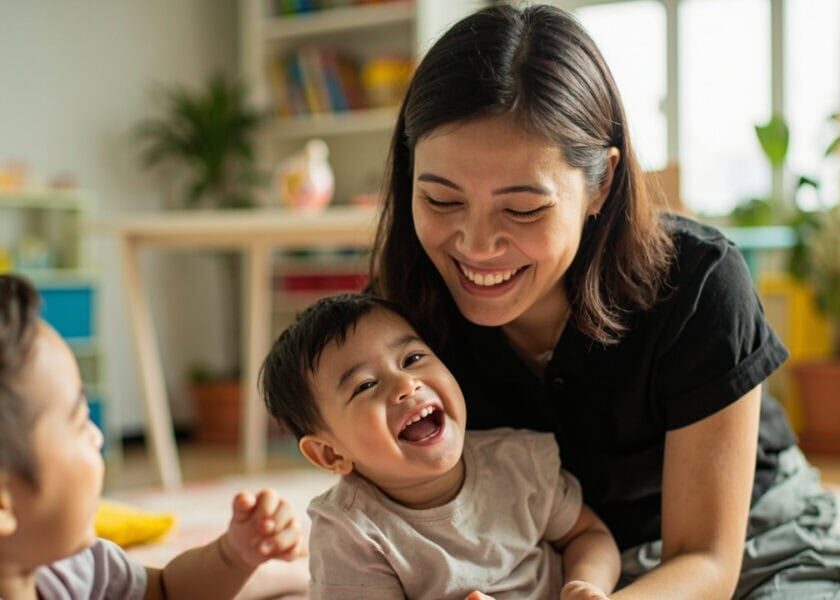
Children learn to be in relationship with others in the presence of other children. They learn it through the friction of sharing, the negotiation of space, the small heartbreak of a toy taken away and the small miracle of it returned. They learn it by watching how others solve problems, how adults intervene with fairness and firmness, how a group of different people finds its rhythm together.
In a quality setting, these moments are not left to chance. The caregiver holds the social curriculum in mind the same way a teacher holds a lesson plan. Not rigidly—children do not learn through coercion—but with intention.
When conflict arises, as it always does, the caregiver’s response teaches something. Do they swoop in and resolve? Or do they create the conditions for children to find their own resolution with gentle support? Do they treat a dispute over a truck as beneath notice, or do they recognize it as the first lesson in negotiation, in empathy, in the hard and beautiful work of getting along?
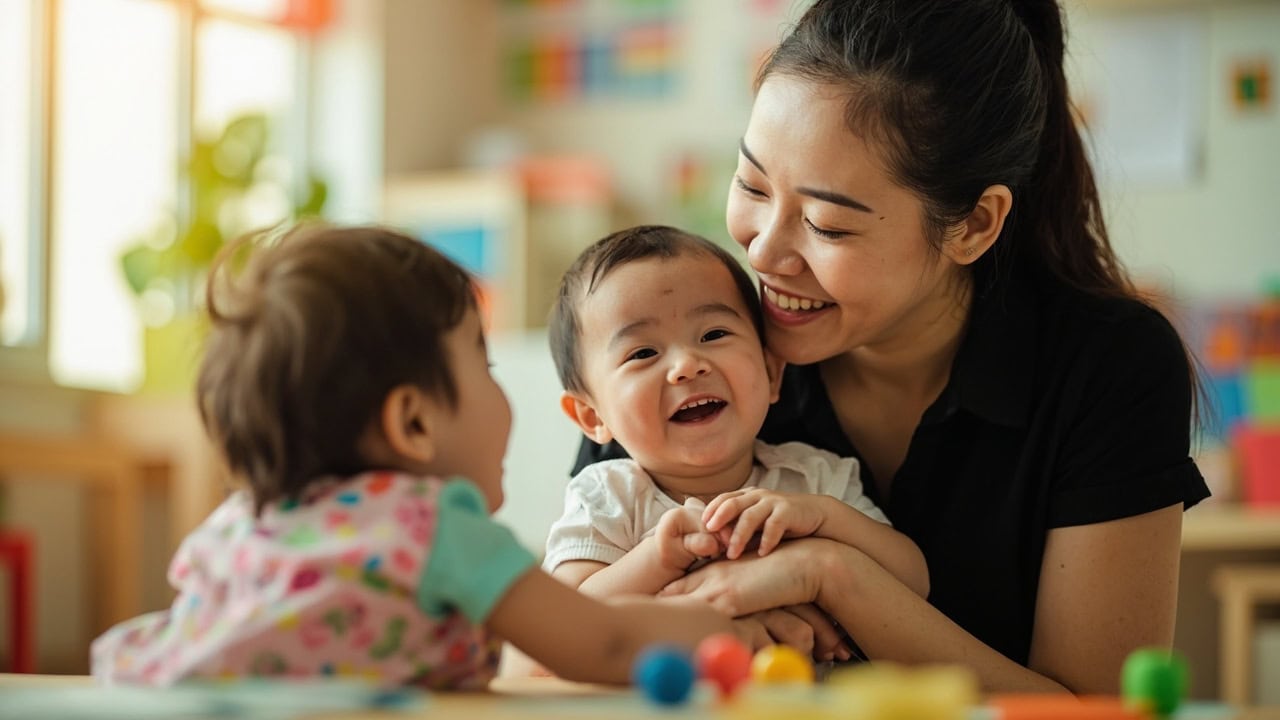
Children learn that they belong to a group. That their presence matters to others. That they can be comforted by peers as well as adults, and that they, in turn, can offer comfort. These are not soft skills. They are the foundations of everything that comes later—the ability to collaborate, to persist through disagreement, to feel the weight of another person’s experience and respond with something other than selfishness.
The Body Knows: Physical and Creative Development
And then there is the body. The way children come to know themselves through movement, through the challenge of climbing, balancing, pouring, tearing, pasting, building and destroying and building again.
Physical development is not separate from cognitive development. It is not a break from learning. It is learning—different, and essential, and impossible to replicate through passive observation or digital engagement.
When a child’s hands learn the resistance of clay, when her body learns the height of a step she was not sure she could climb, when his voice learns the volume required to be heard across a room full of noise—these are not activities that happen while the real learning waits. They are the real learning.
A trained caregiver does not merely provide materials and then stand back. They observe what each child needs in their physical development—more challenge or more support, more risk or more safety, more independence or more companionship. They read the child’s body the way a musician reads a score, finding the places where fluency is building and the places where frustration is rising, and adjusting their response accordingly.
The creative moments follow the same principle. When a child paints, she is not decorating. She is thinking in a language that does not yet have words. She is processing experiences, expressing feelings that have no other outlet, discovering what it means to make something that did not exist before she made it.
The trained caregiver does not evaluate this output. They witness it. They name it. They hold space for the process without rushing toward the product.
This is what quality care looks like when no one is watching. Not just safety. Not just supervision. Genuine attention to the whole child—their social hearts, their growing bodies, their minds that are building themselves through the only medium that works for them: the unhurried, sensory-rich, purposeful activity of childhood.
The Communication Bridge: From Invisible to Understood
We have told you what happens. But we have not yet addressed the bridge—the gap between what is happening and what you know.
This is where trust either forms or fractures. Parents in Singapore are not asking for miracles. They are asking for visibility. They want to know what their child is doing, how they are feeling, who they are becoming in these hours apart. They want to be partners rather than passengers in their child’s daily life.
Communication is not an add-on. It is not the newsletter that arrives at the end of the week, full of pleasant generalities that tell you nothing about the specific, irreplaceable hours your child spent in the world. Communication, done well, is the ongoing translation of invisible hours into visible understanding.
It is the daily message that says: today your child tried something new, and here is what it looked like. Here is what she said. Here is what he discovered he could do. Here is how she was when she arrived, and here is how she was when she left, and here is what we observed in between.
Parents can tell the difference between genuine observation and the paperwork of reassurance. What builds trust is the specificity that only comes from genuine attention—the kind of attention that a caregiver provides when they are not just counting heads but knowing individuals.
What EduNanny Offers: Practice, Not Just Promises
At EduNanny, this is not an aspiration. It is a practice. Through the structures built—communication rhythms, transparency measures, careful documentation of a child’s day—they work to ensure that the invisible hours are not invisible to the people who love the children most.
The belief is simple but important: parents who see what caregivers see, who understand what they understand about their child’s day, become partners in the truest sense. And children benefit when the adults in their lives are aligned, informed, and working from the same picture of who they are and who they are becoming.
Singapore parents carry more than the average weight of expectation. The hours are long. The commutes are real. The pressure to perform at work while performing at home creates a tension that is felt here with particular intensity. EduNanny operates within the ECDA Childminding Pilot, offering pathways that include home-based and community-based options, because families need different solutions and one size does not serve all.
| Feature | What It Means for Your Family |
|---|---|
| Care ratios up to 1:3 for infants | More individual attention, deeper knowing of each child |
| Home-based and community-based options | Flexibility to match your family’s rhythm and needs |
| CDA and Baby Bonus usable where applicable | Financial considerations should not be a barrier to quality |
These are not marketing points. They are the shape of values made practical. They are what it means to take seriously the trust you place in care arrangements.
Finding Care That Sees Your Child: A Practical Path Forward
There is a question that every parent in Singapore eventually asks, whether they voice it aloud or not: Is this right? Is this the right place? Are the people caring for my child seeing who she really is?
The answer is not simple. There is no childcare arrangement that eliminates uncertainty entirely, because raising a child is, by its nature, an act of trust extended into the unknown.
But there is a kind of care that earns that trust through what it does, not just what it promises. There is a kind of transparency that closes the gap between your imagination and reality. Here is what to look for:
- Sensory environment: Spaces designed for calm, with natural materials and thoughtful arrangement that the body recognizes as safe
- Trained observation: Caregivers who notice micro-moments—the hesitation, the shift in breathing, the withdrawal that means something
- Intentional social curriculum: Conflict seen as opportunity, resolution guided rather than imposed
- Physical and creative presence: Activity understood as learning, process valued over product
- Transparent communication: Daily understanding that goes beyond generalities to specific observation
- Developmental attunement: Knowing each child as an individual, not managing them as a group
- Rhythm and structure: Daily patterns that hold and support emotional regulation
When visiting a childcare or childminding service, ask questions that reveal how they work in practice:
- How do you communicate with parents about their child’s day?
- What does a typical daily rhythm look like?
- How do you handle conflicts between children?
- What training do your caregivers have, and how is it applied in daily practice?
- What does free play look like, and how is it supported?
- How do you observe and document each child’s development?
- What is your caregiver-to-child ratio?
Quality care does not ask you to carry that weight by faith alone. It invites you to let them show you what they do with the hours you cannot see. To let them translate their practice into language you recognize, their observations into understanding you can trust, their care into partnership that makes the invisible visible.
The trained caregivers who hold your child in your absence are not strangers performing a service but professionals who have chosen this work because they believe in its importance. The hours your child spends in quality care are hours of genuine development—sensory, emotional, social, physical, creative—hours that are building the person they will become.
And you, as a parent, are not peripheral to this process. You are the center of it. Everything good care does is in service of the relationship between you and your child, not in replacement of it.
If you are researching infant care or childminding in Singapore, you are doing something important: you are looking for people who will hold your child with the same seriousness you do. You are looking for a place where the invisible hours are full of genuine attention, where your child is known rather than just managed, where you are a partner rather than a passenger.
EduNanny welcomes you into that invisible world. Here, your child’s day is not a mystery to be wondered about but a story to be shared. Here, you will see what we see. You will understand what we understand. And you will release your child into the day with something closer to peace.
Because when you walk away from that morning moment, you deserve to do so not with doubt, but with the quiet confidence of a parent who knows—because they have been shown—what is happening in the hours they cannot see.
Because you love your child with a precision that no one else can match. And you deserve to trust what happens when you are not in the room.
#SingaporeChildminding #InfantCareSG #QualityChildcareSingapore #ECDAChildmindingPilot #EduNannySingapore
To learn more about EduNanny’s approach to development-focused childminding and childcare, read about our team and values, or get in touch to discuss your family’s needs.