Beyond Good Day What Your Childcare Updates Should Reveal
The Gap Between What You’re Told and What You Need to Know
You know something important is occurring during the hours your child spends in someone else’s care—the development of language, the emergence of new preferences, the subtle shifts in how they relate to other children, the way they navigate their emotions when tired or hungry or frustrated.
But the bridge between what is happening in that setting and what you are able to comprehend when you pick them up feels thin, and sometimes invisible.
Here is what you need to understand: this is not your failure as a parent. This is a gap that exists in how most childcare providers communicate.
The updates that most parents receive are built on systems, not on observation. They are built on efficiency, on the need to report to many families at once, on the assumption that parents want simple answers to simple questions.
Your child had a good day. Your child ate well. Your child slept well.
These are not lies, but they are not insights. They are the information equivalent of telling someone you visited Paris and offering only the confirmation that you boarded a plane.
In Singapore’s childcare landscape, where center-based infant care can mean one caregiver looking after multiple infants simultaneously, this kind of surface-level reporting becomes almost inevitable. The ratios make deep observation structurally difficult. Documentation systems often prioritize compliance over comprehension.
The result is a parent experience that feels like flying blind—you know something is happening, but you cannot see it clearly.
And this matters more than it might initially seem. The anxiety that defines so many parents’ relationship with childcare does not come from wanting too much. It comes from being given too little to work with.
What Quality Observation Actually Looks Like
Quality childcare offers something fundamentally different. It offers systematic, skilled observation translated into language that helps parents see their child more clearly.
This distinction—this shift from information to insight—is not merely a matter of better communication. It is a reflection of how the care itself is being delivered.
A caregiver who observes deeply, who notices the quality of a child’s play rather than simply whether they played, who tracks the emergence of emotional patterns and cognitive leaps and social discoveries, will have something genuinely meaningful to share with you.
The Difference in Practice
Here is what this looks like concretely.
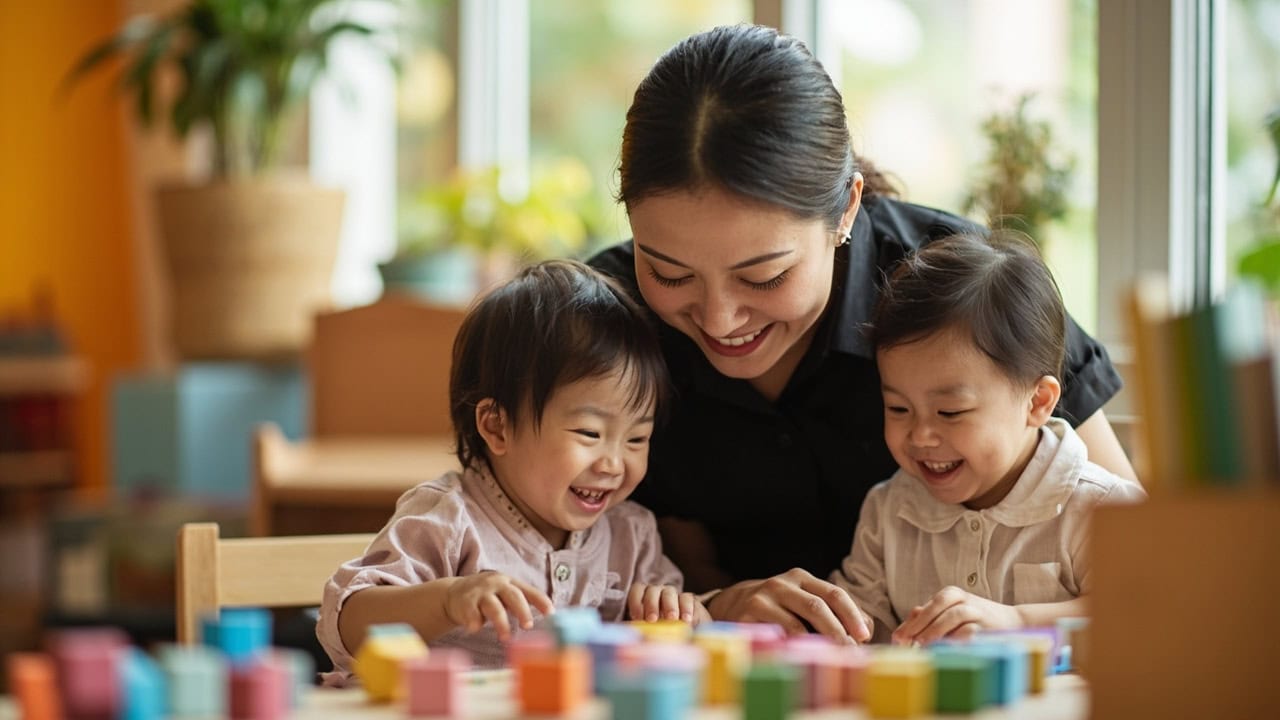
A quality caregiver does not simply note that your eighteen-month-old played with blocks. She notes that your child spent twenty minutes constructing a tower, abandoned it when it fell, showed visible frustration that lasted approximately ninety seconds, and then independently chose to build again—this time making the base wider.
She does not simply record that your child played with others. She observes that your child initiated contact with a peer by offering a toy, that the exchange was brief but reciprocal, that your child returned to parallel play shortly after, and that the brief interaction appeared to satisfy something—curiosity, perhaps, or the beginning of social pleasure.
These are not interpretations without foundation. They are observations made possible by the time, the attention, and the trained eye that quality caregiving requires.
Consider what this means for you as a parent receiving an update. When the communication you receive is built on genuine observation, you are being handed a lens. You begin to see your child differently—not because the caregiver is telling you who your child is, but because the caregiver is showing you how to look.
You start to recognize patterns in your own child that you had not named before. You notice that your child approaches new experiences with a particular hesitation, or that they have a consistent method for solving problems, or that their emotional expressions have a vocabulary you are only now beginning to understand.
This is the beginning of a deeper partnership in your child’s development—one where the caregiver’s observation becomes your own growing capacity to see.
How to Read Your Child’s Updates
The shift from passive recipient of updates to active, discerning reader of your child’s day is not automatic. It requires vocabulary, framework, and a set of questions that open genuine conversation rather than eliciting the same surface-level answers you have grown accustomed to receiving.
Questions That Open Depth
At pickup, instead of asking the caregiver whether your child had a good day—a question that invites a binary answer and forecloses depth—try these alternatives:
- What was my child most engaged by today? This invites the caregiver to share a specific moment rather than a general assessment.
- What did my child return to repeatedly? Repeated behavior reveals interest, comfort, and emerging preferences.
- What surprised you about my child’s choices or behavior? Surprise indicates something unexpected was noticed—which means the caregiver is genuinely watching.
- How did my child respond to transitions today? This opens a window into emotional regulation and security.
These questions communicate that you are interested in texture, not just summary. They invite narrative rather than confirmation.
Surface-Level Updates Versus Quality Observation
| Surface-Level Update | Quality Observation |
|---|---|
| “Played well with others” | “Chose to sit near another child during snack time and appeared to watch them with interest before returning attention to their own food” |
| “Had a good day” | “Returned to the sand table three times throughout the morning, spending increasingly longer periods each time” |
| “Ate well” | “Tried a new texture today—initially hesitant but finished the full serving, reaching for more” |
Both statements in each row might be true. But only the second helps you understand who your child is becoming.
Looking for Patterns Across Time
Look for patterns across updates rather than treating each day’s report as an isolated data point. A quality caregiver will help you see these patterns, but you can also learn to identify them yourself:
- Does your child consistently gravitate toward certain types of play?
- Do you notice shifts in how they respond to transitions or to separation from you?
- Are there recurring emotional themes—frustration, delight, hesitation, persistence—that appear across multiple days?
When you receive information that feels reassuring but empty—the note that says your child was happy, the photo that shows a smile—ask yourself what you are not being told. Happiness is not a measurement. It is a response to something, and that something is what matters.
Why Communication Quality Reflects Care Quality
This is not about demanding more of caregivers in a way that is burdensome or unreasonable. It is about recognizing that the standard most parents currently receive is lower than it should be, and that you are entitled to expect more—not out of entitlement, but out of genuine investment in your child’s development.
The quality of what is communicated to you is a direct reflection of the quality of what is being observed. When a childcare setting offers generic updates, it is often because the observation happening in that setting is itself generic.
The care and the communication are not separate functions. They are expressions of the same underlying practice.
Consider the structural realities. In center-based infant care with multiple infants per caregiver, the ratio itself makes deep observation genuinely difficult. When one caregiver is responsible for several young children simultaneously, the attention required for systematic observation is simply not possible in the same way.
This is not a criticism of center-based care, which serves an essential function for many Singapore families. It is simply a recognition that the communication model appropriate to larger-group settings will necessarily differ from what smaller-ratio care can offer.
Common Concerns, Honestly Answered
“Am I being too demanding if I expect more from my childcare provider?”
No. The desire to understand your child’s day is not demanding—it is parenting. You are not asking for extra work to be placed on caregivers. You are asking for the work they are already doing to be shared with you in a way that is useful.
“Is it realistic to expect this level of detail for every child?”
It depends on the setting’s structure. In center-based care with high ratios, yes, it is unrealistic to expect narrative observation for every child every day. But in smaller-ratio settings designed for this kind of attention, it becomes genuinely possible. The key is matching your expectations to what the structural model can support.
“Will asking these questions make me seem difficult or distrustful?”
Quality caregivers welcome these questions. If your provider becomes defensive or dismissive when you ask for specificity, that itself is information—about the depth of observation happening in that setting, and about how they view the parent partnership.
EduNanny’s Approach: Observation as Partnership
What EduNanny has built is an approach where communication is not supplementary to care—it is central to it.
In the ECDA Childminding Pilot, which EduNanny participates in, the framework recognizes that childminders are not babysitters performing a custodial function. They are trained observers whose documentation of a child’s day has value far beyond administrative record-keeping. It becomes a tool for parents to deepen their own relationship with their child’s development.
In home-based and community-based pathways available through the pilot, the ratio of caregivers to infants—up to one to three in infant care—makes this kind of observation structurally possible. When a caregiver is responsible for a small number of children, she can see each one clearly. She notices the incremental changes, the small victories, the subtle difficulties that larger-group settings miss simply because of scale.
Communication at EduNanny is designed with the same intentionality as the caregiving itself. Parents receive updates that reflect genuine observation—narrative accounts of their child’s day that include not just what happened, but how it happened, what it revealed, what it suggested about where the child is heading developmentally.
EduNanny operates Monday to Friday, with care blocks designed around the rhythms of working families in Singapore. The use of CDA and Baby Bonus funding is supported, making quality care more accessible within pilot fee structures.
Communication and transparency measures—including CCTV where deployed—reflect a commitment to openness that extends beyond mere compliance. These are not selling points in the conventional sense. They are expressions of a philosophy that says: we have nothing to hide, and everything to share.
The caregiver-to-child ratios in EduNanny’s model are not incidental to the quality of communication—they are what make quality communication possible. Observation at the level that produces meaningful insight requires the time and attention that only lower ratios can provide.
Signs the Communication You Receive Is Meeting the Standard
When you find a provider communicating at this level, you will notice specific qualities in what you receive:
- Specificity over generalization: Updates describe particular moments, not general categories like “had a good day.”
- Process over outcome: You learn how your child did something, not just that they did it.
- Pattern recognition: The caregiver connects today’s observation to previous ones, helping you see development over time.
- Two-way potential: Your questions open genuine conversation, not defensiveness or deflection.
- Developmental insight: You learn something about where your child is heading, not just where they are now.
A Different Kind of Childcare Relationship
Here is what changes when you find a provider that communicates at this level.
The anxiety that has defined your relationship with childcare begins to ease. Not because your child is suddenly doing remarkable things every day, though they may be. But because you are learning to see. You are developing the vocabulary and the framework to understand what is happening, and that understanding deepens your connection to your child in ways that no amount of general reassurance ever could.
You begin to notice things at home that you would have missed before. You see the cognitive leap your child made at the childcare setting reflected in their play at home, and you understand that these environments are not separate but connected.
The hours your child spends in someone else’s care stop feeling like a gap in your knowledge—a period of your child’s life that happens outside your view—and become an extension of your own growing understanding. You are learning to read your child alongside someone who has made it their professional practice to observe carefully.
You chose childcare because you had to, perhaps. Because work demanded it, because life required it, because the practical realities of raising a child in Singapore made it necessary.
But what you are discovering—what quality childcare reveals—is that this was never just about logistics. It was about finding people who would see your child the way you see them, who would notice what you notice and notice what you miss, who would share that knowledge with you in language that helps rather than obscures.
Your child is telling you more than you know. Every day, in every interaction, in the way they play and the way they struggle and the way they surprise you with their emerging selfhood, they are communicating.
And now, with the right support, you are learning to read what they are saying. Not as a passive receiver, but as an active, growing, increasingly skilled reader of your own child’s experience.
That is what EduNanny is here for. Not just to care for your child during the hours you cannot be present, but to bridge the distance between what happens in your absence and what you are able to understand. To translate observation into insight, and insight into a deeper bond between you and the child you are raising together.
You have always known your child. Now, with the right partnership, you are beginning to understand them. And that understanding will shape everything that comes next.
If you are exploring infant care or childminding options in Singapore and want to learn more about how EduNanny approaches the relationship between observation, communication, and your child’s development, we would be glad to hear from you. Get in touch or learn more about who we are.