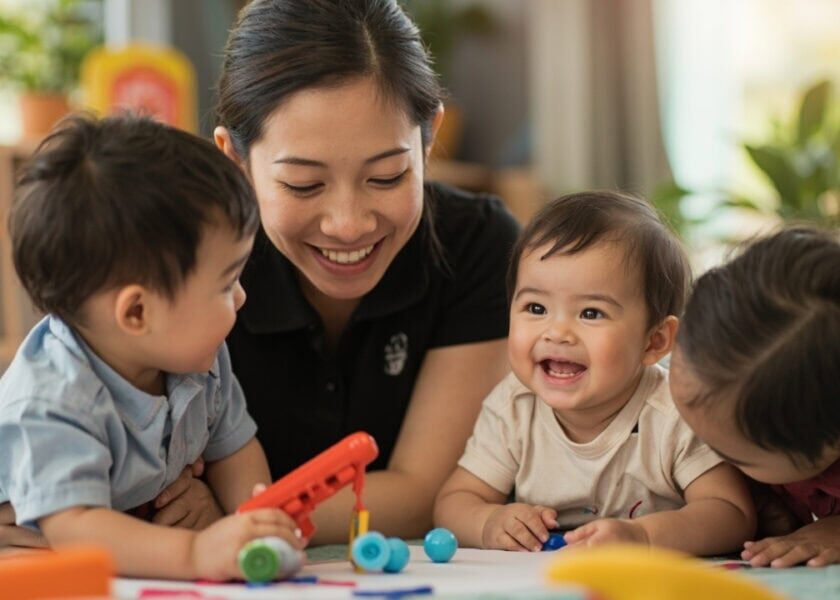
The Trained Difference: How Professional Caregivers See Your Child
The Question Every Parent Carries
There is a question that lives quietly in the mind of every parent who entrusts their child to someone else’s care. It is not a question born of distrust, and it is not one you often ask out loud. It is simply this: What happens in the hours I am not there?
You hand your child over at the door. You glance back once, twice, three times as you walk away. You spend your morning in meetings or on the MRT, and somewhere across the city, your child is playing, eating, sleeping, discovering. And you wonder—with a love that is equal parts beautiful and unbearable—what those hours are actually like for them.
This is not a question about safety. You have chosen this care with care. It is not a question about love, because you know your child is held and cherished. It is something deeper. It is a question about quality. About what unfolds in those hours when you are not there to witness it.
This article is written to answer that question. Not with promises, but with precision. Not with vague assurances, but with a clear view of what professional developmental care actually requires—and what it actually looks like in practice.
The Difference Between Watching and Truly Seeing
Let us begin with a scene you may recognise. A child is playing on the floor with a set of wooden blocks. She picks one up, turns it over in her hand, drops it, picks it up again. She does not yet have words for what she is experiencing. She is learning through her senses, through repetition, through the quiet, persistent work of making sense of the world.
Now imagine two different adults in this moment.
The first is warm, attentive, present. She smiles at the child, responds when the child looks up. She is doing everything right, in the way that kindness allows.
The second is trained. She understands that this child’s sustained concentration on an object is a developmental milestone. She knows that the child’s repetition of the action is not random but purposeful, that the infant is building neural pathways with every deliberate movement. She notes the moment. She responds with language that matches the child’s focus:
“You’re exploring the block. It’s wooden. It makes a sound when it hits the floor.”
She is not merely present. She is professionally, intentionally present. And in doing so, she is supporting the child’s language development, her cognitive growth, her emerging understanding of cause and effect.
This is the difference that training makes. Not the difference between a caring person and an uncaring one. Both adults care deeply. The difference lies in what they are able to see, and how they are able to respond.
What Trained Observation Looks Like in Practice
When an experienced caregiver notices a toddler consistently trying to fit objects into containers, she recognises a cognitive milestone unfolding—spatial awareness, problem-solving, cause and effect.
When she sees a baby babbling with new sounds, she understands this is the precursor to language and responds with engagement that encourages its growth.
When she notices a child becoming frustrated before the frustration escalates, she intervenes with skill rather than waiting for a meltdown that could have been prevented.
Professional observation is not passive watching. It is active, trained perception—the skill of reading developmental cues, understanding what behaviour communicates, and knowing when to intervene versus when to let learning unfold.
Why the Early Years Deserve Genuine Expertise
In the first year of life, a child learns more, and learns faster, than at almost any other point in human development. The brain forms neural connections at an extraordinary rate. Language acquisition begins in the womb and accelerates rapidly after birth. Motor skills emerge in rapid succession: lifting the head, rolling over, sitting up, crawling, standing. Social and emotional development follows its own intricate timeline, as the infant learns to trust, to attach, to regulate increasingly complex feelings.
For parents in Singapore, this reality is compounded by a practical truth: many families rely on professional childcare while both parents work. The hours your infant spends in care are not incidental to their development. They are integral to it.
The Science of Responsive Infant Care
The professional caregiver understands that an infant’s cry is not merely a sound but a communication system. She knows how to read the difference between a tired cry and a hungry one, between a cry of discomfort and a cry of overstimulation.
She understands the science of infant sleep, the importance of routines that support healthy sleep architecture, the delicate balance between stimulation and rest that developing brains require.
She understands that feeding an infant is not merely a matter of nutrition but a moment of bonding, of trust-building, of communication. The way she holds a baby during feeding, the eye contact she maintains, the gentle sounds she makes—these are all part of the infant’s growing understanding that the world is a safe place, that needs are met, that love is reliable.
This is the architecture of early development being built, one moment at a time.
What Professional Care Looks Like in Daily Moments
There is a common misconception that quality childcare requires dramatic interventions, elaborate lesson plans, or constant stimulation. The reality is quite different—and, in some ways, far more demanding.
Quality looks like trained eyes, a knowledgeable mind, and the professional discipline to respond in ways that support development in the smallest moments.
Learning Woven Through Routine
Consider how professional caregivers weave learning into everyday moments:
- During diaper changes: The caregiver narrates what she is doing, names body parts, sings a little song. Language development happens in what might otherwise be a purely functional moment.
- During feeding: The caregiver creates an opportunity for turn-taking in communication, for the back-and-forth exchange that is the foundation of conversational skill. Eye contact and gentle responsiveness build attachment.
- During transitions: The caregiver prepares the child verbally for what comes next, helping them understand the rhythm of their day and building the executive function skills that will later support school readiness.
These are not extras. They are not add-ons or special treatments reserved for children in premium care. They are the daily curriculum of professional developmental practice. The professional caregiver does not set aside time to teach and then stop teaching. She teaches through every interaction, because teaching is not separate from caring. It is what caring looks like when it is done with expertise.
The Environment as Teaching Tool
A professional childcare setting is not simply a space where children are kept occupied. It is a carefully considered environment, designed to support exploration, development, and wellbeing.
Thoughtfully chosen materials, intentional layout, embedded safety, and flexible structure all work together to create spaces where children can thrive. Developmentally appropriate toys and resources, spaces that allow for both active play and quiet retreat, routines that provide predictability while remaining responsive to each child’s needs—these are the hallmarks of a setting built for development.
Making the Invisible Work Visible
Trained caregivers do not simply observe in the moment. They document. They record. They track patterns over time, noting developmental milestones as they emerge, noting areas where a child may need additional support, noting the small victories and the big breakthroughs that mark a child’s growth.
Why Documentation Matters
For the caregiver: It is a professional tool, ensuring that observations are systematic rather than impressionistic, that development is tracked with accuracy and attention.
For the child: It means their growth is seen and honoured. No milestone goes unnoticed. The child’s journey is recorded with care.
For the parent: It is a window into those hours they cannot see. When a caregiver shares written observations, she is not asking you to trust blindly. She is offering evidence, documentation, proof. She is saying: here is what your child did today, and here is why it matters.
Beyond documentation, professional practice includes transparent communication. Regular updates, shared photographs, clear conversations about your child’s day. The goal is always the same: to close the gap between your imagination and the reality of your child’s care, to give you not just trust but knowledge.
Professional Practice vs. Well-Meaning Care
| Well-Meaning Care | Professional Practice |
|---|---|
| Reacts to situations as they arise | Anticipates developmental needs based on trained observation |
| Provides warmth and presence | Provides warmth and presence PLUS intentional developmental support |
| Relies on intuition and good intentions | Grounded in developmental frameworks and evidence-based methods |
| Documents occasionally or not at all | Systematically documents development over time |
| Communication varies with individual caregiver | Transparent communication as professional standard |
EduNanny by BUTLER: Professional Care You Can Trust
At EduNanny by BUTLER, caregivers are not selected for warmth alone, though warmth is present in every one of them. They are selected for their commitment to professional practice, trained in developmental frameworks, and supported in ongoing learning that keeps their skills sharp and their knowledge current.
They are part of a childminding model that has earned recognition from ECDA through the Childminding Pilot, a designation that reflects not just good intentions but demonstrated standards of practice. This is home-based care elevated to professional status, supported by a structure that gives families the assurance they need.
What the Childminding Pilot Offers
- Carefully considered ratios: Ensuring that infants receive the focused attention their development requires
- Flexible pathways: Home-based and community options to suit different family needs
- Monday to Friday care blocks: Designed around the realities of working families in Singapore
- Accessible cost structures: With CDA and Baby Bonus utilisation available
Addressing Your Real Concerns
“I want to trust my child’s caregiver, but I need more than trust.”
You deserve more than trust. You deserve knowledge. You deserve to understand what your child experiences during those important hours. You deserve the confidence that comes not from blind faith but from seeing the professional practice that underlies quality care.
“How do I know if care is truly developmental, not just custodial?”
Ask about observation practices. Ask how developmental milestones are tracked. Ask to see examples of documentation. Professional caregivers should be able to show you, not just tell you, what they see and how they respond.
“Is home-based care really as good as a centre?”
The quality of care depends not on the setting but on the training and frameworks of the caregiver. Home-based care, when professionally structured, offers genuine advantages: smaller ratios, consistency of caregiver, a homelike environment, and the flexibility to respond to each child’s individual needs. The ECDA Childminding Pilot has established standards that position home-based care as a professional option worthy of serious consideration.
“What if something goes wrong?”
Professional caregivers are trained not just in developmental support but in safety, health, and emergency response. Documentation practices mean that concerns are tracked and addressed systematically. And transparent communication means you are kept informed, not left wondering.
Questions to Ask When Choosing Infant Care
- How do caregivers observe and track development? Look for systematic documentation practices, not just verbal updates.
- What training do caregivers have? Look beyond “experienced with children” to specific developmental training.
- What is the caregiver-to-child ratio? For infants, lower ratios mean more focused attention.
- How is learning embedded in daily routines? Quality care happens in moments of feeding, changing, playing—not just in structured activities.
- How does the setting support developmental needs? Look for intentional environments, not just child-proofed spaces.
- What does communication look like? Regular updates, documentation sharing, and open dialogue should be standard practice.
- Is the programme recognised or accredited? ECDA recognition indicates demonstrated standards, not just good intentions.
A Foundation Worth Building
The thousand days from conception to a child’s second birthday are not just a period of time. They are a foundation. And foundations matter.
Every moment of sensory exploration, every act of responsive caregiving, every instance of language-rich interaction, every safe opportunity to test new motor skills, every experience of being calmed by a knowledgeable adult who understands the science of emotional regulation—these are the bricks in the architecture of your child’s future.
You, as parents, are building this foundation with everything you have. And when you entrust part of this work to others, you deserve to know that the work is in trained hands. That the people caring for your child are not just good-hearted, but good at what they do. That they understand the science and the practice, that they observe and document and respond with professional skill.
At EduNanny by BUTLER, we offer not just care, but professional care. Not just presence, but trained presence. Not just a warm environment, but a developmentally sound one, built with intention, grounded in knowledge, committed to excellence.
We know the weight of the responsibility you are placing in our hands. We do not take it lightly. Every caregiver who joins our team is joining a profession, not just accepting a job. And every family who trusts us is trusting that profession—with its standards and its frameworks and its unwavering commitment to doing right by the children in our care.
Because your child deserves more than good enough. Your child deserves the best possible start.
Curious about what professional childminding looks like for your family? Connect with EduNanny by BUTLER to learn more about our trained caregivers, developmental frameworks, and the Childminding Pilot programme.