The Search for a Caregiver Who Truly Knows Your Child
The Question You Carry in Silence
Not with policies. Not with credentials. Not with checklists. Not even with the word “childcare,” which has become so loaded and so administrative that it can obscure what we are really talking about.
We are talking about what happens to your child’s sense of the world in those hours you are not there. We are talking about the quality of the presence that surrounds them when you are somewhere else. We are talking about whether the person caring for your child is not just watching them but truly knowing them — reading their cues the way you do, noticing the small shifts in mood that no one else would catch, responding to the particular way your child reaches for comfort or shows joy or expresses the unspoken thing they cannot yet say in words.
Every parent in Singapore, at some point, asks a question they may not say aloud. It is not, “Is my child safe?” That is the surface question, the practical one, the one that shows up on tours and in orientation packs.
The deeper question — the one that lives in the quiet of the drive home, in the 3 a.m. feed when you cannot sleep even though your child is sleeping — is this:
Does someone else truly know my child the way I do?
Does anyone else notice the particular rhythm of their fussing? Does anyone else understand that the silence after lunch means something different for your child than the silence after a walk? Does anyone else love them, not as a job, but as a person?
That question deserves a real answer. Not a reassuring one. A real one.
What Attunement Looks Like
Here is what we have learned from years of placing caregivers alongside families in Singapore: the answer to your question is yes — it is possible for someone else to truly know your child. But it is not automatic. It is not guaranteed by good intentions, or by a warm smile at the door, or by years of experience listed on a resume.
It is possible because of something specific — something trained, something intentional, something that separates professional care from mere presence. And that something is what we call attunement.
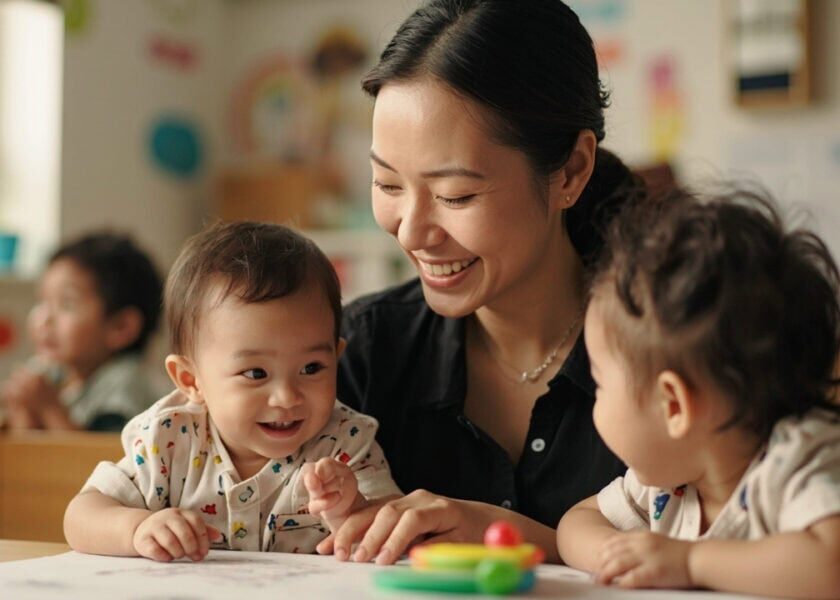
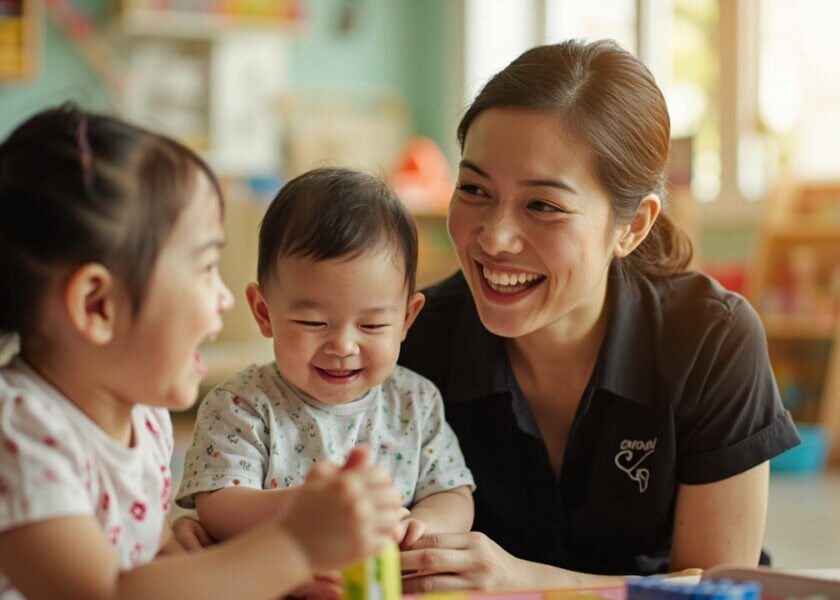
When a caregiver is attuned to a child, they are not simply following a schedule. They are not going through the motions of feeding, changing, putting down, picking up. They are reading the child in real time.
They notice the half-second pause before a cry becomes a wail, and they move to comfort before the distress peaks. They notice which toy the child reaches for when they are tired versus which one they reach for when they are bored. They notice that this particular child does not like being rushed through diaper changes but will laugh if you make a game of it.
This is not intuition. Not entirely. Intuition plays a part, the way it does in any relationship between a caring adult and a young child. But in professional attunement, intuition is developed, refined, and deepened through training.
A caregiver who is trained in infant and toddler development learns to understand what is happening neurologically and emotionally when a child arches away from a stranger, when a toddler has a meltdown over something that seems trivial, when a baby goes quiet and still at a sudden loud sound. They learn that a child’s cry is not random — it is communication, and it has texture and meaning.
What Attunement Looks Like in Practice
- The caregiver anticipates a child’s needs before they escalate — offering comfort, a transition cue, or a change of scene proactively
- She notices patterns over time: which mornings tend to be harder, what helps this particular child settle, when to push gently and when to step back
- She adjusts her tone, pace, and presence to match the child’s emotional state, rather than imposing a rigid routine
- She reads the space between words — the body language, the energy level, the quality of engagement — as carefully as she reads behavior
You can see attunement in the way your child’s caregiver speaks about them. Not just “she ate well today” but “she ate well today, but she seemed like she needed more time with the sensory bin this morning — I think she was processing something.”
That sentence — that is a caregiver who has become your child’s interpreter. Who is reading the whole child, not just their behavior, not just their output, but the inner life that is expressed through the way they move and play and interact.
In the early years, your child cannot tell you in words what they experienced during the day. What you get, at the end of the day, is fragments — a word, a drawing, a mood. But your caregiver, if they are truly attuned, can fill in the spaces between those fragments. They can narrate your child’s day back to you not as a report — not as a list of meals and naps and diaper changes — but as a story, a coherent account of your child’s emotional and developmental experience.
The Difference Between a Report and a Story
| A Standard Daily Report | What Attunement Looks Like |
|---|---|
| “Baby had 150ml formula at 10am.” | “She took her morning feed well but seemed hungrier than usual — I wonder if she had a growth spurt recently?” |
| “Napped from 1pm to 2:30pm.” | “His nap was shorter than usual, but he was really engaged during the morning activity, so I think he was more stimulated than tired.” |
| “Played with blocks.” | “She discovered she could stack two blocks today — and then spent twenty minutes trying to get the third one to stay. The look on her face when she succeeded was amazing.” |
Secondary Attachment and Continuity
In the first thousand days of a child’s life, the architecture of their emotional world is being built. Not metaphorically. Literally. The neural pathways that govern how they will relate to other people, how they will regulate their emotions, how they will experience trust and security and connection — these are being laid down right now, in the interactions they have every single day.
Early relational experiences do not just feel important to a child. They become the internal working model that the child carries into every future relationship, from the playground to the classroom to the boardroom decades later.
That architecture does not only get built at home. It gets built everywhere your child spends their waking hours. Which means that the quality of the caregiving environment is not a secondary concern, something you address after you have handled the primary business of safety and nutrition. It is a primary concern — because those early relational experiences are forming whether you are in the room or not.
This is not a source of guilt. It is a source of clarity.
What Secondary Attachment Looks Like in Your Child
- Your child greets their caregiver with recognition — not just awareness, but recognition, as though they know this person
- Separation protests are brief and manageable, and your child settles within minutes rather than remaining distressed
- Your child is willing to explore new environments, activities, and play — because they feel held enough to venture out
- Your child references their caregiver in positive ways at home: “Miss Sarah helped me build the tower”
- Your child’s behavior remains consistent across days, without the disruption that comes from constantly adjusting to new faces
This is why caregiver continuity matters so much. It is not a nice-to-have. It is not a premium feature for families who want extra comfort. It is the mechanism by which the secondary attachment forms.
When a child sees a different caregiver every single day, or when a caregiver changes without warning, the child must begin the relationship-building process again, and again, and again. Each time, there is a period of re-adjustment — of vigilance, of the child holding back a little before they trust that this new person will know them the way the last one did.
When a caregiver and child have been together for months — when the caregiver can tell from the way the child walks in the door whether this will be a good morning or a difficult one — that is when the real work of attunement becomes visible. Not as a performance for visiting parents, but in the ordinary, daily, unguarded moments that happen when nobody is watching.
What EduNanny Was Built to Answer
The language of partnership matters here, because it corrects a subtle but persistent misunderstanding. There is an old model of childcare — the transactional model — in which the caregiver is a service provider and the parent is a client, and the relationship is defined by the exchange of care for payment.
In that model, communication is a deliverable. Updates are a feature. A daily report is a product spec. There is nothing wrong with any of those things. EduNanny provides transparent communication, regular updates, structured reporting. These are important.
But the deeper relationship we are describing goes beyond transaction. It is relational. It is built over time, through thousands of small interactions — through the caregiver who learns that your child hates having their face wiped but tolerates it if you sing the same little song every time, through the caregiver who knows that your child will only drink water from the blue cup, through the caregiver who sends you a quiet message in the afternoon not because it is policy but because she noticed something today and thought you would want to know.
This is the caregiver who becomes part of your village. Not because she was hired to fill a role, but because she has genuinely come to know and care for your child.
EduNanny operates within a framework that takes both the urgency and the delicacy of this responsibility seriously. As part of the ECDA Childminding Pilot, EduNanny offers home-based childminding pathways alongside community and centre-based options — giving families in Singapore real choices about the environment that best suits their child and their home life.
One structural decision makes everything else possible: the number of children in a caregiver’s care at any one time. At EduNanny, the infant ratios in home-based and community care settings — up to one caregiver for every three infants in applicable pathways — are designed to make genuine attunement possible.
When a caregiver has three children in their care, they can still read each one. When they have six or seven, the reading becomes harder, the responsiveness slower, the secondary attachment thinner. The ratio is not an administrative detail. It is a statement about what we believe is possible in caregiving, and what we believe every child deserves.
The pilot is designed to make quality infant and toddler care not just possible but accessible, with fee structures structured to be affordable for families who need reliable, professional care. For families navigating the practical realities of Singapore’s cost of living, EduNanny works with CDA and Baby Bonus subsidies, so the financial dimension of accessing quality care does not become a barrier to quality itself.
But what matters most is not the infrastructure. It is what happens inside the care — the human part, the relational part, the part that no subsidy can purchase and no policy alone can guarantee.
A Framework for Parents
If you are weighing childcare options in Singapore, here is what to look for — and what to ask.
Look for:
- Consistency of caregiver assignment. Ask how long children typically stay with the same caregiver. Ask what happens if a caregiver leaves. The answer should reflect an awareness that continuity is not incidental but structural.
- Trained attunement. Ask about the caregiver’s training, not just in childcare tasks, but in child development. Ask how they understand and respond to infant distress. Listen for answers that reveal observation, interpretation, and intentionality.
- Described moments. When you visit, ask the caregiver to tell you about a recent moment with a child in their care. Not a summary — a specific moment. The quality of the answer will tell you something real.
- Two-way communication culture. Ask how they share your child’s day with you. Ask what kinds of questions they welcome. A caregiver who is confident in their relationship with your child will not feel threatened by your curiosity.
- Responsiveness to your input. When you share something about your child — a preference, a fear, a pattern — does it register? Does it show up in how they care for your child? This is how partnership begins.
Ask yourself:
- Do I feel seen when I speak about my child, or do I feel like a client completing a transaction?
- Does the caregiver speak about the children in their care as individuals, or as a group?
- When I leave my child, do I feel guilt, or do I feel something closer to trust?
- At the end of the day, do I learn something about my child that I could not have known otherwise?
Addressing the Concerns You Carry
“Will my child feel abandoned?”
When the caregiver relationship is strong, children do not feel abandoned. They feel held — even when you are not the one holding them. Separation protest is normal and healthy. It means your child has formed a secure attachment to you and knows the difference between someone who matters and someone who doesn’t. What matters is what happens after that initial protest: does your child settle? Does the caregiver respond in a way that communicates safety? Over time, with consistency, the answer to both questions should be yes.
“How do I know if my child is really being seen?”
Ask your caregiver questions that require interpretation, not just reporting. Instead of “Did she eat well?”, try “How did she seem to you this morning?” Instead of “Did he have a good day?”, try “Was there a moment today that seemed especially him?” A caregiver who is attuned will not just answer — they will expand. They will share observations that reveal they have been watching not just your child’s behavior, but the person behind the behavior.
“What if the caregiver doesn’t feel like family?”
This is worth naming: the caregiver relationship will not feel the same as family. It is not supposed to. What it should feel like is warm, consistent, and genuinely attentive. It should feel like someone who has taken the time to know your child and who takes joy in that knowing. If it feels clinical, transactional, or performative, that is worth paying attention to — not because warmth cannot develop, but because the early days are when attunement either begins or fails to begin.
“Can quality care really be affordable in Singapore?”
We understand the weight of this concern. Singapore parents carry a particular burden: the cost of living, the demands of dual-income households, the expectations of a society that celebrates achievement and preparation and optimization. It can feel as though every choice you make for your child is a test you might fail.
The ECDA Childminding Pilot, within which EduNanny operates, is designed to address this directly. Fee structures are structured for accessibility, and subsidies — CDA and Baby Bonus — are integrated into the process so that financial barriers do not exclude families from quality care. The goal is to ensure that the quality of your child’s caregiving environment is not determined by your income bracket.
If the answer to those questions points toward genuine relationship — toward a caregiver who is reading your child, not just watching them — you may have found something rare. Protect it. Build on it. Communicate with it.
A Letter to You, If You Are Still Deciding
If you are a parent in Singapore who is weighing these decisions right now — who is asking the quiet questions, the ones you may not have said aloud — we want you to know something.
The kind of care we have been describing is not a fantasy. It is not wishful thinking. It is real, and it is possible, and it is available to your family.
Not through a miracle of personality, but through intentional training, structured ratios, consistent caregiver relationships, and a culture that treats the caregiver-child bond as the heart of everything we do.
You do not have to choose between peace of mind and quality of care. You do not have to accept that the person caring for your child during the day will simply be a competent stranger.
You can find — you can build — a caregiving relationship in which your child is truly known.
And when that happens, you will know it too. Not because someone told you. Because you will see it in your child’s face when they are handed to their caregiver in the morning. You will hear it in the way they talk about their day. You will feel it in the ease with which they wave goodbye — and in the ease with which you drive away.
Monday to Friday, across Singapore, EduNanny caregivers are in the rooms and homes and centres where children spend their formative hours. They are not filling in. They are not just keeping children safe and occupied. They are building relationships. They are learning the children in their care with the same patience and attention that you, as a parent, bring home to them at night.
They are noticing things. They are remembering things. They are holding your child — literally and figuratively — in a way that is worthy of your trust.
Trust is not given. It is earned. It is built, slowly, through consistency and transparency and evidence. And we would be honored to build it with you.
We understand that this decision matters more than almost any other you will make in the early years.
You are not outsourcing your child’s care. You are inviting a capable, warm, trained professional into the ongoing story of your child’s development.
If you would like to learn more about EduNanny’s home-based and community childminding pathways — or if you simply want to ask the questions this conversation has raised — we welcome the conversation.
Because you deserve an answer. A real one.
EduNanny by BUTLER — Part of the ECDA Childminding Pilot. Subsidies available. Enquiries welcome.