The Observation That Transforms Pickup Into Connection
The Tension Every Working Parent Carries
Here is what makes this moment so difficult, and so underestimated. Your child is changing right now. Not someday, not eventually—right now, in these years, in these months, in these weeks. The early years carry developmental weight that is difficult to overstate. The attachments forming, the language emerging, the social instincts waking up, the way they learn to handle frustration or seek out connection—all of it is happening while you are at work.
And yet you are separated from that process precisely when it is most alive. You are managing spreadsheets, attending meetings, navigating commute routes, answering messages, while somewhere across the city your child is learning to share a toy for the first time, or protesting loudly when their block tower falls, or reaching for a caregiver’s hand because they have decided, quietly, without announcement, that this person is safe.
We are more invested in child development than any generation before us, and we are more absent from our children’s daily lives than any generation before us, too. The two facts sit together, uncomfortable and true. This is the central tension of modern parenting that no one really talks about.
Most childcare arrangements offer no way through this paradox. The pickup exchange becomes a ritual where both parties perform the motions of communication without any real exchange occurring. You ask. They deflect. You try a different question. They shrug. The moment passes, and the drive home is quiet, and you wonder whether you are imagining the distance or whether it is actually there.
Consider what you are typically working with at pickup. Your child has been awake since six or seven in the morning. They have eaten, played, perhaps napped, navigated social interactions, experienced transitions, had moments of frustration and moments of delight. And now they are tired, overstimulated, or simply absorbed in the relief of seeing you. They are not equipped to narrate their day. They may not even have the language for it yet.
And yet you need something. Not just reassurance that they survived—you already trust that they are safe. You need to know who they were today. What they discovered. How they connected. Where they struggled. You need to feel like a parent who knows their child, not one who is guessing.
What Quality Observation Actually Changes
The difference that changes everything begins with understanding what observation really means—not as a vague aspiration, but as a practice with real content.
A casual caregiver sees a child who is upset and comforts them. A trained, attentive caregiver sees a child who is upset, notices what triggered it, observes how the child recovered, notes whether the recovery was faster or slower than yesterday, and files that moment away as a small piece of a larger picture of how this particular child regulates emotion.
The child stops crying in both scenarios. But in one, something was learned about your child that you will never hear about. In the other, that learning becomes part of a daily record—a quiet accumulation of understanding that builds into something parents rarely get to see: a picture of who their child is becoming.
Watching, Not Supervising
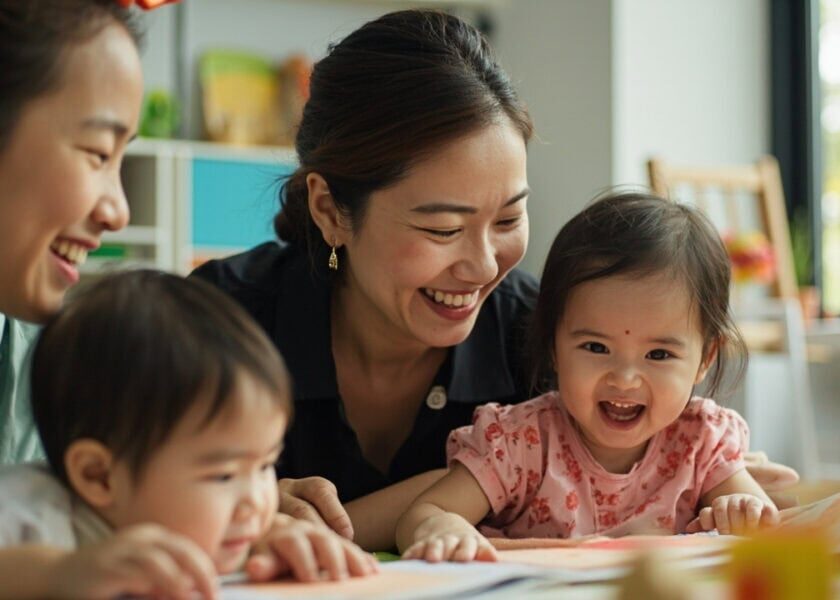
Not supervising. Not babysitting. Not keeping children safe and fed and occupied until the parents arrive. Watching. Noticing. Reading the day the way a naturalist reads a forest—not just seeing that it is there, but understanding what it is doing, and why, and what it means.
Trained observation is not a checklist. It is not an incident report filed only when something goes wrong. It is a continuous, attentive presence throughout the day—not hovering, not intrusive, but genuinely present—that produces meaningful daily insight. And then it communicates that insight in a way that actually reaches you.
Seeing the Moments That Matter
Suppose your child had a small social breakthrough today. Perhaps for the first time, they reached out to another child instead of pulling away. Perhaps they sat with a group during snack time instead of eating alone. Perhaps they laughed at something another child did—a shared joke, a shared delight, the earliest architecture of friendship.
In most childcare settings, this moment happens and disappears. The caregiver is managing a group, handling logistics, keeping things running. There is no one whose specific job is to notice this and remember it and tell you.
In a quality childminding arrangement, that moment is seen. And at pickup, instead of “what did you do today,” your caregiver might say something like:
“She reached for Jia Xin’s hand during circle time today. Not quite holding it—just reaching. She seemed to be watching how the other children were sitting close together. I think she’s curious about that.”
Do you hear the difference? That is not a status update. That is a window. That is your child’s inner life becoming visible to you for a moment—her emerging interest in connection, her careful, observational approach to the social world, the way she is building toward something. And now you know something about her that you did not know this morning.
Consider a different kind of moment. Perhaps your child struggled today. Perhaps the transition was hard, or another child took their toy and they did not know how to respond, or they were tired and out of sorts and the day felt longer than it should have.
In most pickup exchanges, you sense something is off. Your child is clingier than usual, or quieter, or more prone to tears. You ask what happened and they cannot tell you. And you spend the evening a little off-balance, not sure what your child needs, guessing, wondering whether something is wrong or whether you are imagining it.
With consistent, quality observation, your caregiver can say:
“She had a hard afternoon. The transition from nap was tough for her today—she needed about fifteen minutes of quiet time alone before she was ready to join the others again. By the end of the day she was back to herself, but I thought you should know she might need a slower evening than usual.”
That knowledge changes everything. Instead of pushing activities when your child needs stillness, you adjust. Instead of feeling frustrated by clinginess you do not understand, you recognize it as the residue of a hard afternoon and meet it with patience. Instead of going to bed uncertain whether something is wrong with your child or your parenting, you sleep soundly knowing you responded well to what they actually needed.
What Parents Gain Over Time
Here is what most parents find when they experience consistent, quality observation over weeks and months: they become better parents.
Not because they have been given a manual or a lecture or a set of instructions. But because they know their child better. The daily accumulation of specific, meaningful observation builds something in them—a picture of their child that grows more detailed and more true with each passing day.
They begin to anticipate needs. They recognize patterns. They understand why their child acts certain ways in certain situations. They stop taking their child’s behavior personally because they have context for it.
They become, in the truest sense, competent parents—not because someone taught them how, but because they finally had a window into the world their child is navigating.
The Trust Dividend
When you leave pickup feeling seen—not just your child, but yourself, as a parent who deserves to know what is happening with your child—something shifts. The anxiety softens. The trust deepens. You stop feeling like you are leaving your child in a black box and start feeling like you are part of a team, with a caregiver who is watching alongside you, noticing what you would notice if you could be there, and telling you about it in a way that means something.
Understanding your child’s day is not anxiety. It is competence. Quality observation does not create worry—it reduces it. It takes the guesswork out of evenings and weekends. It gives you a framework for understanding behaviour that might otherwise feel random or frustrating. It is not about hovering or worrying more. It is about knowing more, which lets you relax more.
How EduNanny Makes This Possible
EduNanny was designed with this understanding at its centre—as the core conviction from which everything else follows.
We believe that when you cannot be there, someone should be watching—not just supervising, but truly watching. And we believe that what they see should come back to you in a form that helps you understand your child better, connect with your child more fully, and grow in confidence as a parent.
Small Ratios, Real Attention
EduNanny operates under the ECDA Childminding Pilot, which means our arrangements are designed with deliberate attention to ratios and oversight—small groups, trained caregivers, and the kind of environment where a caregiver can actually notice what is happening rather than simply managing it.
When the ratio is one caregiver to three infants, the caregiver can watch. When it is one to twelve, they cannot. This is not a small thing. It is the whole thing.
Small ratios mean the kind of continuous, attentive presence that produces the observations we have been talking about. It means knowing which child is watching the group before joining them. It means noticing when the usually easy child is quiet today. It means having the mental and emotional space to see meaning, not just manage behaviour.
Real Communication, Not Performance
Parents have seen enough apps that send generic daily updates—stock photos, templated language, a sense that someone is checking a box rather than sharing something true. EduNanny’s approach to communication is built on actual observation.
Where deployed, transparency measures including documentation practices allow you to trust what you are being told. Some arrangements include CCTV as an additional layer of clarity, because we understand that trust requires evidence, not just promises.
We have also built tools to support this communication in real time. The Thomas AI Chatbot, integrated into the EduNanny experience, gives parents a way to ask questions and receive considered responses about their child’s day—not replacing the caregiver’s judgment, but extending access to insight and support whenever you need it.
Built Around Real Working Lives
EduNanny’s care is available across Singapore, with both home-based pathways and connections to community and centre-based options where relevant to your family’s situation. Monday to Friday blocks, structured around what working parents actually need, with fee structures designed to be accessible within the pilot framework.
For families with young children, the CDA and Baby Bonus schemes are usable—because we believe good care should not be reserved for those who can afford to make it expensive.
Parenting does not stop at pickup. Neither does our commitment to keeping you connected.
What to Look For When Choosing Infant Care
If you are researching childcare options in Singapore, here are the questions that matter most:
- Ratio matters. Ask how many children each caregiver is responsible for. The lower the ratio, the more attention your child receives. For infants, ratios of 1:3 or 1:4 make observation possible in a way that larger groups do not.
- Ask what pickup looks like. Before you enrol, ask what the pickup conversation includes. Is it a formal handover? A brief status update? Or does it include the kind of meaningful observation described here?
- Notice how caregivers describe children. Quality caregivers speak about children with specificity. They say what happened, not just that something happened. They have opinions about development, not just reports of incidents.
- Ask about communication practices. What does daily communication look like? Is it templated or genuine? Is there space for questions during the day, or only at pickup?
- Consider the trust factor. Transparency measures—clear documentation, consistent caregivers, visible practices—matter more than promises. You should feel confident that what you are told reflects what actually happened.
The Pickup Moment, Reframed
The pickup moment is not a logistical exercise. It is not just the handoff between caregiver and parent. It is a daily opportunity—to learn something about your child, to feel connected across the distance of the working day, to leave knowing that the hours you spent apart were not a void but a world that someone was paying attention to.
Most parents do not get this. Most parents leave pickup with fragments, or silence, or the vague sense that something happened that they will never know about. And they accept this as the price of working parenthood—as if the tradeoff between career and connection is simply inevitable, something to be managed rather than solved.
It does not have to be.
Observation is a practice. It can be learned, trained, and sustained. When it is done well, it changes the mathematics of your day. Instead of spending the hours apart wondering, you spend them knowing—or at least, knowing more. And that daily, specific, meaningful knowing transforms the pickup moment from a five-minute interval of frustration into something you look forward to.
The next time you kneel down at a pickup gate and ask your child how their day was—and they give you that blank, faraway look, or that vague “fine”—you do not have to accept that blankness as the end of the conversation. You can ask your caregiver instead. And if they have been watching, really watching, they will tell you something true. A detail. A moment. A small piece of your child’s day that makes them visible to you again.
You should not have to choose between your career and your connection to your child. Someone should be watching. And what they see should come back to you in a form that means something.
That is what bridges the distance. Not just love, though love is everything. Not just intention, though intention matters. But attention. The trained, consistent, daily attention of someone who has made it their work to notice what your child is becoming—and to bring that noticing back to you, day after day, so that even when you cannot be there, you are not really absent.
You are there. Your eyes are there. Your understanding is there.
And your child knows it, even if they cannot say so yet.
Ready to learn what a quality childminding arrangement could look like for your family? Speak with the EduNanny team to explore your options in the ECDA Childminding Pilot.