The Morning Ritual That Reveals Your Childcare’s True Quality
Quick Summary: What the Morning Handoff Reveals About Your Childcare
- The first five minutes of drop-off are the single best predictor of how your child is treated during the day—not the tour, the curriculum, or the teacher-to-child ratio on paper
- Quality handoff is unscripted and cannot be staged, which is why it reveals who the caregiver truly is
- Your child’s stress hormones settle not when you leave, but when she is genuinely received by a calm, attentive adult
- The helper’s role in Singapore households deserves dignity and intentional integration
- Trust is built through daily micro-moments, not grand gestures or one-time decisions
- Notice: attention quality, level-greeting, two-way information flow, your child’s emotional response, and how you feel when you leave
The Emotional Reality of the Morning Goodbye
Let us be honest about what that doorway actually holds. For many Singapore families, the morning is a choreography of remarkable complexity.
Perhaps your helper has already dressed your child, given breakfast, and brought down the bag with the spare clothes and the comfort toy. Perhaps you have juggled a conference call that started too early while simultaneously making sure the milk bottle was in the fridge and the diaper bag was stocked. Perhaps you are managing all of this alone, and the thought of one more thing going wrong makes your chest tighten.
The bus or car is waiting. The traffic will be what it will be. And somewhere in your mind, a small voice is asking: Did I pack enough? Did I explain everything? Will she be okay?
The physical act of handoff is almost absurdly small. A few steps. A greeting. Maybe the caregiver looks up from what she was doing. Maybe your child runs ahead or clings to your leg.
You do not know—and this is the part that no one talks about enough—you do not know what is happening behind that door until the end of the day.
This is the gap that every working parent in Singapore knows intimately. The space between what you feel during the morning goodbye and what you can know during the hours of care. You have made a decision based on research and instinct and hope. Now you must trust that decision every morning, afresh, as if it were the first time.
What Quality Looks Like in the First Five Minutes
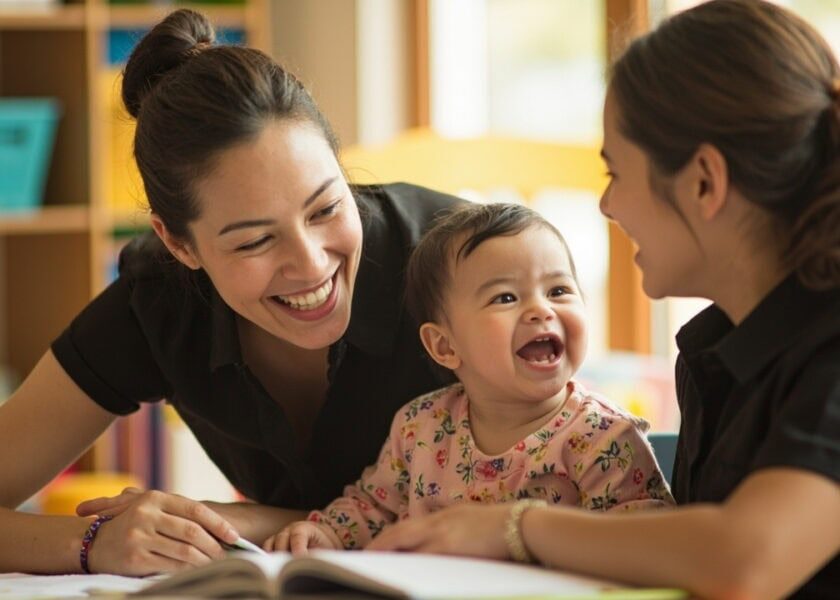
Watch, if you will, what a quality morning handoff actually looks like.
It begins before you arrive. A good caregiver knows the children in her care. She has not just memorized names and allergies—she knows that one child needs a moment of quiet before she can engage, that another arrives hungry and needs a small snack before the transition, that a third is more settled when her helper’s goodbye includes a specific phrase the child finds reassuring.
When you arrive, she is present. Not distracted, not rushing, not already looking past you toward the next task. She meets your child’s eyes first.
A genuine greeting directed at the child: “Good morning, Mei-mei. I see you have your red bag today. Do you want to show me what’s inside?”
This is not performance. This is the beginning of a transition that your child will internalize as: I am being received. I am seen. The person my parents trust is actually here for me.
The caregiver then turns to you. Not as an afterthought, but as a participant in the ritual. She asks a real question—one that acknowledges the handoff is a transfer of information, not just a transfer of body weight.
“How was her night? I noticed she seemed tired yesterday afternoon—was she fighting a bug, or just active?” Or perhaps: “Thank you for the note about the teething. I’ve put the gel in her bag, and I’ll watch how she’s doing with her naps today.”
Notice what is happening here. Your child is watching. She sees you speak to this person. She sees that person listen. She sees that there is something being shared—a thread of continuity that runs from home to this place. The caregiver is not replacing you. She is extending a bridge.
And then there is the moment of release. You say goodbye. Your child may cry, or may not. What matters is not whether there are tears—what matters is what happens after. Does the caregiver gently pick up your child, or crouch to her level, and say something that acknowledges the feeling?
“It’s hard to say goodbye. I know. But your mummy will come back after snack time, and we are going to do something fun until then.”
This is not distraction. This is emotional translation. Your child learns that her feelings are valid and that this person understands them.
And here is what separates adequate childcare from excellent childcare: your child’s stress hormones begin to settle not when you leave, but when she is genuinely received by a calm, attentive, emotionally attuned adult. If that reception is rushed or distracted or cold, the stress continues. If it is warm and present, the child recalibrates. She looks around the room. She sees a familiar toy. She begins to play.
Why the First Five Minutes Predict Everything
The single best predictor of how your child is treated during the day is how the morning handoff feels. Not the curriculum. Not the facility. Not the teacher-to-child ratio on paper. The handoff.
Why? Because it is a moment of zero preparation. It cannot be staged. The caregiver does not know you are coming until you arrive—she does not know what kind of morning you have had, whether your child slept poorly, whether there was a last-minute change in routine. The handoff is unscripted. And in that unscripted moment, who the caregiver truly is becomes visible.
A caregiver who is rushed will rush. A caregiver who is distracted will look past you. A caregiver who sees her role as a job—clock in, feed children, clock out—will do the minimum required to receive your child.
But a caregiver who has internalized a philosophy of care, who has been trained not just in tasks but in attunement, who genuinely believes that these early years matter—that caregiver will be present in a way that feels different from the first moment you meet her eyes.
This is why tours can be so misleading. You see a beautiful environment. You see children engaged in activities. You see staff who know they are being evaluated.
You cannot see what happens at 7:15 in the morning when the parent who is already late for a meeting rushes in without the spare clothes, and the caregiver has to decide whether to express annoyance or to simply receive the child and solve the problem.
You cannot see the moment when the caregiver notices that a child is more clingy than usual, and makes the choice to spend an extra five minutes in gentle transition rather than moving briskly to the activity schedule.
These are the moments that build trust over time. And they are invisible unless you know what to look for.
A Parent’s Observation Framework: Five Things to Notice
In the first five minutes, notice whether the caregiver’s attention is divided or present. You can tell this. It is not a mystery.
1. Attention quality
When a caregiver is truly present, there is a quality of stillness even when she is moving. She is not multitasking at you. She is with you and your child in that moment.
2. Level-greeting
Notice whether your child is met at her level. Not picked up before she is ready, but greeted where she is. A good caregiver reads body language fluently. She knows the difference between a child who wants to be held immediately and a child who needs to observe for a moment before she can engage.
3. Information flow
Notice whether information flows in both directions. You should be able to tell the caregiver something meaningful about your child’s morning or night, and see that it registers. And the caregiver should offer you something—not just “she was fine,” but a detail, an observation, a small window into the day.
4. Your child’s response
Notice your child’s response, but not in the way you might expect. The goal is not a child who never cries. Some children cry every morning at certain developmental stages, and that is developmentally normal. The goal is a child whose crying is met with empathy, not impatience. Watch the caregiver’s face when your child cries. Watch her body language.
5. How you feel when you leave
Notice how you feel when you leave. This is not woo-woo. It is data. If you leave feeling vaguely unsettled, dismissed, or as though something was off—that is worth examining. If you leave feeling that your child is in good hands, not because you have been reassured by words, but because the feeling of the moment was trustworthy—that is also worth examining. Parents have instincts for a reason. Trust them, even when you cannot articulate them.
The Helper’s Role: Singapore’s Unspoken Bridge
For many families, the helper is the person who has dressed your child, fed your child, prepared your child for the day. She may accompany you to the drop-off. She may be the one who hands your child to the caregiver, not you. And she is, in that moment, an ambassador for your family and a bridge between your home and the care environment.
Quality childcare arrangements respect this role. The caregiver does not dismiss the helper or treat her as an inconvenience. She acknowledges the helper’s knowledge. She asks the helper how the morning went. She understands that the helper has been with the child since dawn, that the helper knows things about the child’s night or morning temperament that no parent may have witnessed. The handoff, in this context, is a three-way conversation.
And for families where the helper is the primary continuity figure—who takes the child to and from care, who manages the daily logistics—this relationship deserves to be treated with dignity and intentionality. A child who sees her caregiver and her helper treated as partners, not rivals, learns something important about collaboration. She learns that adults can work together on her behalf. She learns that her care is not fragmented but woven.
What Your Child Learns About Trust
Every morning, your child experiences a small transition—leaving the familiar world of home—of you, of her bedroom, of her routines—and entering another world. This is a psychological shift that mirrors, in miniature, the larger separations she will navigate throughout her life.
When the handoff is handled with care—when she is received by a calm, attentive adult who acknowledges her feelings and the feelings of her parents—she learns that leaving does not mean abandonment. She learns that the world contains people beyond her parents who can hold her safely. She learns that transitions are survivable, even when they are hard.
When the handoff is rushed or cold or dismissive, she learns something else. She learns that she must manage her own distress. She learns that adults cannot be relied upon to help her through hard feelings. She learns to armor herself, or to cling harder, or to perform a precocious independence that is actually a defense.
The morning goodbye is one of the most important educational moments of your child’s day. Not because she is learning letters or numbers or motor skills, but because she is learning something foundational: Am I safe? Can I trust? Is the world a place where people help me through hard things?
This is what we mean when we talk about quality in infant and early childhood care. We are not just talking about safety, though safety is non-negotiable. We are not just talking about stimulation, though stimulation matters. We are talking about the kind of relationship your child has with the adults who care for her—a relationship that is built, day after day, in moments exactly like the morning handoff.
Common Concerns Singapore Parents Have
“Will my child feel abandoned?”
This fear is natural and comes from love, not weakness. The question is not whether your child will experience some distress during transitions—she might, and that is developmentally normal. The question is whether that distress is met with empathy and understanding, or dismissed and rushed. A quality caregiver does not prevent your child from feeling the difficulty of goodbye. She helps your child move through it.
“How can I trust someone I barely know with my most precious person?”
You cannot trust all at once. Trust is built through repetition. This is why daily consistency matters more than a single impressive orientation visit. Over days and weeks, the accumulated evidence of how your child is received each morning builds something that no conversation can create: a felt sense that this is a trustworthy place.
“What if my child cries every single morning?”
Some crying at drop-off is developmentally normal, especially during certain stages. What matters is not the absence of tears but the presence of attunement. Watch whether the caregiver meets your child’s distress with patience or impatience. Watch whether she looks past the moment or is fully present in it.
“I feel guilty for not being home with my child.”
You are not looking for childcare because you have failed. You are looking for childcare because you are a human being living in Singapore in the twenty-first century, where the cost of living is real, where careers demand presence, where the village that once raised children has dispersed into high-rises and busy schedules. You are doing something enormously difficult: balancing your child’s need for you with your family’s need for income, with your own need for meaning and professional growth. This is not a failure. This is modern life.
The EduNanny Approach: Honoring the Daily Ritual
EduNanny Singapore is part of the BUTLER family. We are not a large childcare chain. We are not a franchise. We are a service built on the belief that every Singapore family deserves access to care that is rooted in developmental science and delivered with genuine warmth.
When we designed our approach, we asked ourselves a question that seems simple but is actually profound: What would it look like if the morning handoff was treated as the sacred moment it actually is?
We participate in the ECDA Childminding Pilot, which allows us to offer both home-based childminding and community or centre-based pathways—because Singapore families are not all the same, and neither are their needs. Some families need care in their own home, where the child is in a familiar environment and the helper can maintain continuity. Some families benefit from the social environment of a community setting. We believe in offering both, and in supporting families as their needs evolve.
Our infant ratios are set at up to one to three, because we know that infants need not just supervision but attunement, and attunement is impossible when a caregiver is responsible for too many children at once. This is not a marketing claim. It is a structural commitment that affects everything from staffing to scheduling to training.
We offer Monday to Friday care blocks, because we know that Singapore parents need predictability. You cannot plan your workweek around a caregiver who is only available on some days. Reliability is part of trust.
We have worked to ensure that our fees are structured to be accessible within the pilot framework, so that quality care is not only available to families with significant financial resources. We accept CDA and Baby Bonus payments, because using the tools the government provides should be seamless, not complicated.
What We Believe About the First Five Minutes
Every morning, our caregivers are trained to receive your child as if the day depends on it—because it does.
Not because your child’s safety is at risk, though of course it always is, and we take that seriously with protocols including CCTV where deployed, so that you can have visibility into the environment your child is in. Not because we have a checklist to follow, though we do have communication structures that ensure information flows between home and care.
We receive your child this way because we believe that the first five minutes set the neurological and emotional tone for everything that follows. A child who begins her day in a state of calm attunement is available for learning, for exploration, for connection. A child who begins her day in stress—whether from a harsh transition or simply from being received by someone who is not truly present—spends the morning managing that stress instead of growing.
Staying Connected Between Pickups
We know that after the morning handoff, you spend hours without knowing what is happening. This is not unique to Singapore—it is the nature of childcare. But we also know that this gap between what parents feel and what parents can know creates anxiety that is not unreasonable. You have handed your most precious person to someone else. You deserve more than trust and patience.
So we have developed tools to close that gap—not completely, because some things must remain in the realm of lived experience—but meaningfully. Our Thomas AI Chatbot is available to answer questions, provide updates, and help you navigate the daily rhythms of your child’s care. It is not a replacement for the caregiver. It is an extension of the communication bridge that makes you feel connected, not just after the fact, but during the day.
Because trust is not built only in moments you witness. It is built in the knowledge that you are not alone between pickups. That there is always a thread connecting you to your child’s day.
Making the Choice: What to Look For
When you visit a childcare arrangement—whether a centre or a home-based childminder—go prepared to observe the unscripted moments.
Arrive at drop-off time, not during a scheduled tour. Ask to see the handoff. Watch how the caregiver receives children who are not performing for visitors. Notice whether she is present or distracted. Notice whether she greets the child first or the adult. Notice whether information flows or whether the handoff is a silent transfer.
Ask questions that reveal philosophy: How do you handle mornings when a child is having a hard time separating? What do you do when a child arrives in a bad mood? How do you communicate with parents about how the day is going?
Listen for answers that show genuine thought, not rehearsed responses. A caregiver who has genuinely considered these questions will give you answers that feel considered. A caregiver who is going through the motions will give you answers that feel scripted.
And then, after you have enrolled, pay attention to the daily texture. Notice how you feel when you leave each morning. Notice whether your child seems to be settling or still struggling by the end of the day. Notice whether information flows both ways—do you know what happened at snack time, at nap time, at play time?
The daily ritual of the morning handoff is your window into everything else.
Trust Is Built One Morning at a Time
The morning handoff is hard because you love your child. The fact that you feel the weight of it, every morning, is not a sign of weakness or overprotectiveness. It is a sign of how deeply you care.
What we want you to know is this: trust can be earned. Not all at once, not through a single decision, but through the accumulation of small daily moments—the caregiver who is present at drop-off, who communicates genuinely, who receives your child with warmth and holds her steady through the transition, who treats you as a partner rather than a client.
These moments, repeated day after day, build something real. They build a foundation of trust that lets you breathe during your commute. That lets you focus at work. That lets you believe, not just hope, that your child is in good hands.
EduNanny Singapore was built for this. Not for the grand gestures, but for the daily ritual. For the mornings when everything goes smoothly and the mornings when the milk bottle was forgotten and the afternoon nap schedule was disrupted. For the family where the helper is the primary liaison and the family where parents do the drop-off themselves. For the infant in the early months and the toddler who is learning to say no and the child who is building the foundations of trust that will carry them through school and beyond.
We believe that the morning handoff matters. We believe that the first five minutes tell you everything you need to know. And we believe that by honoring this daily ritual with the attention it deserves, we are not just providing childcare—we are participating in the most important work there is: raising children who feel safe, who trust the world, who know that when they are handed to someone else, they will be received with love.
That is what we are building. One morning at a time. One child at a time. One family at a time.
If you are ready to explore what a childcare arrangement built around daily trust-building looks like, we would be honored to walk this path with you. Learn more about EduNanny Singapore or connect with our team to begin a conversation about your family’s needs.