Read What Your Child Is Really Telling You at Pickup
The Moment Every Singapore Parent Knows
You arrive at the pickup point. You see your child. And in that first glance, before a single word is spoken, something passes between you.
Not just recognition. Not just relief. Something deeper. You are reading your child the way you have always read your child, but now with a new kind of attention — because the hours between you have been full of things you could not see, and your child has just walked out of them carrying everything that happened.
This is the moment. This is the afternoon translation.
Most of us have been doing this for years without knowing we were doing it. We register the energy in their step. We notice whether they reach for us or drift away. We hear the quality of their voice, the texture of their questions, the pace at which they want to tell us something. We are, without ever being taught to, already reading the day from the way our child arrives home.
We just have not yet trusted how much that reading can tell us.
Reading the Afternoon: What Your Child Is Telling You
Here is the truth that no parenting course quite says plainly: your child after childcare is the most honest report you will ever receive about the quality of care they have just come from.
Not the photos sent during the day, though those have their place. Not the handover notes, though they matter. The child themselves. The actual, living child walking through the door.
A childcare environment can have beautiful walls and stimulating materials. It can have a well-reviewed curriculum and dedicated-looking staff. But a child who arrives home shut down, or clingy in a way that feels anxious rather than warmly attached, or developmentally flat in a way that surprises you — that child is telling you something no inspection checklist can capture. The child is the living measure.
Once you begin to notice this, you cannot un-notice it. You realize you have been holding the report card in your arms all along. This is not about judgment. It is about clarity.
Start With the Body
A child who has been in a warm, responsive environment all day will often arrive home moving differently — freely, with a kind of settled ease. They may be tired, because good care involves engagement and learning, but the tiredness should feel like the tiredness of a full day, not the exhaustion of unmet needs.
Watch how they hold themselves. Watch whether they collapse or breathe. A body that feels safe carries itself differently — in the shoulders, in the way they walk to the car, in the ease with which they settle into their stroller or your arms.
Watch the Reunion
The way a child moves toward a parent after a day apart is one of the most revealing things you will ever observe. A child who runs, who reaches up to be held, who buries their face and lifts it to check that you are really there — that child is demonstrating the security that comes from having had their emotional needs met during the day.
This is your child showing you, in real time, that someone across the hours knew their name, knew their hunger, knew when they were frustrated and responded to it. Secure attachment is not a concept. It is a child who comes home ready to be in your arms and also ready to walk away and explore, because they trust that the world is safe enough to come back to.
Listen to the Language
Not just to what your child says, but to how they say it. Language development is one of the most sensitive barometers of a quality care environment.
A child who has been spoken to all day — sung to, narrated to, responded to when they pointed and babbled and tried to make meaning — will arrive home with new words, new inflections, new ways of putting ideas together. They may surprise you with a sentence structure that was not there the week before. They may come home humming a song they learned, or using a phrase they clearly heard from someone else and are now making their own.
Language is a social act, and it grows best in environments where it is met with enthusiasm, repetition, and genuine conversation. The words they carry home are evidence of the conversations they had — or did not have — during the day.
Notice the Curiosity
A child who has been in a responsive, nurturing care environment arrives home not just fed and clean and physically safe, but curious. They want to tell you things. They point to things outside the window on the drive home and ask what they are. They notice a butterfly on the corridor railing and want to stop.
They are, in the language of child development, still in a state of active engagement with the world — because the care they received during the day fed that engagement rather than dampened it.
Curiosity is fragile. It does not survive long in environments where a child’s interests are not noticed, where activities are mechanical, where there is not enough adult attention to go around. A child who arrives home flat, who is compliant but not lively, who does not seem to notice much or ask about much — that child is telling you something important. They are telling you that the hours they spent away did not fill them up the way they needed.
Supervision vs. Care: The Difference That Changes Everything
Understanding the difference between supervision and care becomes crucial at this point. Any adult can watch a child. Keeping a child safe, fed, and within sight is a baseline.
What transforms supervision into care is responsiveness.
It is the caregiver who notices when a child is frustrated and helps them find words for what they are feeling. It is the caregiver who builds on what a child is interested in rather than moving them along to the next scheduled activity. It is the caregiver who understands that a child’s distress is a signal to be received, not a disruption to be managed.
In centre-based care, ratios can make this kind of responsiveness genuinely difficult to sustain day after day. When one caregiver is responsible for many children, the moments where responsiveness would have occurred — the noticing, the pausing, the answering — are the moments most likely to slip. This is not a criticism of centre staff, who are often deeply committed. It is simply the arithmetic of ratios.
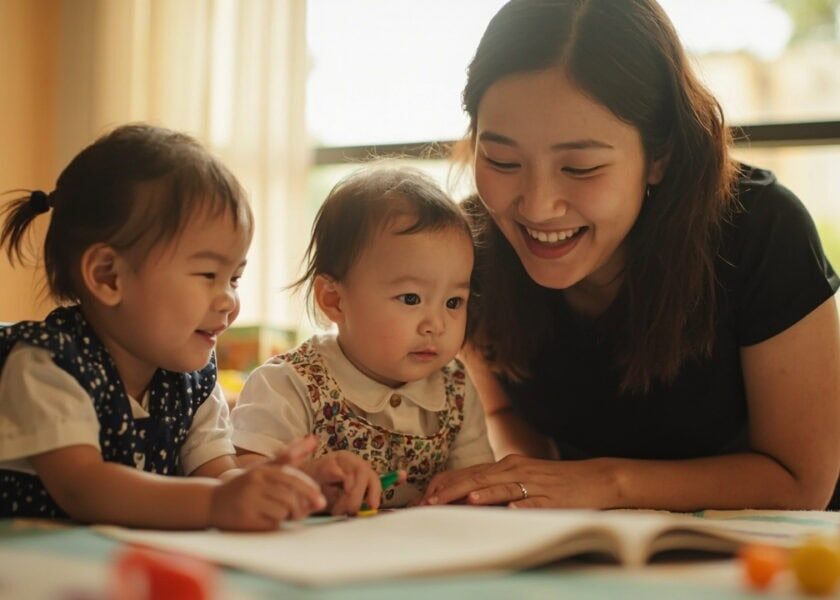
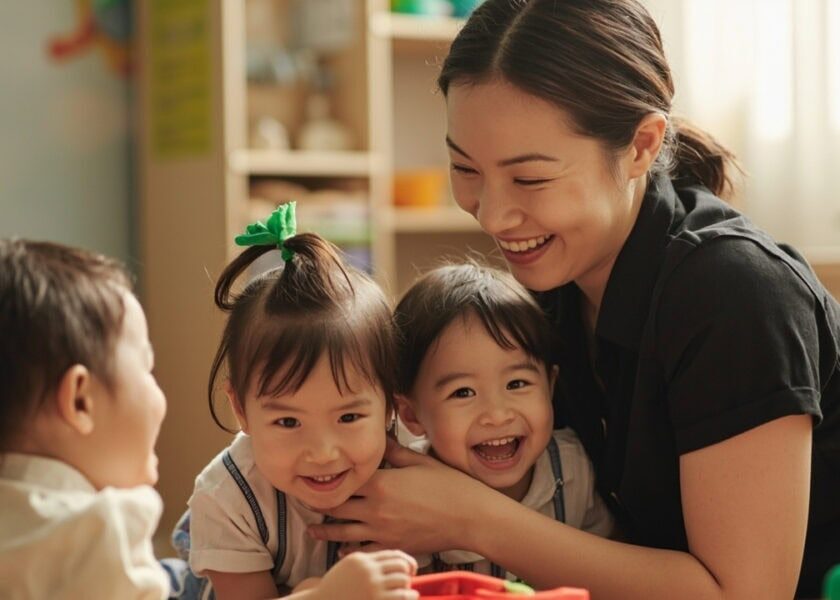
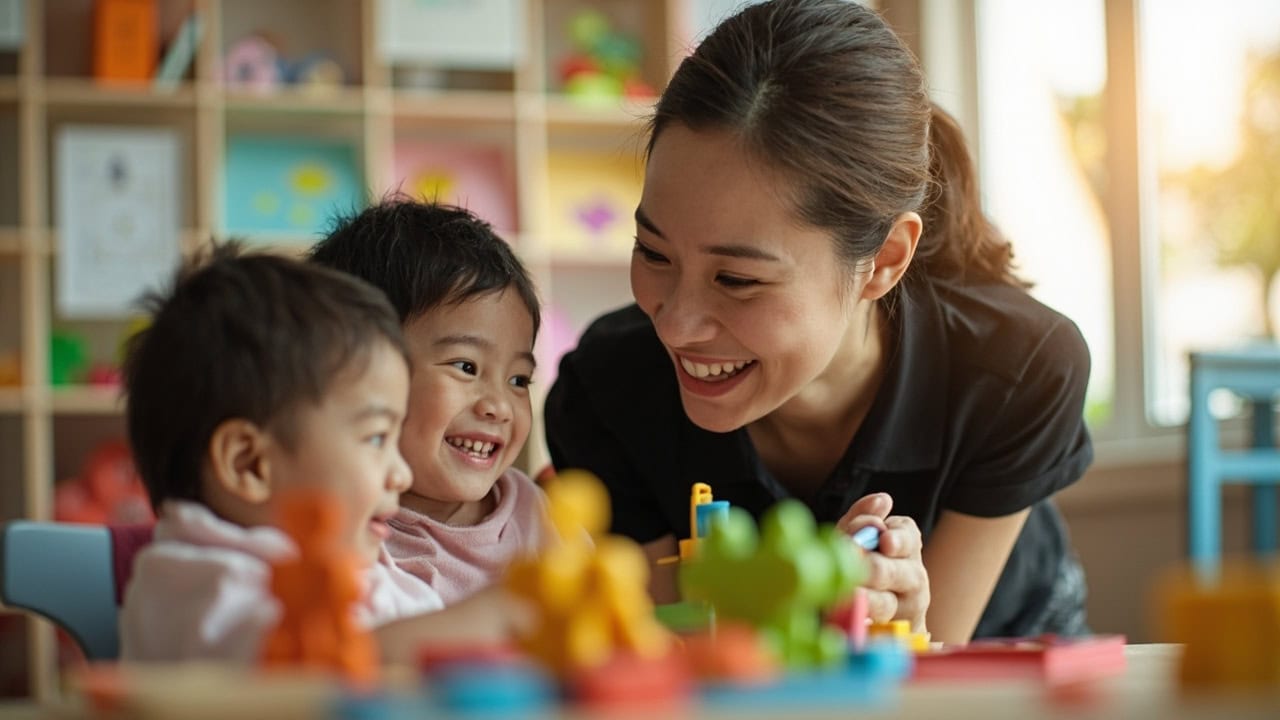
Home-based childminding, when done with intention and quality standards, offers something different. The small ratios allow for the kind of attention that notices a child’s lip trembling before the tears come. That sits with a toddler’s frustration and helps them learn to name it, because they have the capacity to do so.
EduNanny by BUTLER: What the Childminding Pilot Means for Singapore Families
EduNanny by BUTLER operates as part of the ECDA Childminding Pilot. Understanding what that means and why it matters is important for any parent exploring their options.
The Childminding Pilot was designed because Singapore recognized that centre-based care, while right for many families, is not the only answer — and that home-based childminding, when done with intention and quality standards, offers something irreplaceable. It offers the small ratios, the consistency of a primary caregiver, the warmth of a home environment.
What EduNanny’s model looks like in practice
- Infant ratios of up to one to three — every child is genuinely seen and known. Not one among fifteen. One among three.
- Monday through Friday care in blocks that reflect the rhythm of a working parent’s day — not childcare that fits a schedule, but a schedule that fits families.
- Fee structures designed for accessibility — CDA and Baby Bonus can be used in relevant arrangements, so the financial piece does not have to stand between a Singapore family and quality care.
- Built-in communication — the handover is not a rushed exchange of logistics but an actual conversation about your child’s day, connecting the unseen hours to the homecoming you will observe.
- CCTV transparency where measures are deployed — not as a replacement for human trust, but as an architecture of reassurance that lets parents feel connected rather than cut off.
This is not a compromise. It is a philosophy made real.
What a Child Who Arrives Home Whole Looks Like
When EduNanny talks about the kind of child who comes through their doors at the end of the day, they are talking about exactly what we have been describing. A child who has been in an environment of secure attachment and warm responsiveness. A child whose language has been nurtured because someone was always talking back to them. A child whose curiosity has been noticed and fed and celebrated.
That child arrives home, and the evening begins differently.
Because the hours after pickup are not separate from the care that happened during the day. They are its completion. The caregiver who spent the day with your child was, in a sense, writing a sentence — and the evening you spend together is where that sentence finds its period, its meaning, its warmth.
When your child arrives home regulated, curious, language-rich, and securely attached, the evening becomes what it is meant to be — not a frantic recovery from a difficult day, but a continuation of the good work of nurturing a human being.
- You feed them dinner, and they tell you about something that happened at the playground.
- You read them a book, and they bring something from the story into their play the next morning.
- You put them to bed, and they fall asleep the way a child falls asleep when they feel completely safe — with a deep exhale, a small hand relaxed against the pillow, the knowledge that tomorrow the routine will begin again and it will feel the same and that sameness is a gift.
Your Questions Answered: Choosing Infant Care in Singapore
How do I really know what happens during the day?
You already have the most powerful tool. Your child’s behaviour after pickup is not random — it is a direct reflection of their inner experience during the hours you could not see. The child who arrives home regulated and bright is not just lucky. They are telling you something true about the day they had. Learn to read that daily report with the same attention you already give it, and you will know more than any inspection report can tell you.
Is home-based childminding as good as centre-based care?
The question assumes these are equivalent approaches to the same goal. They are not. Centre-based care and quality home-based childminding answer different questions. Centre-based care asks: can we provide a structured, supervised environment for many children? Quality home-based childminding asks: can this one child be genuinely known, responded to, and nurtured by the adult caring for them? The answer to the second question, in a small-ratio home environment, is more likely to be yes.
What if I choose wrong?
The parents who worry most about choosing wrong are often the parents least likely to choose wrong. The fact that you are reading this, paying attention to what your child brings home, willing to learn the language of what you are observing — that is not a small thing. That is everything. Your instincts are not wrong. They may need sharpening, and awareness offers that sharpening — not a new set of rules, but a clearer lens for what you already feel.
Will my child be ready for school later?
Children who arrive home whole from their early care — regulated, curious, language-rich, securely attached — do not need to be drilled to be ready. They are ready because readiness is not a set of facts memorized. Readiness is the capacity to learn, to engage, to trust the process of education. That capacity is built in the years from birth to six, in the quality of the attention your child receives when they are too young to tell you in words whether that attention is there.
Practical guidance for choosing with confidence
- Visit at pickup time. If a centre allows it, arrive slightly before the stated pickup time and observe the children. Notice how they move, how they interact with staff, how they respond when their parents arrive. This is your window.
- Ask specific questions about the day. Not “did my child have a good day?” but “what was my child interested in today? How did they sleep? Did they seem frustrated about anything?” A responsive caregiver will have answers. A supervisory one will give generalities.
- Read the body first. Before you ask anything, before you reach your child, take three seconds to look at them. How are they holding themselves? Where are their eyes? What is the pace of their movement? This is your first data point.
- Track patterns over time. One afternoon of unusual behaviour may mean nothing. A pattern — repeated clinginess, repeated flatness, repeated language silence — means something. Keep the noticing going.
- Consider the ratio. Ask yourself: in this setting, is it mathematically possible for every child to be genuinely noticed? Infant ratios matter not because they are a regulatory checkbox, but because they determine whether the responsiveness your child needs can actually occur.
Trust What Your Child Is Showing You
The parents who ask these questions are already the parents their child needs.
You care so much that it keeps you up at night. You wonder if the care you chose is really the right one. You wonder if your child is happy. You wonder if anyone notices the things about your child that you notice — the small particularities that make them who they are.
What this kind of awareness offers is not a new set of rules, but a clearer lens for what you already feel. When your child walks through the door and you notice something is off, trust that noticing. When your child arrives home bright and open and full of new things to say, trust that too. The daily homecoming is not a mystery to be solved by experts. It is a language you already speak, and it is telling you exactly what you need to know.
EduNanny by BUTLER was built on the conviction that every child deserves to come home whole. That every parent deserves to open the door and recognize in their child’s face the care they hoped for. That childminding, done with dignity and skill and genuine love, is not a lesser path — it is a profound one, and it deserves to be recognized as such.
That conviction lives in the details. In the ratios that allow for real attention. In the training that equips caregivers not just to supervise but to respond. In the transparency that lets parents feel connected rather than cut off. In the structure that makes quality care something a working family in Singapore can actually access, not just aspire to.
So here is what I want to leave you with.
You arrive at the pickup point. You see your child. And this time, you see a little more than you did before.
You see the relaxed shoulders that tell you someone helped your child feel safe. You hear the new word in their sentence and know that someone talked to them with joy. You notice the way they walk toward you — not collapsing, not anxious, but walking toward you the way a child walks toward someone they trust completely.
You read the afternoon report card that was written not in grades or checkboxes, but in the living, breathing evidence of a child who has been well-cared for.
And something in you settles. Not because you have found a perfect solution — there is no perfect solution, only the one that is right for your family — but because you have learned to read the signs with clarity and confidence, and what they are telling you is that your child is going to be alright.
That the hours apart do not have to be a source of anxiety, because you have the tools to know what is really happening in them. That the partnership between you and the people who care for your child can be one of trust and mutual respect, built on the shared commitment to raising children who arrive home curious, secure, and ready to engage with the world.
That is what EduNanny is working toward, every day, with every family they serve.
And that is what the afternoon homecoming has always been trying to tell you.
If you are a parent in Singapore exploring infant care and childminding options, EduNanny by BUTLER offers a free consultation to help you understand whether the Childminding Pilot pathway is the right fit for your family. Book a no-obligation conversation and discover what quality home-based care can look like for your child.