The Courage to Choose Differently: Singapore Parents and Professional Childcare
Understanding the Tension You’re Feeling
There is a moment that many of us in Singapore know, though we do not always speak of it. It arrives quietly, often in the early weeks after your child is born, when exhaustion and wonder collide, and someone—your mother, your mother-in-law, a beloved aunt—leans toward you with love in their eyes and says, “I can help.”
The offer is genuine. The love behind it is real. And yet, something in you hesitates.
You hesitate not because you do not trust them. You hesitate not because you do not need help. You hesitate because somewhere beneath the gratitude, a question has already taken root: What if the help they are offering is not quite the help your child needs? What if your instincts are telling you something different from what generations before you have done? And how do you honor the hands that raised you while choosing a different path for the small person now in your arms?
If you have felt this, you are not alone. You are not ungrateful. And the weight you are carrying is not a sign that something is wrong with you—it is a sign that you are paying attention. That you are taking this role seriously. That you love your child enough to question what you were taught, even when questioning feels like a kind of betrayal.
This is the quiet tension we want to speak with you about today. Not to solve it for you. Not to tell you what to decide. But to sit beside you in it, and perhaps to offer a frame that might bring a little more clarity to a choice that so many Singapore parents are making right now, often in silence, often with guilt they do not know how to name.
What Your Parents Gave You
Before we go further, let us begin with what your parents gave you—because dismissing that would be its own kind of dishonesty, and we are not here for dishonesty.
They raised you in a Singapore that was different from this one. The pace was slower in some ways. The expectations were clearer. When a grandparent said they would help with the children, it was often a given—not a question, not a negotiation, not a considered decision. Your mother may have returned to work knowing her own mother was home with you, or she may not have returned to work at all, because the village was simply there, assumed and unquestioned.
That village was real. It was not imaginary, and it was not inferior.
Your grandparents gave you something irreplaceable: a sense of continuity, of belonging, of being held within a family story that stretched backward and forward in time. When your grandmother sang you a song her mother sang to her, when your grandfather took you to the market and told you stories from his childhood, when your auntie scolded you in Hokkien and then kissed your forehead—that was not nothing. That was everything. That was love in a form that made sense for that time.
The World Has Changed
But here is what we also know: the world your child is growing into is not the world your parents raised you in.
The demands on your time, your attention, your professional life, your emotional reserves—these have shifted in ways that are profound. Singapore parents today navigate a landscape of dual-income pressures, of educational expectations that begin earlier than ever before, of housing arrangements and career demands and the simple geographical reality that many of us live far from our parents now, not in the same kampong or even the same town.
The infrastructure of support that existed when your parents were raising you has changed. And so, the question your child is asking of you is different from the question you asked of your parents.
This does not mean the old way was wrong. It means the old way answered the questions of its time. And the questions of this time are asking something new of you.
What Your Child Actually Needs
There is a phrase that circulates in parenting circles: “It takes a village.” We say it so often now that it has become almost a cliché, but beneath the cliché is a truth that matters deeply.
The village your parents gave you was one kind of village. It was built on proximity and blood and the social norms of a particular era. It served you well, in the ways that mattered then. But a village is not a static thing. A village evolves. A village adapts. And the village your child needs today is one that can meet them with consistency, with trained attention, with developmental understanding, with the capacity to support not just their physical safety but their emerging mind and emotions—week after week, reliably, in a world where you need to be present at work, at meetings, in the professional life that sustains your family.
The First Thousand Days
In the first thousand days—a window from conception to approximately age two that neuroscientists and developmental psychologists have come to understand as foundational—children’s brains are forming connections at a rate that will never be matched again.
The quality of care, the responsiveness of the caregiver, the language they hear, the stimulation they receive, the security they feel: these are not luxuries. These are the architecture of who they are becoming.
Grandparents, with all their love, are not always trained for this. Many are not nearby. Some are still working. Most are doing their best with the resources they have, in a way of caring that was shaped by a different understanding of child development. This is not a failure on their part. It is simply a different situation. And recognizing that difference is not ingratitude. It is clarity.
What Professional Care Actually Offers
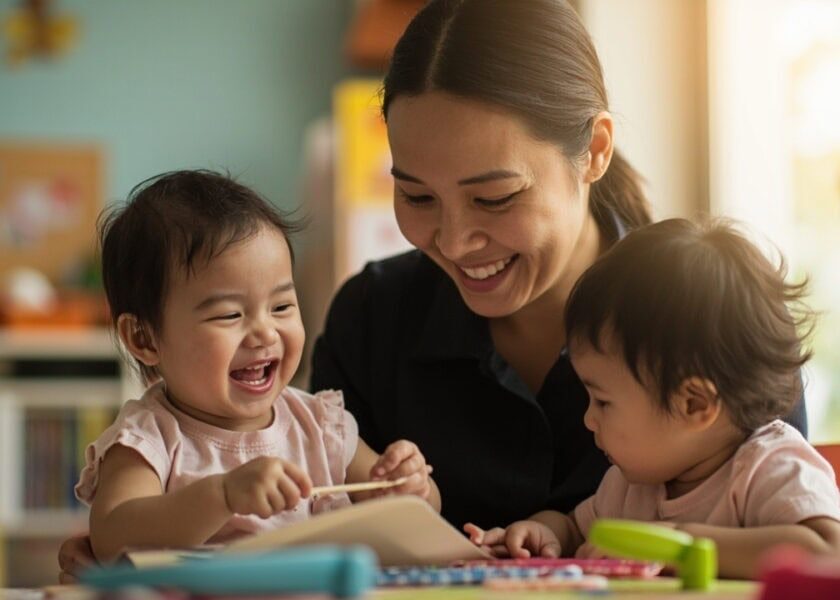
What children gain from consistent, professional, developmentally-informed care is not merely supervision. It is a quality of attention. It is caregivers who are trained to observe, to respond, to create environments that support exploration and security simultaneously.
It is routines built with understanding of infant development. It is the kind of presence that does not just keep a child safe but helps them flourish.
When a caregiver can notice more, she can respond more quickly. She can tune in to the subtle cues that tell her a child is tired, or hungry, or beginning to feel frustrated before that frustration becomes a meltdown. This attunement is not incidental. It is the heart of what quality care provides.
Making This Choice with Clarity and Confidence
And here is the harder thing, the thing we want to name with care: the guilt.
So many Singapore parents describe a particular kind of guilt that accompanies the decision to choose professional care when grandparents are willing and available. It is not the guilt of needing help—that, most parents can accept. It is the guilt of saying no to help that is freely offered. It is the guilt of choosing something that feels, in the moment, like a rejection of your own parents’ wisdom, your own family’s way, the generations that came before you.
We want to tell you something about this guilt. It is not irrational. It is not weakness. It is the response of someone who cares deeply about family, who was shaped by their parents, who does not take these bonds lightly.
The guilt is real because the love is real. And the fact that you feel it at all means you are not someone who dismisses the past or throws away what your parents gave you. You feel it because you are still in relationship, still connected, still trying to be good to everyone—to your child, to your parents, to yourself.
But we also want to suggest something that may help. The guilt, when we examine it closely, is often pointing at a deeper question: Can I be a good parent if I do things differently from how I was parented?
The answer is yes. And the willingness to ask that question is itself evidence of the kind of parent you are becoming.
Common Questions Parents Ask
“Will my child feel abandoned?”
Children are remarkably perceptive. What they feel is not whether you are there every moment, but whether you are present when you are together, and whether the people caring for them are warm, consistent, and attuned. Quality professional care does not replace your bond—it supports it by ensuring your child is in an environment where their developmental needs are met, so that when you come home, you can be fully present rather than exhausted.
“What if my parents are hurt?”
This concern is valid and comes from a place of love. Many families find that once professional care is in place, grandparents often feel a different kind of freedom—they can be grandparents in the fullest sense, focused on connection and play rather than the daily demands of caregiving. And they are often relieved, quietly, to know their grandchild is receiving the support they were unsure they could provide alone.
“How do I talk to my parents about this?”
A few principles help:
- Lead with gratitude. Acknowledge what your parents have given you and their willingness to help.
- Explain your reasoning, not your doubts. Speak about what you believe your child needs rather than expressing uncertainty about their care.
- Emphasize that this is about evolution, not rejection. Help them see that you are building on what they gave you, not replacing it.
- Give them a role. Professional care does not mean grandparents disappear. They remain essential—as grandparents, not primary caregivers.
How EduNanny Supports Your Family
EduNanny operates within the ECDA Childminding Pilot, and this matters for several reasons.
First, it means we are part of a national effort to expand the landscape of childcare options available to Singapore families. Second, it means our structures, our ratios, our practices have been designed with awareness of what families actually need and what children actually require. Third, it means there is a framework of affordability, with pilot fee structures that make professional care accessible in a way that it has not always been.
We offer both home-based and community or centre-based pathways, because families are not all the same, and the right solution is the one that fits your life. Some parents need care in their own home, in familiar surroundings, with the continuity of the child’s daily environment. Others find that a community setting offers their child valuable social exposure and a rich learning environment.
Our infant ratios—up to one to three, depending on the setting and the age of the child—are designed to ensure that every child receives the attention they deserve. This is not a bureaucratic requirement. This is a commitment to quality.
We Hold Space for Your Journey
When families come to us, they often arrive carrying something heavy. They may have already had difficult conversations with their parents. They may feel that they are disappointing people they love. They may be second-guessing themselves, wondering if they are making the right choice, if they are being selfish, if they are somehow failing their families by choosing professional care.
Our role, as we understand it, is not simply to provide childcare. Our role is to hold space for this journey. To be the kind of organization that says: We see you. We understand why this is hard. And we believe that what you are doing—choosing care that aligns with your child’s needs and your family’s reality—is an act of love, not a failure of love.
We honor the role of grandparents. We know that in families where grandparents are present and willing, they bring irreplaceable value—value that cannot and should not be replicated by any professional arrangement. But we also believe that professional care and grandparent care are not in competition. They are different parts of a modern family’s ecosystem.
When parents feel empowered to make a choice that works for them, rather than a choice that feels like obligation, the entire family benefits—including the grandparents, who are often relieved, in ways they may not say aloud, to know that their grandchild is in capable, loving hands.
Your Permission to Choose
The question many Singapore parents are grappling with is not really about childcare at all. It is a question about identity. It is: Can I be my own person while still honoring where I came from? Can I trust myself? Can I make a decision that is mine, based on my knowledge and my values and my understanding of my child, even when it differs from what my parents would have chosen?
The answer, we want to suggest, is that this is precisely what good parenting asks of you. Not in opposition to your parents. Not in rejection of their wisdom. But in continuation of it.
They raised you to be capable. They raised you to think. They raised you to love your children fiercely enough to ask hard questions. And the fact that you are asking those questions—even the guilt you feel, especially the guilt you feel—is evidence that they succeeded.
Choosing professional care does not mean your parents failed. It means you are building on what they gave you. It means you are standing on their shoulders and looking further, not because they were inadequate, but because that is what generations do. Each generation, when it is working well, reaches a little further than the last.
So, if you are a parent in Singapore right now, weighing these decisions, feeling the pull of family expectations and your own instincts, carrying the quiet guilt that comes from wanting to honor everyone at once, we want to leave you with this:
You are allowed to choose what is right for your child.
You are allowed to choose what is right for your family.
You are allowed to make a decision that looks different from the decision your parents made, and to trust that this does not make you ungrateful.
It makes you brave. It makes you attentive. It makes you the parent your child needs.
And if you are looking for a partner in that decision—someone who will not judge you for the choice you make, who will not dismiss the complexity of what you are feeling, who will simply offer excellent, warm, developmentally-informed care for your child while honoring the journey that brought you here—then we are here.
EduNanny Singapore is here. Not to replace your village, but to help you build the village your child needs for the world they are growing into.
That is not a rejection of where you came from. That is a continuation of it.
That is love, in its most forward-looking form.
And that is always, always enough.
At EduNanny, we believe every family deserves thoughtful, development-oriented care that honors their unique circumstances. We welcome the chance to walk this path alongside you.