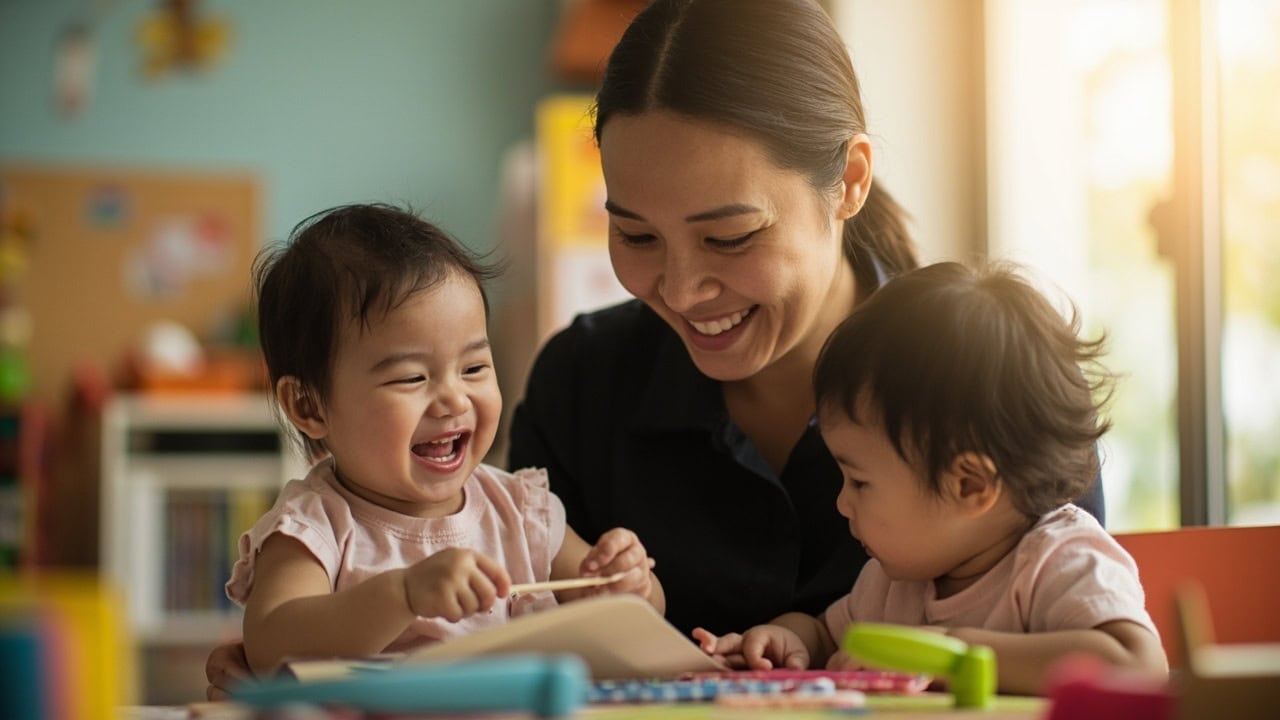
What Your Child’s Face Tells You About Their Childcare Experience
What Your Child Experiences in a Day of Quality Childcare
When you drop your child at a childcare centre in Singapore, their senses are already doing enormous work. The smell of the room arrives before any word is spoken—warm, clean, sometimes carrying the faint sweetness of wooden toys. The acoustics are different from home. Voices blend. A child hears the echo of other children’s laughter and takes it in, classifying it, deciding: Is this a place where people are happy? Is this a place where I am safe?
Children read rooms the way adults read faces. They notice the colours on the walls. They notice the height of the shelves, whether they can reach what calls to them. They notice whether there is a quiet corner where one can retreat. This is not decoration. This is the first language of the environment, and your child is already fluent in it.
And then there is the person who meets them.
The caregiver stands at the centre of everything. Not as a supervisor. Not as a function. As a person who carries the child’s morning in their hands.
The research on attachment tells us something that every parent already knows in their bones: a child’s capacity to explore, to learn, to play, to grow, depends first on whether they feel held. Secure attachment is not a soft concept. It is the neurological foundation on which everything else is built—language, reasoning, emotional regulation, the willingness to try new things, the ability to recover from disappointment.
When a caregiver greets a child each morning with consistency, warmth, and genuine attention, something extraordinary happens. The child begins to build an internal map of what it feels like to be known. In infant care with a ratio of up to one to three, a caregiver can notice when a child’s brow furrows, when their shoulders tense, when their eyes brighten with interest or dim with fatigue. Each child is not a name on a register but a person with a rhythm, a temperament, a way of being in the world that deserves to be understood.
Once that first greeting is made, once the child’s hand finds the caregiver’s, the day begins to take shape—not in a rigid, clock-driven way, but in the way a day should unfold for a young child. Young children are built for patterns. When a day has a rhythm, the child’s nervous system responds with something close to relief. Rhythm is not restriction. Rhythm is safety made tangible. Rhythm says: after this comes this, and you do not have to hold all of it alone because the structure holds you.
Within that rhythm, the child starts to anticipate. They begin to know the sequence of their own day, and this knowing is a quiet act of mastery. Now the songs come. Now we wash our hands. Now we eat. And with each prediction confirmed, the child’s confidence grows by degrees they cannot yet name.
Play: The Serious Work of Childhood
Then there is play. And we must talk about play, not as an activity but as a world.
When your child is playing, they are not merely passing time or being kept occupied. They are doing the most complex, demanding, important work available to a human being in the early years. Through play, children construct their understanding of cause and effect, of social rules, of language, of the relationship between the self and others. They rehearse emotions they have not yet learned to name. They test hypotheses about the physical world by building towers and knocking them down, by pouring water and watching where it goes, by filling a container and emptying it, again and again, with total absorption.
What does a child discover through play at a quality childcare centre? They discover that objects have properties—some things roll, some stack, some make noise when dropped. They discover that other children have wants and feelings that may not match their own, and that these differences can be negotiated. They discover that they are capable—capable of building, of solving, of imagining, of creating something that did not exist before they made it.
Play is your child’s first language. It is the language they are most fluent in. In quality childcare, play is not an interruption between lessons. It is the lesson.
The most significant learning happens in the ordinary moments. Not during a structured activity. But in the moment when a child picks up a stick and pretends it is a spoon, and the caregiver does not correct them but simply says, “You found something interesting,” and watches to see what the child does with it. That is where learning lives—in that unguarded space between curiosity and understanding.
The Emotional Foundation: Security, Feeling, and Growing Independence
Your child is not only playing and learning. Your child is feeling.
The early years are an emotional education without a textbook. Children experience the full range of human emotions—but they do not yet have the language or the neurological development to regulate these feelings on their own. They need co-regulation. They need a calm, attuned adult to sit with them in the storm of a tantrum and help them find their way back to calm. They need someone to name what they are feeling when they cannot name it themselves: “I can see you are feeling very frustrated right now. That is a big feeling. I am here.”
Children who experience this kind of emotional attunement are building something that will serve them for the rest of their lives. They are building the capacity for emotional intelligence. They are learning, through experience rather than instruction, that feelings are not dangerous, that they can be felt and expressed and managed, that there are people in the world who can help them carry big emotions without being overwhelmed.
There is something else that happens in quality childcare that is rarely articulated: children learn about themselves through the experience of trusted care.
When a child is consistently cared for by someone who is warm, responsive, and reliable, they begin to learn, in the most primal and pre-verbal way, that they matter. That their needs will be met. That they are worthy of attention and care and love.
A child who carries this foundation into their later years—who knows, in their bones, that they are capable of being loved and cared for—approaches the world differently. They take social risks. They speak up. They try new things. They are more resilient in the face of difficulty, not because they have been taught to be resilient, but because they have lived resilience from the inside, in the daily experience of being held and known.
Independence grows from this foundation, not in spite of it. A child who feels secure does not cling. A child who trusts their caregiver’s return does not panic at separation. A child who has been seen and valued in their earliest years is the child who walks into a classroom with quiet confidence, who makes friends with ease, who says, “I can try this.”
What Your Child Brings Home: Reading the Signs of Thriving
What we have been describing—the rhythm, the safety, the discoveries, the emotional attunement, the growing independence—does not end when the day ends. It travels home with your child. It travels in the things your child carries that you cannot see.
After pickup, your child is different from the child who left in the morning. Not because something was taken from them. Because something was given. A new word learned from a song. A social rule discovered in shared play. A feeling successfully navigated with a caregiver’s help. A small, private wonder at something they touched or saw that made them pause and smile.
Parents often ask: how do I know if my child is thriving in childcare?
The answer is quieter than you might expect. You read it in the way your child walks through the door of the centre in the morning—not with dread, but with something that approaches recognition. You read it in the way your child speaks about their caregiver, not with formal language, but with the easy intimacy of a person they trust. You read it in their play after they come home—the stories they enact, the words they use, the confidence with which they navigate their toys and their world.
You read it in what they bring home that cannot be photographed or measured. The quiet assurance that the world is a place where they are known.
What Quality Childcare Looks Like: A Practical Guide
Understanding what your child experiences during childcare hours requires knowing what to look for. Here is what the research and best practice tell us matters most:
- Sensory environment: Spaces that feel warm, orderly, and inviting—not sterile or overwhelming. Children should be able to reach materials, find quiet corners, and move comfortably.
- Caregiver consistency: The same familiar faces day after day. A caregiver who knows your child’s rhythms, preferences, and signals. In infant care, ratios that allow for genuine attunement rather than task-focused supervision.
- Predictable rhythm: A daily structure that flows from one activity to the next with gentle consistency. Children thrive when they can anticipate what comes next.
- Play as serious work: Time and space for unstructured, open-ended play. Materials that invite exploration. Caregivers who observe and support rather than direct every moment.
- Emotional presence: Adults who name feelings, sit with difficult emotions, and respond to distress with comfort rather than dismissal.
- Communication: Regular updates that help parents feel connected to their child’s day—not just photographs, but meaningful glimpses into discoveries and moments.
When visiting potential childcare options, consider asking these questions:
- What is the caregiver-to-child ratio, especially for infants? Lower ratios mean more individual attention and attunement.
- How long have the caregivers been with the programme? Consistency matters. Children need familiar faces.
- What does a typical day look like? Is there rhythm and structure, or is the schedule loose and unpredictable?
- How do caregivers respond to distress? Ask for specific examples. Look for answers that centre the child’s emotional experience.
- How will you communicate with me? What kind of updates can I expect?
- How is the physical environment designed? Can children reach materials? Are there quiet spaces? Does it feel warm?
- What happens during meals, rest, and transitions? These ordinary moments reveal a great deal about care quality.
- How does the programme support children who are new or still settling in?
The Worries Beneath the Questions
Every parent choosing childcare carries questions. Some are practical. Others run deeper.
“Will my child feel abandoned?” The research on attachment is clear: when care is warm, consistent, and responsive, children do not experience childcare as abandonment. They experience it as a second attachment that supports rather than replaces the parent-child bond. The caregiver becomes a secondary secure base from which your child can explore—knowing, as you would want them to know, that you will return.
“How do I know what’s really happening?” You know by watching your child. Does your child show increasing comfort at arrival? Does their play after returning home reflect confidence and imagination? Do they mention their caregiver with warmth? These are the signs that cannot be faked. A quality childcare environment produces children who are ease-filled, curious, and socially confident.
“Is the cost worth it?” The question is not just whether you can afford quality childcare. It is whether you can afford the alternative. Early childhood is not a rehearsal. The emotional, social, and cognitive foundations built in these years shape everything that follows.
“What if my child doesn’t settle?” Settling takes time. Some children adjust quickly; others need more patience. What matters is the caregiver’s response: consistent, warm, patient presence. The goal is never to force comfort. It is to create the conditions for comfort to grow—over days, sometimes weeks. That is not a sign of failure. It is the process working as it should.
EduNanny Singapore: Making Quality Care Accessible
EduNanny operates under the ECDA Childminding Pilot, reflecting a commitment to making quality childcare accessible—not as a privilege for some families, but as a real option for many. CDA and Baby Bonus funding can be applied, extending the financial planning that parents undertake for their children’s early years into the childcare decision itself.
EduNanny offers pathways that recognise families are not all the same. There is a home-based pathway, where a trained childminder provides care within a home environment—a setting that offers warmth and personal attention at a scale that is simply not possible in larger facilities. And there is the centre-based pathway, where children benefit from a richly equipped environment, peer interaction, and a structured programme. Both pathways are shaped by the same philosophy of care. Both reflect the same understanding of what children need in their earliest years.
Communication matters to parents, and EduNanny takes this seriously. Where deployed, transparency measures including CCTV and regular updates give parents a window into their child’s day—not because surveillance replaces trust, but because transparency builds it. These small moments of connection—receiving a photograph, reading a note about what their child discovered, hearing that their child pointed at a picture of a bird and said the word—bridge the gap between parent and childcare experience.
EduNanny also offers the Thomas AI Chatbot, a resource designed to support parents in navigating the questions that arise between one day and the next—about development, behaviour, nutrition, sleep, and the thousand small concerns of early parenthood. It is not a replacement for professional guidance where that is needed, but it is a presence—a knowledgeable, available presence—for the moments when a parent needs an answer and does not know where to turn.
The Evidence Is in Their Face
The child’s perspective is not a soft, sentimental concept. It is the most honest quality signal available to any parent choosing childcare. Because quality that is real will be felt by the child first. It will register in their body, in their behaviour, in their comfort, in their curiosity. The child knows. They always know.
What EduNanny Singapore has tried to build, in its programmes and pathways and philosophy, is a place that honours what the child knows. That creates environments worthy of a child’s trust. That trains caregivers to be more than supervisors—as observers, as emotional anchors, as the steady presence that allows a child to flourish while their parents are doing what parents in Singapore do every day: working, building, providing, loving, and trusting that the choices they are making are the right ones.
They are. And the evidence is in your child’s face when you pick them up at the end of the day. The evidence is in the way they wave goodbye to their caregiver. The evidence is in the way they fall asleep tonight, peacefully, knowing that tomorrow there will be a door with familiar light behind it, a person who says their name the right way, and a day full of the quiet, profound, world-building work that childhood was always meant to be.
EduNanny Singapore is honoured to stand in that doorway with you. And with your child.
If you are considering infant care or childminding in Singapore and want to understand how EduNanny’s ECDA-approved programmes support your child’s earliest years, we invite you to connect with us. Every child’s experience begins with a single step through a door. We would be grateful to walk that step with you.
Explore EduNanny Singapore today.