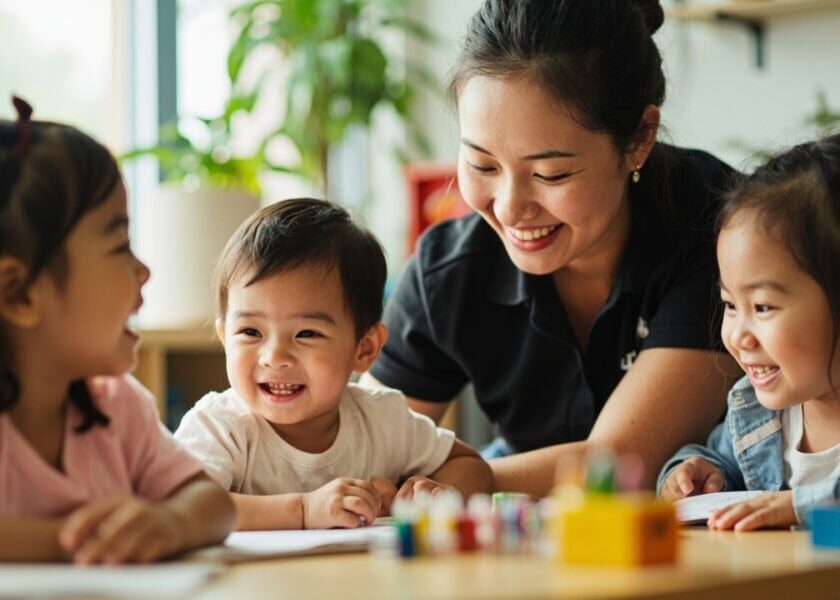
The Invisible Architecture of Your Child’s Developing Brain
The Invisible Architecture: What Quality Childcare Is Actually Building in Your Child
There is a moment familiar to every parent who has left their child in care—a moment that never stops being strange no matter how many months or years you have been doing this. You drop your child off in the morning: small, uncertain, sometimes tearful. By the time you collect them in the afternoon, something has shifted. A word they had not said before. A way of holding eye contact that feels more confident. A sudden interest in sharing a toy, or a new way of expressing frustration that actually sounds like language instead of pure need.
You stand there at the door, or in the pickup line, and you think: where did that come from?
And then, quieter: what else is happening in there, when I am not watching?
That question is the most honest thing a parent can ask. It is also the question that too few childcare conversations are willing to sit with.
Most of what parents see is the surface. The clean room. The colorful walls. The caregiver who smiles and says the right things at pickup. The daily photo or update that shows a craft activity, a birthday celebration, a well-fed child at lunch. These things matter. Safety matters. Nourishment matters. A warm, organized environment is not nothing.
But if this is all you are choosing between—if every childcare option looks roughly the same from the outside—then something important is being hidden from view. And what is being hidden is the very thing that makes the difference between a place where your child is merely kept and a place where your child is being quietly, systematically, and with extraordinary precision, built.
The Gap Between Surface and Substance
When you tour a childcare centre or meet a childminder, you are seeing a performance. This is not a criticism—it is simply the nature of selection. You see the best rooms, the most engaged moments, the caregivers on their most professional behavior. You see crafts on the walls and fruit on the plates. You see a schedule of activities that looks purposeful.
What you cannot see is the quality of interaction happening in the ordinary moments—the transitions, the conflicts over toys, the child who is quietly overwhelmed in the corner, the infant whose emerging interest in a texture or sound is noticed and built upon by a caregiver who understands what is developmentally significant about that moment.
These are the moments where development actually happens. And they are, by their nature, invisible to anyone who is not the child experiencing them or the caregiver attuned to them.
This creates a genuine problem for parents. You are making one of the most consequential decisions of your child’s early years—you are leaving them in someone else’s care for the hours that make up the majority of their waking life—and you are being asked to evaluate something you cannot directly observe.
What Brain Science and Attunement Tell Us
The research here is not new. It has been accumulating for decades, though it rarely makes it into parent conversations or marketing brochures. The first few years of life are not a warm-up for the real thing. They are the real thing.
The architecture of the human brain—the neural pathways that will determine how a person thinks, feels, relates to others, manages stress, and learns—is constructed primarily before the age of five. The primary material of that construction is not worksheets or flashcards or even books. It is relationship. It is the quality of interaction between a developing child and the responsive, attentive adults around them.
Every time a caregiver notices what a child is attending to and responds to it—naming it, building on it, turning a moment of interest into a moment of shared meaning—that caregiver is laying down a neural pathway that did not exist before. This is not metaphor. It shows up in brain imaging. It shows up in longitudinal studies tracking children into adolescence and adulthood. The quality of early relational experience literally shapes the physical structure of the brain.
There is a concept in developmental psychology called attunement. It describes the quality of being genuinely tuned in to a child’s internal state—not just their behavior, not just their words, but the feeling underneath both.
A well-attuned caregiver notices when a child’s interest is flagging before the child begins to act out. She notices when the loud play is actually overstimulation masking distress. She notices when the quiet child in the corner is not simply content but quietly overwhelmed and in need of gentle redirection.
And when she notices, she responds—not with a script, not with a behavioral protocol, but with a calibrated, human adjustment that tells the child: I see you. Your inner experience is real and it matters.
This might sound like something soft, something intuitive, something any good-hearted person would naturally do. And in the best moments, it is intuitive. But attunement as a sustained, professional practice—the kind that produces measurable developmental outcomes across hundreds of children over years—is not something that happens by accident. It is a trained skill. It is the difference between a caregiver who works from a checklist and a caregiver who has genuinely studied how children develop and why. It is the difference between supervision and scaffolding. Between keeping a child occupied and helping a child grow.
The ratio question: One caregiver responsible for five or six infants is a room where genuine attunement is simply not possible. There is not enough bandwidth, enough attention, enough time to notice and respond to each child’s subtle signals in the way that builds neural pathways. A room where one caregiver is responsible for one, two, or three children is a room where your child’s development—and far more than their development—can actually grow.
What Quality Care Looks Like in Practice
Language Growth Through Conversation
Language development is one of the most visible outcomes of quality care, and it is one of the most misunderstood. Parents often assume that language grows because children are taught words—flashcards, picture books, songs with explicit vocabulary. And these things have their place.
But the engine of language growth in the early years is conversational exchange. It is the back-and-forth, the turn-taking, the slight expansion of a child’s utterance by a responsive adult.
Imagine this: a child points and says “dog.” The caregiver leans in and says, “Yes, that big brown dog. He’s running after the ball.” The child hears his word reflected back, extended, made richer. A moment later, the caregiver notices the child looking at a bird and says, “You see that bird? It’s a sparrow. Watch it hop.”
That microsecond of interaction—repeated hundreds of times a day across months and years—is what builds the neural infrastructure for language. It cannot be replicated by a screen. It cannot be replicated by a caregiver who is managing too many children and simply does not have the bandwidth for this kind of conversational attunement.
Social Competence Through Guided Participation
Social competence is another thing that compounds invisibly and then shows up all at once—usually at a playdate, a preschool orientation, or in the first weeks of Primary One when a teacher notices that your child navigates conflict with unusual maturity or reads a social situation with unusual accuracy.
Social competence is not something children are born with. It is learned. And it is learned through exactly the kind of guided peer interaction that a well-designed childcare environment provides.
Consider this scenario: two children reach for the same toy truck. A caregiver who is attuned notices the brewing conflict before it escalates. She does not solve it for the children. She enters the situation with a question, a redirection, a quiet narrative that helps both children see the problem from a different angle.
“I see both of you want to use the truck. What could we do so that both of you get a turn?”
This is not a minor moment. This is a tiny, repeated lesson in perspective-taking, in negotiation, in the recognition that other people’s desires are real and matter. It is happening dozens of times a day in a quality care environment, across contexts and conflicts and social textures that a child simply cannot encounter in the same richness at home.
There is a term for this kind of learning: guided participation. The caregiver is present in the space between—close enough to scaffold, far enough to let the child practice. This is what separates a genuinely developmental environment from one that simply fills time with activities.
Executive Function: The Management System of the Mind
Executive function is perhaps the least understood and most consequential of the things that quality childcare builds. It is the set of cognitive processes that allow us to plan, to focus attention, to remember instructions, to resist impulses, to switch tasks when circumstances change, to regulate our emotional responses. In plain terms, it is the management system of the human mind.
Executive function is not taught through lectures or discipline or reward-and-punishment systems. It is built through relational scaffolding.
When a caregiver helps a frustrated child move from dysregulation to calm—not by suppressing the frustration but by being present with it, offering co-regulation until the child develops the internal capacity to do this themselves—she is building the neural circuitry for emotional regulation.
When a caregiver sets up a transition—giving a child warning that free play is ending in five minutes, then two minutes, then one, and helps them tolerate the shift—she is building cognitive flexibility and impulse control.
When a caregiver plays a simple game that requires a child to wait, to take turns, to inhibit an immediate impulse in favor of a delayed reward, she is exercising and strengthening the prefrontal cortex—the brain region responsible for executive function.
These are everyday interactions that, repeated over months, become the architecture of self-regulation. Of the capacity to sit still in a classroom. To wait your turn. To begin a task without being reminded. To manage the disappointment of not getting what you want immediately. These are the readiness skills that schools do not teach. They have to be built before school can do its work.
Secure Attachment in Group Care
Here is something important that gets lost in most childcare conversations: this kind of attunement does not require a parent. It requires a consistent, trained, responsive adult.
This is not a replacement for parental attachment. It is an extension of it.
Research on secure attachment in group care settings shows something that should quietly reassure every working parent in Singapore: children who develop secure attachments with qualified caregivers in their early years do not love their parents less. They do not prefer their teachers to their mothers.
What they develop is something more nuanced and more valuable. They develop the capacity to carry an internal working model of secure relationship outward into the world. They learn, through repeated experience with a responsive caregiver, that people can be trusted, that their signals matter, and that the world is generally a place where their needs will be heard and met.
That belief system—laid down through hundreds of small interactions over months and years—becomes the lens through which they navigate every subsequent relationship. At school. With peers. With teachers. Eventually with colleagues and partners and their own children.
This is what quality childcare builds. Not just skills. Not just readiness for Primary One. It builds the internal relational architecture that will outlast any curriculum.
Choosing Quality Infant Care in Singapore
In Singapore, the decision to place your infant in someone else’s care carries its own particular weight of expectation and judgment. There are families where both parents work because they must. There are families where one parent would rather be home but the mathematics of Singapore’s cost of living make that choice feel impossible. There are families where a grandparent arrangement has reached its natural limit. There are families where parents have concluded, with honesty and clarity, that they want their child to have the social, developmental, and relational environment that quality care provides—not as a substitute for family, but as an enrichment of it.
Whatever your reason, the question you are carrying is the right one: is this actually good for my child?
The answer is yes, when the care is the right kind. And the right kind is not primarily about the facilities or the curriculum or the brand name on the door. It is about the quality of the adult in the room.
As you evaluate your options, here are the questions that matter most:
- What are the caregiver-to-infant ratios? One to three is fundamentally different from one to five or six. Ask specifically, and ask why.
- What is the training background of the caregivers? Are they trained in child development, not just in safety protocols and activity delivery?
- What does a typical day actually look like? Not the schedule on paper, but the lived experience. How much of the day involves free play and guided interaction versus structured activities?
- How do caregivers handle transitions and conflicts? Listen for attunement in their answers. Are they describing scripted responses or genuine, calibrated interactions?
- How do they communicate with parents? Is there a system for daily updates, for questions, for building a shared understanding of your child’s development?
- Can you observe an ordinary moment? Not a special activity designed for visitors, but a regular part of the day when you can see how caregivers and children actually interact.
What you are ultimately looking for is a place where your child is responded to—not just supervised, not just entertained, but genuinely seen and engaged with in a way that builds who they are becoming.
The Quiet, Daily Act of Human Construction
What does all of this invisible construction look like when it becomes visible?
It shows up at Primary One. A teacher, meeting your child for the first time, will observe something she cannot quite name. Something in the way your child settles into a new environment. The way they engage with learning. The way they handle frustration. The way they relate to the children around them. She might describe it as “school readiness.” What she is actually seeing is the accumulated result of years of relational scaffolding.
It shows up in moments of unexpected stress. A fall, a disappointment, a new social situation—and your child demonstrates a level of emotional resilience that surprises even you. Where did that come from? It came from every time a trusted caregiver sat with them through a hard moment and helped them learn that hard moments are survivable. It came from co-regulation, repeated thousands of times, until it became self-regulation. It came from feeling held, consistently, by adults who knew what they were doing.
It shows up in the conversations you will have with your child years from now. In adolescence, in adulthood, when they talk about who they are and how they grew up. The school they went to may be a footnote. The childcare they attended in those first invisible years will be part of the foundation they never think to question because it became the ground they stand on.
Quality childcare is not a replacement for family. It is a second environment of consistent, trained, developmentally intentional care. And just as the caregiver’s work in that environment matters, so does your work at home.
The conversations you have with your child at the end of the day matter. The way you respond to their stories—whether they fought over a toy or shared a moment with a caregiver—reinforces the social and emotional learning that is happening in care. The attunement you practice at home compounds what is being built elsewhere.
When you ask your child, “What was the best part of your day?” and listen with full attention to whatever they say—however fragmented or puzzling—you are doing the same work that a quality caregiver does. You are telling your child: your inner experience is real and it matters.
You are not choosing between family and childcare. You are not choosing between being a good parent and going back to work. You are not choosing between your child’s safety and their development.
You are choosing whether to give your child access to something that most children in history have not had: a second environment of consistent, trained, developmentally intentional care. An environment where a trained caregiver knows your child’s rhythms, notices your child’s emerging interests, sits with your child’s frustration, celebrates your child’s small triumphs, and does this with professional skill and genuine warmth, day after day, building something inside your child that will outlast any classroom, any curriculum, any assessment.
Your child is becoming someone in there. Someone more capable, more socially fluent, more emotionally steady, more linguistically rich, more cognitively flexible than they were when they walked in the door that morning.
You may not be able to see it in the moment. You may not fully see it for years. But it is happening.
And the question is not whether you can see it. The question is whether the environment you are choosing is the kind of environment in which it can happen at all.
That is what quality childminding and infant care, done right, is offering. Not supervision. Not a service. An architecture. The quiet, invisible, profoundly important construction of a human being, one attuned interaction at a time, one scaffolded moment at a time, one act of being truly seen by a trained and caring adult at a time.
Your child will show you. Years from now, in the ways they navigate the world, in the quality of their relationships, in their capacity to meet difficulty with steadiness, in the way they grow into whoever they are becoming. You will look back and realize: the most important things that were built inside my child happened in hours I was not there to see.
That is not a failure of parenting. That is the whole point of a developmental environment done right.
Ready to Explore Your Childcare Options?
EduNanny, operating under the ECDA Childminding Pilot framework, offers community-based and home-based pathways designed to support the kind of individualized, responsive care described in this article. With caregiver-to-infant ratios of up to one to three, CDA and Baby Bonus funding eligibility, and communication tools including Thomas AI Chatbot, EduNanny creates the structural conditions for the invisible construction work that builds your child’s foundations.
For families in Singapore seeking to understand how ECDA-supported pathways create the conditions for genuine developmental care, we invite you to connect with our team and explore what the right environment can offer your child.
#childmindingSingapore #infantcareSG #earlychildhooddevelopment #EduNannySG #schoolreadiness