The Extraordinary Science Behind Your Baby’s Day in Care
What Your Baby Is Doing While You’re Apart
It is eleven in the morning. You are in a meeting, or at your desk, or perhaps navigating a lunch rush on the MRT—and somewhere across the city, your baby is doing something extraordinary.
You do not know what it is. That is the nature of separation during these years: the most beautiful and the most wrenching simultaneity parents in Singapore ever experience. You are building your career, your family, your future, and somewhere a small person is building something equally critical, though you cannot see it—the architecture of a brain that will carry them through the rest of their lives.
What you are imagining right now—the vague, loving blur of your baby’s day—is actually a precise and carefully constructed sequence of sensory experiences, relational moments, and developmental processes. And what this article aims to do is pull that blur into focus.
Not because knowing should replace feeling, but because understanding is its own form of peace. When you know what your baby is building, the question that lives underneath every infant care decision—is this really okay for my child—begins, finally, to answer itself.
A Quick Summary: What Science Tells Us
Here is what is actually happening in your baby’s hours in quality infant care:
- Emotional regulation is being built—neural pathways that help a child recognize what they feel, name it, and choose how to respond rather than simply react.
- The sensory world is being constructed—every texture, sound, light change, and movement literally builds the brain architecture that will let them navigate the physical world with confidence.
- Social intelligence is developing—studying faces, mirroring expressions, engaging in early “conversations” that lay the foundations of empathy and collaboration.
- Language is being absorbed—not through lessons, but through the responsive, contingent communication of a caregiver who narrates their world throughout the day.
- Memory and focus are strengthening—through the reliable rhythms of feeding, play, rest, and exploration that give their developing brain the scaffolding it needs.
None of this happens passively. Every element of quality infant care is designed—intentionally—to provide exactly what a developing brain requires during these critical first months.
The Science of the Developing Brain
Your baby’s brain is developing faster in these first years than it ever will again. Every surface they touch, every texture they encounter, every change in temperature, light, and sound feeds sensory development in ways that are measurable and specific.
The developing brain, in its earliest phase, is essentially a sensory construction engine. It builds itself from the bottom up, beginning with the brainstem and sensory cortices, and it requires abundant, varied, appropriately patterned sensory input to do so.
When a baby in quality infant care moves from a smooth mat to a textured one, their brain is processing the difference—building the neural connections that will eventually allow them to distinguish a firm handshake from a limp one, to feel comfortable in a variety of physical environments, to integrate sensory information without overwhelm.
The Architecture Beneath the Surface
Here is what neuroscience reveals is happening in your baby’s developing brain:
The prefrontal cortex—the region that manages executive function, impulse control, and the capacity to focus—is among the last to fully mature, reaching completion near the mid-twenties. But its foundations are laid in infancy through moments of appropriate challenge followed by supportive response, situations where the infant exercises choice within a safe structure, periods of frustration met not with rescue but with patient encouragement.
The hippocampus—the region responsible for memory—builds its circuits through the repetition of predictable daily rhythms. The reliable sequence of feeding, play, rest, and exploration gives the infant’s brain the stable scaffolding it needs to store and retrieve new information.
The social-emotional brain—the amygdala, the insula, the anterior cingulate—develops rapidly through every attuned interaction, every consistent caregiver response, every experience of being seen and responded to as a full, communicating person.
This is the daily neurological construction that is happening in your baby’s first year. It does not pause when you are not in the room. It accelerates, when the environment is right.
How Social Infants Really Are
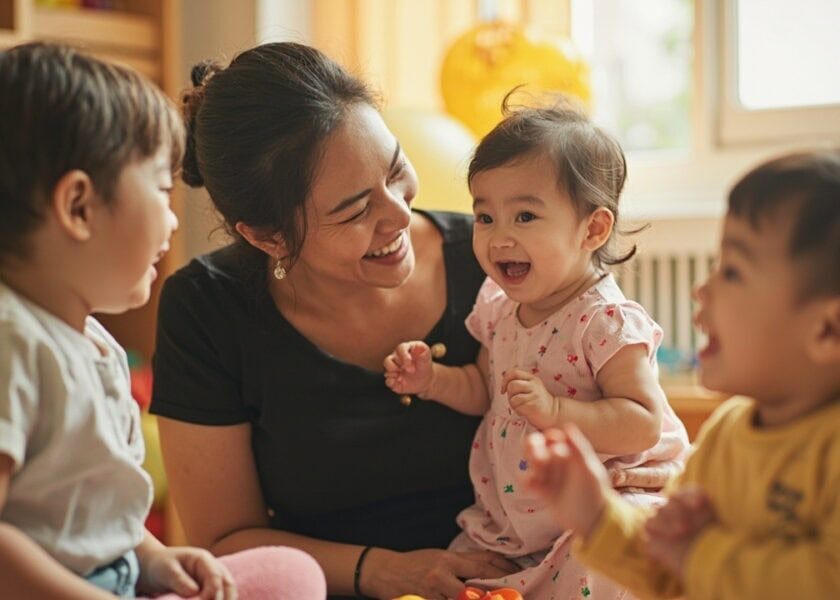
One of the realities that surprises many parents is how deeply social the infant months actually are. From around four months, babies begin to study one another’s faces with focused attention. By nine months, they are reaching toward each other, mirroring expressions, vocalizing in conversational exchange.
This is not incidental social behaviour. It is the infant brain’s critical window for social scaffolding—the period during which the neural circuits dedicated to empathy, social referencing, and cooperative behaviour are being established through direct peer interaction.
A baby who regularly observes another baby’s expressions and responds to them is building mirror neurons, social cognition pathways, and the earliest foundations of collaborative thinking. These are not abstract, far-off skills. They are being built right now, alongside three or four other infants who are each doing the same extraordinary work.
Language That Builds a Brain
And alongside all of this—woven through the sensory world and the social world—there is language. Not baby language as adults tend to define it, but real, responsive, enriched linguistic exposure.
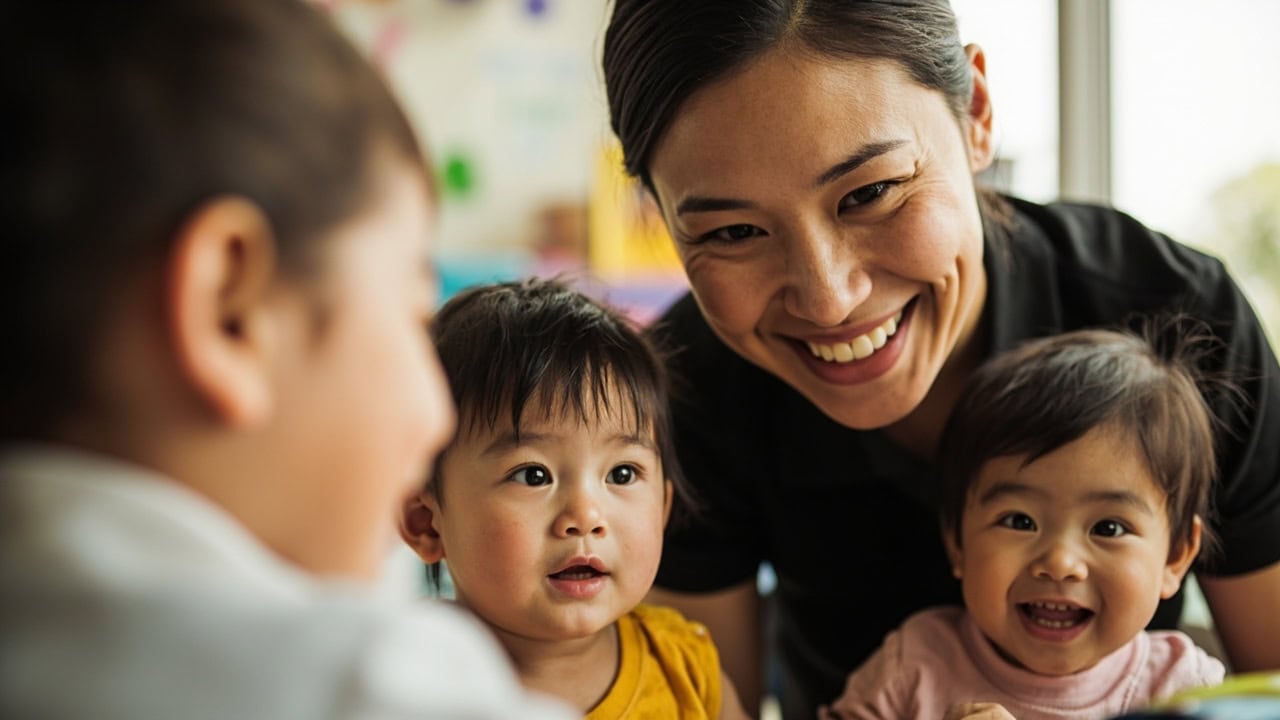
A trained caregiver narrates the infant’s experience throughout the day: You are reaching for the red block. You noticed the light changed when the cloud moved. You made a sound just now, and I heard it.
This is not performance. It is the mechanism by which early vocabulary is seeded, and the mechanism is specific: infants build language circuits not from being talked at, but from being talked with—from responsive, contingent communication where their vocalizations are met with genuine reaction.
Studies consistently show that infants in high-quality care settings enter toddlerhood with measurably larger receptive vocabularies—not because they were drilled, but because they lived inside language-rich environments where their every sound was received and returned.
The Caregiver at the Centre
The first thing your baby encounters in quality infant care is not a lesson. It is not an activity or a curriculum or a schedule. It is a response.
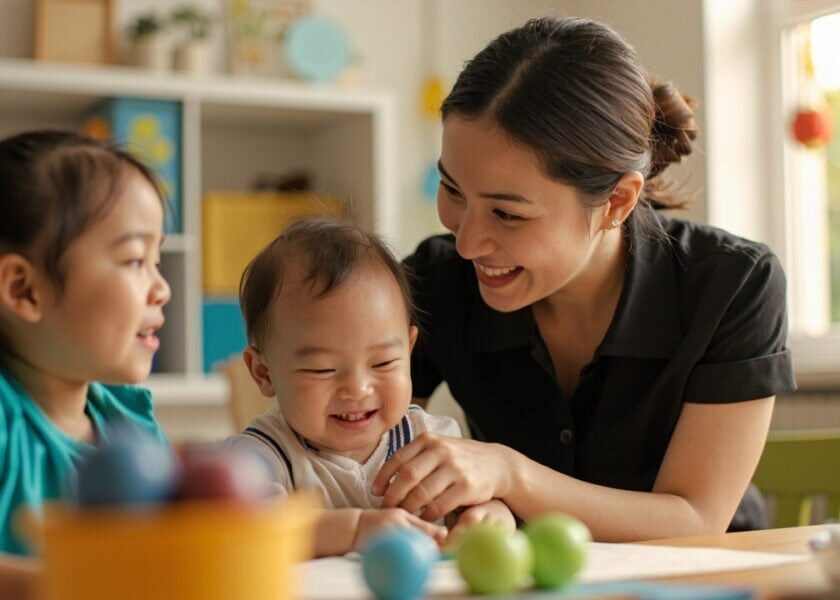
A face that turns toward them. A voice that adjusts when they fuss. A pair of hands that does not reach for a pacifier out of convenience but waits, first, to read the signal in the baby’s body—whether this cry means hunger, fatigue, overstimulation, or simply the need to be held.
Developmental psychologists call this attunement. The trained caregiver lives inside it every hour of every day. It is the capacity to slow down, to observe, to match the infant’s state before attempting to move them forward.
The difference between a caregiver who soothes and a caregiver who attunes is the difference between a baby who stops crying and a baby who learns that crying is heard and meaningful.
It matters enormously that this attunement comes from a caregiver who has been specifically trained in infant development. The attunement of a trained caregiver is not instinct alone—it is instinct refined by knowledge. It is the ability to recognize, for instance, that a six-month-old entering a period of separation anxiety is not regressing but demonstrating healthy attachment—and to respond to that distress in a way that is genuinely comforting rather than simply suppressive.
No training programme, no ratio, no environment design works without the caregiver at its centre. The caregivers are not an afterthought or a resource to be managed. They are the work itself.
The Promise of Connection
Parents navigating work and infant care need more than good intentions. They need to feel genuinely connected to their baby’s day.
This means communication that goes beyond perfunctory updates—thoughtful, specific information about what your baby experienced, how they responded, what they discovered. Where monitoring measures are in place, they are there not because trust is absent but because parents deserve to feel that connection even when they are not physically present.
These are not administrative details. They are the infrastructure of peace of mind, and peace of mind is not a luxury for parents in these high-stakes months. It is a prerequisite for everything else.
What Quality Infant Care Looks Like
Understanding what quality means matters, because the term is used widely but applied inconsistently. Here is what genuine quality looks like in practice:
- Caregiver ratios that allow responsiveness. In infant care, one-to-three ratios are not a luxury—they are a baseline for the attunement your baby needs.
- Trained caregivers at the centre. Not supervised amateurs, but trained professionals who understand infant development as a discipline.
- Intentional sensory design. The environment is not accidental. Textures, sounds, lighting, and spatial arrangement are considered for their developmental purpose.
- Predictable daily rhythms. Consistent sequences of feeding, play, rest, and exploration that build the memory and regulatory systems of the brain.
- Language-rich interaction throughout. Every routine moment is an opportunity for responsive communication, not just custodial care.
- Social scaffolding. Opportunities for peer interaction that build the early foundations of empathy and collaborative thinking.
Understanding Your Options
Quality care can take different forms. Here is how they compare:
| Care Setting | Key Strengths | Considerations |
|---|---|---|
| Home-based | One-to-one or one-to-three ratios; highly individualised; familiar environment; strong attachment continuity | Requires careful vetting of caregiver training and approach |
| Community-based | Peer interaction; enriched environment; trained caregivers with smaller ratios | Varies by provider; examine training standards carefully |
| Centre-based | Structured peer interaction; professionally designed environments; multiple trained staff | Ratio quality varies significantly between centres |
Across all settings, the principles that determine quality are consistent: trained caregiver expertise, intentional sensory and developmental design, responsive attunement as a daily practice, and language-rich interaction throughout every hour.
What to Look For When Choosing Infant Care in Singapore
You chose infant care not because it was easy or because you wanted to be apart from your baby, but because you are building a life that works—a family that is financially stable, a future that has room for your child’s dreams as well as their present.
These are the questions that matter most when evaluating your options:
- How is the sensory environment designed? Ask specifically about textures, sounds, lighting, and how daily activities incorporate varied sensory experiences.
- What is the caregiver-to-infant ratio? For infants, one-to-three or better is the baseline for genuine responsiveness.
- What training do caregivers have? Look beyond certifications to understand whether training includes infant development, attunement practices, and responsive caregiving.
- How is the daily rhythm structured? Predictable sequences of feeding, play, rest, and exploration are not incidental—they are the scaffolding for memory and emotional regulation.
- What does communication with parents look like? Ask for examples of updates. Are they specific and thoughtful, or generic and brief?
- How are caregivers described? Do they speak of caregivers as trained professionals, or as supervised helpers?
- Are there opportunities for peer interaction? Even in smaller settings, infants benefit from exposure to other children.
You Did Not Abdicate—You Expanded
Here is the picture of what your baby is doing during the hours you are apart: they are growing. Consuming the world through every sense, building neural architecture at a rate that will never be equalled, learning that other people are responsive and interesting and worth engaging with, discovering the pleasure of movement and the beauty of language, forming the earliest memories of a life that will extend far beyond these rooms.
The infants who thrive in quality care settings are not thriving despite the time away from their parents. They are thriving because of the intentional developmental architecture that is available to them during those hours—architecture that works alongside your presence at home, not instead of it.
In choosing infant care, you did not abdicate your role in your baby’s development. You expanded it. You joined it with the work of trained, dedicated, deeply skilled caregivers who are building alongside you, in those unseen hours, the most important thing your child will ever possess: a brain that is strong, curious, resilient, and ready.
That is what quality infant care is. Not a service you hand your baby to. A partnership built on training, built on transparency, built on the understanding that every single hour in your baby’s first year is a window that cannot be opened twice.
So as you go back to your meeting, your desk, your commute, the next thing on your calendar—know this. Somewhere across the city, your baby is not waiting for you in the way you might fear.
They are busy. They are learning. They are building.
They are going to be extraordinary.
And so, it turns out, are you.
For families in Singapore seeking infant care that reflects these standards—trained caregivers, intentional development, and genuine partnership with parents—EduNanny offers pathways designed around both your baby’s needs and your peace of mind.