Stop Choosing Childcare in Isolation: Design Your Family’s Care System
The Problem Is Not Who Cares—It Is How They Connect
Most parents approach childcare like they are shopping for a product. They research providers, compare curricula, visit centres, and ask about food and sleep schedules. They make individual decisions as if each choice exists in isolation—one provider for this phase, one arrangement for this season, one solution for this particular problem.
But families are not a series of isolated decisions. Families are living systems. And like any system, they function best when their parts are designed to work together—when there is a logic that holds the pieces in place, when someone has taken the time to understand how everything connects.
Right now, somewhere in Singapore, a mother is struggling with her helper. The helper has been with the family for three years and the children adore her, but she does not follow the same gentle approach the parents have been trying to establish. She defaults to her own instincts, which are not wrong, just different. The parents feel caught—caught between not wanting to undermine her or create tension, and quietly watching their parenting choices being overwritten every afternoon.
In another household, a father is coordinating care with both sets of grandparents. His parents prefer to keep the baby at their home. Her parents prefer visits at their place. Each set has strong opinions about feeding, screen time, and sleep training. He loves his parents and is grateful for their involvement. He also feels like he is constantly navigating competing visions of how his child should be raised, with no language for what is actually happening between them.
These stories are not about guilt or blame. They are about systems. They are about what happens when care arrangements grow organically without a unifying design.
The Hidden Cost of Fragmented Care
The hidden cost of fragmented care is something most parents feel before they can name it. It lives in:
- The low-grade anxiety that accompanies every handoff
- The small inconsistencies that confuse children and frustrate parents
- The mental load of tracking who knows what, who does what, who needs to be updated on the latest change
- The relationship strain that comes when grandparents feel criticised and helpers feel micromanaged and parents feel pulled in too many directions
Children are extraordinarily perceptive. They read the unspoken tension in a handoff. They notice when grandma does things differently than Mama. They adapt, as children do, but adaptation is not the same as security.
This is not an argument against multiple caregivers. Singapore families have always been and will always be multigenerational. Helpers are part of countless households. Community and centre-based care are lifelines for working parents. The issue is not diversity of care. The issue is design.
A family with multiple caregivers who share a common framework—who understand the same rhythms and approaches, who communicate and coordinate—that family experiences diversity of care as genuine richness. The child benefits from exposure to different personalities and perspectives. The parents benefit from flexibility and support. The whole system hums because the pieces are connected.
A family with the same caregivers but no shared framework, no coordinating logic, no intentional design—that family experiences the same diversity as fragmentation. The same people doing different things in different ways, creating friction without meaning to, leaving parents to manage the chaos rather than design it.
The difference is everything.
What an Integrated Care System Actually Looks Like
Designing a family care system means stepping back from the question of who will care for your child and asking the deeper question: what are we trying to create?
- What kind of family life do we envision?
- What does our child need to feel secure?
- What do we need as parents to be present and grounded?
- What roles do the different people in our lives naturally play?
- What connects these pieces?
When you begin with these questions, everything shifts. You stop asking, “Is this provider better than that provider?” and start asking, “How does this piece fit into our whole?”
A grandparent becomes not just a babysitter but a source of cultural continuity. A helper becomes not just an extra pair of hands but a trained partner in the rhythms you are building. A centre or home-based programme becomes not just a place your child goes, but the organising spine around which your family’s daily life takes shape.
Think about what most families actually need:
- Consistency—a reliable daily rhythm that helps children feel secure and parents feel grounded
- Expertise—someone who understands infant and early child development, who can respond to cues with confidence and care
- Communication—clear channels between home and care so that parents are informed and included even while they are at work
- Flexibility—the ability to navigate unexpected changes without the whole system collapsing
- Peace of mind—the confidence that their child is not just supervised but genuinely nurtured
Most care arrangements provide some of these. Very few provide all of them. And almost none are designed from the beginning as a coherent system with the family’s whole picture in mind.
How Professional Childminding Becomes Your Care Architecture
This is where professional childcare, thoughtfully chosen, becomes something more than a service. It becomes the architecture.
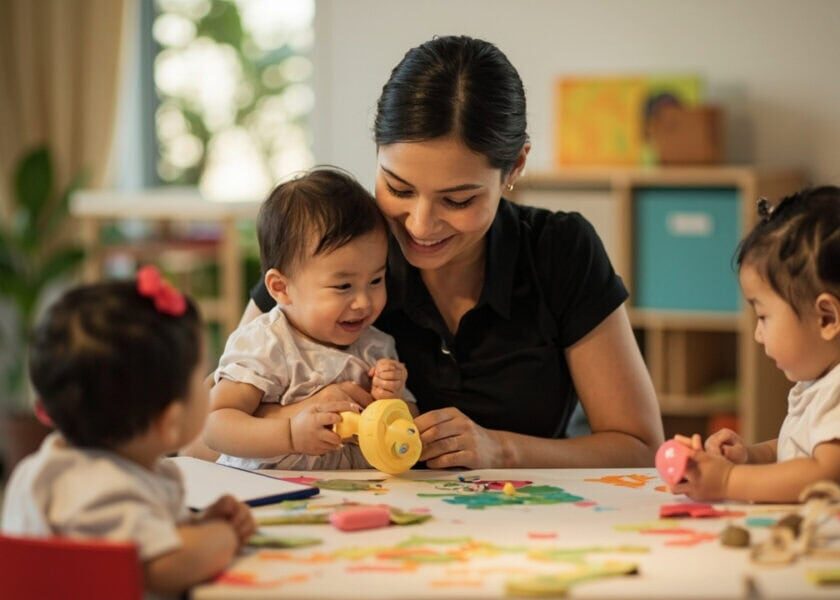
EduNanny by BUTLER operates within the ECDA Childminding Pilot, offering home-based care with ratios of up to one to three infants. This is not an accident of design. It is a deliberate architecture.
When one caregiver is responsible for no more than three infants, something changes. There is space to truly observe. Space to respond to individual needs. Space to build the kind of consistent, attentive relationship that young children require for healthy development.
The care runs Monday through Friday, in structured blocks that give families the reliability they need to plan their weeks. For families navigating the complexity of Singapore’s working life—where both parents may work demanding schedules, where grandparents have their own lives, where helpers have their limits—having a professional, consistent anchor changes the entire feel of family life.
The practical details matter here, not because they are features to be sold, but because they represent real relief. The ability to use CDA and Baby Bonus funds. The pilot fee structures designed to be accessible. The communication channels and transparency measures that let parents check in throughout the day. These are not peripheral benefits. They are part of a system designed to reduce the cognitive load on parents, to take the coordination burden off their shoulders, to let them focus on being parents rather than logistics managers.
But the deepest value professional childminding offers is not any single feature. It is the framework.
When a family brings their child to a professional childminding arrangement, they are not simply outsourcing childcare. They are establishing the spine of their care system. Everything else can connect to it:
- Grandparents who want to be involved can do so in ways that complement rather than conflict with the professional care
- Helpers who need guidance now have a model to follow
- Parents who have been navigating without a map suddenly have a centre of gravity, a reference point, a place where their child’s daily experience is held with intention and expertise
What Quality Childminding Looks Like
Before choosing any infant care arrangement, it helps to know what you are actually looking for. Here are the markers of quality that distinguish professional childminding from mere supervision:
Ratios That Allow Genuine Attention
One caregiver to three infants is not an arbitrary number. It reflects what research and practice suggest about the kind of responsiveness infants need. Smaller ratios mean more observation, more attuned responses, more consistency in the relationship.
Trained Caregivers Who Understand Development
Professional caregivers know how infants communicate before words, how to read cues about hunger and tiredness and overstimulation, and how to respond in ways that support healthy attachment.
Communication Systems That Include Parents
Daily updates, photo sharing, transparent routines—these are not extras. They are how parents stay connected to their child’s day and how care at home can align with care at the programme.
Structured Rhythms That Build Security
Predictable daily patterns help infants feel safe. When children know what comes next—feeding, play, rest, care—they develop the security that supports all later learning.
Observations That Inform Practice
Quality childminding means tracking each child’s development, noting milestones, identifying patterns, and adjusting care to individual needs. This is different from simply keeping children safe and entertained.
Choosing the Right Infant Care in Singapore
It is normal to have questions before committing to any care arrangement. If you are evaluating infant care options, here are questions worth asking—not just of providers, but of yourself and your family:
Questions to Ask Yourself
- What is our vision for our child’s daily life? What rhythms do we want to establish? What values do we want reflected in their care?
- Who are the people already involved in our child’s life? What roles do grandparents, helpers, and community play? How can professional care complement rather than compete with these relationships?
- What does our child actually need right now? Infants have different needs than toddlers. What phase is our family in?
- What would reduce our parental cognitive load? Where are we expending energy on coordination that could be freed up for presence?
- How does this choice connect to everything else? Is this a standalone decision or does it serve as part of a larger design?
Questions to Ask Potential Providers
- What is your caregiver-to-infant ratio?
- How are caregivers trained in infant development and responsive caregiving?
- What does a typical day look like? How do you structure rhythms?
- How do you communicate with parents throughout the day?
- How do you handle feeding, sleep, and transitions?
- What happens if a caregiver is unwell?
- How do you support consistency between home and your programme?
Addressing Common Parent Concerns
“Will my child bond with me if someone else is caring for them most of the day?”
Attachment develops through the quality of interactions, not just the quantity of hours. When professional caregivers support consistent, warm routines, children learn that the world is reliable and adults are trustworthy. This actually supports the attachment security they need to eventually explore and learn.
“How do I coordinate with grandparents and my helper without creating tension?”
This is exactly what an integrated system makes possible. When you have a clear framework and a professional anchor, conversations with family members become easier. Instead of micromanaging, you can share a vision. Instead of reacting to inconsistencies, you have a reference point for what you are building together.
“What if the arrangement falls apart and I have to scramble?”
A well-designed system has backup logic built in. When professional care is the reliable spine, temporary gaps can be covered by family support without the whole structure collapsing. The difference is having an anchor versus hoping everything holds.
“Is this just for wealthy families?”
The ECDA Childminding Pilot includes fee structures designed to be accessible. CDA and Baby Bonus funds can be used. The goal is not to serve only those who can afford premium private arrangements, but to offer a professional option that genuinely supports families across different circumstances.
Your Family’s Care Ecosystem Starts Here
The question every parent in Singapore can ask themselves is this: what would it mean to stop making isolated childcare decisions and start designing a cohesive system?
It would mean taking the spreadsheet of arrangements and looking at it differently. It would mean having conversations with the different people involved in your child’s care—not just coordinating schedules but sharing a vision.
It would mean asking your parents what role they want to play and what approach they feel comfortable with. It would mean thinking about your helper not just as an employee but as a partner in something you are building together.
It would mean choosing your professional care not based on proximity or price alone, but on how well it can serve as the organising heart of your family’s care design.
It would also mean giving yourself permission. Permission to admit that managing multiple care relationships is hard. Permission to stop pretending you have it all figured out. Permission to seek support not because you are failing but because you are wise enough to know that complex systems require thoughtful design.
Here is what experience with hundreds of Singapore families teaches: the parents who feel most in control of their family life are not the ones who have the most help or the biggest village. They are the ones who have designed their system on purpose. They know what each piece is for. They have communicated their vision to the people involved. They have a clear centre of gravity, a trusted anchor they can rely on.
This matters in Singapore for reasons that go beyond the individual family. We are a society that depends on working parents. We are a culture where grandparents play a vital role and helpers are part of countless households. We are a city-state where the pressure is high and the support systems are stretched.
In this context, having a clear, intentional care architecture is not a luxury. It is a necessity for family wellbeing.
Children who experience consistent, coordinated care show it in their security. Parents who have a reliable system show it in their presence. Families where the pieces connect show it in their ease, in the way they navigate transitions, in the warmth that remains even when logistics are complex.
You already know that something is not quite working in your current arrangement. You already feel the weight of the coordination, the inconsistency, the sense that the pieces do not quite fit. You already suspect that there should be a better way.
There is.
It starts with seeing your family as a system worth designing. It starts with asking better questions. It starts with choosing a professional care partner who understands that their role is not to replace your village but to help your village function as one.
Your family deserves a care architecture that works. Your children deserve consistency, expertise, and love in every setting. You deserve to stop managing chaos and start designing coherence.
The care system your family has been quietly engineering alone is possible. It is not only possible—it is available. And it begins with a single decision to stop choosing childcare in isolation and start designing your family’s care ecosystem on purpose.
EduNanny by BUTLER is ready to be the trusted anchor of that design. Not just for the days or months you need support, but for the long arc of your family’s care journey, as it grows and changes and develops its own coherence.
The question is no longer whether you can find the right caregiver or the right centre. The question is whether you are ready to design your whole system with intention, clarity, and the confidence that comes from knowing the pieces fit.
You are. And you do not have to do it alone.
If you are ready to explore how EduNanny can serve as the trusted anchor of your family’s care ecosystem, reach out for a conversation. No pressure, no hard sell—just a thoughtful discussion about what your family actually needs.
#SingaporeChildcare #FamilyCareSystem #InfantCareSingapore #EduNanny #ChildmindingPilot