What Quality Infant Care Really Looks Like in the First Thousand Days
A Morning in Quality Care: What Happens Behind the Door
The morning your child arrives, the room has already been awake for a while. Not loudly. Not abruptly. The lights are already calibrated — warm, never harsh, because a child’s nervous system does not need to be jarred awake any more than an adult’s does.
The surfaces your child will touch have been checked, cleaned, considered. The colours on the walls are chosen not for aesthetics alone but for their effect on a young nervous system — soft blues, warm greens, natural wood tones that communicate calm and regulate arousal. A room that breathes, that offers visual rest between moments of stimulation, is quietly teaching a child how to regulate themselves.
The floor plan has been arranged so that the space does not overwhelm. There are open areas and enclosed ones. There are surfaces to pull up on and corners to retreat into. There is a geography of safety, designed not simply to furnish a room but to invite a child who has just walked in carrying the residual weight of a car seat and a commute and a wave and a separation to find something that says, come here, this is for you, without needing a single word.
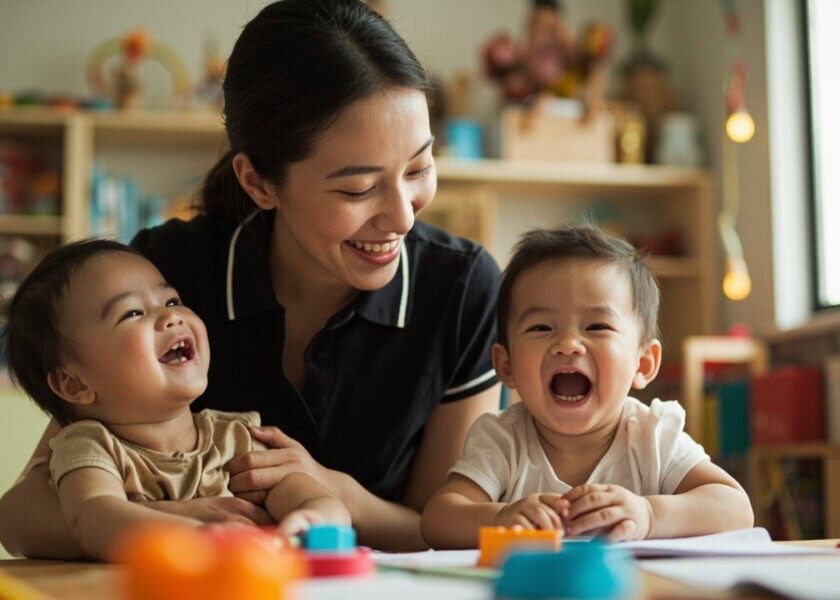
And then the caregiver is there. Crouched down, or kneeling, or sitting low enough that the child is looking at a face, not up at an institution. The greeting is not perfunctory. It is the first communication of the day, and it carries weight — a person who is genuinely glad to see this particular child, who knows their name, their routine, their current obsession, whether it is a fascination with wheels or a need to be held for the first ten minutes.
A trained caregiver reads these things. Because they have been taught to notice, and they know that every child writes a kind of language in the way they move through a room. You are known here.
The Sensory Experiences That Build the Brain
Throughout the morning, the room is alive with intentional sensory experiences. A tray of rice. A bowl of water with floating objects. A basket of fabrics with different textures — smooth silk, rough burlap, soft fleece. These are not activities to fill time. They are experiences through which a child’s brain builds itself.
The neural pathways that form when a child pours water from one container to another, when they squeeze playdough and feel resistance and texture, when they press their fingers into sand and discover that it shifts and slides and escapes between their fingers — these pathways are the building blocks of motor planning, of spatial reasoning, of the architecture of thought.
The soundscape is equally deliberate. The hum of activity, the murmur of voices, the occasional sound of a child discovering that dropping a wooden block makes a satisfying sound on a tile floor and doing it eleven more times. This is the auditory environment of a small community, and it is the environment in which language grows.
What a trained caregiver does in those ordinary moments is speak to your child with the assumption that every utterance matters:
- You are stacking the blue block on top of the red one — look, it is getting taller.
- I see you noticed that the water is spilling over the edge.
- Shall we count how many beads are in the bowl?
This is the natural language of intentional caregiving — the quiet, continuous narration of a morning that says: the world is interesting, and I will help you name it.
Learning From Each Other
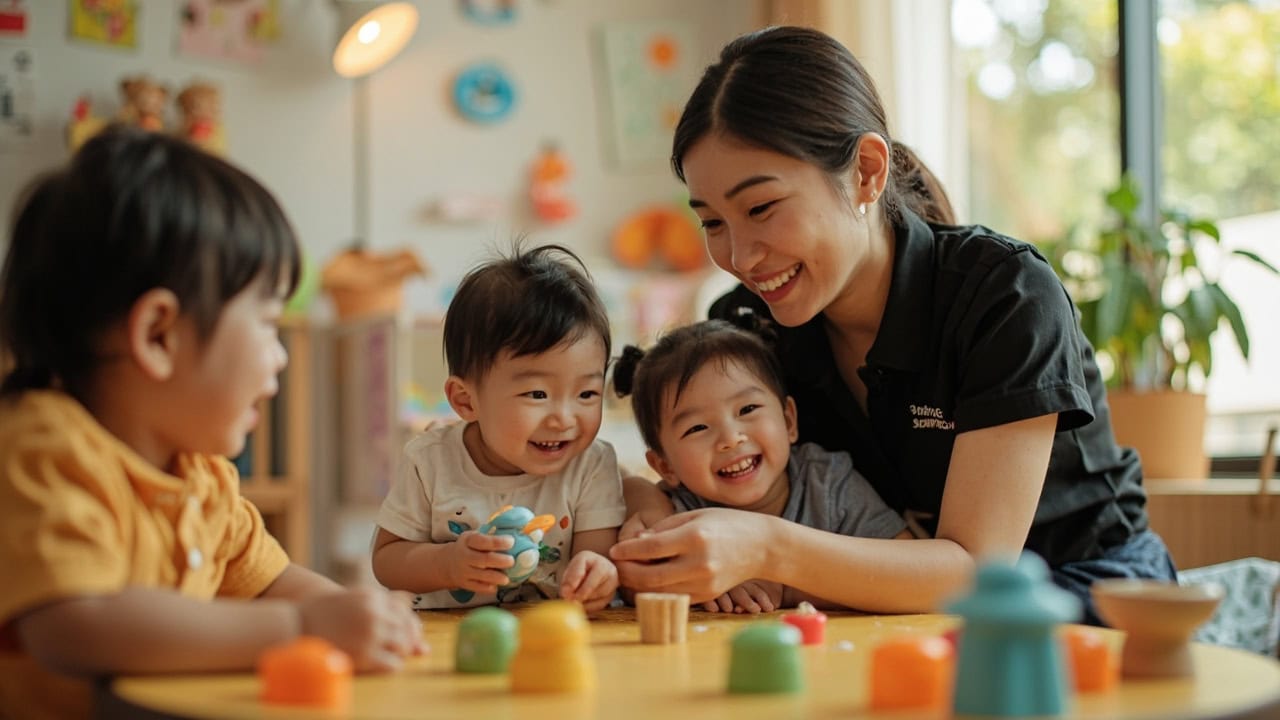
There is a boy — perhaps two, perhaps younger — sitting with a set of wooden cylinders. He is concentrating in the way only a young child can, with his whole body. A girl nearby watches him for a moment, then moves closer, not to take, not to interrupt, but to observe. She tilts her head. She leans in slightly. And then she sits beside him and picks up a cylinder and begins to work alongside him.
No words. No negotiation. A small, wordless negotiation of space and companionship that is, in that moment, a lesson in social learning that no adult could teach through instruction alone.
This is what researchers call parallel play evolving into associative play — the early, pre-verbal stages of social competence. And it happens not because a caregiver arranged it but because the environment made it available and the caregiver recognised its value and did not interrupt it with unnecessary intervention.
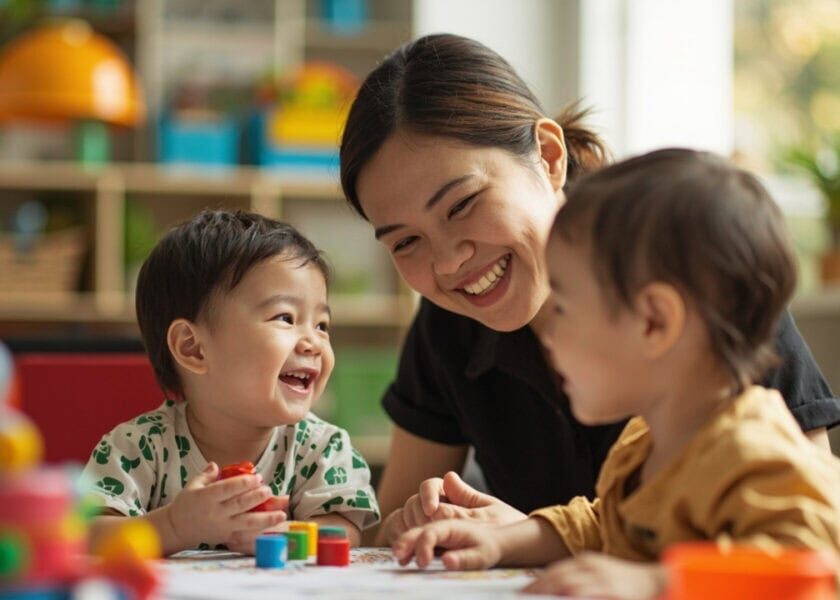
There is a trained instinct in quality caregivers to know when to step in and when to step back. When a caregiver allows two toddlers to navigate a disagreement over a toy rather than swooping in with a resolution, they are communicating trust in the child’s capacity to learn social negotiation. They are teaching resilience through the act of simply being present and letting the learning happen.
The Rhythm That Signals Safety
Young children are not built for abrupt transitions. A child who is deeply absorbed in a sensory experience and is suddenly told to stop and come to the mat is a child whose nervous system registers that disruption as something close to alarm.
Quality care understands this. Transitions are not disruptions. They are signals: a five-minute notice before the next activity begins; a song that gradually gathers the children together; a caregiver who begins the tidy-up alongside the children rather than issuing commands from across the room.
The shift from one activity to the next is paced, communicated, and made safe — because a child who knows what comes next is a child who feels secure. When the morning snack comes at roughly the same time each day, when the nap routine follows the same sequence — the dimming of lights, the soft music, the familiar words that signal it is time to rest now, and we will be here when you wake — that constant, quiet communication of safety through predictability is what supports the enormous developmental task of learning to trust the world.
The Caregiver and Home Partnership
A trained caregiver in quality infant care is not simply a person who is kind. Kindness is necessary but not sufficient. A trained caregiver understands child development — knows that a six-month-old communicates through crying and that not all crying means the same thing, can distinguish the cry of hunger from the cry of overstimulation from the cry that simply says I need to be held and reminded that I am not alone.
In the ECDA Childminding Pilot pathways, this training is foundational. It is the reason that ratios are kept low — because an adult who is responsible for fewer children can see more, notice more, respond more. When a caregiver is responsible for one, two, three infants at most, every cry is heard, every smile is registered, every developmental milestone is observed and supported. This is not a staffing model born of convenience. It is a pedagogical choice that says: this child’s early experiences matter so much that we will not crowd them out with numbers.
In home-based and community-based pathways — where care is offered in smaller, more domestic settings — there is an intimacy that even the best centre-based care cannot fully replicate. A child in a home-based setting moves through a home. They encounter the ordinary textures of domestic life — the sound of a kettle, the smell of food being prepared, the feeling of being in a space that is also someone’s actual home. This is not lesser care. For many families, it is precisely the right care — small, warm, grounded in the rhythms of an actual household.
| Centre-Based Care | Home-Based Care |
|---|---|
| Structured environment with intentional design | Domestic intimacy and familiar household rhythms |
| Peer socialisation and community | Smaller group sizes, more individual attention |
| Consistent routines across the day | Flexible, adaptive care arrangements |
| Trained caregivers with low ratios | Caregivers with ECDA pathway training |
The Communication That Connects
After lunch, after the gentle wind-down, the children are asleep or resting — cots arranged in a quiet room, the low hum of a white noise machine, the particular hush that falls over a room full of sleeping toddlers. And in this hush, the caregiver has a moment to document: that this child ate well today but pushed away the new food; that this child fell asleep quickly but woke after only thirty minutes; that this child used a new word for the first time and said it clearly, reaching for the block play.
These are not administrative details. They are the connective tissue between what happens in the day and what a parent needs to know at pickup. The communication that quality care offers is not a daily report stapled to a folder. It is a living conversation — about your child, about their day, about what they discovered and what they struggled with and what made them laugh.
In centres where technology supports this transparency, parents may receive updates through a platform or app. And when you arrive to pick up your child and see them building a tower with a caregiver who is kneeling beside them, narrating each block with genuine delight — look, we added the big one at the bottom, and it did not fall — that moment is the visible tip of a day that has been full of exactly this: responsive, intentional, developmentally rich care.
What you see at pickup is the ending of a story. What you did not see is the whole story — and when your child looks up at you with the calm, open face of a child who has had a good day, that is not a sign that they did not miss you. It is a sign that they were well. It is a sign that the place you left them was doing exactly what it was designed to do: holding your child with the same seriousness and tenderness you hold them with yourself.
Why Quality Care Is Not a Compromise
Let us be honest about what parenting in Singapore actually looks like. It takes place against a backdrop of dual-income pressure, of rising costs, of a housing market that makes geography unpredictable, of social media that offers a constant feed of expert opinion — much of it contradictory, much of it anxiety-producing.
Parents are exhausted not just by the physical demands of caregiving but by the cognitive load of deciding, constantly, what is right. They are making decisions about childcare with incomplete information, under time pressure, with a child’s wellbeing as the stakes. And the system, for all its strengths, does not always make it easy.
There is a real and understandable anxiety that sits beneath the decision to enrol a child in infant care or childminding. It is not the anxiety of parents who have made a poor choice. It is the anxiety of parents who have made the right choice and still cannot shake the uncertainty of not knowing what happens during the hours apart. The fact that you worry about what your child is experiencing when you are not there is not a sign that you should have chosen differently. It is a sign that you understand, at a deep level, what is at stake.
The First Thousand Days
Here is what research has established about those early years. The first thousand days of a child’s life are not a metaphor. They are a biological fact. The brain is building itself at a rate that will never be repeated. The relationships a child forms in this window — the responsiveness they experience, the safety they feel, the language they hear, the sensory world they are allowed to explore — are not background conditions. They are the conditions themselves.
They are what the child is made of, years from now, when they sit in a classroom and listen, when they manage a frustration, when they form a friendship, when they reach for something they want and manage their disappointment when they do not get it. All of it — every capacity the adult will possess — traces back to these early years, to the quality of care and attention and environmental richness that was available when the building was happening.
Quality infant care and childminding is not a compromise. It is not a concession made by families who have no other option. It is, for many families in Singapore, a choice made from strength: the recognition that children benefit from rich environments, from trained caregivers, from peer socialisation, from the rhythms and structures of a well-designed day.
That a village raises a child is not a sentimental idea. It is an ecological one. Human children were never meant to develop in isolation. They were meant to be held, named, seen, challenged, and comforted by a wide circle of attentive adults. What EduNanny offers is not a replacement for that circle. It is an addition to it — a trusted, trained, intentional addition that works alongside you, that communicates with you, that keeps your child safe and curious and developing in ways that will matter for the rest of their life.
What EduNanny Offers Singapore Families
EduNanny was built with this reality in mind — not to add to the noise but to reduce it. The approach is rooted in a belief that parents deserve clarity: about what their child is experiencing, about the care their child is receiving, about the choices available to them and what each choice means.
This is why EduNanny participates in the ECDA Childminding Pilot, which offers pathways that are not one-size-fits-all but responsive — whether a family needs centre-based care with its structure and community, or home-based care with its intimacy and flexibility.
The pilot fee structures are designed to be accessible, and the use of CDA and Baby Bonus funds means that the financial architecture of childcare — which can feel opaque and burdensome — is simplified and within reach. Monday to Friday care blocks are available, because the reality of Singapore working life is not a nine-to-five abstraction but a daily negotiation of hours, commutes, and obligations.
And because EduNanny is Singapore-wide, this clarity is not available only to families in certain districts or certain income brackets. It is available to any family who is navigating the honest, difficult, beautiful work of raising a child and needs support that is trustworthy, transparent, and designed with genuine understanding of what they are going through.
Support Between Visits
There is also a digital resource developed to sit alongside this care. The Thomas AI Chatbot is not a replacement for human caregiving. It is something else: a tool for parents who have a question at eleven o’clock at night, who are wondering about sleep regression or feeding schedules or how to talk to a toddler about a new sibling, who need reliable, grounded guidance in the moments between visits to the centre. It is the system extending a hand to parents not only when their child is in care but in all the hours in between.
Practical Guidance: Choosing Infant Care in Singapore
If you are a parent in Singapore beginning to explore infant care or childminding options, here are some questions worth asking during your search:
- What does the environment feel like? — Visit during operating hours if possible. Observe whether the space feels calm, intentional, and designed for children, not just filled with toys.
- How do caregivers greet children? — Watch for warm, eye-level interactions. Notice whether caregivers kneel, sit, or crouch to speak with children rather than speaking down to them.
- What is the ratio of caregivers to children? — Lower ratios mean more individual attention, more observation of milestones, more responsive care.
- How does the day flow? — Ask about transitions. Are they signalled in advance? Is there a predictable rhythm to the day?
- How is information communicated to parents? — What does pickup communication look like? Is there transparency about what happened during the day?
- What training do caregivers have? — Ask about ECDA pathway participation, ongoing development, and how the team is supported.
- What is the financial structure? — Understand how CDA and Baby Bonus funds can be used. Clarify fee structures and what is included.
When you drop your child off tomorrow morning, and you feel that silence in the car, you can let it be a different silence. Not the silence of uncertainty. The silence of a person who knows, because they have been inside the story, what is actually happening on the other side of that door:
- A warm, structured arrival
- An intentional environment
- A caregiver who kneels down to say good morning, I am glad you are here
- A room that teaches through sensation, that builds through play, that speaks through language
- Children who discover each other and learn, wordlessly, the grammar of companionship
- Transitions that signal safety
- A nap routine that communicates rest, and we will be here
- A day that ends not with exhaustion but with the quiet satisfaction of having been thoroughly, attentively, lovingly cared for
That is what happens when you are not there. And that is why, when you come to pick your child up, and they do not cry at the sight of you, but look up with the calm, open face of a child who has had a good day — that is not a sign that they did not miss you. It is a sign that they were well.
That is what EduNanny is for. That is what quality childminding is for. And that is what every parent in Singapore who makes this choice — imperfectly, courageously, with love — deserves to know: that they are not alone in this. That the village exists. And that it is, genuinely, a good place to be.
If you are ready to explore what quality infant care and childminding looks like for your family in Singapore, EduNanny is here to answer your questions and help you find the right pathway. Visit EduNanny to learn more about the ECDA Childminding Pilot and the options available to your family. You can also connect with the team directly, or read more about the EduNanny approach to understand how the service is designed around the needs of Singapore families.