What Happens Before the Cry Reveals Everything About Your Childcare Choice
The Knowledge You Already Have
Let us begin with what you already know—and what you perhaps do not yet realize you know. You have held your child through moments of distress and watched their body relax against yours. You have learned, over months and years, to read the shift in their breathing before the cry comes. You know the difference between a hunger cry and a tired cry, between the cry that needs comfort and the cry that needs distraction.
You have become, without formal training, an extraordinarily attuned reader of your own child’s signals.
Now consider: what if you could bring that same quality of attention to the room where someone else cares for your child? What if the uncertainty you feel is not a sign that you are ill-equipped, but a sign that no one has yet shown you how to apply what you already possess?
At EduNanny Singapore, we believe every parent carries this knowledge. Our role is simply to help you see it clearly—and to show you how to recognize it in any care setting.
This is not reassurance. This is competence. And it changes everything.
Reading the Room: Key Observable Moments
The Space Itself
When you enter a childcare room for the first time, do not look first at the posters or the learning corners. Look at the children. Look at where they are in the room. Look at how their bodies are positioned.
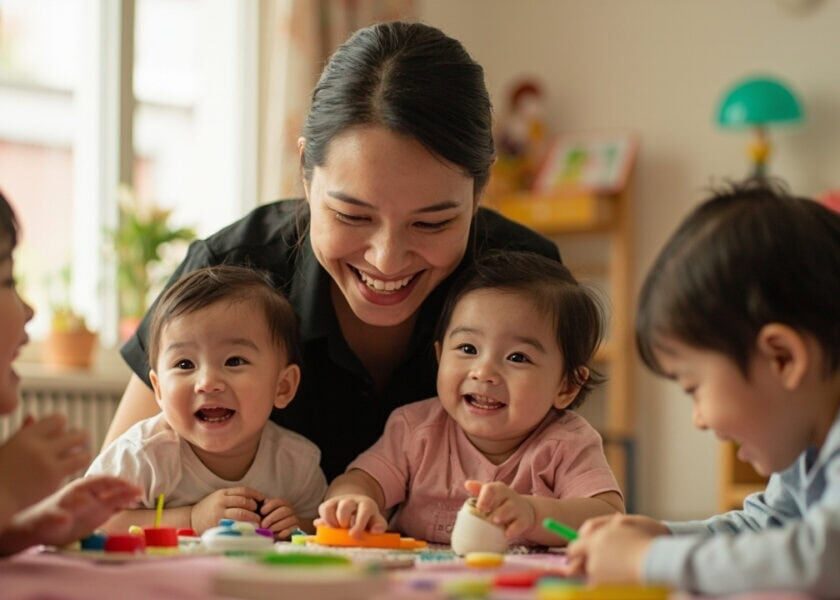
In a room where genuine attunement is practiced, you will notice something subtle: children are not clustered in a single area, waiting for direction. They are distributed through the space in ways that suggest choice. Some are on the floor with materials. Some are near a caregiver, engaged in parallel play. Some are in a quiet corner, looking at a book.
This distribution is not accidental. It tells you that the adults understand something essential—that children need both connection and the freedom to explore, sometimes within sight of a caregiver and sometimes not, and that these needs exist simultaneously, not in opposition.
The Caregiver’s Position
Now look at the caregivers themselves. Watch not just what they do, but how they are positioned in relation to the children.
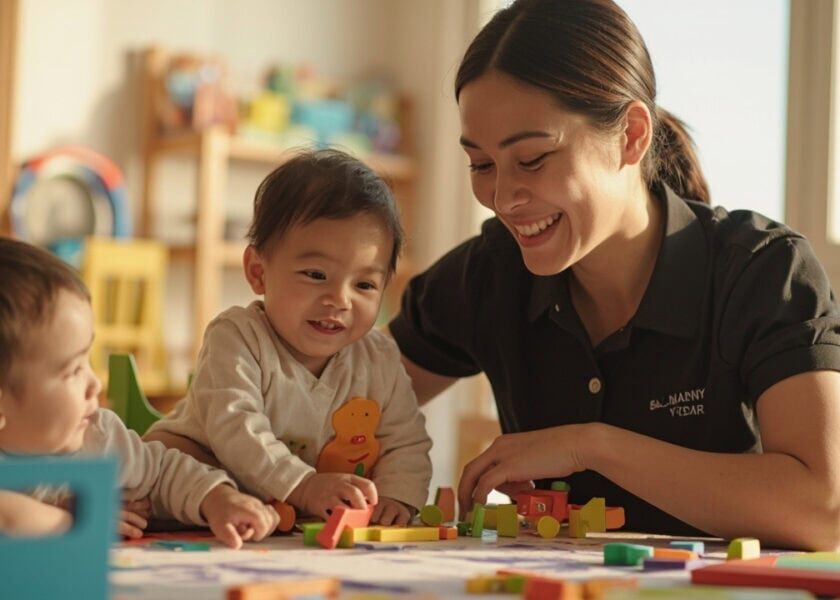
A caregiver who is genuinely attuned does not stand at the periphery, supervising. They are embedded in the room, near enough to be reached, oriented toward the children even when their hands are busy with another task.
The Signal Before the Signal
Watch what happens when a child signals. Not a cry—the cry is the signal after the signal. Watch for the moment when a child begins to shift, to reach, to look up with a question forming in their face. Notice whether the caregiver sees it. Notice whether they respond to what is coming rather than what has already arrived.
This is the first hidden moment we want you to learn to read: the response that arrives before the need becomes urgent. It is a small thing. It happens in a matter of seconds. But it tells you everything about whether the person in the room is watching for your child or simply watching your child.
Transitions
Transitions are the hinge points of a child’s day—arrival, departure, moving from activity to activity, moving from one caregiver to another.
In inadequate care, transitions tend to be managed through efficiency and control. Children are moved quickly. The next activity begins. The day proceeds according to schedule.
But genuine attunement handles transitions differently. Watch how a caregiver greets a child who has just arrived:
- Do they make eye contact?
- Do they kneel or crouch to the child’s level?
- Do they speak to the child before they speak to you?
This greeting is not a courtesy—it is a statement of priority. The child is the one who matters in this room, and the first act of the day is to acknowledge them.
Now watch the transition from one activity to the next. In a room where genuine care is practiced, children are prepared, not just directed. They are told what is coming. They are given a moment to finish what they are doing. They are gently guided, not forcibly moved. The rhythm of the room is something the children have learned to anticipate, not something imposed upon them.
When transitions are done well, children do not resist them. They flow from one activity to the next with a sense of continuity that tells you they feel safe enough to leave one thing and move to another. That sense of safety is not incidental. It is the foundation of everything.
The Language of Attunement
Listen, during your visit, to how caregivers speak to children. Not the cheerful, performative narration that some settings mistake for engagement—“Look at the ball! The ball is red! What color is the ball?”—but the quieter, more responsive language that happens in the spaces between activities.
Listen for the caregiver who speaks to a child about what the child is doing, not about what the caregiver wants the child to do. Listen for the caregiver who names what the child is feeling, even when the child has not yet found words for it.
This is the language of attunement. It sounds like this:
- “I see you are working very hard on that puzzle.”
- “You feel frustrated because it keeps falling.”
- “You want to try again.”
- “I will be right here while you figure it out.”
Notice that none of this language is instructional. It is not teaching colors or numbers or vocabulary. It is reflecting the child’s experience back to them, confirming that what they feel and do matters to someone else.
This is the beginning of what researchers call secure attachment—the child’s growing understanding that their inner world is seen, heard, and held by another person.
The child who feels known will explore more freely. The child who feels responded to will take the risks that learning requires. The child who hears their own experience reflected will develop the vocabulary to understand themselves and others.
The Physical Ease of Children
Stand back for a moment. Observe the children not as individuals but as a group. Watch how they move through the space. Watch their faces when they are not performing for anyone. Watch what their bodies are doing when they are simply existing in the room.
In a room where genuine care is practiced, you will notice a quality of ease that is difficult to describe but unmistakable once you recognize it. The children’s bodies are relaxed. They are not hypervigilant, scanning the room for threats or cues. They do not cluster near the door. They do not cry more than is typical for their age. They move with a kind of permission—a sense that the space belongs to them, that they do not need to hold themselves together in order to be safe.
This physical ease is the visible manifestation of psychological safety. It cannot be faked, not over time. It can only be built, slowly, through thousands of small moments in which the child learns that their needs will be met, their signals will be seen, and their feelings will be accepted.
When you see this ease, you are seeing evidence of a room that has been thoughtfully designed for children—not just in terms of furniture and materials, but in terms of the emotional environment that the adults create and maintain.
What EduNanny Singapore Offers
EduNanny was founded on a simple but radical premise: that Singapore parents deserve access to infant and child care that is not merely adequate, not merely supervised, but genuinely attuned to the developmental needs of the children in our care.
We have built our approach around the belief that quality is not a vague aspiration but a concrete, observable, trainable practice—and that parents themselves can learn to recognize it.
The ECDA Childminding Pilot
We are proud to be part of the ECDA Childminding Pilot, an initiative that reflects Singapore’s growing recognition that home-based and community-based care pathways are essential parts of a complete early childhood ecosystem.
Through this pilot, EduNanny offers families a choice that has not always been available in Singapore: the warmth and individualized attention of home-based care, combined with the oversight, support, and professional standards that give parents confidence.
Caregiver Ratios and Transparency
Our caregivers maintain a ratio of up to one to three infants, meaning that every child receives the attention that early development requires. Our care operates Monday through Friday, in structured care blocks that give families predictability and routine. Fees are structured to be affordable within the pilot framework, and parents can access available subsidies including the Child Development Account and Baby Bonus where applicable.
Where deployed, our settings include communication measures and CCTV that allow parents to stay connected to their child’s day—not as surveillance but as partnership. We are committed to transparency because we believe trust is built through visibility, not promises.
Support When You Need It
Our Thomas AI Chatbot offers families an accessible resource for questions, guidance, and support—bringing knowledge and expertise directly to parents whenever they need it, wherever they are.
Your Practical Checklist
Before you leave any childcare visit, ask yourself these questions:
- Are the children distributed through the space, or clustered waiting for direction?
- Is the caregiver embedded with the children, or standing at the periphery?
- Did you observe a caregiver respond to a child before the signal escalated?
- How did the caregiver greet a newly arrived child—at the child’s eye level, or over them?
- Were transitions announced and prepared, or merely directed?
- Did you hear language that reflected the child’s experience, or only instructional language?
- Do the children appear physically at ease, or alert and guarded?
These observations will not tell you everything. But they will tell you the most important thing: whether your child is being seen as an individual, or processed as a task.
Common Questions
“How do I know if this care is actually good for my child?”
You already know how to evaluate quality—you just need the vocabulary to name what you are observing. Watch for these four things: before-the-signal response, prepared transitions, reflective language, and physical ease. If you see these, you are seeing evidence of genuine attunement.
“What if I’m not qualified to judge?”
You are more qualified than you think. The same attunement that helps you distinguish your baby’s hungry cry from a tired cry is the same skill that helps you read a room. You do not need credentials to observe whether a caregiver’s attention is genuine or performed. You need only to pay attention to what you already know.
“Is home-based care really as good as centre-based care?”
The question is not where care happens, but how. A well-run centre with high ratios can provide excellent care. A poorly-run centre cannot. The same is true for home-based care. What matters is the quality of attunement, the training of the caregiver, and whether the environment has been thoughtfully designed for children.
Making the Decision with Confidence
Singapore parents are not lacking in love or concern for their children. They are lacking in the specific vocabulary that allows them to translate that love and concern into confident evaluation. They are not unsure because they are inadequate. They are unsure because no one has yet handed them the tools.
That is what this article has attempted to offer. Not reassurance—knowledge. Not promises—observable criteria. Not the assurance that you should simply trust us—but the competence to evaluate any care setting, including ours, with eyes that have been opened to what actually matters.
When you visit a room, watch for the caregiver who notices before the signal. Watch for transitions that prepare rather than direct. Listen for language that reflects the child’s experience. Observe the physical ease of children who feel safe.
These are not abstract ideals. They are specific, concrete, learnable observations that any parent can make, with practice.
And when you have made them—when you have walked into a room and recognized what you are seeing—you will find that the decision you were dreading becomes something else entirely. Not a leap of faith. A recognition.
You already know how to read your child. Now you are learning to read the room.
We invite you to visit us. To observe. To ask questions that go beyond the brochure. To watch for the moments we have described, and to notice whether you see them in our rooms.
Your child is watching. Your child is learning. Your child is being shaped by the quality of the moments that happen when you are not in the room.
Make those moments count. Make them visible. Make them worthy of the love you bring to everything else.
Interested in learning more about EduNanny Singapore? Read our story or get in touch to arrange a visit and see these principles in practice.