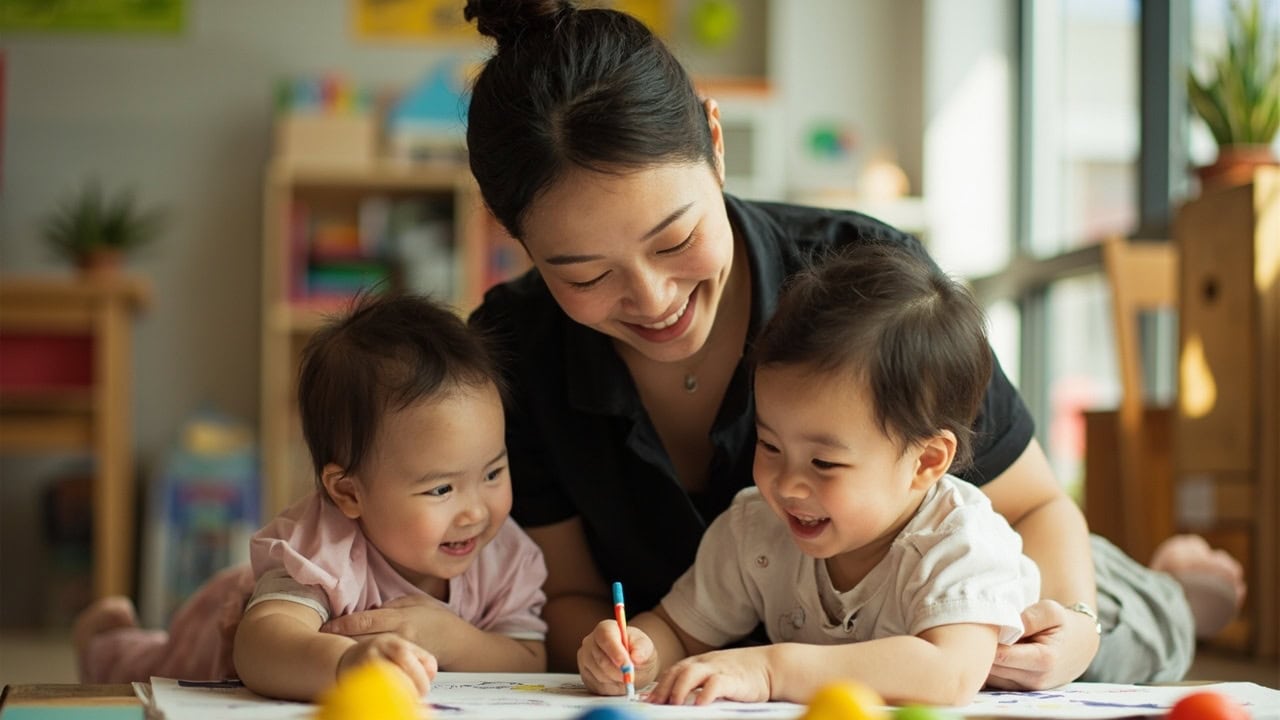
Why Belonging Is Your Child’s Most Important Lesson
“`html
The Village We Have Lost — and What Singapore Families Are Rebuilding
Singapore is a remarkable place to raise a child. It offers opportunities, safety, and infrastructure that many families around the world simply do not have access to. And yet, in ways we do not always speak about plainly, the old architecture of community has quietly shifted here.
Two generations ago, a toddler in Singapore had what anthropologists call a village. Grandparents, aunts, cousins, neighbours — a web of familiar adults who knew the child’s name, who corrected them gently, who celebrated their small victories, who taught them, simply by being present, that the world was full of people who cared about them. That child learned belonging the way they learned to breathe: naturally, through immersion, through repetition, through the ordinary texture of daily life among others.
We are not that village anymore. And I say that without nostalgia, because the Singapore we live in now offers extraordinary things the old villages could not. But we have to be honest about what we have let go of in the process.
For many Singapore families today — especially those living far from extended family, especially in newer estates, especially in dual-career households where grandparents are still working — the first and most consistent community a young child encounters is not an extended family. It is a childcare centre. Or a childminder’s home.
That is the new village.
And the question we have to ask is not just whether that village is safe and stimulating. We have to ask whether it is building what every human being needs most in the first years of life: the capacity to belong.
What Belonging Actually Looks Like for a Three-Year-Old
Let me be clear: if your child is already enrolled in a quality programme, if you have found people you trust to care for your child, that matters enormously. What I am suggesting is something subtler than alarm. It is a reframing of what childcare actually does — and why the social skills your child is developing right now may be the most important curriculum they ever encounter.
When a three-year-old walks into a room full of other children for the first time, something profound is happening that cannot be replicated at home, no matter how many playdates you arrange and no matter how much your child loves their grandparents.
Your child is encountering, for the very first time, a world that does not arrange itself around them. There are other children who also want the red truck. There are other children who also want to sit closest to the teacher. There are other children who are tired, and hungry, and upset, and who have needs that are not the same as your child’s needs.
This is not a small thing. In a family — a loving, attentive family — a child’s world is necessarily child-centred. Parents adjust. Siblings accommodate. The child’s wants and needs receive disproportionate attention because that is what love does in a family.
But belonging to a community requires something different. It requires the ability to hold one’s own desires alongside the desires of others. It requires the discovery that conflict is not a catastrophe. It requires learning, through repetition and gentle guidance, that sharing is not loss — that there is actually more joy in a game played with others than in a toy hoarded alone.
Consider what happens in a single morning at a quality programme. A child reaches for a toy another child is holding. The caregiver does not intervene immediately — not because she doesn’t notice, but because she understands that this moment is curriculum.
She is nearby. She is watching. She is ready to guide, to narrate, to help the children find words for what they feel. But she gives the children a chance to discover, first, that this problem is solvable. That there are words for frustration. That the other child is not an obstacle but a person who also wants to play.
This is social cognition at its most fundamental. This is where empathy is born — not in a lesson, not in a storybook about kindness, but in the raw, real, repeated experience of navigating a world with others in it.
Play is not what children do when they are not learning. For a young child, play is learning — particularly the kind of play that happens spontaneously among peers. The block tower that two children build together, that collapses, that they rebuild with negotiation and laughter and a whispered plan — that is mathematics, that is physics, that is teamwork, that is resilience, and it is happening in the language of play.
A quality programme does not just supervise play. It protects it. It creates the conditions for it. It trusts it. And it allows the social lessons to emerge naturally, without forcing them, without over-structuring, because the most powerful learning happens when children do not know they are being taught.
Social Readiness Is Not the Same as School Readiness
Over months and years, what you see in a child who has grown up in this kind of community is extraordinary.
You see a four-year-old who can look at a classmate who is crying and go get a tissue — not because anyone told them to, but because they have learned, through hundreds of small experiences, that other people have feelings and that those feelings matter.
You see a child who can wait. Who can lose. Who can be disappointed and recover. Who can walk into a Primary One classroom — that intimidating, unfamiliar room full of strangers — and feel, not fear, but curiosity. Because they already know something about being the new person in a room. They already know that community means the people make space for you, and you make space for them.
This is what we mean when we talk about social readiness, and it is distinct from school readiness in important ways.
School readiness is about letters and numbers, about the ability to sit and listen, about whether your child can follow instructions in a group. Yes, quality childcare builds school readiness too — but that is not its deepest work.
The deepest work is something harder to measure and infinitely more important. It is the work of building a child who believes they are the kind of person who belongs. Who can make friends. Who can repair friendships when they break. Who can exist among others without losing themselves, and without diminishing others in the process.
That child — the one who carries a quiet, deep confidence in their own capacity to belong — is not built by a curriculum. They are built by community. By being held inside a group of people who see them, day after day, and who reflect back to them that they matter.
What Quality Looks Like: Signposts for Choosing a Childcare Community
Singapore parents are among the most thoughtful, most prepared parents in the world. You research. You plan. You save. You enrol your child in enrichment from the age of twelve months. You have every right to feel that you are giving your child every possible advantage.
But here is the paradox. In our deeply organised, deeply ambitious society, the one thing we cannot engineer at home — no matter how much we love our children — is the experience of community membership. That requires other people. It requires peers. It requires a setting where a child is one among many, where the world is not arranged around them, where they must learn the art of being a citizen before they ever sit in a classroom.
So what does quality look like when community is the lens? Here are the signposts worth watching for:
Warmth That Is Habitual, Not Performed
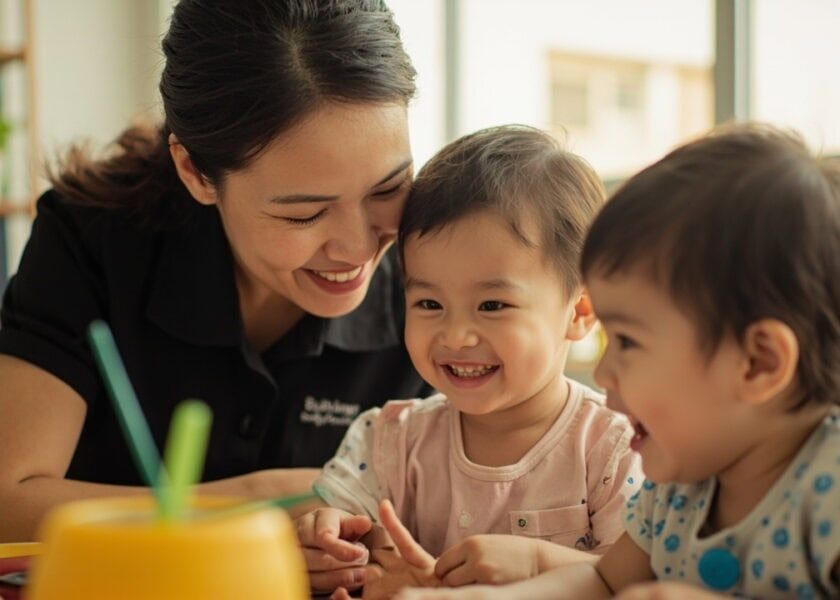
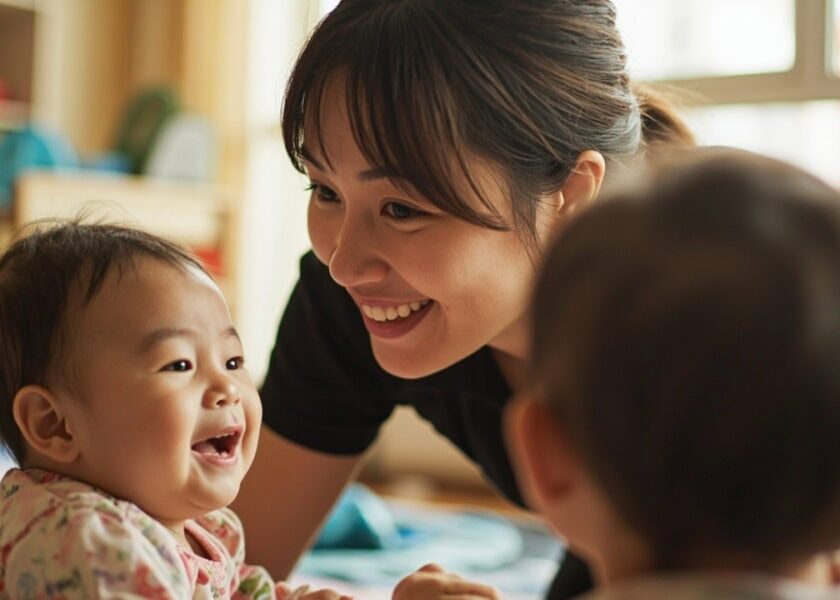
The children in a quality programme are not just supervised. They are known. The adults around them know their rhythms, their preferences, their fears. They greet each child by name. They notice when a child is withdrawn and create space for that child to rejoin the group at their own pace.
That attentiveness is not written into any curriculum framework. It comes from small ratios. When a caregiver is responsible for one, two, or three infants at most, something fundamental shifts. Every cry is heard. Every need is met with presence rather than urgency. The pace of the room slows to the pace of the child, and that slowness is not inefficiency. It is the architecture of trust. It is where your child’s sense of safety — the bedrock on which all social learning is built — takes root.
A Programme That Understands the Social Curriculum
Look for a programme that does not just supervise play but protects it. That creates the conditions for spontaneous peer interaction. That allows the social lessons to emerge naturally — sharing, turn-taking, negotiation, conflict resolution — without forcing them into artificial lessons.
The most powerful social learning happens when children are not aware they are being taught. Watch for whether caregivers give children time to solve their own small problems before stepping in. That restraint is a sign of deep understanding.
Genuine Transparency About Who Your Child Is Becoming
Look for a programme that communicates with you — not with daily reports that feel transactional, but with real insight into what your child is experiencing, how they navigate the social world of the group, who they are becoming.
When a programme can tell you, with specificity and care, that your child has been learning to share the tricycle with another child and that they are making progress in a way that feels true to who your child is — that is a programme that understands community. That sees your child not as a student to be assessed but as a person being initiated into belonging.
A Programme That Feels Like a Community — For Families Too
There is a reason that parents who choose home-based childcare or community-based programmes often describe them differently than centre-based care. It is not about one being superior to the other. It is about the texture of belonging.
A small, warm environment — whether it is a carefully structured home setting or a thoughtfully designed centre — where the same faces appear day after day, where your child is recognised, where relationships deepen over time because the ratios allow it, where trust is built through consistency rather than convenience — that is where the village lives.
Accessible Pathways for Real Families
The conversations about social development, community, and what your child is really building in these first years have to include the question of access. Every child deserves a first community that is warm, consistent, and skilled.
Look for programmes that make quality care practical — fee structures designed for real family budgets, payment options like CDA and Baby Bonus usability, Monday to Friday care blocks that work with how families actually live. These are not just administrative features. They are tools that help families build the village their child needs.
The EduNanny Approach: Architects of Belonging
At EduNanny by BUTLER, we are part of an ECDA Childminding Pilot because we believe the landscape of infant and early childcare in Singapore needs to evolve to serve all families, not just some.
Our home-based and community pathways exist to offer what many families cannot find elsewhere: quality care that is accessible, consistent, and built around the understanding that your child’s first community is foundational.
The communication and transparency measures we have in place — the regular updates, the open dialogue, the trust infrastructure that lets you leave your child in the morning and feel, genuinely, that they are in good hands — all of this exists for one reason. Because we know that the community your child belongs to must be a community you can trust.
We are not asking you to take that on faith. We are asking you to look at what we do, to see who we are, and to decide whether this feels like the kind of place where your child’s first community could take root.
Choosing Your Child’s First Community
I want to close with something I have seen so many times that I no longer think of it as extraordinary. I think of it as simply what children do, when they are given the chance.
I have watched a three-year-old, new to a programme, standing at the edge of a group of children playing in the sandbox. She does not walk in immediately. She watches. She is assessing. She is asking, without words, whether there is a place for her.
And then — one of the children looks up, and sees her, and says, “Come.” Just that. “Come.” And she does. And within minutes she is kneeling in the sand beside them, building something, laughing at something, part of something.
That moment — that simple, unrehearsed, ordinary moment of inclusion — is the most important thing that will happen to that child all week. Maybe all month. Because what she has just learned is not how to build a sandcastle. What she has learned is that the world contains people who will make room for her. And that she knows how to find them. And that she is the kind of person who belongs.
We cannot give our children everything they need. No parent can. No family can. But we can choose, with care and with intention, the community into which we send them.
We can look for warmth that is habitual. For ratios that allow every child to be known. For adults who understand that sharing and turn-taking and conflict resolution are not small matters — they are the foundation. For a place where play is trusted, where transparency is real, where belonging is not left to chance but is built, thoughtfully, day by day, by people who understand what they are doing and why.
The child who learns, in their first years, that they are a person capable of connection — that they can navigate the joy and the friction of being with others, that they can belong without losing themselves — that child carries something with them into Primary One, into secondary school, into university, into marriage, into career, into parenthood. They carry the quiet, deep knowledge that they are equipped for the world.
And that is the gift you are giving your child when you choose well. Not academic advantage. Not developmental edge. Something more fundamental and more lasting. The knowledge that they are not alone. That they know how to find their people. That they belong.
If you are in the middle of this search — if you are reading centre profiles and wondering if you are making the right choice — I want you to know: the fact that you are asking these questions, with this much care, tells me everything I need to know about the kind of parent your child has. They are lucky. And so are you.
We invite you to visit EduNanny, to see our community in action, and to ask us anything about how we build belonging — one child, one family, one day at a time.
Ready to explore what a community-first approach to childcare could mean for your child? Schedule a conversation with our team or learn more about our childminding programmes.
“`