The Invisible Foundation: Why Caregiver Continuity Shapes Your Child
Why Caregiver Continuity Matters More Than Anyone Has Said
There is a moment, quiet enough that it rarely makes it into the stories parents tell, that carries more developmental weight than most people realize. It happens when a child looks up from a block tower, searching for the face that has always been there to catch the proud grin — and finds someone new.
This moment is not dramatic. It does not announce itself. But it leaves a mark.
It is the mark this article is about. Not because it is a reason to fear childcare — but because it is a reason to choose it more wisely. Somewhere between the logistics of drop-off and the curriculum discussions, there is a dimension of early care that has been almost entirely absent from how Singapore families make one of their most consequential decisions.
It is the dimension of who stays. And why it matters far more than anyone has been willing to say.
If you take nothing else from this article, let it be this: the person your child bonds with matters as much as the activities they do. Maybe more.
The Fear You Cannot Name — and What Children Actually Lose
For most families in Singapore, the search for childcare begins with a practical question. Where is it? What are the hours? What do they teach? Does my child seem happy when I visit?
These are reasonable questions. They are the questions that reviews and brochures are designed to answer. But they are not the questions that keep parents awake at three in the morning.
What keeps parents awake is something less specific and far more tender. It is the thought — sometimes spoken aloud, sometimes not — that their child’s world depends on people they cannot fully control. That a caregiver who has learned the particular music of their child’s cries, who knows the exact way to soothe a particular fear, who has become a figure of safety in a small child’s expanding universe — could simply not be there one morning.
In Singapore, this is not an irrational fear. It is a documented reality.
When a caregiver leaves, someone who has spent months learning your child’s rhythms, preferences, and inner life, your child does not simply “adjust” in the way adults adjust to a new colleague. They grieve. They recalibrate. They learn, in the most adaptive way their developing nervous system knows how, to protect themselves by holding back a little. By not attaching too fully. By treating every new person as provisional.
Here is what this looks like in practice:
- A child who stops showing their caregiver their drawings with pride, because they have learned that the person who praised the last drawing might not be there to see the next one.
- A toddler who clings tighter at drop-off, not because they are anxious about separation, but because they are protecting themselves from the pain of losing someone else.
- A confident child who suddenly becomes cautious on the playground — not because they have lost physical ability, but because the internal safety net of “someone who knows me will be there” has frayed.
Parents may notice these changes and attribute them to developmental phases, stranger anxiety, or temperament. Sometimes they are. But sometimes, they are the signature of a child who has learned an invisible lesson: the people I depend on may not be there tomorrow.
The Science Behind the Silence
Attachment research — the foundational work of John Bowlby and the subsequent decades of neuroscience that have validated and extended it — tells us something that most parenting advice still treats as optional reading:
A child’s capacity to explore the world, to take intellectual and emotional risks, to trust that they will be met with understanding when they return, depends on a foundational sense of security that is built through consistent, responsive caregiving relationships. Not intermittently. Not by a rotating cast of well-meaning adults. Consistently, over time, with a person who knows them.
When that security is disrupted repeatedly, children develop what researchers call “attachment avoidance” — a protective stance that keeps them from investing fully in relationships. This is not a character flaw. It is the logical, neurologically sound response of a system that has learned, through experience, that the people it depends on may not be there tomorrow.
The consequence is not catastrophic in most cases. Children are resilient. They adapt. But here is the distinction that matters:
Adapting Is Not the Same as Flourishing
A child who is adapting has learned to function within constraints. They are safe, they are cared for, they are learning. But they are also holding something back — a reserve of emotional energy kept in reserve, just in case.
A child who is flourishing is something different. They are bold enough to climb to the top of the playground structure because they trust that someone who knows them will be there at the bottom. They can concentrate deeply on a puzzle because their emotional baseline is calm. They show a caregiver their drawing with genuine pride rather than cautious hope.
The difference between these two children — the one who is adapting and the one who is truly thriving — is built, one stable relationship at a time, in the first years of life.
Why Turnover Is a Systemic Problem in Singapore
Singapore parents understand this instinctively. They feel it. But they have rarely been given a language for it, let alone a framework for evaluating childcare through this lens. The conversation defaults to curriculum, to facilities, to teacher qualifications — all of which matter. But none of which matters as much as whether your child will have the same face, the same consistent presence, the same deepening relationship, month after month, year after year.
The reason this conversation rarely happens is that caregiver turnover is treated as inevitable — a fact of life in the early childhood sector. But it is not inevitable. It is the predictable result of systemic conditions:
- Caregivers are undervalued. Despite the enormous emotional labor required to care for infants and young children, early childhood educators in Singapore are often compensated in ways that do not reflect the skill and dedication the work requires.
- Ratios are stretched. When one caregiver is responsible for too many children, it becomes impossible to form the deep, individual relationships that children need. The work becomes supervision, not care.
- Emotional exhaustion without support. Caring for infants is profoundly rewarding and profoundly draining. Without adequate support, mentorship, and professional recognition, caregivers burn out — not because they lack commitment, but because the conditions do not allow them to sustain it.
When caregivers leave under these conditions, they take with them something a child had only just begun to build: the specific, irreplaceable knowledge of that child’s inner life. What frightens them. What makes them laugh. How they like to be held when they are tired. The face that makes them feel safe.
Quality Childminding and the EduNanny Model
There is a difference — one that most parents are never taught to see — between transactional supervision and genuine relationship-based care.
Transactional supervision asks: Is my child safe? Fed? Entertained? These are baseline requirements, and any reputable provider should meet them.
Relationship-based care asks something deeper: Does my child feel known? Does the person caring for them understand their particular temperament, their fears, their joys, the way their face lights up when they discover something new?
Here is how this difference shows up in everyday moments:
- A caregiver in a relationship-based setting notices a subtle shift in mood before a meltdown arrives — and intervenes with the specific comfort that child responds to.
- That same caregiver knows this child hates having their face wiped but will cooperate if offered a cloth to hold first.
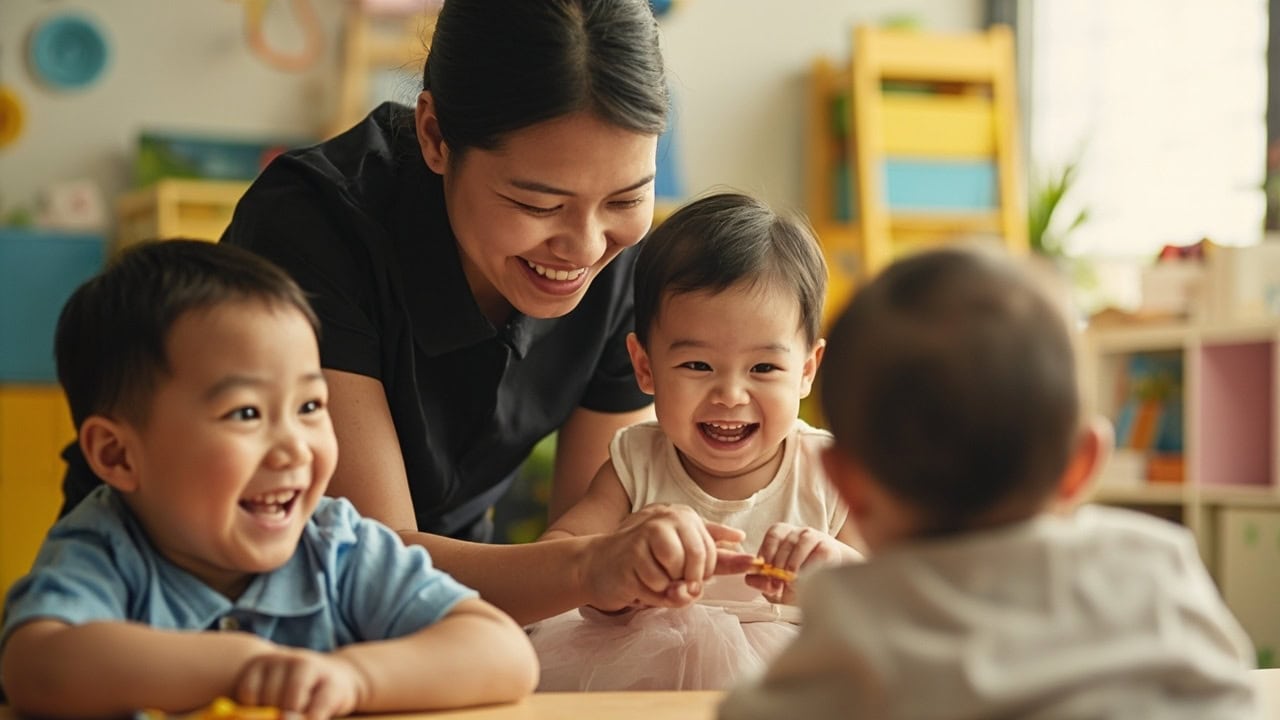
- Over months, this caregiver becomes someone the child runs to — not out of desperation, but out of genuine connection. The child knows: this person sees me. This person remembers me. This person will be here.
That knowledge is not a nice-to-have. It is the substance of security. And it is only possible when the conditions allow a caregiver to form and sustain real bonds with the children in their care.
The EduNanny Model: Built Around the Continuity Question
EduNanny Singapore, a service under the ECDA Childminding Pilot, was built with this problem at its center. The organizing question: what would it take to actually keep the right people in a child’s life?
EduNanny maintains a caregiver-to-infant ratio of up to one to three in its home-based care pathway. This is not a regulatory floor. It is a philosophical statement about what is necessary for genuine relationship-building. With fewer children, a caregiver can know each one deeply. Can notice the subtle shift in mood before a meltdown arrives. Can remember the specific ways each child needs to be soothed.
By offering both home-based and community-based pathways, EduNanny creates care environments where a caregiver can develop real expertise in a manageable setting — rather than being stretched across fifteen infants in a room that prioritizes throughput over relationship. The ECDA Childminding Pilot framework gives this model structure, oversight, and a pathway to professional recognition that elevates the role of the caregiver from job to vocation.
Job vs. Vocation
When a caregiver is treated as interchangeable — as a pair of hands in a room — their investment in the children in their care will be correspondingly limited. They will do the job. They will do it well, perhaps. But they will not stay for the right reasons. They will stay because they have no better options, and when those options appear — as they always do in a high-demand labor market — they will leave, and the children in their care will pay the developmental price.
When a caregiver is treated as a professional, given the training, the ratios, the respect, and the conditions that allow them to form real bonds with the children in their care, they stay for different reasons. They stay because they are invested. Because they have seen a child grow from a tentative, clingy twelve-month-old into a confident three-year-old who runs to greet them every morning. Because they understand that their role is not supervision. It is the slow, daily work of building a human being’s capacity to love and be loved.
EduNanny’s caregiver investment model — the retention architecture that is built into its structure rather than tacked on as an initiative — is designed to make that vocation possible.
What EduNanny Offers — and Common Questions
Beyond the philosophical commitments, there are practical features that reflect how EduNanny operationalizes this model:
- Home-based and community care pathways that allow for smaller ratios and deeper relationships than traditional centre-based models typically permit.
- ECDA Childminding Pilot framework that provides structure, oversight, and professional recognition for caregivers — treating their work as skilled vocation rather than entry-level job.
- Tools like the Thomas AI Chatbot to support communication and transparency between caregivers and families, so parents can feel connected to their child’s daily experience.
- CCTV measures where deployed, offering parents additional peace of mind about the environment their child is in.
- Pathways for CDA and Baby Bonus funds to be used, making quality care more accessible for Singapore families.
What if the caregiver still leaves?
No childcare model can guarantee that a caregiver will never leave. Human lives contain disruptions, changes, unforeseen circumstances. What EduNanny can offer — and what its model is structurally designed to provide — is an environment where stability is the default rather than the exception. Where the conditions for lasting relationships are present. Where a parent can, with reasonable confidence, expect to watch their child’s world expand through the steady, deepening presence of someone who knows them.
Is home-based care as safe as centre-based care?
The ECDA Childminding Pilot framework provides the regulatory oversight and quality standards that give families confidence in home-based arrangements. Additionally, CCTV measures where deployed, transparent communication tools, and clear protocols create accountability that matches — and in some ways exceeds — what traditional centre-based settings offer.
How is this different from hiring a domestic helper?
A domestic helper typically manages a household alongside childcare, with limited training in early childhood development. EduNanny’s childminders are trained, supported professionals working within a framework that provides mentorship, professional development, and the ratios necessary for genuine relationship-building. The caregiver investment model ensures they are in this work as a vocation, not just a job.
Questions to Ask Any Provider
Whether you are considering EduNanny or another provider in Singapore, these are the questions that reveal whether a childcare arrangement has genuinely grappled with the continuity problem — or simply hopes it will not affect your family.
- What is the average length of service for caregivers who work with infants in your setting?
- How long have the current caregivers in the infant room been there?
- What do you do to invest in your caregivers? Are they offered training, mentorship, a career pathway?
- What is the caregiver-to-infant ratio in practice, not just on paper?
- How does your ratio enable the kind of responsive, individual attention that supports attachment?
- How are transitions handled when they do occur — because they will, at some point, even in the best systems?
- Are children given time and emotional support to build new attachments without being forced to abandon the old ones?
These are the questions that separate a provider that has built continuity into its model from one that is simply hoping for the best.
The Invisible Foundation — and A Confident Choice
What your child is doing in those early years is not just learning colors and numbers, though they will learn those too. What your child is doing is building the internal architecture that will determine how they relate to the world for the rest of their life.
Whether they approach new situations with curiosity or caution. Whether they trust that the people around them will be reliable. Whether they feel, at the most fundamental level, that they are known.
A child who feels known is a child who is free. Free to explore. Free to fail and try again. Free to develop the quiet confidence that is not bravado — that is the genuine, hard-won knowledge that there are people in this world who see them, who remember them, who will be there.
We talk a great deal in Singapore about preparing children for the future. Building their resilience. Giving them the skills they will need in an increasingly complex world. These are worthy ambitions. But the most powerful thing we can give a child is not a head start on reading or a portfolio of extracurriculars. It is the experience of being consistently, reliably, deeply cared for by people who have the conditions and the commitment to stay.
Choosing childcare is one of the most intimate decisions you will make. Not because of the curriculum or the facilities, though those are part of the picture. Because you are choosing the environment in which your child will spend their earliest, most formative hours. You are choosing the people who will shape their first understanding of what the world feels like when they are away from you.
Choosing with intention — with attention to the conditions that make stability possible — is not an anxious act. It is a loving one. It is the quiet, powerful decision to build your child’s world on something that does not shift.
EduNanny Singapore was built for families who want more than supervision. For children who deserve more than adaptation. For the caregivers who chose this work as a vocation, and who — with the right conditions — will stay long enough to see what your child becomes.
That is the invisible foundation. Not the curriculum. Not the facility. The relationship.
And the question of whether the person providing that relationship will still be there in six months, in a year, in two years — that is not a logistical detail. That is the question that everything else is built on.
That peace — the quiet, grounded peace of knowing that your child’s caregiver is building something lasting — is not a small thing. It is the thing that allows you to be present at work. It is the thing that allows you to trust the process. It is the thing that lets your child feel, without ever being told, that the world is a reliable place, full of people who stay.
To learn more about EduNanny Singapore’s home-based and community care pathways — or to explore whether this model is right for your family — reach out to speak with their team directly.
EduNanny Singapore — infant care and childminding under the ECDA Childminding Pilot.