The Real School Readiness Skills Your Child Needs Before P1
The 5 Signals Every Primary 1 Teacher Reads
When your child walks into Primary 1, their new teacher is not primarily assessing whether they can write their name or count to twenty. She is reading five deeper signals:
- Emotional regulation — Can your child return to equilibrium after something upsets them?
- Curiosity — Does your child scan the room, wanting to explore and discover?
- Independence in learning — Does your child try before asking for help?
- Social confidence — Can your child join a group, handle rejection, and navigate peer interactions?
- Trust in adults — Does your child believe that grown-ups will help them?
These qualities are not personality traits your child either has or does not. They are developmental capacities that grow—hour by hour, day by day—in the right kind of care environment. Which means they are capacities you can actively invest in right now.
What Teachers Actually Notice on the First Day
An experienced Primary 1 teacher has learned to read these signals the way a doctor reads vital signs—not because she is judging children, but because she understands that what she sees in those first weeks tells her a great deal about what kind of support each child will need to thrive.
When Singapore parents ask “Is my child ready for Primary 1?”, the conversation often starts in the wrong place. It starts with academics. Can my child write her name? Does she know her alphabet? Can he count to twenty?
These are not irrelevant questions. But they are not where Primary 1 teachers start.
Emotional Regulation: The Invisible Foundation
What teachers notice first is something much deeper: how a child regulates their emotions when the morning routine changes, when the promised activity is not the one that happens, when another child takes the toy they wanted.
A child with strong emotional regulation does not necessarily never cry or never get frustrated. What she demonstrates is the capacity to return to equilibrium. She can be upset and then, with time and gentle support, re-engage. She can handle a transition without a complete collapse. She can express frustration in words instead of actions, even when those words are imperfect and the frustration is very real.
This capacity develops in direct proportion to whether a child has experienced consistent, responsive, attuned caregiving in their earliest years. When an infant cries and someone comes—predictably, warmly, with genuine presence rather than just efficiency—the infant learns something profound: that her signals matter. That her needs are heard. That the people around her can be trusted.
This is not sentiment. This is the neurological architecture of self-regulation being built, one responsive interaction at a time.
As that infant becomes a toddler and then a preschooler, this looks like a child who, when faced with the unfamiliar structure of a Primary 1 classroom, does not spiral into panic because she has learned, over years, that new situations are manageable. It looks like a child who can tolerate the discomfort of not knowing something, because she has been supported through that discomfort before. It looks like a child who trusts that adults will help her, because she has experienced adults helping her, reliably, again and again.
Curiosity: The Irrepressible Desire to Find Out
There is another signal teachers notice almost immediately, closely related to emotional regulation but distinct enough to deserve its own attention: genuine curiosity. Not the performative kind, not the scripted kind, but the natural, irrepressible desire to find out what is around the next corner.
A curious child walks into a Primary 1 classroom and immediately scans the room. She gravitates toward the book corner, pulls out a book she has never seen before, turns the pages, brings it to the teacher and says, “Can you read this one?” A curious child encounters a science activity about how plants grow and asks, “But what happens if there’s no sun?” A curious child finishes a drawing and immediately asks, “Can I draw another one?”
This is not a trait that appears in a child who has been drilled on worksheets. It is a trait that emerges in a child who has been allowed—encouraged, even celebrated—to ask questions, to explore, to wonder. It is the natural consequence of a care environment where curiosity has been treated as valuable, where “I don’t know” has been met with “Let’s find out together” instead of “Sit down and focus.”
The Singapore curriculum, whatever its pressures, cannot be navigated by a child who only proceeds when they know the answer in advance. Learning requires a learner. And a learner, by definition, must be comfortable with not knowing. A child who has been raised in an environment that nurtures natural curiosity enters Primary 1 not just academically ready but fundamentally willing to learn.
Independence: How a Child Approaches Learning
Closely connected to curiosity is how a child approaches learning independently—and specifically, how a child asks for help. This sounds simple. It is not.
A child who has been in a high-quality developmental care environment will, when she does not know something, do something remarkable: she will first try. She will experiment, attempt, probe. She will not immediately freeze or give up. And when she genuinely needs help, she will ask—not passively, not with tears and resignation, but with the clear, purposeful communication of someone who understands that asking for help is a skill, not a failure.
This is profoundly different from a child who has learned, through experience, that not knowing is something to be ashamed of, or that asking for help will bring impatience rather than support. That child may sit quietly, avoid the work, or guess randomly rather than risk exposing her confusion.
The way a child seeks help is one of the most reliable signals a Primary 1 teacher reads. And it is almost entirely determined by how that child has been responded to in the years before Primary 1—in moments when she did not know something, when she was frustrated, when she needed support.
Social Confidence: Navigating Other Children
Singapore parents often underestimate the raw, practical reality of what happens in a Primary 1 classroom. Beyond academics, there is the daily social complexity: how a child navigates other children, how she enters a group, shares, negotiates, stands up for herself, and recovers when social encounters do not go as she hoped.
A child who arrives at Primary 1 with strong social confidence is not necessarily the loudest or the most dominant. She is something more useful: she is flexible. She can join a group of children she has never met and find a way to participate. She can handle rejection—”You can’t play with us”—without it shattering her sense of worth. She can read social cues, adjust her behavior to fit a context, and express her needs in ways that other children respond to.
This is not a personality trait that some children have and others do not. It is a developmental capacity that develops through practice—through hundreds of supervised social encounters in which a skilled caregiver helps a child understand what happened, what she might try differently, and why another child’s behavior does not mean anything is wrong with her.
In a quality developmental care environment, social learning happens constantly, but with support. A caregiver notices when a toddler is struggling to share a toy. She does not intervene with a solution. She sits nearby, makes herself available, and helps the child find words: “You can say, ‘I am still using that’.” She notices when a child has been excluded and helps her understand that sometimes groups change, that there will be other opportunities, that her worth is not determined by whether another child plays with her today.
Why Developmental Readiness Comes First
Here is the tension that many Singapore parents feel: this all makes sense. You want your child to be ready in this deeper way. But you are also under enormous pressure to make sure she can read, can write, can count. Your relatives ask what school she is going to. Your friends’ children are already in enrichment classes. The school you want her to attend has an interview process.
How do you reconcile this?
The qualities I have been describing—emotional regulation, curiosity, independence, social confidence—do not come at the expense of academic readiness. They come before it, and they make it possible.
- A child who is emotionally regulated can sit and focus.
- A curious child wants to learn.
- An independent learner will try before asking for help, and will retain what she learns because she is engaged rather than compliant.
- A socially confident child can collaborate on projects, ask a classmate for help, and participate in group work without anxiety dominating her cognitive capacity.
Research on school readiness, conducted across decades and across cultures, consistently shows the same thing: children who arrive at Primary 1 with these foundational capacities perform better academically, not just in the first year, but cumulatively, across their entire schooling. Because learning builds on learning, and the capacity to learn is more fundamental than any specific knowledge.
This does not mean you should ignore academics entirely. It means that the order of operations matters. You build the foundation first. When the foundation is strong, the academic knowledge follows more easily, more naturally, and with greater retention.
A child who is pushed into academics before the foundational capacities are in place often performs adequately for a while, and then struggles when the social and emotional demands of school increase. A child who enters Primary 1 with a strong foundation will, over time, close any initial academic gap and surpass it—because she has the internal capacity to learn that the other child was never given the chance to develop.
What Quality Childcare Actually Looks Like
So what does this mean for the childcare decision you are making right now? It means that the question you should be asking is not “Will my child learn letters here?” It is “What kind of person will my child become here?”
You are not just choosing a place for your child to be cared for while you work. You are choosing an environment that will shape your child’s stress response system, her capacity for connection, her relationship with learning, her sense of herself as competent and worthy. These are not soft concerns. They are the hard architecture of who she will become.
When you visit a childcare centre or meet with a childminder, here is what you should watch for:
- Warmth: Does this environment feel genuinely warm—not just clean and organized, but warm? Are the caregivers present with the children, or multitasking and distracted?
- Responsiveness: When a child approaches a caregiver with a need, what happens? Does the caregiver stop what she is doing and engage, or respond without looking up?
- Freedom within structure: Are children free to explore within safe boundaries, or constrained by the need for efficiency? Do they seem curious and engaged, or compliant and waiting?
- Question culture: How do caregivers respond to a child’s spontaneous question? Is curiosity welcomed or redirected?
- Conflict facilitation: How do they handle conflicts between children? Do they resolve problems for children, or guide children to find their own solutions?
Listen not just to the answers but to the values behind them. Ask yourself: is this environment designed around the needs of the children, or around the needs of the adults who run it?
Why caregiver ratios matter so much more than most parents realize: it is not just about safety, though safety is essential. It is about whether there is enough adult presence to attune to each child, to notice when a child is stuck, to respond in a way that builds the child’s confidence rather than simply rescuing them. When a caregiver has one, two, or three infants or toddlers under her care, she can observe, can pause, can respond thoughtfully. When she has seven or eight, the responses become generalized, efficient, superficial. The child who needs encouragement to try again may instead receive a quick answer that solves the immediate problem but erodes the long-term capacity for independent learning.
How EduNanny Singapore Builds These Capacities
EduNanny Singapore is part of the ECDA Childminding Pilot, operating under a framework designed to bring quality developmental care to more Singapore families through flexible, home-based pathways. We are not a traditional centre. We are something different—an approach that recognizes that the conditions for building school readiness are best created in small, consistent, responsive care environments where one or two caregivers can truly know the children in their care.
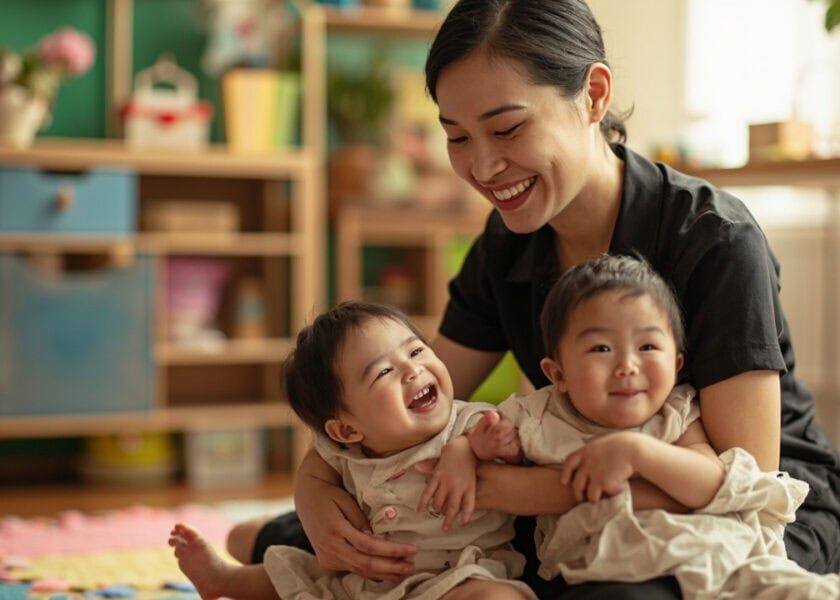
Our childminders care for a maximum of three infants at a time. This ratio is intentional and consequential. It means that when your infant cries, someone responds—not eventually, not when someone is free, but with presence and attention. It means that when your toddler is struggling with a social encounter, a skilled adult is there to help him make sense of it, in real time. It means that the qualities Primary 1 teachers recognize—emotional regulation, curiosity, independence, social confidence—have the space and attention they need to develop.
Our childminding services are available Monday through Friday, in care blocks designed to meet the realities of working families. We understand that Singapore parents need affordability as well as quality, and our pilot fee structures are designed with that in mind. You should not have to choose between the care your child deserves and the care you can afford.
We also understand that trust is not given; it is built. This is why transparency is woven into everything we do. Our communication practices give parents visibility into their child’s day—not because we believe parents should micromanage, but because we believe that parents who trust the care their child is receiving can relax into the experience of parenting rather than constantly worrying. And that peace of mind matters too.
For families navigating payment logistics, we work with CDA and Baby Bonus structures, because these schemes exist precisely to make quality care more accessible, and we want you to be able to use them.
Common Questions From Parents Like You
“My child is only six months old. Is it too early to think about Primary 1 readiness?”
It is never too early. The foundations I have described are being built right now, in every interaction your infant has with her caregiver. The first year of life is not a waiting period—it is the period when the neurological architecture of emotional regulation is laid down. The choices you make today about who cares for your child are school readiness decisions.
“My relatives think I’m being too anxious about all this. Should I just relax?”
There is a difference between productive concern and paralyzing anxiety. Paying attention to the quality of your child’s care environment is not anxious—it is attentive parenting. The question is whether that attention leads you toward better information and better choices, or toward more worry and more enrichment classes. We believe in equipping you with information so you can make decisions with confidence, not fear.
“How do I know if a childcare arrangement is really building these capacities, or just claiming to?”
Visit. Observe. Ask specific questions about a typical day. Ask what happens when a child is frustrated. Ask how they handle sharing conflicts. Watch whether caregivers engage with children as individuals or move through routines. The best childcare environments are proud to show you exactly what they do and why.
Walking Through That Door Ready
Return with me, for a moment, to that teacher standing at her classroom door. She is the person who, ultimately, will tell you whether your child is ready—not in those terms. She will not say “Your child has good emotional regulation.” She will say something like, “She’s wonderful. She asks such good questions. She seems so comfortable here. She made a friend on the first day.”
She will notice the child who gets back up after falling. The child who says “I don’t know, but can we find out?” The child who, when another child is upset, walks over and says, “Are you okay?”
These are the signs of readiness. They are quiet, ordinary, human signs. And they are not produced by flash cards or enrichment classes or academic drilling. They are produced by years of being cared for—attentively, consistently, intentionally—in the place where your child spends most of her waking hours in the years before school begins.
This is the truth that most parents in Singapore never hear, because the noise of academic competition drowns it out: the most consequential school readiness investment you will ever make is not the enrichment class you sign your four-year-old up for. It is the childcare decision you are making right now, for your infant and your toddler, in these years that feel so far from Primary 1 but are, in fact, exactly when the foundations are being laid.
Every time a caregiver responds to your child’s cry with presence instead of impatience, she is building emotional regulation. Every time she turns a “why” into an exploration, she is building curiosity. Every time she helps your child navigate a conflict instead of resolving it for him, she is building social confidence. Every time she waits for your child to try before helping, she is building independence.
Every day, with every child, we are building the capacities that Primary 1 teachers recognize.
The fact that you are here, reading this, thinking carefully about the kind of care your child deserves—that tells me something important about the kind of parent you are. You care. And caring is the foundation of everything else.
Your child’s Primary 1 teacher is waiting. Let’s make sure your child walks through that door ready—not just academically, but fully.
If you are exploring infant care or childminding options in Singapore and would like to learn more about the ECDA Childminding Pilot, we invite you to speak with us. We take these questions as seriously as you do—and we believe the right childcare decision begins with an honest, thoughtful conversation.
Learn more about EduNanny Singapore and how we support families through these foundational years.